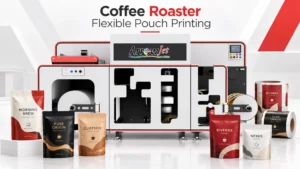
Coffee Pouch Printing: Valve Bags and Stand-Up Pouches In-House
Table of Contents Coffee Pouch Printing: Valve Bags and Stand-Up Pouches In-House In-house coffee pouch printing lets specialty roasters produce exact quantities on demand, swap

Cosmetic labeling isn’t just about aesthetics—it’s a heavily regulated communication channel between brands and consumers. The FDA, FTC, and state regulators enforce strict requirements on what must appear on cosmetic labels, how it must be formatted, and what claims can be made.
For 2026, several factors are increasing regulatory scrutiny:
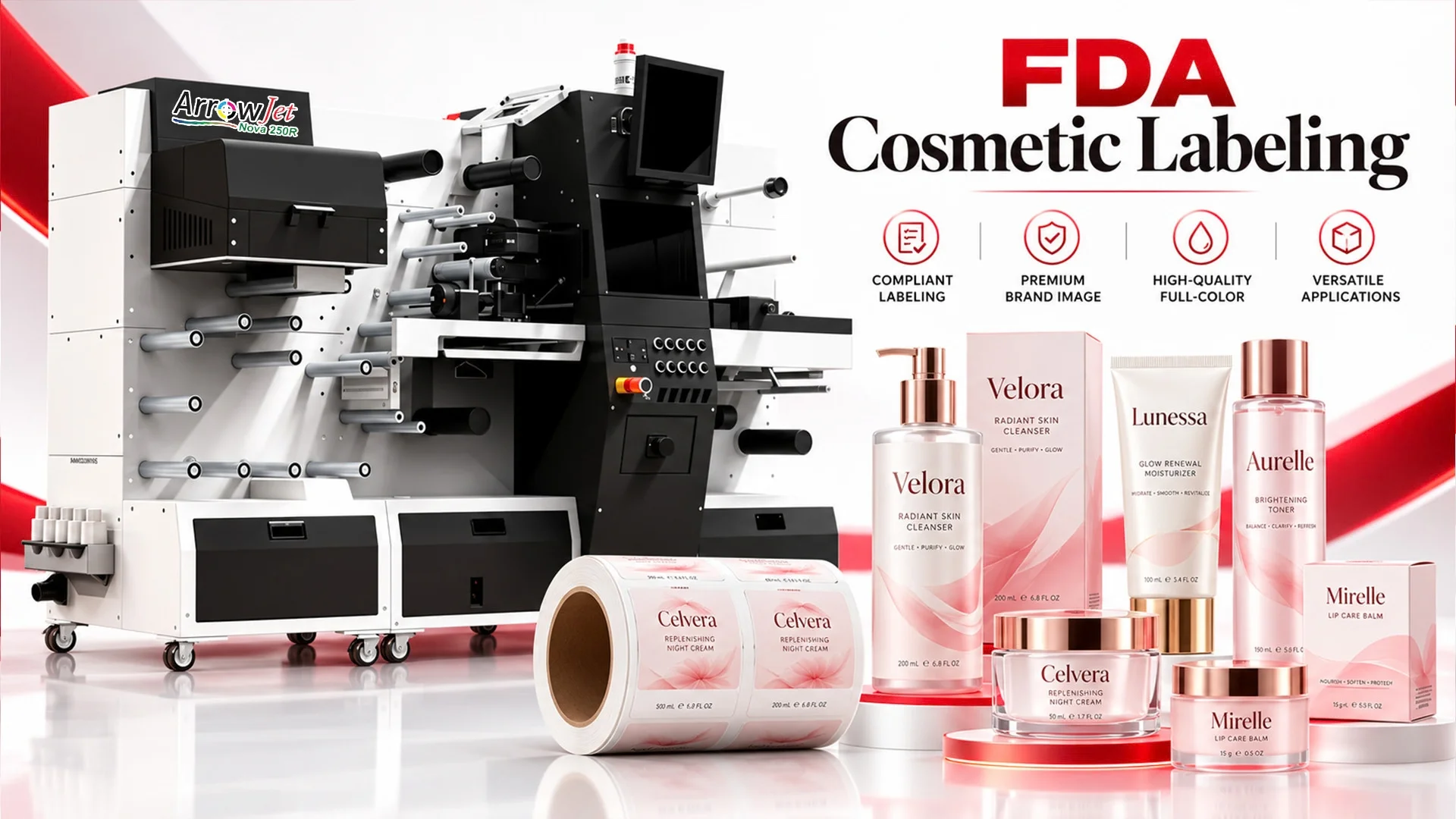
This guide breaks down the current FDA requirements for cosmetic labels, explains INCI naming conventions, and provides a compliance checklist for beauty brands. We’ll also cover how the ArrowJet Nova 250R’s precision printing capabilities help ensure your labels meet these demanding standards.

Required Label Elements
Every cosmetic product sold in the United States must include these elements on its label:
Requirements:
Examples:
Requirements:
Format by Product Type:
Type Size Requirements:
| Package Size | Minimum Type Size |
|---|---|
| ≤ 5 sq in | 1/16 inch (1.6mm) |
| 5-25 sq in | 1/8 inch (3.2mm) |
| 25-100 sq in | 3/16 inch (4.8mm) |
| > 100 sq in | 1/4 inch (6.4mm) |
Requirements:
Type Size: Minimum 1/16 inch (1.6mm) for packages > 5 sq in
Requirements:
Products Requiring Warnings:
| Product Type | Required Warning |
|---|---|
| Feminine deodorant sprays | “Caution: For external use only” |
| Products containing AHA | Sunburn alert and sunscreen recommendation |
| Products containing talc | “Keep powder away from child’s face” |
| Eyelash/brow dyes | Professional use only warning |
| Products with high alcohol content | Flammability warning |
The FDA prohibits certain claims and statements:
Common Violation Examples:
The International Nomenclature of Cosmetic Ingredients (INCI) is a standardized system of names for cosmetic ingredients maintained by the Personal Care Products Council (PCPC). INCI names are:
Regulatory Compliance:
Using common names instead of INCI names is a violation. “Vitamin E” must be listed as “Tocopherol” or “Tocopheryl Acetate.”
Consumer Transparency:
INCI provides consistency so consumers can identify ingredients regardless of brand or country of origin.
Scientific Accuracy:
Common names are often ambiguous. “Almond oil” could be sweet almond or bitter almond—very different safety profiles.
| Common Name | INCI Name |
|---|---|
| Vitamin E | Tocopherol |
| Vitamin C | Ascorbic Acid |
| Vitamin A | Retinol |
| Hyaluronic Acid | Sodium Hyaluronate |
| Aloe Vera | Aloe Barbadensis Leaf Juice |
| Green Tea | Camellia Sinensis Leaf Extract |
| Coconut Oil | Cocos Nucifera Oil |
| Shea Butter | Butyrospermum Parkii Butter |
| Jojoba Oil | Simmondsia Chinensis Seed Oil |
| Rosehip Oil | Rosa Canina Fruit Oil |
| Lavender Oil | Lavandula Angustifolia Oil |
| Tea Tree Oil | Melaleuca Alternifolia Leaf Oil |
| Vitamin B5 | Panthenol |
| Glycerin | Glycerin (or Glycerol) |
| Alcohol | Alcohol Denat. |
| Witch Hazel | Hamamelis Virginiana Water |
| Chamomile | Chamomilla Recutita Flower Extract |
| Argan Oil | Argania Spinosa Kernel Oil |
Many cosmetic ingredients have complex INCI names that challenge label space:
Surfactants:
Emulsifiers:
Preservatives:
Silicones:
Rules:
Example:
Ingredients: Water (Aqua), Glycerin, Cetearyl Alcohol, Cocos Nucifera (Coconut) Oil,
Butyrospermum Parkii (Shea) Butter, Dimethicone, Phenoxyethanol,
Tocopherol (Vitamin E), Aloe Barbadensis Leaf Juice, Fragrance (Parfum),
May Contain: Titanium Dioxide (CI 77891), Iron Oxides (CI 77491, CI 77492, CI 77499)
The Modernization of Cosmetics Regulation Act of 2022 significantly expanded FDA authority over cosmetics. Key provisions now in effect:
Requirement:
Impact on Labeling:
Labels must now include accurate manufacturer information that matches FDA registration.
Requirement:
Impact on Labeling:
Labels must match the ingredient list submitted to FDA exactly.
Requirement:
Impact on Labeling:
Labels must accurately reflect contents (GMP requires consistent formulation).
Requirement:
Impact on Labeling:
Contact information on labels must be current for adverse event reporting.
Requirement:
Impact on Labeling:
Claims must be supported by safety data (e.g., “dermatologist-tested” requires testing records).
Expected 2026-2027:
Impact on Labeling:
Labels will need to identify specific fragrance allergens, not just “Fragrance (Parfum).”
Proposition 65:
Safe Cosmetics Act:
Toxic-Free Cosmetics Act (2025):
Disclosure Requirements:
Mistake: Listing active ingredients first, then inactive (drug format) on cosmetic products.
Correct: All cosmetics list ingredients in descending order by weight, regardless of function.
Mistake: Using common names like “Vitamin E” or “Shea Butter” instead of INCI names.
Correct: Use Tocopherol and Butyrospermum Parkii Butter.
Mistake: Net contents or ingredient list in font too small for package size.
Correct: Measure carefully; FDA checks type size.
Mistake: Claims like “treats acne,” “cures eczema,” or “prevents aging.”
Correct: Use cosmetic claims: “cleanses,” “moisturizes,” “improves appearance.”
Mistake: Putting all information on the front of the package.
Correct: Ingredient list and business information on an information panel (back or side).
Mistake: Using EU or Asian labeling formats for US market.
Correct: US has specific requirements; EU format alone isn’t compliant.
Small type requirements (1/16 inch minimum) demand high-resolution printing. Blurry, illegible ingredient lists violate FDA regulations.
1600×1600 dpi Resolution:
Precise Registration:
Print-and-Cut Integration:
Variable Data Capability:
Substrate Versatility:
Cosmetic label compliance is complex, detailed, and strictly enforced. The 2026 regulatory environment—with MoCRA fully implemented and state laws expanding—demands precision in both formulation documentation and label execution.
The foundation of compliance is accurate INCI ingredient naming, proper order of declaration, and adherence to type size and placement requirements. Violations aren’t just regulatory risks; they damage brand credibility and consumer trust.
The ArrowJet Nova 250R provides the print precision needed for compliant cosmetic labels. At 1600×1600 dpi, even complex INCI names in small type remain crisp and legible. Print-and-cut integration ensures professional presentation that reinforces compliance and brand quality.
For beauty brands, compliance isn’t a burden—it’s a competitive advantage. Accurate, professional labels signal attention to detail that extends from regulatory compliance to product quality.
Need compliant cosmetic labels? Arrow Digital provides regulatory guidance, INCI verification, and precision printing that meets FDA requirements.

Table of Contents Coffee Pouch Printing: Valve Bags and Stand-Up Pouches In-House In-house coffee pouch printing lets specialty roasters produce exact quantities on demand, swap

Table of Contents Cosmetic Label Printing: FDA Requirements for Beauty Brands U.S. cosmetic labels must satisfy 21 CFR Part 701, the FPLA, and MoCRA 2022

Table of Contents Flexible Pet Packaging: Digital Printing for Pouches and Bags Flexible pet packaging — stand-up pouches and flat-bottom bags — is now the

Table of Contents GMP Label Printing for Supplements: A Manufacturer’s Guide to 21 CFR Part 111 GMP label printing for supplements means producing every bottle

Table of Contents Cannabis Gummy Packaging: Labels, Flexible Pouches, and State Compliance — A 2026 Brand Guide Cannabis gummy packaging must meet child-resistant standards, opaque-material

Table of Contents AAFCO Pet Food Label Requirements: 2026 Brand Guide AAFCO pet food label requirements define eight mandatory elements every dog and cat food