Table of Contents

Flexible Pet Packaging: Digital Printing for Pouches and Bags

Flexible pet packaging — stand-up pouches and flat-bottom bags — is now the dominant format for pet food and treats, replacing rigid tubs and cans across nearly every category.

Key Takeaways

  • Stand-up pouches handle fills up to ~3 lb and suit treats, wet food, freeze-dried, and small-batch lines; flat-bottom bags are standard for 4–30 lb kibble.
  • Digital printing eliminates flexo plate charges, enables variable data between jobs, and makes short-run flexible packaging economically viable at volumes where converter MOQs are prohibitive.
  • Substrate choice — kraft, MOPP, foil laminate, or mono-material flexible packaging film — depends on product chemistry, barrier requirements, target shelf life, and retailer sustainability requirements.
  • The ArrowJet Eco 330R is suited to short-run, variant-heavy, and sustainability-forward flexible pet food packaging workflows including kraft and mono-material films.
  • The ArrowJet Aqua 800M handles high-volume co-packer production across multiple brands, mixed substrates, and tight changeover windows on a single wide-web platform.

Why Pet Brands Are Moving to Flexible Packaging

Flexible formats offer better shelf presence, lower logistics costs, and stronger sustainability credentials than rigid containers — driving rapid category-wide adoption.

Shelf appeal and billboard print area

Pouches and flat-bottom bags offer large, uninterrupted print surfaces — effectively a billboard on shelf. Matte finishes, soft-touch laminates, and premium kraft stocks create a tactile premium cue that rigid plastic tubs rarely match.

Lighter logistics and lower freight cost

Flexible packaging ships flat and fills on demand. That means less cube in inbound freight, less warehouse space for empty containers, and lower outbound weight per unit sold compared to rigid formats.

Resealability and freshness cues

Zippers, sliders, and press-to-close closures are now table stakes for treat pouches and mid-size kibble bags. Pet parents consistently reward freshness cues at the point of purchase and repurchase.

Sustainability and retailer scorecard compliance

Retailers are tightening packaging scorecards and consumers are reading material claims. Kraft paper structures, recyclable mono-material films, and lighter laminates help brands tell a credible sustainability story without compromising barrier performance.

Stand-Up Pouches vs. Flat-Bottom Bags: Which Format Fits

Stand-up pouches suit fills up to ~3 lb and wet food formats; flat-bottom bags take over from 4–30 lb kibble with five printable panels and superior pallet efficiency.

Stand-Up Pouches

Stand-up pouches are the workhorse for smaller fills — typically up to roughly 2–3 lb for dry treats and kibble, and the standard format for wet food single-serve and multi-serve. They offer strong shelf presence in smaller footprints, accept zippers and spouts easily, and run efficiently on horizontal or vertical form-fill-seal lines. A stand-up pouch is usually the right call for treats, toppers, freeze-dried products, and premium small-batch lines.

Flat-Bottom Bags

Flat-bottom bags (also called box pouches or quad-seal bags) are designed for heavier fills. They stand unsupported with a true rectangular footprint, stack cleanly on pallets, and present five printable panels — front billboard, two sides for claims and feeding guidance, back for ingredients, and top for branding. For roughly 4 lb to 30 lb kibble, the flat-bottom bag is the preferred format.

Format Comparison

FactorStand-Up PouchFlat-Bottom Bag
Typical fill weightUp to ~3 lb~4 lb to 30 lb
Shelf presentationHanging or standingStacked or shelved
Printable panelsFront and back primaryFive panels including top
Closure optionsZippers, spouts, press-to-closeHeavy-duty zippers, sliders, tin-ties
Best-fit productsTreats, wet food, freeze-dried, toppersMid and large-format kibble
Pallet efficiencyLowerHigher (rectangular footprint)

Additional decision factors: barrier needs (wet food and oxygen-sensitive recipes may require specific structures), fill line compatibility with existing equipment, changeover frequency, and run length per SKU.

Digital Printing for Pet Food Flexible Packaging

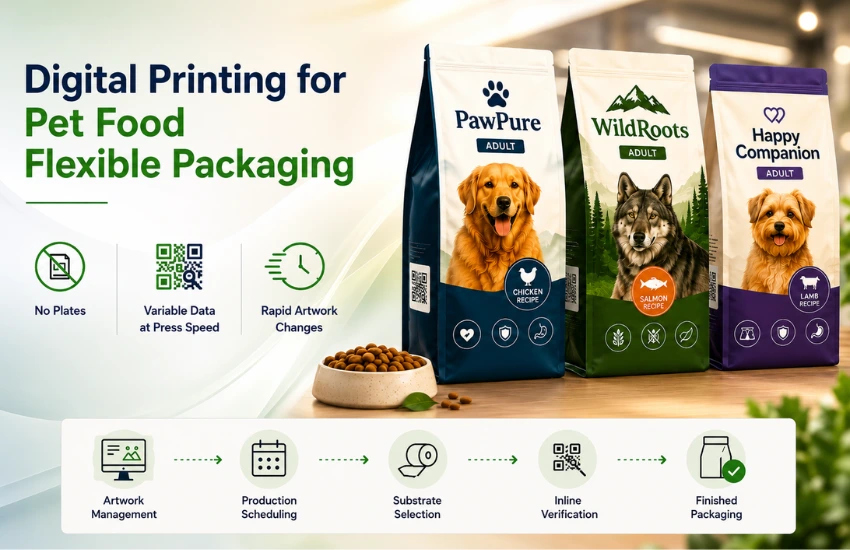
Digital printing for pet food packaging eliminates plate charges, enables variable data between jobs, and makes short-run pet food bags economically viable at volumes where flexo minimum order quantities are prohibitive.

Traditional flexo printing has been the default for flexible packaging for decades, but its economics punish the way modern pet brands actually operate. Plate charges, long setup times, and minimum order quantities that often start in the tens of thousands of bags per SKU leave brands overproducing artwork they may revise within a year. See our guide on making the switch from flexographic to digital printing.

No plates, no plate fees

Digital pet food pouch printing moves from a tooling-based cost model to a per-impression model. This makes short-run flexible packaging economically viable at volumes where flexo minimum order quantities are prohibitive — particularly for brands with seasonal flavors, regional variants, or limited releases.

Variable data at press speed

Variable data printing enables batch codes, regional claims such as state-specific feeding statements, promotional call-outs, and private-label variants to change between jobs without stopping for plate changes. A co-packer serving multiple brands can run sequential jobs in a single shift.

Rapid artwork iteration

When a formula changes, a supplement panel updates, or a retailer requests a custom variant, digital printing supports revision cycles measured in days. Flexo plate remakes and converter scheduling typically require several weeks.

Shelf-ready print quality

Modern digital presses produce high-resolution imagery with consistent color across runs and strong substrate compatibility across kraft, MOPP, and laminated films. For most pet food flexible packaging applications, the print quality gap versus flexo has effectively closed.

Digital printing also integrates cleanly with operations automation. Artwork management systems, production scheduling, and inline verification can be connected so the correct file, substrate, and batch code come together automatically for each run.

Material Selection: Kraft, MOPP, Foil, and Recyclable Films

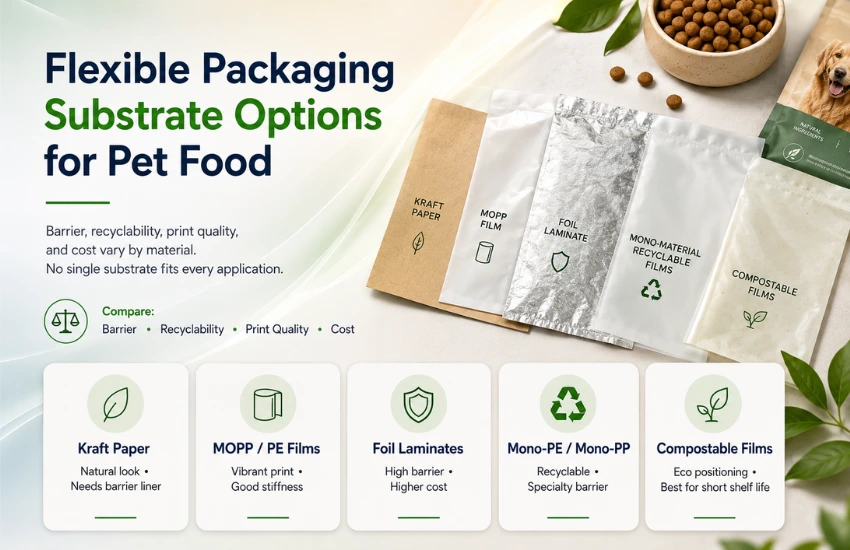
Flexible packaging substrate selection requires balancing barrier performance, recyclability, print quality, and cost — no single material is optimal across all pet food applications.

Kraft Paper Structures

Kraft pet food bags carry strong natural and premium shelf cues and perform well for grain-free, limited-ingredient, and clean-label brand positioning. Kraft typically requires a barrier liner for oil, moisture, and oxygen protection. Print contrast is distinctive but requires careful color management due to the warm substrate tone.

MOPP and PE Films

Metallized or clear oriented polypropylene (MOPP) delivers good clarity, stiffness, and printability. It is a common choice for treats and mid-tier kibble where brands want vibrant graphics and a crisp package structure without paying for foil. See our overview of multilayer flexible packaging with ArrowJet for multi-layer film configurations.

Foil Laminates

Where oxygen and moisture barrier are critical — especially for wet food pouches, freeze-dried proteins, and long shelf-life kibble — foil laminates are the high-barrier standard. They print with excellent quality but carry higher cost and are difficult to recycle.

Recyclable Mono-Material Films (Mono-PE / Mono-PP)

Mono-PE and mono-PP structures support store drop-off recyclability and are gaining ground as retailers tighten sustainability requirements. Achieving comparable barrier to a multi-layer laminate often requires higher film gauges or specialty coatings, and heat-seal windows can be narrower.

Biodegradable and Compostable Films

Compostable and bio-based films exist, but barrier performance, shelf life, and cost currently lag conventional structures. They are best suited to short-shelf-life treats and specialty brand positioning rather than mainstream kibble.

Substrate Trade-Off Summary

Substrate

Barrier

Recyclability

Relative Cost

Best-Fit Products

Kraft with liner

Medium (with barrier layer)

Varies by liner

Medium

Premium, clean-label lines

MOPP / PE film

Medium

Limited

Lower

Treats, mid-tier kibble

Foil laminate

High

Low

Higher

Wet food, freeze-dried, long shelf-life

Mono-PE / mono-PP

Medium (gauge-dependent)

Store drop-off

Medium to higher

Retailer-driven sustainability SKUs

Compostable / bio-based

Lower

Compostable (verify certification)

Higher

Short-shelf-life treats, specialty

Testing note: The right substrate choice depends on product chemistry, target shelf life, retailer requirements, and the sustainability story the brand needs to tell. Always review food-safe printing requirements for pouches and bags before committing to a substrate at production scale.

ArrowJet Eco 330R: Short-Run and Sustainable Flexible Pet Food Packaging

The ArrowJet Eco 330R is suited to short-run, variant-heavy, and sustainability-forward flexible pet food packaging workflows — an accessible entry point for brands prioritising kraft, mono-material films, and fast revision cycles.

Short-run economics without converter dependency

Print the exact quantity needed for each production run — from a limited-release seasonal SKU to a regional variant. No overproduction, no plate fees, and no minimum order quantity constraint that forces brands to pre-build inventory they may never use.

Water-based ink for sustainable substrate workflows

The Eco 330R’s aqueous ink profile is compatible with kraft structures, recyclable mono-material films, and lighter laminates. Learn why water-based pigment inks are the future of sustainable packaging — the ink system fits cleanly into workflows where the substrate itself is part of the brand story.

Rapid artwork iteration for variant-heavy portfolios

When a formula changes, a feeding statement updates, or a retailer requests a custom SKU, revised artwork is in production within hours. For brands managing 20 or more active packaging variants, eliminating the two-to-four week converter lead time is a significant operational gain.

Right-sized entry point for growing pet food brands

Brands launching or expanding a flexible packaging line typically manage a concentrated set of SKUs that grow incrementally. The Eco 330R scales to that growth pattern — producing the exact quantities needed per run without the capital commitment of an enterprise-class press.

ArrowJet Aqua 800M: High-Volume Co-Packer Runs

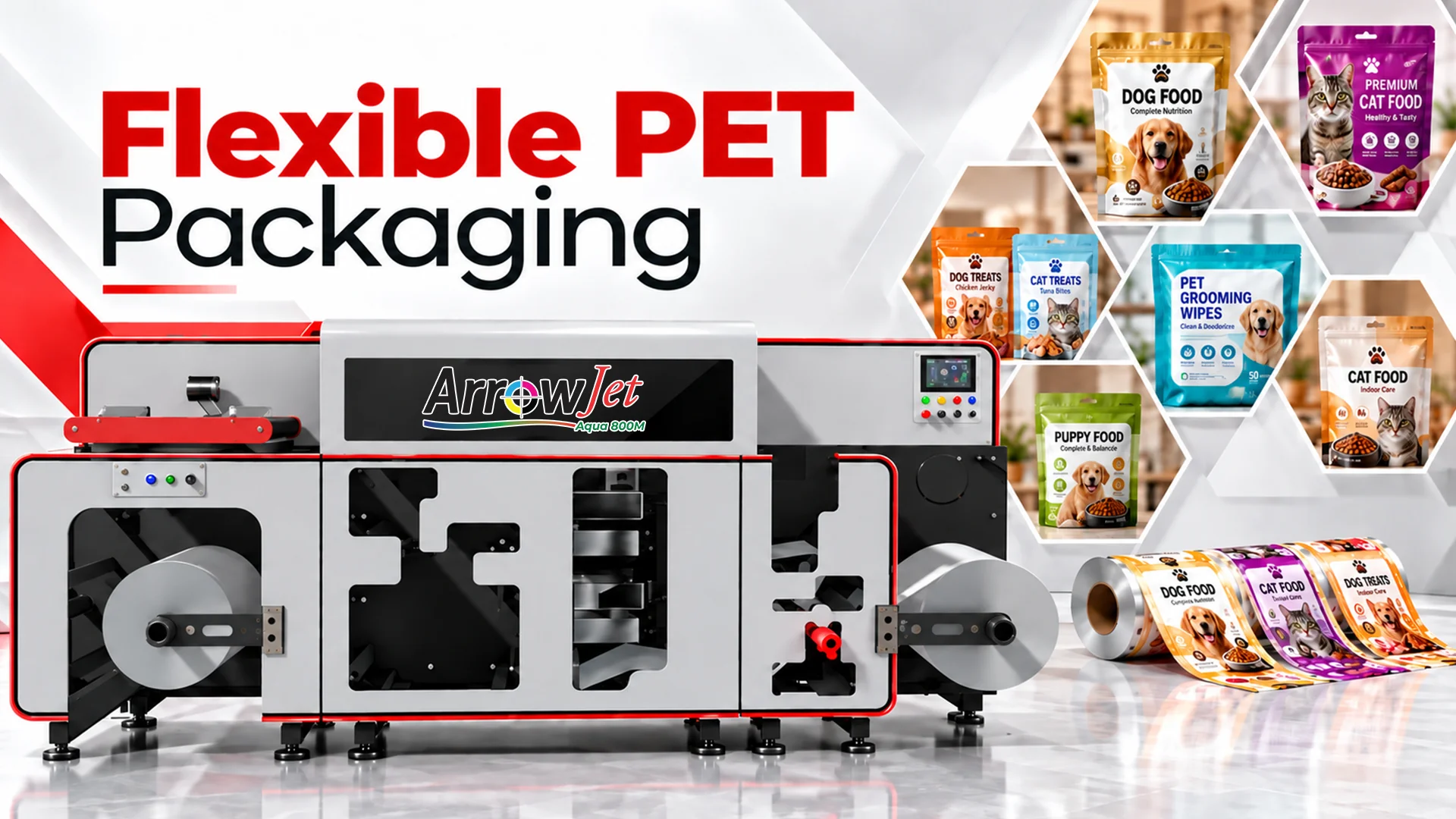
The ArrowJet Aqua 800M handles multi-brand, multi-substrate co-packer production with tight changeover windows, operations automation integration, and consistent throughput across standard and premium substrates.

Multi-brand throughput without mechanical setup

The ArrowJet Aqua 800M handles mixed substrate runs and supports the format changes that come with serving a varied brand portfolio. Co-packers managing dozens of active jobs can switch between brand-specific artwork and substrate configurations without plate changes or extended downtime between runs.

Operations automation integration

Artwork management systems, production scheduling, and inline verification can be connected to the Aqua 800M so the correct file, substrate, and batch code are confirmed automatically for each run. This reduces manual verification burden and supports traceability documentation across multi-brand production shifts.

Mixed substrate capability in a single shift

High-volume co-packer portfolios typically mix standard and premium substrates — kraft alongside MOPP, or foil laminate alongside mono-material film — within the same production schedule. The Aqua 800M is configured to handle that substrate variety without requiring a separate press for each material category. View the full range of digital flexible packaging printers.

For co-packers running pet food flexible packaging at scale — multiple brands, multiple substrates, tight changeover windows — the Aqua 800M is the platform that pairs high-volume commercial contract throughput with the digital flexibility to serve a varied client base on a single production line.

Frequently Asked Questions — Flexible Pet Food Packaging

Common questions from pet food brands and co-packers evaluating digital printing economics, format selection, and substrate compatibility for flexible packaging.

Flexo typically wins at very high volumes, where plate costs amortize across hundreds of thousands of impressions. Digital printing wins at short-to-mid volumes — the range where most pet food SKUs actually operate, especially for brands managing 20 or more active variants. The economic crossover point shifts further toward digital when plate fees, artwork obsolescence costs, and inventory carrying costs are factored in. A side-by-side cost model using your actual SKU list and run volumes is the most reliable way to identify the break-even point for your operation.
Flat-bottom bags are the stronger choice for premium kibble above roughly 4 lb. They stand cleanly on shelf, offer multiple print panels for ingredient storytelling, and accept heavy-duty zippers for resealability. Stand-up pouches can work for premium small-format or sampling SKUs, but flat-bottom construction carries the premium shelf cue most full-size kibble brands require.

Yes, with the correct ink chemistry and press configuration. Mono-PE and mono-PP structures can be printed digitally on ArrowJet flexible packaging presses — the ArrowJet Eco 330R for short-run and sustainability-forward workflows, and the ArrowJet Aqua 800M for higher-volume and multi-substrate co-packer production. A structured substrate qualification is recommended before committing to a material standard at production scale.

Get a Flexible Packaging Workflow Assessment for Your Pet Food Operation

If you’re managing variant-heavy SKU portfolios, carrying pre-printed bag inventory that becomes obsolete with every formula change, or losing weeks to converter lead times on short-run flexible packaging, a structured evaluation can clarify your best path forward.

Arrow Systems offers packaging workflow assessments tailored to your pet food formats, SKU count, substrate requirements, and sustainability goals — helping you identify whether the ArrowJet Eco 330R, ArrowJet Aqua 800M, or another ArrowJet configuration fits your production volume and operational objectives.

Book a 30-Minute Flexible Packaging Assessment →