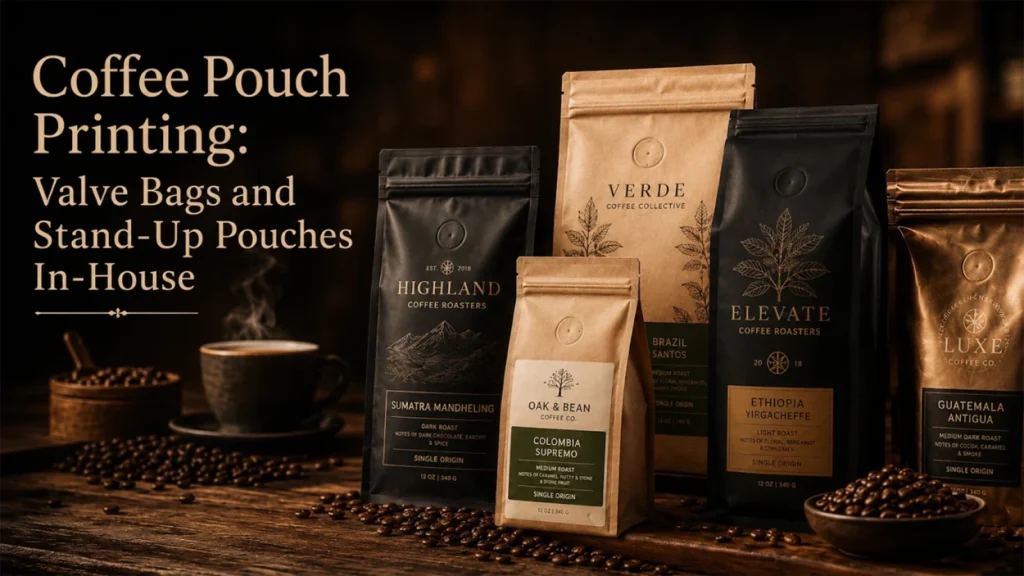
ArrowJet Aqua 800M producing coffee valve bags and stand-up pouches in a specialty roastery setting.

Table of Contents

Coffee Pouch Printing: Valve Bags and Stand-Up Pouches In-House

In-house coffee pouch printing lets specialty roasters produce exact quantities on demand, swap artwork between runs, and print roast dates without retooling.

Key Takeaways

  • Stand-up and flat-bottom coffee pouches are the workhorse retail formats; flat pouches suit wholesale and subscription fulfillment at lower cost.
  • One-way degassing valves prevent CO₂ rupture; print pre-made valve bags with keep-out zones or apply valves after printing rollstock.
  • Digital pouch printing is cost-competitive with flexo below roughly 10,000 bags per SKU and eliminates obsolete inventory from artwork changes.
  • Kraft substrates need white underprint for vibrant color; foil-lined (PET/AL/PE) pouches deliver the best oxygen and moisture barrier for whole-bean shelf life.
  • The ArrowJet Aqua 800M is the primary press for coffee pouch and flexible substrate production; the ArrowJet Eco 330R is the entry point for smaller roasteries bringing label and pouch printing in-house

Why Roasters Are Bringing Coffee Pouch Printing In-House

Traditional coffee pouch printing through flexo converters creates cash flow and velocity problems for multi-SKU roasteries with seasonal rotations and private-label work.

If you roast coffee, your packaging problem isn’t really a packaging problem — it’s a cash flow and velocity problem. You’re sitting on pallets of pre-printed bags for a single-origin Ethiopian that won’t land for another six weeks, your new seasonal blend needs artwork yesterday, and your wholesale account just asked for a private-label run of 1,200 bags. Traditional coffee pouch printing through a flexo converter wasn’t designed for any of that.

On-demand digital printing for beverage labels and flexible packaging changes the shape of the problem. You produce the exact quantity you need, change artwork between runs in minutes, and print variable data per unit. For a multi-SKU roastery with seasonal rotations and growing private-label work, that’s a different operating model, not just a different print method.

Types of Coffee Pouches: Flat, Stand-Up, Flat-Bottom, Side Gusset

Format choice affects shelf presence, fill speed, shipping density, and cost per unit across all flexible packaging formats — there’s no universally best pouch, only the right one for your channel mix.

Flat Pouches
Two-panel flat pouches (sometimes called pillow pouches) are the lowest-cost format and the easiest to print. They ship flat, store compactly, and fill quickly on simple equipment. The trade-off is shelf presence: they don’t stand on their own and read as utilitarian, which works for wholesale, foodservice, or subscription fulfillment but underperforms on retail shelves.
Stand-Up Pouches
The coffee stand-up pouch is the workhorse of specialty retail. A bottom gusset lets the bag stand on a shelf, giving you a full front panel for branding. Stand-ups work well from 8 oz up to 2 lb sizes and are widely compatible with one-way valves and tin-tie or zipper closures. Expect a slightly higher cost per unit than flat pouches and meaningfully better retail performance.
Flat-Bottom (Block Bottom) Bags
The flat-bottom coffee bag — often called a box pouch — has become the premium default for specialty roasters. Five printable panels (front, back, two sides, bottom) give you room for origin storytelling, brew guides, and compliance copy without crowding the front. They stand rigidly, block-stack well for shipping, and signal quality on the shelf. They cost more per unit and run slower on entry-level fillers, but for bagged whole-bean retail they’re hard to beat.
Side Gusset Bags
Side gusset bags are the classic coffee silhouette — tall, narrow, with expanding sides and usually a tin-tie closure. They’re efficient for 12 oz and 1 lb fills, project heritage branding well, and typically use a kraft coffee pouch substrate with a foil or PE liner. They don’t stand as reliably as flat-bottom or stand-up formats, which matters for some retail placements.

The One-Way Valve: Print Around It or After?

Fresh-roasted coffee off-gasses CO₂ for days — the one-way degassing valve prevents bag rupture but complicates printing.

Without a one-way degassing valve, sealed bags balloon or rupture. The valve complicates printing because it’s a small plastic component that interrupts your print surface. There are two practical approaches to valve bag printing, and the right one depends on your volume and setup.

Option A: Print Rollstock Before Valve Application

In this workflow, you print continuous rollstock film, then the valve is heat-welded on (typically by a converter or a separate valve applicator) before the pouch is formed and filled on a form-fill-seal line. This is the cleaner approach for printing: the substrate is flat, registration is simple, and you avoid any risk of smearing or impacting the valve. It’s the right path if you run an FFS line or partner with a converter who applies valves to your pre-printed rollstock.

Option B: Print Pre-Made Valve Bags with Registration

Many small and mid-size roasters don’t have an FFS line — they fill and seal pre-made pouches that already have valves installed. To print these in-house, you register artwork around the existing valve location. That means:

  • Designing artwork with a clear keep-out zone around the valve (typically 1 to 1.5 in. diameter, positioned per the bag supplier’s spec sheet).
  • Feeding pre-made pouches through a printer that can handle the slight thickness bump at the valve without print-head strikes.
  • Accepting that the valve itself won’t be printed over.

Done correctly, Option B works reliably. Done carelessly, you get smeared ink, registration drift, or a damaged valve that vents prematurely.

Choosing the Right Approach for Your Volume

If you’re running under roughly 10,000 bags per SKU per run and value format flexibility, pre-made valve bags printed in-house are usually the better fit. If you’re consistently running above that and have — or plan to add — form-fill-seal capacity, pre-printed rollstock coffee film makes more economic sense at scale.

Digital Printing vs. Pre-Printed Rollstock for Coffee Bags

Flexo-printed rollstock wins on per-unit cost at high single-SKU volume; digital wins on everything else roasters need.

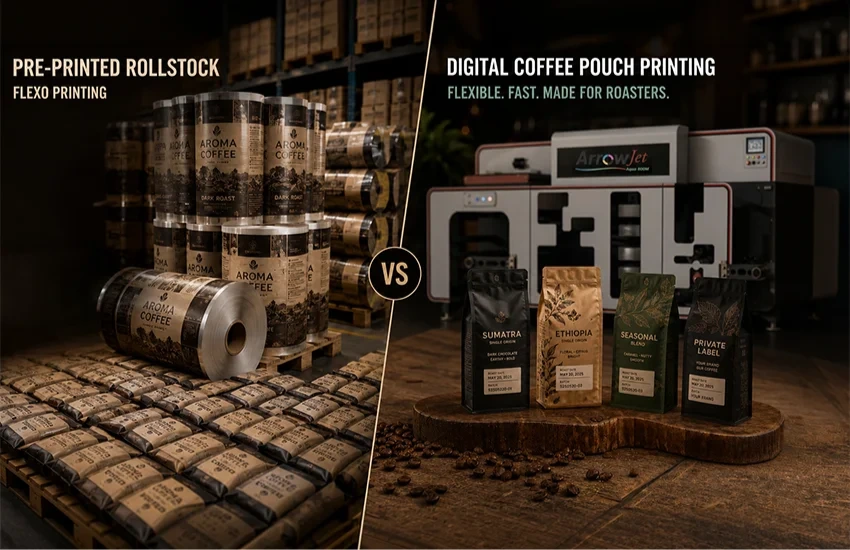
Comparison of flexo converter rollstock production versus in-house digital coffee pouch printing showing workflow and cost differences.

Where Pre-Printed Rollstock Still Wins

Flexo-printed rollstock gets cheaper as runs get longer. Once you’re producing 50,000+ bags of the same SKU with stable artwork, rollstock with inline valve application is hard to beat on per-unit cost. Food-contact-grade laminated films with full-coverage graphics are a mature, commoditized product at scale.

Where Digital Pouch Printing Wins

Digital pouch printing wins on everything rollstock is bad at: short runs, frequent artwork changes, multi-SKU production, variable data, and speed. For a roaster with 15 active SKUs, two seasonal rotations per year, and growing private-label work, digital isn’t a nice-to-have — it’s the only economically sane option.

No plates, no minimums
Print 300 bags or 3,000 from the same file.
Same-day artwork changes
A new origin lands Monday, labels print Tuesday.
Variable data built in
Roast dates, batch codes, lot numbers, and customer-specific private-label panels print per-unit without stopping the press.
No obsolete inventory
You print what you need, when you need it.

Illustrative Per-Unit Cost Comparison

The figures below are illustrative estimates for comparison only — not benchmarks. Real costs depend on substrate, artwork coverage, run length, and your specific equipment.

ScenarioRun SizeIllustrative Cost per Bag
Pre-printed rollstock, flexo50,000~$0.18
Pre-printed rollstock, flexo10,000~$0.32
Digital-printed pre-made pouch2,500~$0.38
Digital-printed pre-made pouch500~$0.45
Label-over-kraft (stock bag + label)500~$0.52

The pattern that matters: flexo economics fall apart below roughly 10,000 units per SKU, while digital stays roughly flat across run sizes. For a multi-SKU roastery, the blended per-unit cost across your whole catalog often favors digital even when any single SKU could theoretically be cheaper on flexo.

ArrowJet Aqua 800M for Coffee Pouch and Flexible Substrate Digital Printing

The ArrowJet Aqua 800M is designed for flexible substrate production — pouches, sachets, and rollstock — addressing the specialty roastery market’s need for on-demand, multi-SKU coffee bag printing without converter dependency.

Flexible substrate compatibility for coffee pouch formats
Engineered to handle film-based materials — including kraft-look laminates, matte white PET/PE, and foil-lined Mylar and PET/AL/PE pouches — that standard roll-label presses cannot reliably process. This makes the Aqua 800M directly applicable to stand-up pouches, flat-bottom bags, side gusset bags, and pre-made valve bags across the full range of specialty coffee packaging formats.
Pre-made valve bag handling with registration
Artwork keep-out zones are managed at file level, and the print path accommodates the slight thickness variation at the valve location without print-head strikes. Variable data — roast dates, batch codes, lot numbers, and origin copy — are set up as dynamic fields and print per-unit from a CSV or ERP feed, eliminating manual date-code editing across multi-SKU production weeks.
No MOQ, no plates, same-day artwork changes
A new single-origin SKU, a seasonal blend, or a private-label run of 1,200 bags can go from approved artwork to printed pouches the same day. There are no plate charges, no minimum order quantities, and no converter lead times. For a multi-SKU roastery with two seasonal rotations per year, this is the operating model that makes the catalog manageable.
SKU agility across a growing private-label portfolio
Roasteries producing private-label pouches for wholesale accounts or co-packing arrangements can switch between brand-specific artwork on the same production day — without plates, setup waste, or scheduling coordination with an outside converter. This directly reduces per-run cost and scheduling complexity for multi-client pouch production.

For specialty roasteries where flexible packaging represents the majority of the product lineup — stand-up and flat-bottom formats across 10 to 30 active SKUs — the ArrowJet Aqua 800M provides the substrate capability and production flexibility that rigid-bottle label presses and desktop printers are not designed to deliver. Roasteries requiring hybrid roll-to-roll and flatbed capability alongside flexible pouch production may also consider the ArrowJet Aqua 330R Hybrid Pro M for wider format versatility.

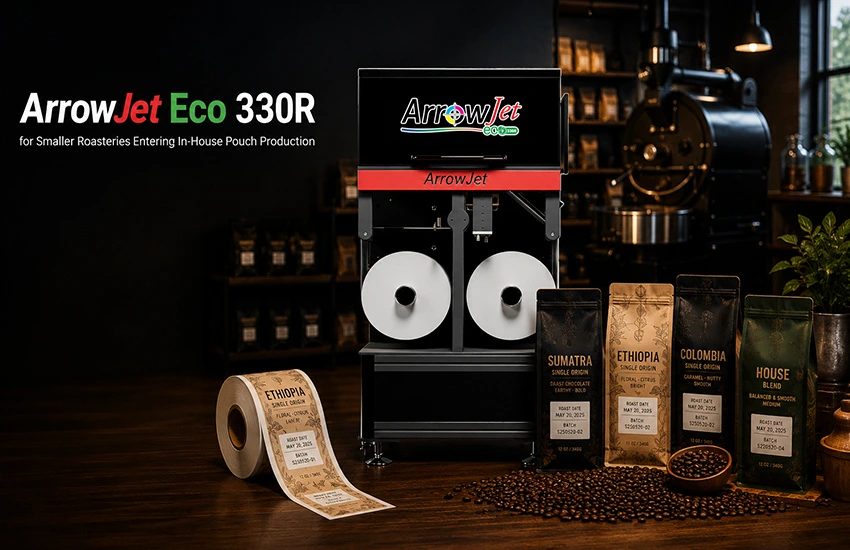
ArrowJet Eco 330R for Smaller Roasteries Entering In-House Pouch Production

The ArrowJet Eco 330R is the entry point for smaller roasteries moving label and short-run pouch production in-house — lower investment, straightforward installation, and immediate elimination of converter lead times for short-run SKUs.

ArrowJet Eco 330R digital press in a small specialty roastery bringing coffee label and pouch printing in-house.
In-house entry point for growing roasteries
For roasteries producing lower pouch volumes across a manageable SKU count, the Eco 330R provides the core capability of digital on-demand production — no plates, no MOQ, no converter dependency — at a lower system investment than high-throughput commercial presses. Single-phase 230V power means no dedicated electrical infrastructure upgrade; no air compressor required.
Rapid response to artwork and seasonal changes
Smaller roasteries are often most exposed to the costs of pre-printed bag obsolescence because they lack the volume to negotiate flexible terms with converters. With the Eco 330R, updated artwork — a new origin, a refreshed seasonal label, a private-label panel for a wholesale account — is in production the same day the change is approved.
Right-sized for a developing SKU portfolio
Roasteries launching a new line or expanding from one to five active SKUs typically need a press that grows with the catalog rather than one sized for peak capacity from day one. The Eco 330R handles the exact quantities needed per run without the capital commitment of an enterprise-class press, and its compact footprint (78×106 cm) fits existing production spaces without structural changes.
Foundation for variable data and compliance printing
Roast dates, batch codes, and country-of-origin copy are set up as variable fields and printed per-unit — eliminating hand-stamping or secondary date-coding operations. For roasteries moving toward more rigorous traceability documentation, this is the foundation for a controlled, auditable packaging workflow.

For specialty roasteries at an earlier stage of growth — typically those managing under 15 active pouch SKUs or producing fewer than 5,000 bags per week across all formats — the ArrowJet Eco 330R is the practical entry point into in-house digital production, providing immediate control over revision cycles and print scheduling without over-investing in press capacity.

Step-by-Step: Printing Coffee Pouches with the ArrowJet Eco 330R

The ArrowJet Eco 330R is built for short-run production — the profile most specialty roasters need when bringing pouch printing in-house. Here’s a realistic in-house production workflow.

1. Artwork Prep and Color Management

Build artwork to the pouch supplier’s dieline spec, with bleed, safe zones, and a clearly marked valve keep-out for pre-made bags. Work in CMYK with a calibrated profile for your substrate. Soft-proof before committing — kraft, matte white, and foil-lined substrates all shift color differently. Lock approved files in a versioned artwork library so operators can’t accidentally run an outdated SKU.

2. Substrate Selection: Kraft, Matte White, Foil-Lined

Common coffee pouch substrates for the Eco 330R:

Kraft
Natural brown look, signals specialty and artisan; needs a white underprint for vibrant colors.
Matte white
Cleanest color reproduction, strong for bold artwork and photography.
Foil-lined (PET/AL/PE)
Best oxygen and moisture barrier; critical for longer shelf life and whole-bean freshness.

Confirm your substrate has a food-contact-compliant inner layer and is rated for the inks you’re running.

3. Loading and Registration

For pre-made pouches, load with the valve orientation consistent run-to-run. For rollstock, align web tension and register to the print mark. Run a short setup pass (20 to 50 units) before committing the full run.

4. Valve Handling and Variable Data

Verify the valve keep-out zone clears the print heads on your first-article samples. For variable data, set up roast date, batch code, and origin as dynamic fields driven by a CSV or ERP feed. This is where operations automation earns its keep — a roaster printing 20 SKUs per week shouldn’t be hand-editing date codes.

5. Curing, Laminating, and Finishing

Ensure inks are fully cured before handling or sealing. If your pouch construction requires lamination, run it through your finishing workflow per the substrate spec. Inline or near-line finishing keeps the process tight and minimises WIP.

6. QC and First-Article Checks

Pull a first article from every run and check:

  • Color against the approved proof.
  • Registration, especially around the valve.
  • Readable barcodes, roast dates, and batch codes.
  • Seal integrity after fill — run a sample through your filler before committing the run.

Document the first-article approval. If you ever need to trace a batch, that record is gold.

ROI for Independent Roasters

The biggest win isn’t per-unit cost — it’s escaping MOQ traps and compressing concept-to-shelf time from weeks to days.

Cash Flow: Escape the MOQ Trap

The single biggest win isn’t per-unit cost — it’s not buying 10,000 bags of an SKU when you’ll sell 1,800 before the artwork changes. Roasters bringing pouch printing in-house typically see a meaningful reduction in packaging inventory capital tied up at any given time, freeing cash for green coffee, equipment, or staffing.

Speed to Market for Seasonal and Limited Releases

Limited drops and seasonal blends live or die on timing. In-house coffee bag artwork production compresses the cycle from concept to on-shelf from weeks to days. For subscription programs and competition coffees, that speed is a direct revenue lever.

Brand Consistency Across Growing SKU Counts

Label-over-kraft approaches break down once you’re running more than a handful of SKUs — labels misalign, artwork feels inconsistent, and shelf presence suffers. Full-face printed pouches across your entire lineup create the brand cohesion retail buyers look for.

At realistic roastery volumes of 500 to 10,000 bags per SKU per run across 10 to 30 active SKUs, the typical range for full payback on an in-house digital pouch workflow lands somewhere in the 12 to 24 month window — faster if you’re also absorbing private-label or co-packing work.

Frequently Asked Questions — Coffee Pouch Printing

Common questions from roastery operators on kraft substrates, valve handling, run sizes, and food-contact compliance for coffee packaging.

You can print on uncoated kraft, but expect muted color, ink absorption, and limited barrier performance. Most specialty roasters use a kraft-look pouch with an inner barrier film (commonly PE or foil) — giving you the artisan exterior with the shelf life coffee needs. For full-color artwork on kraft, a white underprint dramatically improves color pop.
Two rules: design a keep-out zone around the valve in your artwork (per your bag supplier’s spec), and confirm your printer’s head clearance accommodates the slight thickness of the valve without strike. On pre-made valve bags, run a first-article check specifically looking at registration around the valve before committing the run. If you’re printing rollstock, apply valves after printing, not before.

Digital pouch printing is economically viable down to a few hundred bags per SKU — which is why it suits limited releases, single-origin drops, and small private-label jobs. The real question isn’t minimum run size; it’s how many short-run SKUs you have in a typical month. If that number is growing, in-house digital makes increasing sense.

Food-contact compliance is a property of the pouch substrate and its inner layer, not the exterior printing. Whole-bean coffee is also a lower-risk food-contact application than many wet or high-fat products. Work with pouch suppliers who provide documentation on food-contact-compliant materials, and confirm that any inks you use are rated for your specific application. Your substrate supplier and equipment partner should be able to walk you through the relevant documentation.

Operational Takeaways and Next Steps

Match format to channel, decide your valve strategy early, and measure ROI on cash flow and speed — not just cost per bag.

Match format to channel
Flat for wholesale and subscription, stand-up and flat-bottom for retail, side gusset for heritage positioning.
Decide your valve strategy early
Pre-made valve bags with keep-out zones for most roasters; pre-printed rollstock plus FFS at high single-SKU volume.
Use digital where flexo breaks
Short runs, frequent artwork changes, multi-SKU catalogs, and variable data.
Lock in first-article QC
Color, registration, barcode and date-code legibility, and post-fill seal integrity on every run.
Measure ROI on cash flow and speed, not just cost per bag
The MOQ trap and concept-to-shelf time usually move the business more than unit cost.

If you’re weighing in-house pouch printing against your current converter setup, the right next step isn’t a sales demo — it’s a practical assessment of whether the numbers work for your specific operation. Arrow Systems offers roastery-focused consultations covering substrate compatibility for your pouch formats, valve handling for your volume, variable data setup for roast dates and batch codes, and illustrative per-unit cost modeling based on your real SKU mix and run sizes. If the ArrowJet Aqua 800M or ArrowJet Eco 330R fits your production profile, you’ll see it in the numbers. If it doesn’t, you’ll know that too.

Get a Roastery Pouch Printing Consultation with Arrow Systems

If you’re managing frequent artwork changes, carrying obsolete pre-printed pouch inventory, or losing weeks to converter lead times, a structured evaluation can clarify your best path forward.

Arrow Systems offers roastery-focused consultations tailored to your pouch formats, SKU count, valve handling requirements, and variable data needs — helping you identify which ArrowJet system fits your production volume and operational goals.

Request Your Pouch Printing Consultation →