
Table of Contents
What Is Mylar? Uses, Thickness & Printability Explained (Ultimate 2026 Guide)
Mylar is a brand name for biaxially-oriented polyethylene terephthalate (BoPET) — a stretched polyester film known for its exceptional strength, chemical stability, and barrier properties. Invented by DuPont in the 1950s, Mylar has become the generic term for all BoPET films used in packaging, electronics, and industrial applications.
Mylar is a strong, flexible polyester film used primarily for food storage, flexible packaging, and protective barriers. Available in thicknesses from 2 to 14 mil (0.002″ to 0.014″), Mylar bags offer superior oxygen and moisture barriers compared to standard plastic — making them ideal for long-term food storage, cannabis packaging, and electronics protection. This guide covers Mylar types, thickness selection, and how to print professional labels and designs directly on Mylar packaging.
Mylar bags are everywhere today from coffee packaging to pet treats, snacks, supplements, cannabis packaging, nutraceutical pouches, and even emergency food storage. Yet despite their popularity, many brands and converters still ask:
“What exactly is Mylar, what thickness do I need, and how do I print it?”
If that sounds like you, you’re in the right place.
This guide breaks down Mylar in simple, business-friendly language while giving you the deep technical accuracy your converters, production teams, and brand managers expect.
Let’s dive in.
What Is Mylar?
Mylar is a brand name for biaxially-oriented polyethylene terephthalate (BoPET), a strong polyester film known for its durability, barrier protection, heat resistance, and smooth print surface.
In simpler terms?
Mylar is the ultra-tough, food-safe, shiny (or matte) plastic film used to make most modern flexible packaging especially resealable bags and stand-up pouches.
Why Mylar Became the Packaging Standard
Mylar is trusted across industries because it offers:
- Exceptional oxygen and moisture barrier performance
- High tensile strength (it doesn’t tear easily)
- Heat-seal compatibility
- Lightweight construction
- Smooth, ink-friendly surface
- Long shelf-life stability
It checks every box brands care about: product protection, branding potential, and reliable performance.
Where Is Mylar Used? 10 Major Applications
Mylar is one of the most versatile substrates on earth. You’ll find it in:


1. Custom Mylar Bags & Pouches
The #1 use case — from food to wellness products.
2. Coffee & Tea Packaging
Oxygen barrier = preserved aroma.
3. Cannabis & CBD Packaging
Child-resistant + scent-proof performance.
4. Snack & Confectionery Packaging
5. Pet Food & Treat Bags
6. Powdered Supplements & Protein Pouches
7. Long-Term Food Storage
Preppers love Mylar for a reason.
8. Electronics & Component Packaging
Anti-static protection.
9. Medical & Pharmaceutical Packaging
10. Industrial Films & Insulation
Because Mylar is exceptionally stable across temperature ranges.
Mylar Thickness Guide: 1 Mil to 7 Mil (What You REALLY Need)
If you’ve ever been confused by “Mils,” you’re not alone.
1 Mil = 0.001 inches (0.0254 mm)
Here’s a practical breakdown:
Mylar Thickness | Best For | Why It Works |
1–2 Mil | Small flat pouches, inner liners | Lightweight, low-cost |
3 Mil | Standard consumer packaging | Flexible, good barrier |
4 Mil | Resealable food bags, coffee, snacks | Strong + protective |
5 Mil | Premium foods, longer shelf life | Higher puncture resistance |
6–7 Mil | Bulk food storage, industrial uses | Extreme durability |
Pro Tip:
Most modern stand-up pouches fall between 3–5 Mil, depending on branding requirements and filling conditions.
Mylar Grades for Different Industries
Not all Mylar is created equal. Different applications require specific material certifications and performance properties:
MYLAR GRADES BY INDUSTRY
Food-Grade Mylar (FDA Compliant)
- 21 CFR 177.1630 compliant for direct food contact
- Typically 5–7 mil thickness
- Often combined with foil layer for enhanced oxygen barrier
- Suitable for nuts, dried goods, powders, and ready meals
Cannabis-Grade Mylar
- Child-resistant compatible closures
- Smell-proof barrier properties
- UV-resistant options for light-sensitive products
- Typically 6–8 mil with resealable zipper closures
Electronics-Grade Mylar
- ESD (electrostatic discharge) protection
- Ultra-high purity film
- 2–5 mil for static shielding bags and component packaging
Medical / Pharmaceutical Mylar
- ISO 13485 certified manufacturing available
- Sterilizable grades for medical device packaging
- Tamper-evident compatible seals
Is Mylar Good for Printing? Understanding Printability
The short answer?
Yes — Mylar is excellent for printing, especially with modern digital inkjet technology.
But print success depends on three factors:
1. Surface Treatment (Corona or Chemical)
Untreated Mylar is too smooth for ink adhesion.
Processors treat it to increase surface energy, making ink bond tightly.
2. Ink Compatibility
Mylar works with:
- Pigment inkjet inks (best for durability & lamination)
- UV-curable inks (great for labels, not ideal for food contact)
- Solvent/eco-solvent inks (depends on food safety)
- Flexo inks (industry standard for large volumes)
- Gravure inks (for extremely high-volume runs)
Food, beverage, and nutraceutical brands increasingly prefer water-based pigment inkjet because it offers:
- Excellent rub resistance
- Food-grade compliance
- Compatibility with lamination, pouching, sealing
- Vibrant colors
3. Heat Sensitivity
Because Mylar films can distort under extreme heat, print engines must maintain precise temperature control.
This is where high-end systems like the ArrowJet Aqua series outperform basic inkjet printers.
Method | Best For | Durability | Setup Cost |
Digital Inkjet | Short runs, variable data | High (pigment ink) | Low |
Rotogravure | Long runs (10K+) | Excellent | High |
Flexographic | Medium runs (1K–50K) | Very Good | Medium |
Screen Printing | Spot colors, specialty | Excellent | Medium |
Thermal Transfer | Labels on Mylar | Good | Low |
Best Printers for Custom Mylar Bags (Inkjet vs. Digital vs. Flexo Compared)
Marketers and converters often ask:
“What’s the best printer for Mylar bags?”
The real answer depends on your volume, SKU count, turnaround time, and food-safety requirements.
Let’s compare the top three.
Printing Method | Ideal For | Print Quality | Setup Costs | Per-Unit Cost | Speed | Food-Safe Ink Options | Best For Mylar? | Pros | Cons |
Digital Inkjet (Water-Based Pigment) | Short–medium runs, high SKU variation, fast turnaround | ⭐⭐⭐⭐ High | Low (no plates) | Medium | Fast | Yes (e.g., Swiss-compliant pigment inks) | Excellent | Vibrant colors, fast changeovers, perfect for customization, supports lamination | Higher cost than flexo for ultra-high volumes |
Digital Toner (Electrophotographic) | Short runs, prototypes, labels | ⭐⭐⭐ Very good | Low | Medium–High | Medium | Limited | Good for Labels; Limited for Mylar Films | Sharp graphics, good for small batches | Heat sensitivity can distort films; not ideal for wide-web |
Flexographic Printing | Large-volume production (≥100k+) | ⭐⭐⭐⭐ High | High (plates) | Low | Very fast | Yes (depending on ink sets) | Great for High Volume | Cheapest per unit at scale, durable output | Expensive plates, slow changeovers, not flexible for many SKUs |
Gravure Printing | Ultra-high volume (million+ units), premium packaging | ⭐⭐⭐⭐⭐ Exceptional | Very High (cylinders) | Lowest at massive volume | Extremely fast | Yes | Excellent for Massive CPG Runs | Metallics + luxury finishes, unbeatable consistency | Extremely expensive setup, long lead times |
UV Inkjet | Labels, rigid packaging | ⭐⭐⭐⭐ Sharp | Low | Medium | Fast | Not ideal for food-contact Mylar without barrier/overprint varnish | Good for labels; not ideal for pouches | Immediate curing, durable | Food-safety limitations, brittle feel |
Solvent/Eco-Solvent Inkjet | Banners, outdoor media | ⭐⭐⭐ Good | Low | Medium | Medium | Limited for food packaging | Not Recommended | Strong colors | Ink migration concerns, odor |
Why Digital Inkjet Is Dominating Mylar Packaging in 2026
Modern inkjet systems deliver what traditional flexo and gravure simply cannot:
- Short Runs without financial penalties
- Micro-versioning for flavors, batches, SKUs, and regions
- Personalization at scale from influencer drops to limited editions
- Lightning-fast turnarounds to keep up with fast-moving markets
- Zero plate costs, eliminating delays and cutting waste
This combination has made inkjet the preferred choice for converters focused on premium flexible packaging.
Pros of Digital Inkjet for Mylar Films
Digital inkjet offers a set of advantages uniquely suited to the challenges of printing onto Mylar, especially when paired with pigment-based, food-safe inks:
✔ Ideal for Small to Medium Production Volumes
Inkjet empowers converters to run 500 bags in the morning and 5,000 in the afternoon—without changing hardware or printing plates.
✔ Ultra-Fast Job Changeovers
Switch SKUs, flavors, languages, or artwork with a click. Inkjet workflow is built for multi-SKU environments.
✔ Zero Plates = Lower Costs for Short Runs
Every new design printed flexographically adds cost. Inkjet eliminates plates entirely, making short runs extremely profitable.
✔ Perfect for Seasonal, Promotional & Limited-Edition Packaging
Holiday editions, collaboration drops, event packaging these projects thrive with inkjet’s flexibility.
✔ High-Resolution, Photo-Realistic Print Quality
Modern inkjet heads deliver sharp text, rich blacks, vibrant colors, and photographic detail that stand out on shelves.
✔ Works Exceptionally Well With Pigment Inks
Pigment inks are the gold standard for Mylar bags because they offer:
- Superior durability
- Excellent rub and water resistance
- Stability during lamination and heat sealing
- Fade-free performance in long storage cycles
This makes inkjet an even stronger choice for food, supplements, and cannabis applications.
Best Use Cases for Digital Inkjet Mylar Printing
Digital inkjet is the top-performing solution for converters serving high-growth packaging categories:
1. Custom Mylar Bags for Supplements
Perfect for vitamin blends, protein powders, pre-workouts, nutraceuticals, and sample-size trial packs.
2. Cannabis & CBD Packaging
Mylar bags dominate this segment because of their durability, oxygen barrier, and premium feel. Inkjet allows rapid SKU changes for strains, flavors, and compliance updates.
3. Coffee Pouches
Print small-batch roasts, origin-specific blends, or seasonal drops without minimum order headaches.
4. Limited Editions & Promotional Packaging
Brand collaborations, influencers, seasonal promos, or short-term campaigns thrive with inkjet’s flexibility.
5. Prototype & Sampling Runs
Designers and brand owners can test multiple variants quickly—critical for startups and new product development.
1. The Best Digital Printer for Mylar Bags in 2026: ArrowJet Aqua 800M
If you’re looking for a printer purpose-built for flexible packaging and Mylar,… nothing beats the ArrowJet Aqua 800M.

Why It Outperforms Standard Inkjet Printers
Designed specifically for flexible packaging & Mylar films
The wide-web format, optimized tension control, and precision drop placement make it ideal for PET, MET-PET, and multilayer films.
2. Powered by ArrowJet Pigment Inks (Swiss Ordinance Compliant)
These inks are food-safe, highly durable, and engineered to survive:
Lamination
Heat sealing
Abrasion
Long shelf-life storage
3. High-speed, production-grade output
Perfect for converters scaling beyond entry-level devices.
4. Ideal for short-run and medium-run Mylar bag manufacturing
Supports multiple SKUs and variable data.
2. Flexographic Printing for Mylar (Best for Mass Production)
Flexo has dominated packaging for decades.
Pros
- Lowest cost per unit at high volumes
- Excellent durability
- Wide material compatibility
Cons
- Slow changeovers
- High plate costs
- Not cost-effective for short runs
- Limited agility for SKU proliferation
Best Use Case
- Millions of identical Mylar bags with minimal artwork variation.
3. Gravure Printing for Mylar (Premium, Ultra-High Volume)
Gravure is used by global CPG giants.
Pros
- Highest print quality
- Extreme consistency
- Best for metallic, luxury finishes
Cons
- Very expensive cylinders
- Only profitable at massive volume
- Long lead times
What About Hybrid Printing? The Best of Both Worlds
Hybrid printing is becoming one of the fastest-growing printing methods in flexible packaging and Mylar production — and for good reason.
Instead of choosing between digital and flexo, hybrid technology allows converters to use both on the same press, unlocking benefits neither platform can deliver alone.
How Hybrid Printing Typically Works
- Flexo handles the high-coverage, repeatable parts
– Solid background colors
– Flood coating
– White ink layers
– Varnish or primers - Digital handles the dynamic, changeable parts
– Variable data
– SKU variations
– Seasonal editions
– Short-run campaigns
Why This Matters for Converters
Hybrid printing significantly reduces cost while improving operational speed:
- Flexo prints the “cheap-to-produce” static area.
- Digital prints only the variable or SKU-specific segments.
- No need to waste digital ink on large backgrounds.
- No need to create a flexo plate for every SKU.
The result?
Lower production cost, faster time to market, and far more flexibility.
ArrowJet Hybrid Pro M: The Future of Hybrid Printing for Flexible Packaging & Mylar Bags
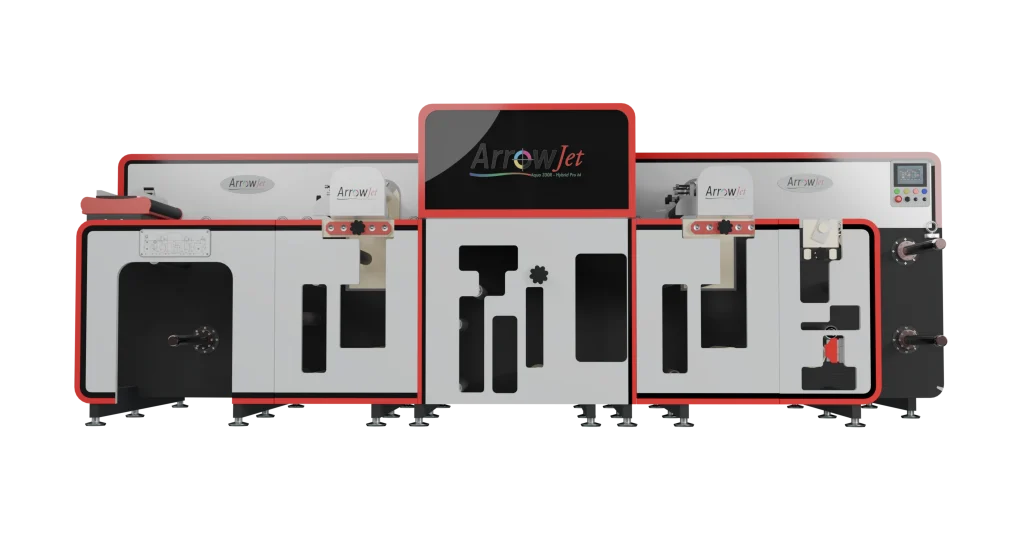
The ArrowJet Hybrid Pro M (Bolt 330R Hybrid Pro M) is one of the most advanced hybrid platforms available today — built specifically for converters who want high speed, low cost, and digital flexibility in one compact machine.
This system combines full flexo capability with high-resolution digital inkjet printing, giving converters the power to scale Mylar bag production like never before.
Why ArrowJet Hybrid Pro M+ Is a Game-Changer

1. True Hybrid Architecture
This is not a “digital press with a flexo station” — it’s a fully integrated hybrid press.
You can run:
- Flexo → Digital → Flexo
- Digital → Flexo
- Flexo-only
- Digital-only
This adaptability allows converters to build workflows around cost, ink usage, SKU complexity, and turn-around time.
2. High-Speed Digital Engine for Variable SKUs
Powered by advanced Memjet DuraFlex® pigment inkjet technology, the Hybrid Pro M delivers:
- 1600 dpi resolution
- Industry-leading color vibrancy
- Food-safe pigment ink options
- Instant changeovers for new SKUs
Perfect for Mylar bag producers managing hundreds of flavors, strains, blends, or seasonal editions.
3. Flexo Units for Coatings, White, Flood Colors & Metallics
Why waste digital ink on solid backgrounds?
The Hybrid Pro M’s flexo section allows you to:
- Lay down white ink for Mylar films
- Apply varnish or OPVs
- Print brand colors at extremely low cost
- Add metallic or specialty effects
- Apply primers inline for optimized digital adhesion
This dramatically reduces digital ink consumption while improving durability.
4. Perfect for Mylar & Flexible Packaging Films
The Hybrid Pro M is engineered for challenging substrates like:
- PET
- Metallized PET
- Clear BOPP
- Laminated films
- Mylar used in stand-up pouches
Its advanced web handling ensures tight tension control, which is critical for thin, heat-sensitive Mylar films.
5. Full Finishing Inline (Optional)
The system can integrate:
- Flexo coating
- Cold foil
- Die-cutting
- Slitting
- Rewinding
Meaning converters can move from blank film → finished roll → pouching line with minimal touches.
6. Lowest Cost Hybrid Production in Its Class
With flexo doing heavy lifting on ink coverage and digital handling design variations, converters can enjoy:
- 60–80% reduction in digital ink cost
- Faster job setup
- Minimal waste
- Massive SKU capability without added plate cost
This makes the Hybrid Pro M especially attractive for:
- Cannabis/cultivation packaging
- Nutraceutical brands
- Snack and confectionery packaging
- Co-packers with frequent design changes
- Private-label producers
Hybrid Printing Example Workflow
Here’s how a real Mylar job might run on the ArrowJet Hybrid Pro M:
Flexo Unit #1: Lay down white ink for metallized Mylar
Flexo Unit #2: Print spot background colors
Digital Inkjet Section: Print all SKUs, graphics, variable data
Flexo Unit #3: Apply gloss/matte varnish
Inline Finishing: Slit, rewind, or die-cut
Output:
Perfect, ready-for-lamination Mylar rolls at a fraction of the cost of digital-only production.
Who Should Invest in the ArrowJet Hybrid Pro M+?
It’s ideal for converters who:
✔ Produce Mylar bags and stand-up pouches
✔ Handle high SKU volumes
✔ Want to cut plate costs
✔ Need to reduce digital ink consumption
✔ Require food-safe printing
✔ Want a single machine for both long and short runs
✔ Want to eliminate outsourcing
If your customers constantly request new flavors, limited editions, or rapid redesigns, this system is a strategic advantage.
Frequently Asked Questions — What Is Mylar?
Yes. Mylar is DuPont’s brand name for biaxially-oriented polyethylene terephthalate (BoPET), which is a type of polyester film. All Mylar is polyester, but not all polyester is Mylar — the same way all Xerox machines are photocopiers but not all photocopiers are Xerox.
Yes, FDA-compliant food-grade Mylar meets 21 CFR 177.1630 standards for direct food contact. Always verify your supplier provides food-grade certification with the specific lot you purchase.
For long-term food storage (5+ years), use 6–7 mil Mylar bags with oxygen absorbers. For short-term or retail packaging, 4–5 mil provides adequate protection for most dried goods.
Yes, properly sealed Mylar bags (6+ mil) with aluminum foil layers are highly effective at containing odors — making them popular for cannabis, coffee, and strong aromatic products.
No. Mylar is not microwave-safe and can melt or release chemicals when heated. Transfer food to microwave-safe containers before heating.
With proper sealing and oxygen absorbers, low-moisture foods can last 10–25 years in Mylar bags. Typical shelf life ranges from 5–10 years for most dried goods under proper storage conditions.
Mylar is a polyester plastic film often laminated with aluminum foil. Pure foil offers better barrier properties but tears easily. Mylar provides strength and flexibility with excellent barrier when foil-laminated — giving you the best of both materials.
Most standard inkjet printers cannot print white ink. For white printing on Mylar, use UV printers with white ink capabilities, hybrid systems with a dedicated flexo white unit, or choose pre-printed Mylar stock with white base.
For short to medium runs, the ArrowJet Aqua 800M (digital inkjet) is the top choice for food-safe, high-quality Mylar bag printing. For high-volume production at scale, the ArrowJet Hybrid Pro M combines digital and flexo for the lowest cost per unit.
Water-based pigment inks compliant with Swiss Ordinance or FDA standards are the safest for food-contact Mylar packaging. Avoid UV-curable and solvent inks unless a tested barrier lamination is applied between ink and food contact surface.
Key Takeaways
✓ What is Mylar: BoPET polyester film invented by DuPont, known for strength and barrier properties
✓ Thickness Matters: 4–5 mil for retail, 6–7 mil for long-term storage, 8+ mil for maximum protection
✓ Food Safe: FDA-compliant grades available for direct food contact (21 CFR 177.1630)
✓ Printable: Digital inkjet works well for short runs; coated Mylar required for ink adhesion
✓ Best Uses: Food storage, cannabis packaging, electronics protection, chemical containment
Contact With Our Team Now
Cannabis Label Versioning Workflow for Multi-State Brands
Table of Contents Cannabis Label Versioning Workflow for Multi-State Brands A cannabis label versioning workflow produces state-specific labels from one master template by moving state-variable
Water-Based vs UV-Cured Label Adhesive: Food & Pharma Guide
Table of Contents Water-Based vs UV-Cured Label Adhesive: Food & Pharma Guide Water-based adhesives suit dry, ambient containers; UV-cured hot melts suit cold, wet, curved
Is Your Confectionery Brand Ready to Bring Flexible Packaging In-House?
Table of Contents Is Your Confectionery Brand Ready to Bring Flexible Packaging In-House? In-house flexible packaging pays off for confectionery brands with many SKUs, short
Label Slitting and Matrix Removal: Where Converters Lose Finishing Time
Table of Contents Label Slitting and Matrix Removal: Where Converters Lose Finishing Time Label slitting and matrix removal, plus rewinding, cost converters more finishing time
Limited Edition Spirits Label Printing: 4 Holiday Delay Fixes
Table of Contents Limited Edition Spirits Label Printing: 4 Holiday Delay Fixes Limited edition spirits label printing runs late because of the calendar, not the
Section 179 Label Printer Timing: Install Before December 31
Table of Contents Section 179 Label Printer Timing: Install Before December 31 A section 179 label printer purchase counts for 2026 only if the press