Natural Wine Label Printing: Design, Materials & In-House Options
Table of Contents Natural Wine Label Printing: Design, Materials & In-House Options Natural wine labels stand apart through bold illustration, farming values, and artistic identity
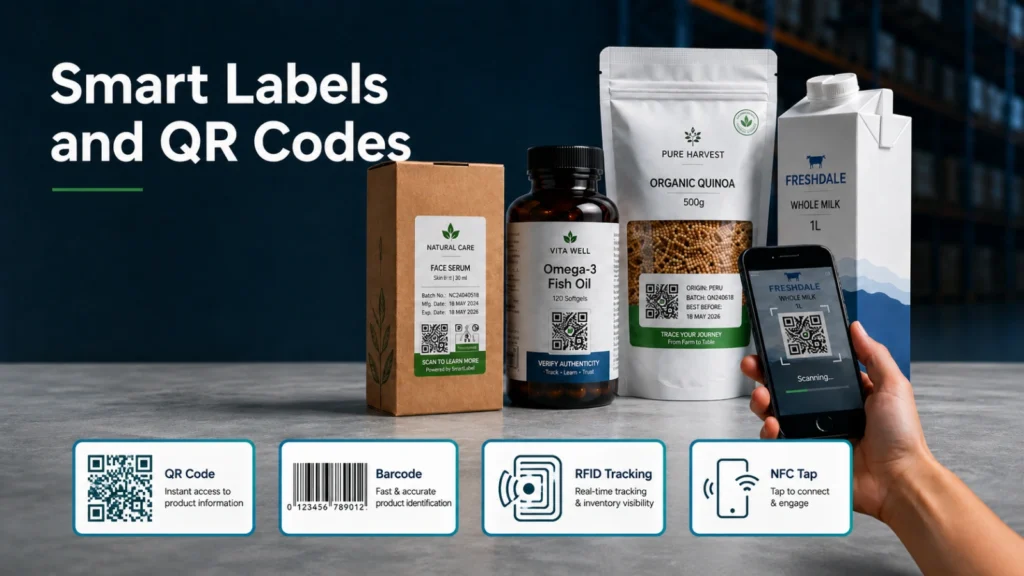
Smart labels use QR codes or barcodes to connect physical packaging to digital content — keeping labels clean while making more information available on demand.
A smart label connects a printed product label to digital content using a scannable code such as a QR code or standard UPC barcode.
Instead of trying to fit every detail onto a small package, a brand uses the label as a gateway to a website, product page, or related digital resource. The physical label carries the essentials — branding, required information, and key product communication — while the code points shoppers toward anything that needs more space to explain.
The core idea responds to a straightforward shift in buyer behavior: customers increasingly want more context before they purchase. A smart label makes that information accessible without making the physical package harder to read.
A product label that includes a scannable element — such as a QR code or barcode — linking the physical product to a digital destination like a product page, ingredient database, or brand resource.
Short for “quick response code.” A two-dimensional barcode that stores data both horizontally and vertically, allowing it to carry significantly more information than a traditional one-dimensional barcode — including full URLs.
Universal Product Code. A one-dimensional barcode that encodes a product identifier for point-of-sale scanning. A QR code can carry this same identifier plus additional data in the same label space.
QR codes store data in two dimensions — horizontally and vertically — so they can carry far more information than a standard barcode in the same footprint.
For product labels, that capacity matters. A QR code can point customers toward detailed information that simply does not fit on a package — product origin and sourcing, process and production details, sustainability context, ingredient or material breakdowns, allergen information, and handling or disposal guidance.
That range of content is increasingly what shoppers want before making a purchase decision, particularly for food, beverage, supplement, and personal care products where transparency is a selling point rather than a compliance checkbox.
Feature | Traditional 1D barcode | QR code |
Data dimensions | Horizontal only | Horizontal and vertical |
Typical data capacity | Product identifier (numeric) | Full URL, numeric, or alphanumeric data |
Scanner required | Dedicated barcode scanner | Standard smartphone camera |
Links to digital destination | No | Yes |
Updateable destination | No | Yes (via dynamic QR code) |
A smart label shifts supporting information off the printed surface and onto a digital destination, freeing the physical label for branding and required content.
Packaging design always balances two competing needs: provide enough information to satisfy a buyer, and stay visually clear and appealing. A crowded label can undermine both goals — overwhelming the reader and weakening the brand presentation at the same time.
Smart labels resolve that tension by separating the layers of communication. The physical label handles what must be visible at shelf: brand identity, product name, key claims, and any required regulatory content. The QR code handles what the buyer may want to explore — backstory, certifications, extended ingredient lists, or sustainability detail.
This approach is especially relevant for brands that want a minimal label aesthetic. Rather than forcing every piece of brand storytelling or specification onto the printed surface, the label becomes an invitation to continue the experience online — on a page the brand controls and can update without reprinting.
In digital label production, QR-linked job data can help identify and separate label runs produced on a single web path — a useful capability for variable-data and short-run jobs.
The consumer-facing use of a QR code is the most visible application, but smart labels can also support the production side of the label business. When multiple label versions are produced in sequence on one continuous web, linked data attached to each job can be scanned during finishing to identify where one run ends and another begins. That separation supports more accurate job completion, reduces the risk of mixed runs reaching a customer, and can simplify how work orders are tracked through the production workflow.
For businesses producing high volumes of short-run or variable-data label jobs — where the label content changes frequently between orders — that workflow integration can become as valuable as the consumer-facing application of the code itself.
Before printing QR codes on labels, confirm that the destination experience and the production setup are both ready to support the code.
Question | Why it matters |
What information do customers actually need after scanning? | A scan that leads to nothing useful damages brand credibility. Define the destination before printing the code. |
Will the destination page be mobile-friendly? | Virtually all QR code scans happen on smartphones. A page that does not render well on mobile undermines the entire interaction. |
Does the label design give the code enough visual space? | A QR code that is too small, too low-contrast, or visually crowded may not scan reliably across all devices. |
How will the linked information stay accurate over time? | Dynamic QR codes allow the destination URL to be updated without reprinting the label. Static codes lock in the URL at print time. |
Will the smart label also support internal workflow tracking? | If QR-linked job data will be used during finishing, confirm that the production and finishing equipment can read and act on that data. |
A smart label works best when the scan leads to something genuinely worth the customer’s time. The code should never be treated as a design decoration — it should connect the buyer, or the production workflow, to something of real value.
A smart label is a product label that includes a scannable element — such as a QR code or barcode — linking the physical product to a digital destination like a product page, ingredient list, or brand resource.
A traditional barcode stores data in one dimension (horizontal lines) and typically encodes only a product identifier. A QR code stores data both horizontally and vertically, allowing it to carry significantly more information — including full URLs — in the same amount of label space.
A QR code lets brands direct customers to detailed product information — such as origin, sustainability details, or extended instructions — without crowding the printed label. It keeps the physical design cleaner while making more content available on demand via smartphone scan.
No. The physical label still needs clear branding, required regulatory information, and an attractive design. The QR code extends what the label can communicate; it does not compensate for a weak physical design.
Yes. In digital label production, QR-linked job data can help identify and separate different label runs produced on a single web path, which is especially useful for short-run and variable-data label jobs where many different versions are produced in close succession.
Arrow Systems manufactures digital label printers and finishing systems for businesses that produce labels in-house. If you are evaluating label printing equipment for short-run, variable-data, or smart label production, contact the Arrow team to discuss your production requirements.

Table of Contents Natural Wine Label Printing: Design, Materials & In-House Options Natural wine labels stand apart through bold illustration, farming values, and artistic identity

Table of Contents Barcode Label Printing: What They Are, How They Work, and How to Print Them In-House A barcode label encodes product or tracking

Table of Contents Pet Food Label Design: AAFCO Compliance & Printing Guide Pet food labels must satisfy specific AAFCO label requirements — guaranteed analysis, net

Table of Contents Tamper-Evident Label Printing: Types, Applications & In-House Options Tamper Evident Label Printing provide visible proof of unauthorized opening — protecting consumers, brands,

Table of Contents Nutraceutical Packaging: Digital Printing for Short Runs Nutraceutical packaging digital printing eliminates plates, setup charges, and MOQs — so supplement brands and

Table of Contents Craft Beer Label Printing: TTB Approval, Design, and In-House Guide Craft beer labels must clear federal TTB COLA review before any product