The Innovation Behind Memjet’s Digital Printing Technology
The Power of Memjet Printing:
Digital printing has seen many changes in recent years, and even more so with the rise of COVID-19 pandemic and the rise in the demand for digital printing. When production is continuous, digital roll-to-roll printing will achieve far greater speeds than traditional printing presses. Sheet processing does not have start-stop difficulties, and the roll-to-roll process can rapidly and cost-effectively mass create rolls of finished material at quite high production rates.
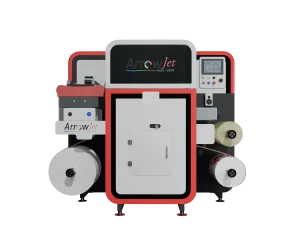
Roll-to-roll printing can provide faster printing and set up times on flexible material, and increase the number of pages printed per minute without the need for an industrial printing plate.
Memjet is an industrial printer company that provides some of the newest innovations in cutting-edge technology at some of the highest resolutions and print quality in the industry.
It’s also simple to use since the technology is a modular printing system that’s built right into the machine. Implementing the modular design helps tailor productions to individual requirements.
Being modular means that businesses can react more quickly to changes in customer demand and the global market. It also means the technology is more flexible and adaptable, adding to the productivity of production, customer loyalty and brand.
Memjet’s DuraFlexⓇ technology helps do just that – adapting well under the pressures of high demand and quick returns.
Utilizing A3+ and A4 printheads and durable pigmented aqueous based ink that can be seamlessly incorporated into a bench-top, economical production with cost sensitive, wide format solutions that enable fast, full-bleed color printing that is highly durable and versatile.
Use the A4 printheads with CMYK pigmented ink capabilities, or implement the A3+ printheads by utilizing up to four printheads at once to create prints from 220mm (8.6 in) to 1270 mm (50 in) that can print up to 27 m/min at 1600×1600 dpi resolution or 46 m/min at 1600×954 dpi.
DuraFlexⓇ inks provide some of the highest image qualities that work with the widest range of markets and applications. Their durability between runs offers a resistance to water, light, ozone and abrasion across a wide range of substrates including paper to high-quality inkjet glossy material.
The replicable printhead enhances the functionality and flexibility of the prints, engineered to deliver increased speed, image quality, and longer life.
Print Module:
The Print Module takes on all printing-related functions, including; data-path, printhead maintenance, and ink supply. This module has two power distribution boards, which transport print data and power to the printhead.
The printhead is primed by ink supply components, and it is serviced automatically by an integrated wiper system. Each Print Module will hold a single printhead and provide connections to the rest of the printer’s components.
Ink Delivery System Module:
The Ink Delivery System Module extracts ink from the bulk ink supply (ink tanks 500 mL, 2 L, and 10 L) and routes it to the Print Module for printing. It also filters the ink and has enough storage for hot swapping and big job sizes.
Ink Management Module:
The Ink Management Module removes any residual ink from the printhead wiper and printhead cap for easy waste removal.
With print speeds up to 46 m/min (30 in/sec), DuraFlexⓇ can meet the demands of a wide range of cost sensitive print applications while delivering stunning image quality.
Unlike other solutions in the market today, DuraFlex’sⓇ data pipeline was designed to handle complex files without slowing the printing down and impacting the productivity of the print solution. DuraFlexⓇ technology is not only a printhead, but a flexible set of modules designed for fast integration and ease of use.
The modular technology provides businesses the fastest time to market, lowest development costs and the ultimate flexibility for different media handling configurations such as cut-sheet, roll-to-roll, or belt-driven applications.
Memjet’s DuraFlexⓇ Technology:
DuraFlexⓇ is an economical printing technology with stitching configurations up to 1270 mm (50 in), providing OEMs with custom solutions for creating a wide range of applications. DuraFlexⓇ powered solutions can be competitively priced and the long-life printheads provide strong advantages over competitive solutions.
Unlike other systems on the market today, DuraFlex’sⓇ data pipeline was built to handle complicated files without slowing down printing and negatively compromising print solution productivity.
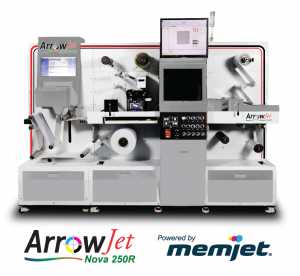
The technology is more than just a printhead; it’s a modular system intended for quick integration for ease of usage.
The modular technology offers businesses the quickest time to market, the lowest development costs, and the most flexibility for various media handling configurations such as cutsheet, roll-to-roll, or belt-driven applications.
Arrow Systems utilizing Memjet’s technology, provides the durability and creative flexibility OEM’s need between their short-run productions, for much less than other technologies that boast faster print speeds and set up times. It’s the one of the best and simplest solutions to help streamline and inspire a growing business.