Table of Contents
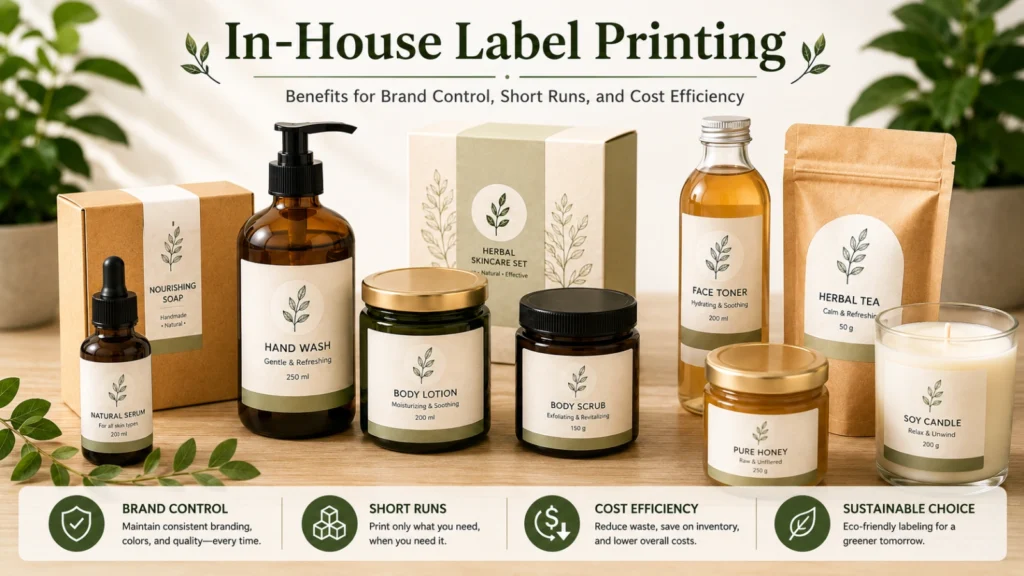
In-House Label Printing: Benefits for Brand Control, Short Runs, and Cost Efficiency
In-house label printing gives businesses direct control over label changes, short runs, and inventory — without waiting on outside schedules or committing to bulk print orders.
Key Takeaways
- In-house label printing removes dependence on outside production schedules — teams can make changes, run short batches, and restock faster without waiting on proofing or shipping cycles.
- Printing closer to actual demand reduces obsolete label inventory, particularly for products with frequent formula, regulatory, or design updates.
- Short-run and limited-edition labels are where in-house digital printing delivers the clearest cost advantage over outsourced plate-based production.
- The ArrowJet Aqua 330R and ArrowJet Eco 330R cover production-speed and entry-level aqueous label printing; both use water-based pigment inks with no air compressor required.
- The ArrowJet UV 330H adds white ink, varnish, and flatbed capability for premium labels; the ArrowJet Aqua 330R Hybrid Pro M adds inline primer, varnish stations, and NIR drying for high-throughput finishing.
What In-House Label Printing Means for Your Operation
In-house label printing means owning a label press and producing labels within your own facility — directly from digital artwork files, on your schedule, in the quantities you need.
Rather than placing orders with an outside printer and waiting on production, proofing, and shipment timelines, businesses with an in-house press control the label workflow internally. This model is most valuable when label needs change frequently — new product launches, regulatory updates, seasonal versions, and short-run SKUs are all situations where an internal workflow reduces both cost and delay.
In-House Label Printing
The practice of producing product labels within a company’s own facility using a dedicated digital label press. The company owns the equipment, manages artwork files, and controls print timing, quantities, and substrate selection directly.
Digital Label Press
An industrial inkjet printing system for roll-fed pressure-sensitive label stock. Digital label presses print directly from digital files, require no printing plates, and can switch between designs without physical tooling changes.
Control Over Timing and Label Changes
When label production is internal, artwork corrections, SKU additions, and regulatory updates go from approved file to printed label the same day — not the same week or month.
With outsourced label printing, every change involves a sequence of handoffs: revised artwork submitted, proofs reviewed, plates updated, production scheduled, labels shipped. For minor corrections or urgent updates, that chain can take days or weeks. An in-house digital press removes most of those steps — the label file is revised and the press runs.
Reducing Unused Label Inventory
Printing closer to actual demand reduces the risk of obsolete label stock — a real cost for any product line where designs, ingredients, or regulations change before pre-printed inventory is used up.
Traditional label ordering encourages larger runs to reduce per-unit cost, but increases the stock that must be used before any change can be made. When a design is refreshed or a regulation updates, pre-printed inventory under the old version must be quarantined or destroyed — and replacement labels often need to be ordered urgently. In-house digital printing allows teams to print in smaller batches that match current demand, reducing that exposure. This is especially useful for:
- New product launches where initial demand is uncertain
- Seasonal or limited-run products with predictable end dates
- Products subject to ongoing regulatory updates (ingredient lists, allergen declarations, dosage instructions)
Short-Run Flexibility and Limited Editions
Short-run and limited-edition labels are where in-house digital printing is most cost-effective — producing 200 to 2,000 labels of a new variant carries no plate charges and no minimum order requirement.
Plate-based printing carries a setup cost amortized across the run. For short batches — test runs, seasonal variants, limited editions — that makes per-unit cost disproportionately high. Digital label presses have no plates: a new design is loaded as a file and the press starts printing. A 250-label run of a seasonal variant costs the same per-unit as a 2,500-label run of a core SKU, making label changes a routine workflow step rather than a major print order.
Improved Quality Control at the Source
Internal label production lets teams inspect color, alignment, copy accuracy, and adhesive performance before a full batch is committed — catching problems at the press rather than after labels are applied to finished goods.
When labels arrive from an outside printer in bulk, quality issues may not surface until labels are being applied to product. With in-house production, a short test run can be checked before a full batch is committed. Color accuracy, registration, copy content, and label dimensions can all be verified at the press — and for operations where ingredient copy, allergen statements, or weight declarations must match an approved file exactly, this tighter verification loop reduces the risk of applying a non-current label version to finished goods.
Outsourcing vs. In-House Label Printing: When Each Makes Sense
Neither approach is right for every business — the decision depends on label volume, change frequency, number of SKUs, and how the cost of internal equipment compares to the fully-loaded cost of outsourcing.
|
Factor |
Outsourced Label Printing |
In-House Digital Label Printing |
|
Label change turnaround |
Days to weeks (proofing, plates, shipping) |
Hours to same day (file update → print) |
|
Minimum order quantities |
Often high — plates require volume to be cost-effective |
No minimums — print exactly what you need |
|
Inventory risk |
Pre-printed stock may become obsolete before use |
Print on demand; reduce or eliminate dead stock |
|
Short-run and limited-edition cost |
High per-unit cost due to plate and setup charges |
Cost-effective — no plates, no setup minimums |
|
Multi-SKU switching |
Each design change may require new plates or proofs |
File-based switching — no physical tooling change |
|
Quality inspection point |
After delivery to your facility |
At the press, before full batch is committed |
|
Capital requirement |
None — pay per order |
Equipment purchase and operator training required |
|
Best fit |
Stable, high-volume products with infrequent design changes |
Short runs, frequent changes, multiple SKUs, fast-moving product lines |
Digital Label Presses for In-House Production
Arrow Systems manufactures four digital label presses covering the full range of in-house label production needs — from entry-level compact systems to production-grade platforms with inline finishing and UV/white ink capability.
The right press depends on label volume, required output effects, inline finishing needs, and facility power and footprint constraints. The four systems below span that range.
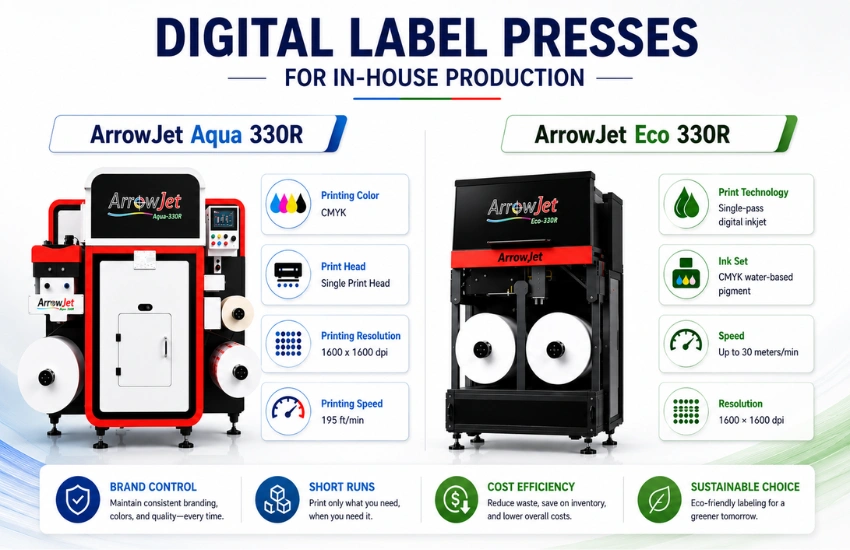
ArrowJet Aqua 330R — High-Speed Production Label Press
The ArrowJet Aqua 330R is a high-speed, roll-to-roll digital label press using Memjet DuraFlex technology, suited for businesses running significant label volumes in-house at production-grade speed.
Print technology
Memjet DuraFlex — CMYK single printhead with 2x redundancy
Print speed
Up to 150 ft/min (45.7 m/min)
Max print width / Resolution
12.75″ (324 mm) / up to 1600 × 1600 dpi
Ink type
Aqueous (water-based) pigment inks
Options
NIR Drying Technology; upgradable to 10L bulk ink system
ArrowJet Eco 330R — Entry-Level Industrial Digital Label Press
The ArrowJet Eco 330R is a compact industrial label press designed as an accessible entry point for brands starting in-house label production. Single-phase power and no air compressor requirement reduce installation complexity.
Print technology
Single-pass digital inkjet
Print speed / Max print width
Up to 20 m/min (65.6 ft/min) / 324 mm (12.75″)
Resolution
1600 × 1600 dpi
Ink type
Economical CMYK water-based pigment inks
Power / Air compressor
Single phase — no three-phase requirement; no air compressor needed
ArrowJet UV 330H — Hybrid UV Label Press for Premium and Specialty Labels
The ArrowJet UV 330H combines roll-to-roll and flatbed printing in a single platform, enabling opaque white, spot varnish, and multi-layer label effects in-house — capabilities typically sent to outside specialty converters.
Print technology / Configurations
ArrowJet UV LED (Ricoh Gen6, 14 printheads) — CMYK + WW, CMYK + VV, or CMYK + WV
Printing modes
Roll-to-roll and flatbed — switchable within the same platform
Max resolution / Max print width
Up to 720 × 4800 dpi / 330 mm
Flatbed area
350 mm × 1500 mm — rigid media up to 50 mm thickness
Power
220V Single Phase, 50/60Hz
ArrowJet Aqua 330R Hybrid Pro M — Production Press with Inline Finishing
The ArrowJet Aqua 330R Hybrid Pro M builds on the Aqua 330R’s Memjet DuraFlex engine and adds inline primer and varnish stations with an IR dryer, modular web handling with digital tension control, and optional inline slitter or lamination — reducing post-press passes for finished label rolls.
Print speed
90 ft/min, 150 ft/min, or 195 ft/min* (*configuration dependent)
Max media width / Max print width
15.75″ (400 mm) / 12.75″ (324 mm)
Inline stations
Inline primer and varnish stations with inline IR dryer — standard
Power
Three phase 400V AC + N+E; air source 6 bar required
Options
Inline rotary slitter or lamination; NIR dryer module; additional flexo stations; RIP software
Which ArrowJet Label Press Fits Your Operation?
The table below covers the four ArrowJet label presses described above across the key decision factors for in-house label production. Use it to narrow down the right configuration based on your production volume, finishing needs, and facility setup.
|
Factor |
ArrowJet Eco 330R |
ArrowJet Aqua 330R |
ArrowJet UV 330H |
ArrowJet Aqua 330R Hybrid Pro M |
|
Best for |
Entry-level in-house label production |
High-speed aqueous label runs |
Premium labels: white ink, varnish, flatbed substrates |
Production-grade runs with inline finishing |
|
Print technology |
Single-pass digital inkjet |
Memjet DuraFlex |
UV LED (Ricoh Gen6) |
Memjet DuraFlex |
|
Max print width |
324 mm (12.75″) |
324 mm (12.75″) |
330 mm |
324 mm (12.75″) |
|
Resolution |
1600 × 1600 dpi |
Up to 1600 × 1600 dpi |
Up to 720 × 4800 dpi |
Up to 1600 × 1600 dpi |
|
Ink / effect options |
CMYK water-based pigment |
CMYK aqueous pigment |
CMYK + White and/or Varnish (UV LED) |
CMYK aqueous + inline primer/varnish |
|
Flatbed mode |
No |
No |
Yes — up to 50 mm media thickness |
No |
|
Inline finishing |
No |
No (offline finishing options available) |
No |
Yes — primer, varnish, IR dryer; optional slitter/lamination |
|
Power requirement |
Single phase |
Three phase 220V |
Single phase 220V |
Three phase 400V |
|
Air compressor |
Not required |
Not required |
Not required |
Required (6 bar) |
Businesses considering in-house label printing can explore the full range of Arrow digital label printers to identify the configuration that best matches their production volume, substrate requirements, and facility setup.
Frequently Asked Questions — In-House Label Printing
Common questions about the operational and financial considerations of moving label production in-house, and how digital label presses support that workflow.
- In-house label printing is the practice of producing product labels within a company’s own facility using a dedicated digital label press. The company controls artwork files, print timing, quantities, and substrate selection directly — eliminating dependence on outside production schedules and minimum order requirements.
The primary benefits are faster label changes (hours instead of days or weeks), the ability to print short runs without high per-unit costs, reduced obsolete inventory when designs or regulations change, and tighter quality control at the point of production.
It depends on production volume and required output. The ArrowJet Eco 330R is a compact, single-phase entry-level option. The ArrowJet Aqua 330R is a high-speed production press using Memjet DuraFlex technology. The ArrowJet UV 330H adds white ink, varnish, and flatbed capability for premium labels. The ArrowJet Aqua 330R Hybrid Pro M adds inline finishing for operations that need primer, varnish, and slitting without a separate post-press pass.
The ArrowJet UV 330H supports CMYK + White, CMYK + Varnish, or CMYK + White + Varnish configurations — enabling opaque white on clear and metallic substrates, spot gloss varnish, and tactile multi-layer finishes in-house rather than through an outside specialty converter.
Ready to explore in-house label printing for your operation?
Arrow Systems manufactures digital label presses for brands across food, beverage, personal care, and specialty manufacturing.
CBD Label Printing: State-Compliant In-House Guide
Table of Contents CBD Label Printing: State-Compliant In-House Guide CBD label printing for hemp-derived products must satisfy federal FDA baselines and state-specific mandates — batch

Label Design Trends: Simple, Bold, and Built for In-House Production
Table of Contents Label Design Trends: Simple, Bold, and Built for In-House Production The strongest label design trends share one principle: every element earns its
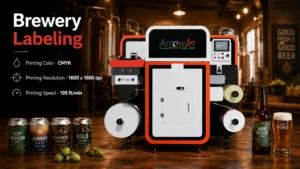
Brewery Labeling: How Craft Breweries Print Labels In-House to Cut Costs
Table of Contents Brewery Labeling: How Craft Breweries Print Labels In-House to Cut Costs In-house brewery labeling lets craft operations print exact run quantities on
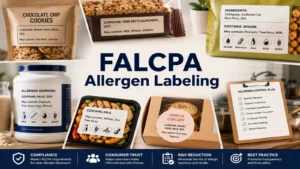
FALCPA Allergen Labeling: What Food Brands Must Print to Stay FDA Compliant
Table of Contents FALCPA Allergen Labeling: What Food Brands Must Print to Stay FDA Compliant FALCPA allergen labeling requires US food brands to declare nine
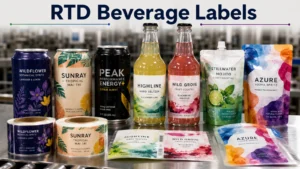
RTD Beverage Labels: How to Print for Cans, Bottles, and Flexible Pouches
Table of Contents RTD Beverage Labels: How to Print for Cans, Bottles, and Flexible Pouches RTD beverage labels vary by container format — pressure-sensitive for
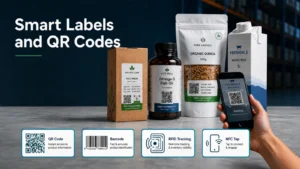
Smart Labels and QR Codes: How They Work on Product Packaging
Table of Contents Smart Labels and QR Codes: How They Work on Product Packaging Smart labels use QR codes or barcodes to connect physical packaging