FALCPA Allergen Labeling: What Food Brands Must Print to Stay FDA Compliant

FALCPA Allergen Labeling

Table of Contents

FALCPA Allergen Labeling: What Food Brands Must Print to Stay FDA Compliant

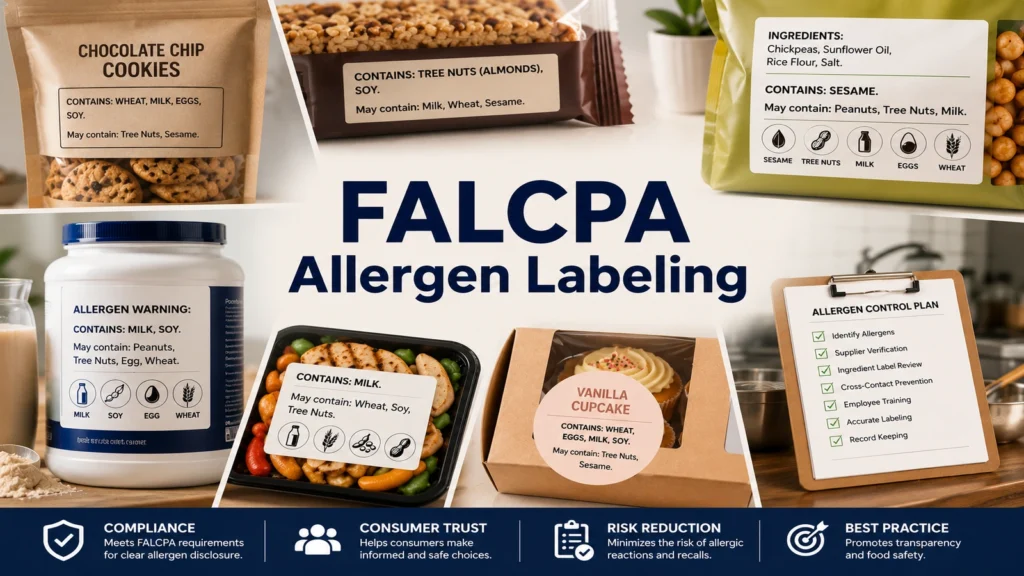
FALCPA allergen labeling requires US food brands to declare nine major allergens — milk, eggs, fish, crustacean shellfish, tree nuts, peanuts, wheat, soybeans, and sesame — on FDA-regulated packaged foods, either parenthetically inside the ingredient list or in a properly formatted “Contains” statement adjacent to it. This guide covers the mandatory label elements, correct “Contains” formatting, where voluntary precautionary statements fit, and how in-house variable-data printing keeps labels current as products and regulations change.

Key Takeaways

  • Declare all nine major allergens — including sesame since January 1, 2023 — using the parenthetical method or a compliant “Contains” statement.
  • Specify tree nut variety and fish or shellfish species; generic “nuts” or “fish” is not compliant.
  • A “Contains” statement, if used, must be complete — a partial statement does not satisfy FALCPA for omitted allergens.
  • Treat precautionary “May Contain” language as a risk-assessment output, not a default disclaimer. It does not replace cGMPs.
  • Tie every label revision to a controlled artwork workflow with QA approval, version lock, and audit trail.
  • Evaluate in-house variable-data printing where reformulation frequency, SKU count, or regulatory change is driving obsolete-label write-offs.

Practical compliance reference only — not legal or regulatory advice. Verify all requirements against current FDA regulations and consult qualified regulatory counsel before implementing label changes.

What FALCPA Requires on FDA-Regulated Food Labels

FALCPA was enacted in 2004, effective January 1, 2006 — establishing a federal mandate for clear allergen disclosure on all FDA-regulated packaged food labels.

The Food Allergen Labeling and Consumer Protection Act of 2004 (FALCPA) governs how major food allergens must be disclosed on packaged foods regulated by the FDA under the Federal Food, Drug, and Cosmetic Act. It applies to most packaged foods sold in the United States, including dietary supplements, but does not cover meat, poultry, or most egg products that fall under USDA food label guidelines administered by FSIS.

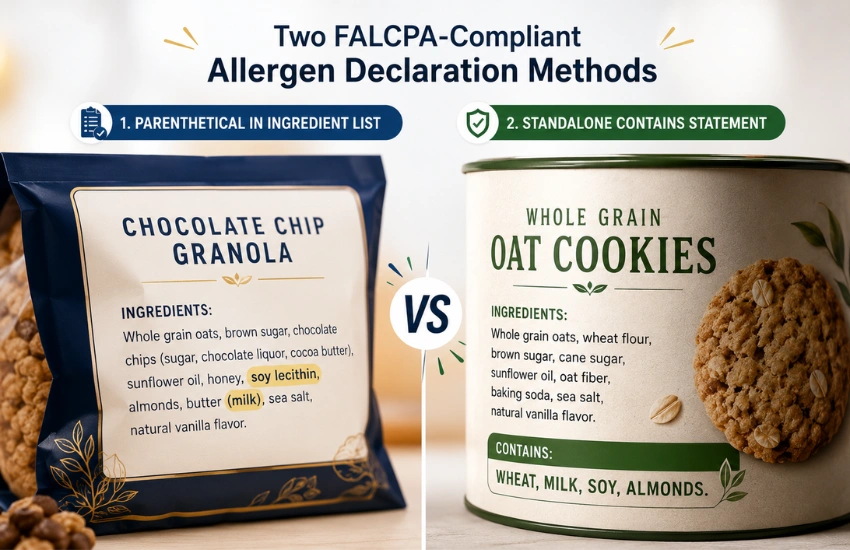
Under FALCPA, any ingredient that is or contains protein from a major food allergen must be declared on the label using the plain English (common or usual) name of the allergen source. FDA permits two acceptable declaration methods:

Parenthetical declaration within the ingredient list

The allergen source name is included directly in the ingredient list, either as part of the ingredient name or in a parenthetical immediately following it. Example: “lecithin (soy), whey (milk).” No separate statement is required if all allergens are covered this way.

Separate “Contains” statement

A standalone statement placed immediately after or adjacent to the ingredient list, listing all major allergens present. Either method satisfies the statute, but the chosen approach must be applied consistently and the allergen source name must be unambiguous.

Type size and legibility requirements

Declarations must appear in type at least as prominent as the surrounding ingredient text and must be legible to a typical consumer under normal use. FDA does not specify a fixed point size; the practical expectation is parity with the ingredient declaration.

Who bears compliance responsibility

The manufacturer, packer, or distributor whose name appears on the label is accountable. Co-manufacturers, private label brands, and contract manufacturing partners share responsibility based on their agreements — but the entity on the label faces FDA enforcement exposure.

The 9 Major Allergens Under Current FDA Rules (Including FASTER Act Sesame Since 2023)

Eight allergens were defined in the original 2004 FALCPA legislation. The FASTER Act added sesame as the ninth, with mandatory compliance effective January 1, 2023.

Allergen declaration is one component of a broader set of food traceability and labeling requirements food brands must manage. The table below lists all nine allergens currently recognized under FDA regulations, with required declaration name format, species/variety disclosure rules, and the legislation that established each.

Allergen

Required Disclosure Name

Species / Variety Detail Required?

Law / Effective Date

Milk

“milk”

No

FALCPA / Jan 1, 2006

Eggs

“egg”

No

FALCPA / Jan 1, 2006

Fish

“fish” + species, e.g., “fish (salmon)”

Yes — species name required

FALCPA / Jan 1, 2006

Crustacean shellfish

“shellfish” + species, e.g., “shellfish (shrimp)”

Yes — species name required

FALCPA / Jan 1, 2006

Tree nuts

“tree nuts” + variety, e.g., “tree nuts (almond)”

Yes — specific nut variety required

FALCPA / Jan 1, 2006

Peanuts

“peanut”

No

FALCPA / Jan 1, 2006

Wheat

“wheat”

No

FALCPA / Jan 1, 2006

Soybeans

“soy” or “soybean”

No

FALCPA / Jan 1, 2006

Sesame

“sesame”

No

FASTER Act / Jan 1, 2023

Common compliance errors include declaring “nuts” generically, omitting the species for fish or shellfish, treating coconut inconsistently (FDA classifies coconut as a tree nut for allergen labeling purposes), and failing to update legacy label inventory for sesame following the FASTER Act. Brands that printed large label runs before the January 1, 2023 effective date have had to redesign, overprint, or write off stock that no longer reflects current compliance requirements.

FALCPA Allergen Labeling

How to Format the 'Contains' Statement Correctly

A “Contains” statement must be complete, use common allergen names, and appear immediately after or adjacent to the ingredient list — partial statements are not FALCPA-compliant.

When a brand uses the “Contains” statement approach — alone or alongside parenthetical declarations — FDA expects a specific structure:

Capitalization and punctuation

The word “Contains” must begin with a capital “C,” followed by the names of the allergen sources present, typically separated by commas, with a period closing the list. Example: Contains: Milk, Wheat, Soy, Almond.

Placement on the label

The statement must appear immediately after or adjacent to the ingredient list, on the same label panel, with no intervening unrelated text. FDA treats proximity to the ingredient list as a non-negotiable formatting requirement.

Type size

The “Contains” statement must be set in type no smaller than the ingredient list. FDA does not mandate a minimum point size, but conspicuousness relative to the ingredient declaration is the standard.

Completeness

If a “Contains” statement is used, it must list every major allergen present in the product. A partial statement that covers, say, milk and wheat but omits sesame does not satisfy FALCPA for the omitted allergen — even if sesame appears in the ingredient list by common name.

When “Contains” and parenthetical declarations are used together

Many brands include both a parenthetical and a “Contains” statement for clarity and to meet retailer requirements. When both are used, they must be consistent — an allergen cannot appear in one declaration method but be absent from the other.

Multi-variety tree nuts and fish species

For products containing multiple tree nut varieties or fish species, each must be listed by specific name in the “Contains” statement. “Contains: Tree Nuts” without specifying almond, cashew, etc. is not sufficient.

Declaration Method Comparison

Both methods satisfy FALCPA — the right choice depends on label panel space, SKU allergen complexity, and retailer requirements.

Element

Parenthetical in Ingredient List

“Contains” Statement

Placement

Inside the ingredient declaration, immediately after the ingredient name

Immediately after or adjacent to the ingredient list — same panel, no intervening text

Type size

Same as surrounding ingredient text

No smaller than the ingredient list type

Must cover all 9 allergens present

Yes — all allergens in the product must be declared

Yes, if used — partial “Contains” statements are not compliant

Required by FALCPA?

Required when a “Contains” statement is not used

Optional — but must be complete and correctly formatted if included

Common use case

Single-panel SKUs, products with minimal allergen load, clean-label formats

High-allergen products, retailer-driven label specifications, consumer-facing clarity

Can both methods be used together?

Yes — many brands use both. When both are used, they must be mutually consistent.

Voluntary Precautionary Statements: Best Practices

Precautionary allergen statements are voluntary, unregulated by FDA as mandatory declarations, and cannot substitute for required FALCPA disclosure or for cGMP controls.

Voluntary precautionary statements — also called precautionary allergen labeling (PAL) — address cross-contact risk from shared equipment, production lines, or manufacturing facilities. Common formats include “May contain traces of peanuts” or “Manufactured in a facility that also processes wheat.”

FDA’s position is clear: precautionary statements are voluntary and do not substitute for current Good Manufacturing Practices (cGMPs). They cannot be used to mask inadequate sanitation, poor allergen segregation, or weak supplier controls, and they must not be false or misleading to consumers.

When precautionary statements are appropriate

Precautionary language should be based on a documented risk assessment of actual cross-contact exposure — not applied as a blanket disclaimer. Using “May Contain” across every product without a supporting risk assessment is considered misleading by FDA and erodes consumer trust with the allergen-sensitive population most dependent on accurate labeling.

Cross-contact vs. cross-contamination

Cross-contact is the preferred technical and regulatory term for the unintended transfer of allergen residues between products. Cross-contamination refers broadly to microbial or chemical hazards. Using “cross-contact” specifically for allergen events matters in regulatory correspondence, FSMA documentation, and food safety audits.

What precautionary statements cannot do

A precautionary statement cannot substitute for a mandatory FALCPA allergen declaration. If milk is a known ingredient in a product, “May Contain Milk” does not satisfy FALCPA — the milk must be declared as an ingredient allergen source. This is a common error when brands reformulate quickly or launch new SKUs under time pressure.

Change-control and precautionary statement drift

Precautionary statement drift — where advisory language expands to cover allergens not supported by a current risk assessment, or fails to reflect line or supplier changes — is often a leading indicator of weak change-control discipline. Locking the precautionary language to a controlled, SKU-level master record with mandatory review triggers helps prevent the inconsistencies that confuse consumers and create audit exposure.

Printing Allergen Labels In-House with the ArrowJet Aqua 330R

The operational challenge of allergen labeling compliance is not understanding the rules — it is keeping labels current as the business and regulations change.

Reformulations, supplier swaps, new SKU variants, private-label runs, and regulatory updates like the FASTER Act sesame mandate all trigger label revisions. When labels come from external converters with long lead times and high minimum order quantities, brands face a compounding problem: each change event forces a choice between writing off non-compliant pre-printed label inventory or running the risk of shipping product with outdated allergen declarations.

In-house digital label printers change that equation. On-demand variable data printing allows brands to produce exactly the quantity of each allergen-variant label needed for a given run, switching between label versions through artwork changes in the RIP software — with zero plate changeover and zero setup waste.

The risk of carrying short-run food label printing non-compliant stock through a regulatory change is one of the strongest operational arguments for on-demand production over batch-ordering inventory months in advance.

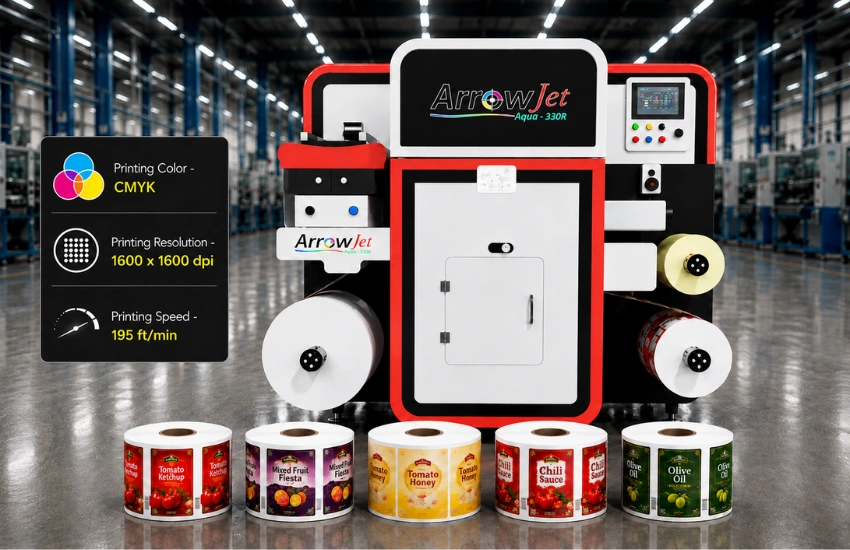
The ArrowJet Aqua 330R is Arrow Systems’ high-resolution aqueous inkjet label press, used in food and beverage production environments for exactly this type of allergen-variant label management. For allergen labeling specifically, this enables:

  • SKU-specific allergen declarations printed on demand, with the “Contains” statement, ingredient panel, and any precautionary language driven from a controlled data source — reducing the risk of incorrect label-to-product matching.
  • Rapid response to reformulations. When a supplier change introduces or removes an allergen, updated labels can be produced for the next production run rather than waiting weeks for a converter reprint.
  • Reduced obsolete label inventory. Producing labels closer to consumption — rather than in large pre-printed batches — significantly reduces write-offs when allergen content or regulations change.
  • Tighter integration between QA approval and label production. Locking artwork release to a documented approval workflow supports version control and print authorization across regulatory review cycles.

The operational benefit extends beyond speed. Treating the label as a controlled, current document — rather than a fixed inventory item — is particularly valuable for brands managing many SKUs, frequent new-product development, or contract-manufactured lines where allergen profiles vary across the portfolio.

Brands moving allergen label production in-house typically pair the press with a governed artwork workflow: regulatory approval, version lock, and audit trail before any print job releases. That combination is where compliance and production operations reinforce each other.

Specification

ArrowJet Aqua 330R

Print speed

Up to 195 ft/min (60 m/min)

Print resolution

1600 × 1600 dpi

Max print width

12.75″ (324 mm)

Ink system

CMYK aqueous pigment — Nestle Guidance compliant; REACh and RoHS 3 compliant

Print engine

Memjet DuraFlex™

Substrates supported

Coated paper, BOPP, PP, PET, PVC, Mylar, Tyvek, and more

Artwork changeover

Digital via RIP software — no plates required

Frequently Asked Questions — FALCPA Allergen Labeling

Common questions from QA, regulatory, and packaging operations teams on FALCPA scope, sesame compliance, and enforcement consequences.

No. FALCPA applies to FDA-regulated foods under the Federal Food, Drug, and Cosmetic Act. Meat, poultry, and processed egg products fall under USDA’s Food Safety and Inspection Service (FSIS), which administers its own allergen labeling requirements separately. In practice, FSIS allergen labeling expectations closely mirror FALCPA, but they are governed by different regulatory authority and enforced through different mechanisms.

The “Contains” statement is optional if all major allergens are properly disclosed via parenthetical declarations within the ingredient list. However, if a “Contains” statement is used, it must list every major allergen present in the product, appear immediately after or adjacent to the ingredient list, and be set in type no smaller than the ingredient list. Partial “Contains” statements are not compliant — if the statement is used, it must be complete.

Since January 1, 2023, sesame must be declared as a major allergen when present in FDA-regulated packaged foods. Labels printed before that date that do not declare sesame are no longer compliant for products manufactured after the effective date. Brands have generally addressed this by reprinting, overprinting, or transitioning to on-demand digital label production — which allows allergen declaration updates without carrying large non-compliant pre-printed label stock through a regulatory change.

No. Voluntary precautionary statements are not required by FALCPA or FDA. They are advisory and must not replace cGMP controls for allergen cross-contact. When used, they should reflect a documented risk assessment — not serve as a blanket disclaimer for inadequate allergen segregation practices. Overuse of precautionary statements on products without a genuine evaluated cross-contact risk is considered misleading.

Consequences can include FDA warning letters, product detention, mandatory or voluntary recalls, retailer chargebacks, and litigation exposure. Undeclared allergens are consistently among the leading causes of Class I food recalls in the United States — the highest-severity recall classification, reflecting a reasonable probability of serious adverse health consequences. A single undeclared allergen event can generate significant financial, reputational, and regulatory damage for the brand responsible.
Managing Frequent Reformulations or Multi-SKU Allergen Complexity?

If your team is managing FALCPA compliance across a growing SKU portfolio, frequent formulation changes, or contract-manufactured lines with variable allergen profiles, an in-house labeling assessment can quantify where variable-data digital printing fits in your workflow. Book a 20-minute allergen labeling audit with Arrow Systems to review your current SKU portfolio, compliance profile, and allergen label production environment.

Leave a Comment

Your email address will not be published. Required fields are marked *