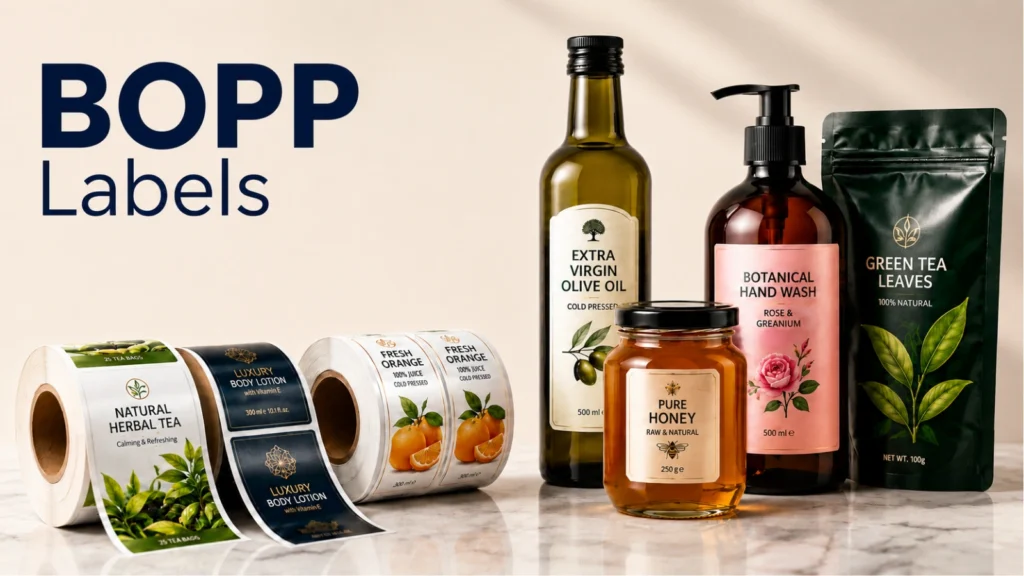
BOPP Labels

Table of Contents

BOPP Labels: Material Properties, Finish Options & When to Use Them

BOPP (biaxially oriented polypropylene) is a moisture-resistant, durable film substrate used for labels across food, beverage, personal care, and specialty product categories.

Key Takeaways

  • BOPP stands for biaxially oriented polypropylene — a film made by stretching PP in two directions for greater strength and clarity.
  • BOPP resists moisture, acids, and oils, making it suitable for food, beverage, personal care, household chemical, and supplement labels.
  • Three common BOPP finish types — clear, white, and metallized — each serve different packaging design objectives.
  • Digital inkjet presses — including the ArrowJet Aqua 330R, ArrowJet Eco 330R, and ArrowJet UV 330H — can print on BOPP film stock for short-to-medium label runs without plate costs or minimum order quantities.
  • The ArrowJet Aqua Hybrid Pro M extends BOPP printing to flexible packaging formats — sachets, stand-up pouches, and flexible film — for operations producing both labels and flexible packaging.
  • Recyclability claims for BOPP labels depend on the full label construction — adhesive, coatings, substrate — not the film alone.

What Is BOPP?

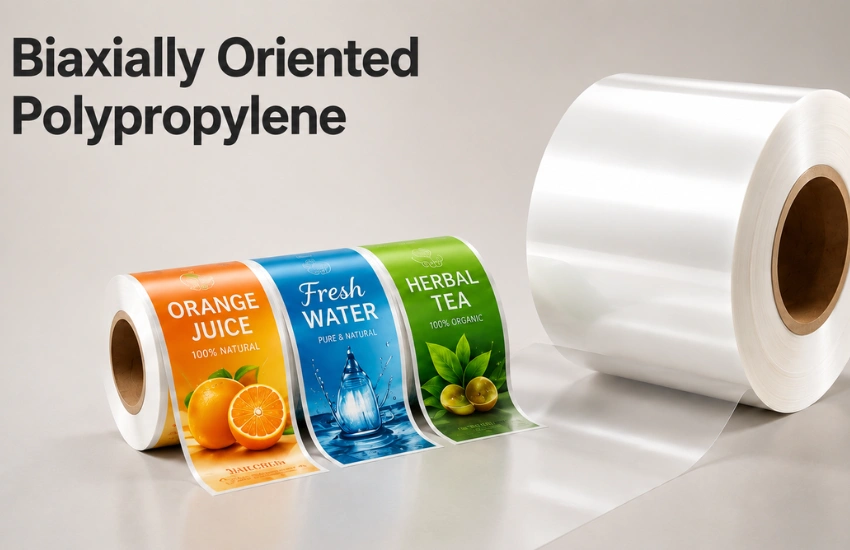
BOPP stands for biaxially oriented polypropylene — a film produced by stretching polypropylene in two perpendicular directions to improve its strength, clarity, and dimensional stability.

Polypropylene on its own is a lightweight thermoplastic polymer. When it is stretched in both the machine direction and the transverse direction during manufacturing, the resulting film becomes thinner, stronger, and optically clearer than unoriented polypropylene. This biaxial orientation is what separates BOPP from standard PP film and gives it the combination of properties that make it a leading label substrate.

BOPP is the second most produced synthetic plastic globally after polyethylene. It is widely used in packaging films, flexible pouches, bags, and pressure-sensitive label stock. In label applications, it is valued for conforming consistently to containers of varying shapes — bottles, jars, tubes, and canisters — while maintaining print quality and adhesion through the product’s shelf life.

Biaxially Oriented Polypropylene

Key Properties of BOPP Label Film

BOPP’s combination of moisture resistance, chemical tolerance, and finish flexibility makes it a versatile label substrate across a wide range of product categories.

Moisture Resistance

BOPP does not absorb water and resists surface wetting. Labels printed on BOPP will not wilt, wrinkle, or lift in humid conditions, refrigerated storage, or environments where the container is handled with wet hands or briefly submerged. This property is one of the primary reasons BOPP is specified over paper for beverage, food, and personal care labels.

Resistance to Acidic and Low-pH Products

BOPP film tolerates contact with acidic substances including citrus juices, vinegars, sauces, and coffees without degrading. For products where label-to-content contact is possible — such as fill lines, top-of-container placement, or retail environments with condensation — this resistance prevents label staining and print degradation that can occur with paper or certain other film types.

Non-Toxic and Food-Contact Compatible

Polypropylene is widely accepted in food-packaging applications and is generally recognized as suitable for food-contact use. Brands using BOPP labels for food and dietary supplement products should verify that the specific label construction — including inks, adhesives, and any surface coatings — meets applicable food-contact requirements for their product category and market.

UV Resistance

BOPP film has inherent resistance to UV degradation compared to paper substrates, which can fade, yellow, or become brittle under prolonged light exposure. This makes BOPP a practical choice for products displayed on retail shelves under continuous lighting, or products sold outdoors or in sunlit environments such as garden centers, nurseries, and outdoor food markets.

Dimensional Stability and Conformability

BOPP conforms reliably to cylindrical, tapered, and irregularly shaped containers without wrinkling or flagging at label edges. This is especially relevant for round bottles, squeezable tubes, and tapered containers where label edges must lay flat without lifting. The film also maintains dimensional stability through temperature and humidity changes during distribution and storage.

Recyclability Considerations

BOPP film is a polypropylene material and is accepted in certain plastic recycling streams. However, the recyclability of a complete label depends on additional factors: adhesive type, any top coatings or laminates, the substrate to which the label is applied, and the recycling infrastructure available at end of use. Brands making recyclability claims should evaluate the complete package system rather than the film substrate alone.

BOPP Finish Options: Clear, White, and Metallized

BOPP is available in three primary finish types — clear, white, and metallized — each suited to different packaging design objectives and container formats.

Finish Type

Visual Effect

Best Used For

Typical Industries

Clear BOPP

Transparent; allows container surface or contents to show through the label

No-label-look packaging; glass and clear plastic containers; products where contents visibility builds purchase confidence

Spirits and wine, craft beverages, premium food products, personal care

White BOPP

Opaque white; provides a bright, clean printing surface that maximizes color saturation

Products requiring bold graphics, strong color contrast, or legible text on dark or colored containers

Food and beverage, household chemicals, supplements, pet food

Metallized BOPP

Reflective, metallic sheen — silver or gold-toned — without a separate foil layer

Premium shelf presence; products positioned in a luxury, artisan, or specialist tier; branding that benefits from a reflective surface

Spirits and wine, premium personal care, specialty food, cosmetics

The choice between finish types depends on the container material, the brand’s design language, and the print method. Clear BOPP requires that the printed design account for the container color and texture showing through. White BOPP gives the artwork a predictable, neutral background. Metallized BOPP delivers visual impact without the cost of hot or cold foil application.

When BOPP Labels Make Sense

BOPP is the appropriate substrate choice when a product’s use environment, ingredients, or shelf presentation requirements exceed what paper labels can reliably deliver.

Paper labels work well for many dry-goods and ambient-temperature retail products where label durability is not a primary concern. BOPP becomes the stronger specification when one or more of the following conditions apply:

Use Condition

Why BOPP Outperforms Paper

Refrigerated or chilled products

Condensation forms on cold surfaces. Paper absorbs moisture and degrades; BOPP does not.

Products used near water (shower, kitchen sink)

Repeated water contact will erode paper. BOPP maintains print clarity and adhesion.

Products containing citrus, vinegar, or acidic ingredients

Acidic contents can stain or dissolve paper if label contact occurs. BOPP resists low-pH exposure.

Products on sustained retail display under lighting

UV exposure yellows and fades paper faster. BOPP has better UV stability.

Premium or no-label-look packaging

Clear BOPP creates a seamless, transparent appearance on glass or clear PET containers. Paper cannot replicate this effect.

High-handling or high-friction environments

Film labels resist scuffing and tearing during distribution, stacking, and consumer handling better than uncoated paper.

Industries That Commonly Specify BOPP Labels

BOPP is a cross-industry substrate — its moisture resistance and finish versatility make it relevant across multiple product categories.

Food and Beverage

Sauces, condiments, salad dressings, juices, dairy products, and refrigerated items all benefit from BOPP’s moisture tolerance. Clear BOPP is particularly common in the craft beverage category for its clean, high-end shelf appearance on glass bottles.

Personal Care and Cosmetics

Shampoo, conditioner, body wash, and skincare products are stored and used in bathroom environments with sustained humidity and direct water exposure. BOPP labels maintain adhesion and print quality in these conditions where paper labels typically fail.

Household Chemicals

Cleaning products, detergents, and surface sprays often contain active ingredients that can damage unprotected paper labels. BOPP’s chemical resistance helps maintain label integrity and legibility for safety-critical label information including ingredient declarations and hazard warnings.

Supplements and Nutraceuticals

Supplement bottles are frequently stored in bathrooms and kitchens where humidity is elevated. BOPP also tolerates the oil-based ingredients found in some supplement formulations. White BOPP provides a clean, high-contrast surface for the detailed text required on supplement facts panels and allergen declarations.

Wine and Spirits

Bottles in this category are chilled, handled extensively, and often displayed in ice baths or refrigerated cases. Clear and metallized BOPP are both common in this category — clear for a no-label look on premium bottles, metallized for brands seeking a reflective, high-end shelf presence.

Pet Food

Pet food packaging — especially wet food pouches and canned goods — involves humid storage conditions and handling in food-preparation environments. BOPP labels are a standard specification in this category.

Printing BOPP Labels In-House with ArrowJet

Digital inkjet label presses can print directly on BOPP film stock, giving operations full control over label production — from design to finished roll — without plate costs or minimum order quantities.

In-house label printing on BOPP eliminates the dependency on external print suppliers, shortens revision cycles, and removes the risk of holding obsolete pre-printed label inventory. For brands managing multiple SKUs, seasonal packaging, or frequent regulatory updates to label content, on-demand digital BOPP label printing is a practical operational improvement over bulk outsourced print runs.

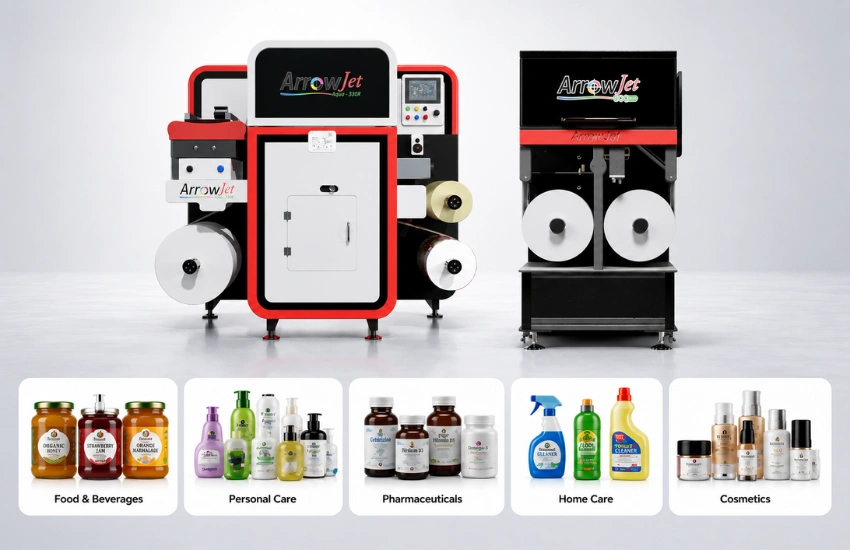
Three ArrowJet digital label presses are well-suited to BOPP label production on roll stock:

ArrowJet Aqua 330R

An aqueous inkjet label press designed for roll-to-roll pressure-sensitive label production. The Aqua 330R handles BOPP film stock — clear, white, or metallized — and is suited to mid-to-high volume label runs across food, beverage, personal care, and supplement applications. Digital production means any label version change is a file update, not a plate remake. View the ArrowJet Aqua 330R.

ArrowJet Eco 330R

A compact entry-level digital label press designed for operations beginning their in-house label production journey. The Eco 330R prints on BOPP and standard label substrates with a small equipment footprint and single-phase power requirement — making it accessible for converters, smaller brands, and operations without dedicated pressroom infrastructure. View the ArrowJet Eco 330R.

ArrowJet UV 330H

A UV inkjet label press that supports opaque white ink and spot varnish on BOPP film — capabilities that are particularly valuable for wine, spirits, and premium personal care labels where a tactile or high-gloss finish differentiates the product on shelf. UV curing produces a durable, scratch-resistant label surface that holds up to chilling and handling. View the ArrowJet UV 330H.

For operations producing both pressure-sensitive labels and flexible packaging formats on BOPP film, the ArrowJet Aqua Hybrid Pro M extends in-house BOPP printing to sachets, stand-up pouches, and flexible film structures. If your product mix includes both roll labels and flexible packaging — common in nutraceuticals, food, and personal care — the Hybrid Pro M allows a single press to address both format types.

For a full overview of ArrowJet digital label press options, visit the Arrow digital label printer range.

If your use of BOPP extends into flexible packaging formats — pouches, sachets, or flexible film — explore the Arrow digital flexible packaging printer range for equipment options matched to those formats.

Frequently Asked Questions — BOPP Labels

Common questions about BOPP film properties, finish options, and compatibility with digital label printing.

BOPP stands for biaxially oriented polypropylene. The film is produced by stretching polypropylene in two perpendicular directions — machine direction and transverse direction — which increases tensile strength, improves optical clarity, and reduces film thickness compared to unoriented polypropylene.

BOPP film is highly moisture resistant and will not absorb water or degrade when wet. However, complete label performance under prolonged water exposure — including whether the label stays adhered — also depends on the adhesive, surface coating, and the container material. BOPP is a strong choice for humid, refrigerated, and wet-use environments, but the full label construction should be tested for the specific use case.

Clear BOPP is transparent, allowing the container surface or contents to show through the label — used to create a no-label look on glass or clear plastic containers. White BOPP is an opaque film that provides a bright, neutral printing surface, making colors more saturated and text more legible. The right choice depends on the packaging design objective and the container material.

BOPP labels are widely used in food and beverage (especially refrigerated products), personal care and cosmetics, household chemicals, wine and spirits, nutraceuticals, and pet food. The film’s moisture resistance, chemical tolerance, and finish versatility make it a practical specification across all of these categories.

Yes. Digital inkjet label presses — including the ArrowJet Aqua 330R and ArrowJet Eco 330R — can print on BOPP film substrates. Aqueous inkjet systems typically require surface-treated or corona-treated BOPP stock to ensure ink adhesion. The combination of digital printing flexibility and BOPP durability is effective for short-to-medium label runs with frequent design revisions.

BOPP film is a polypropylene material accepted in some plastic recycling streams. Actual recyclability depends on the complete label construction — adhesive type, any applied coatings, the substrate the label is applied to, and local recycling infrastructure. Brands making recyclability claims should assess the full system rather than the film material alone.

Aqueous inkjet presses — such as the ArrowJet Aqua 330R and Eco 330R — use water-based pigment inks on surface-treated BOPP and are well-suited to food, beverage, supplement, and personal care labels where cost-per-label and color quality are the primary priorities. UV inkjet presses — such as the ArrowJet UV 330H — cure ink instantly under UV light, producing a harder surface and enabling opaque white ink for dark or transparent substrates and spot varnish for selective gloss or matte effects. UV printing is commonly specified for wine, spirits, and premium personal care labels where finish differentiation supports the brand’s shelf positioning.

Print BOPP Labels In-House — Without Plate Costs or Minimum Quantities

If your products require labels that hold up to moisture, refrigeration, or demanding retail environments, BOPP is likely the right substrate. ArrowJet digital label presses give you the equipment to produce those labels on-demand — in the exact quantities you need, with the ability to revise artwork without reprinting an entire inventory.