Batch Coding Technology Comparison: Food Labels & Industrial
Table of Contents Batch Coding Technology Comparison: Food Labels & Industrial CIJ suits wet and curved packs, TTO suits film and barcodes, laser suits permanent
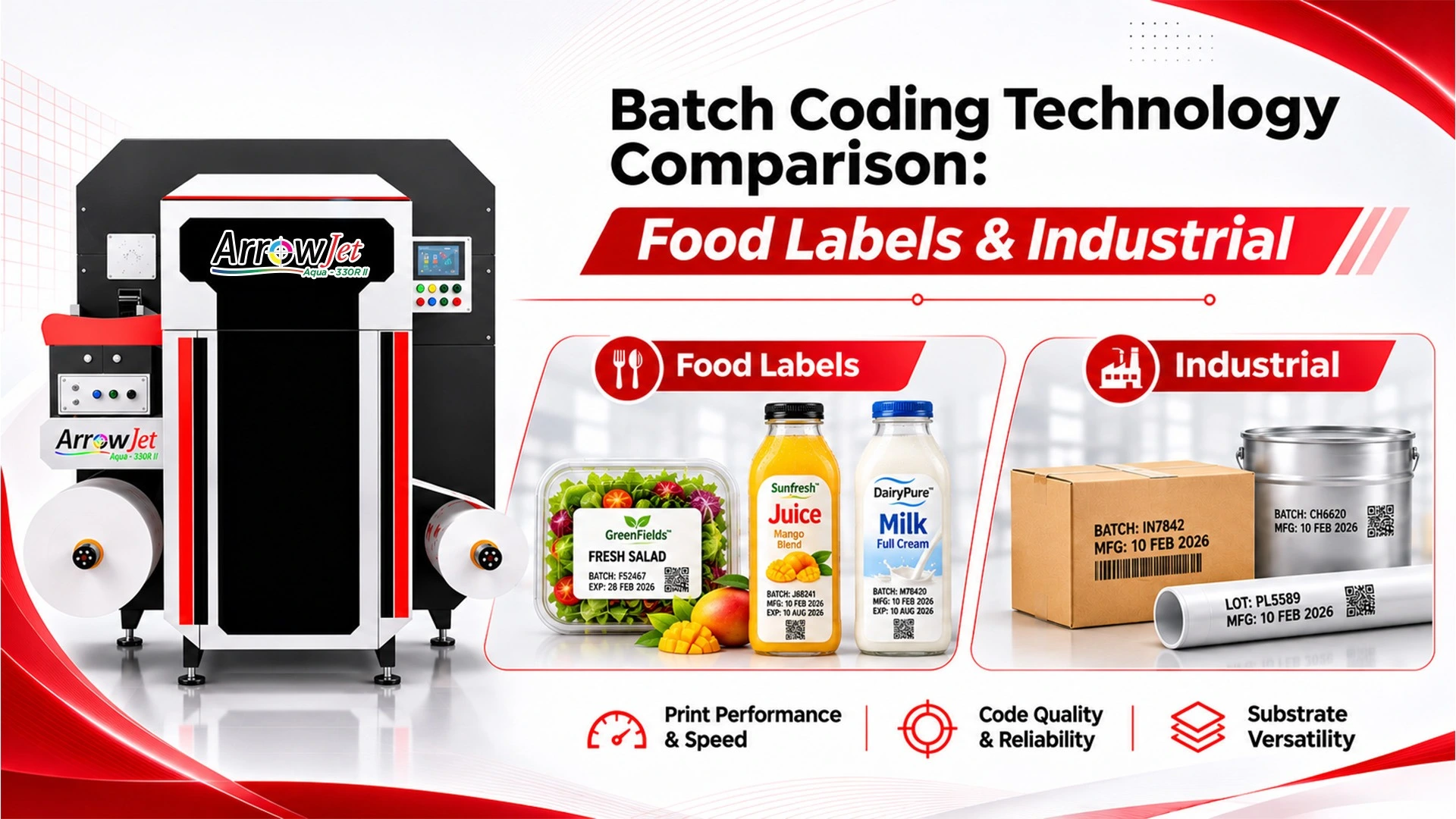
CIJ suits wet and curved packs, TTO suits film and barcodes, laser suits permanent codes; data known before the run belongs in the label.
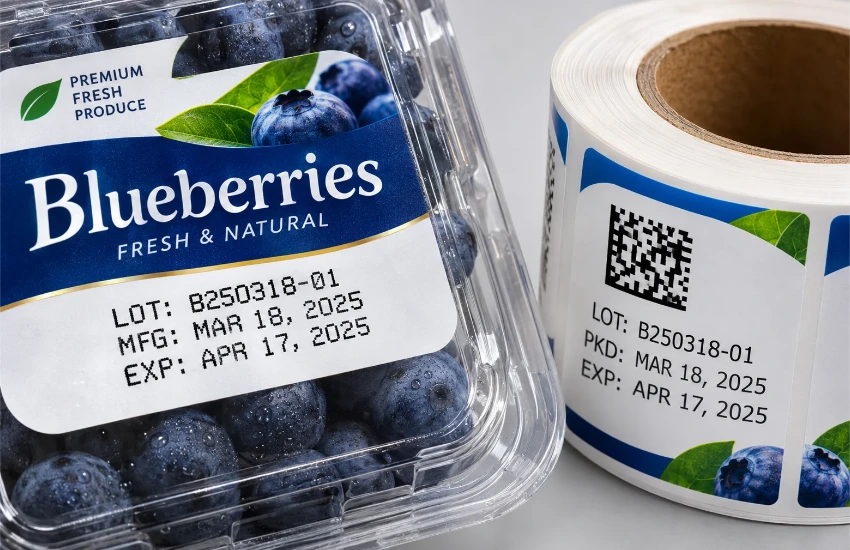
CIJ, TTO, and laser all print legible date and lot codes; they differ on substrate tolerance, resolution, and code survival.
Continuous inkjet (CIJ)
CIJ fires charged ink droplets at a moving surface without touching it. It is the default non-contact coding method for cans, pails, corrugated cases, and condensation-covered packs.
Thermal transfer overprinting (TTO)
TTO presses a heated printhead against a ribbon to deposit high-resolution marks on flexible film or pressure-sensitive labels. It is a contact process, so web tension and print-window stability matter.
Laser marking
Laser marking removes or discolors a surface layer with focused light and uses no ink or ribbon. The mark becomes part of the substrate, which makes it permanent and tamper-evident.
All three are industrial marking systems that produce legible date and lot coding. They diverge sharply once the product meets condensation, retort steam, oil mist, or a solvent wipe, and once the code content moves from human-readable text to a verified 2D symbol.
Substrate and topcoat
Coated paper, BOPP, PE film, foil lidding, corrugated, and HDPE each respond differently to ink, heat, and laser energy, so the exact facestock and topcoat set the shortlist.
Line speed and print window
A code that looks clean on a bench test can smear or stretch once the print window shrinks to milliseconds at full line rate.
Environment and post-process exposure
Washdown, blast chill, retort, hot-fill, freezer storage, and solvent contact each attack codes differently, so the code must be judged after the process it will face.
Code content
Human-readable date and lot text is straightforward for every method. GS1-128 barcodes and GS1 DataMatrix codes that must pass a verification grade narrow the field considerably.
Changeover frequency
A 60-SKU line with weekly artwork revisions fails differently from a three-SKU line running 24/5; high changeover favors moving fixed content into the label.
Point-of-print coding
Point-of-print coding applies data at fill or case pack. It is required for anything determined in the moment: fill time, shift, net weight, and actual production date.
Variable data printed into the label
Variable data printing on a digital inkjet label press covers everything known before the run: lot ranges, allergen statements, SKU-specific artwork, serialized identifiers, and promotional variants. Most plants running high SKU counts end up doing both.
The three coding methods compared on substrate fit, speed, permanence, consumables, environment, and changeover effort.
Factor | Continuous Inkjet (CIJ) | Thermal Transfer Overprinting (TTO) | Laser Marking |
Best-fit substrates | HDPE drums and pails, cans, corrugated, films, curved and irregular surfaces | Flexible film, pouches, lidding, pre-applied pressure-sensitive labels | Coated label stocks, PET and specialty films, some rigid plastics |
Typical speed band (illustrative) | High; commonly specified for fast conveyor and filler speeds | Moderate to high, depending on intermittent or continuous mode | Very high; often the fastest option for short code strings |
Code resolution | Strong for date and lot text and larger 1D barcodes; limited for small 2D modules | Highest of the three for small text, GS1-128, and 2D DataMatrix | High on substrates that mark with good contrast |
Code permanence | Good with matched ink chemistry; can be abraded or solvent-wiped | Excellent on film; abrasion-resistant ribbons available | Permanent and tamper-evident by nature |
Consumables | Ink and make-up fluid, filters, printhead service | Thermal ribbon consumed per print, printhead replacement | None for marking; lens cleaning and fume filter media |
Environment tolerance | Strong on cold, wet, condensation-covered surfaces with the correct ink | Good in dry and chilled conditions; needs stable web tension | Excellent; unaffected by moisture, retort, or a solvent wipe |
Changeover effort | Low; a format change is a data or recipe change | Low for data, moderate if the print window or web path changes | Very low; file-driven, with no physical parts to swap |
Speed bands are illustrative, not quoted figures. Actual throughput depends on code length, resolution, and print orientation, so validate against your own line before you commit.
CIJ is the most substrate-tolerant coding method because nothing touches the package, but resolution limits small 2D codes.
How CIJ works
A continuous inkjet printer breaks a pressurized ink stream into droplets, charges them, and deflects selected drops onto the passing surface with an electrostatic field. Unused drops return to the ink system.
CIJ strengths
Aluminum cans, HDPE pails, corrugated cases, shrink film, and coated labels all accept CIJ with the right ink. Ink chemistries exist specifically for condensation-covered and sub-freezing surfaces, and cost per code is typically very low.
CIJ trade-offs
Small-module 2D DataMatrix codes that must hold a verification grade often exceed what a CIJ head delivers reliably. Solvent and make-up consumption is ongoing, printheads reward cleaning discipline, and ink migration matters when coding near food contact surfaces.
CIJ best fit
Chilled and wet protein lines, beverage fillers, corrugated case and tray coding, and industrial pails and drums where abrasion is manageable.
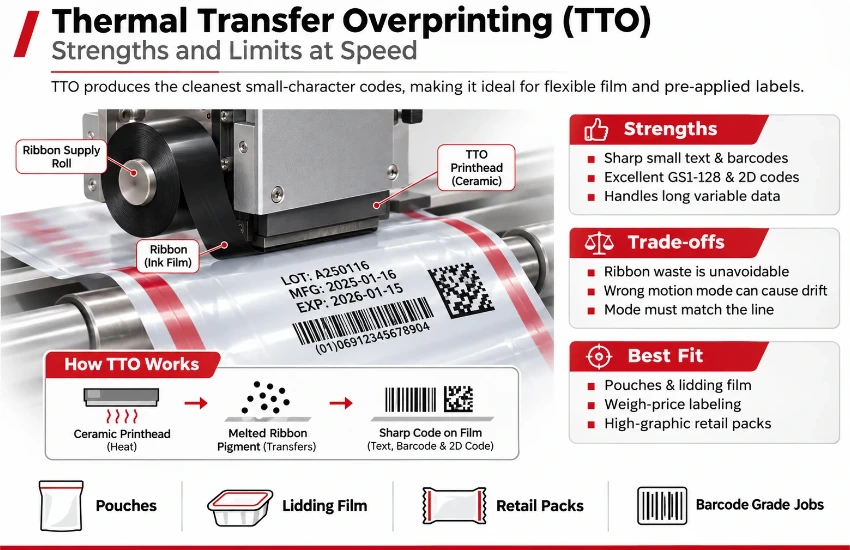
TTO produces the cleanest small-character codes of the three, which is why it dominates flexible film and pre-applied labels.
How TTO works
A ceramic printhead melts pigment from a ribbon onto the substrate, giving sharp edges at resolutions suited to demanding barcode work.
TTO strengths
TTO prints crisp small text, dense allergen or ingredient blocks, and consistently high-quality GS1-128 and 2D DataMatrix codes. It carries long variable strings, such as GS1 application identifiers and serialized data, without crowding, and reads as intentional rather than stamped on retail packs.
TTO trade-offs
Ribbon is a real consumable with real waste; ribbon-saving modes reduce it but do not eliminate it. Intermittent-motion TTO suits VFFS and thermoform lines, continuous-motion TTO suits horizontal flow wrap, and mismatching the mode to the line causes registration drift and stretched codes.
TTO best fit
Pouches, lidding film, weigh-price labeling, high-graphic retail packs, and any application where the customer specifies a barcode grade.
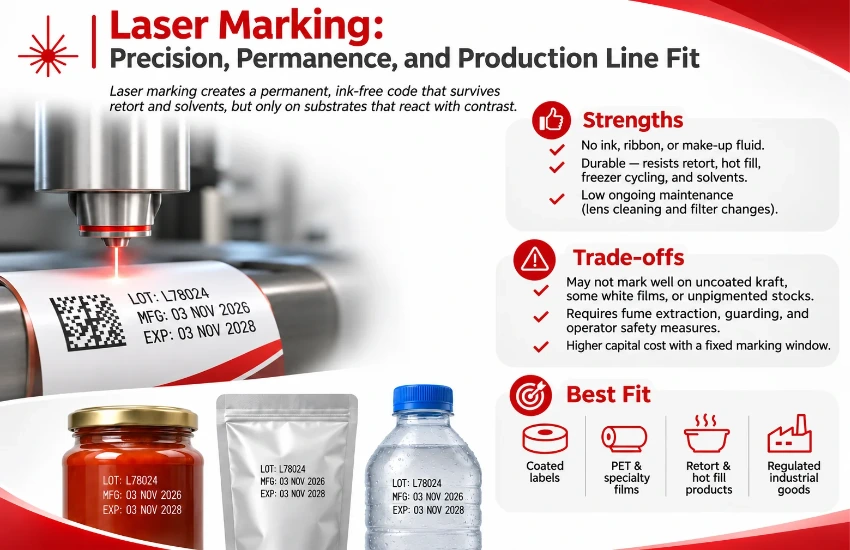
Laser marking creates a permanent, ink-free code that survives retort and solvents, but only on substrates that react with contrast.
How laser marking works
Laser coding ablates a topcoat or induces a color change in the substrate itself. CO2 laser marking systems are the practical choice for paper labels, coated stocks, and many films; fiber lasers are generally aimed at metals and certain pigmented plastics.
Laser marking strengths
Laser uses no ink, ribbon, or make-up fluid. Because the mark is integral to the material, it survives retort, hot-fill, freezer cycling, solvent contact, and washdown, and it cannot be wiped off or relabeled. Ongoing maintenance is mainly lens cleaning and extraction filter changes.
Laser marking trade-offs
Uncoated kraft, some white films, and unpigmented stocks may mark faintly or not at all, and laser-reactive topcoats add label cost. Laser also brings fume extraction, guarding, and operator safety requirements, a higher capital entry point, and a fixed marking window that limits flexibility on irregular packages.
Laser marking best fit
Coated pressure-sensitive labels, PET and specialty films, retort products, hot fill coding where the mark must survive heat, and regulated industrial goods that need a permanent, non-removable lot mark.
Digital inkjet label presses print lot, allergen, and serialized data into the label before it reaches the line, alongside full-color artwork.
Digital inkjet label printing solves a different problem than line coding, and neither replaces the other. It moves every piece of data known before the run off the packaging line and into a controlled print step, using variable data printing on the same pass as the label graphics.
Variable data at label-print resolution
Because labels are produced on a digital press, 2D DataMatrix and GS1-128 symbols print at module sizes and contrast levels that in-line coders struggle to match. That matters when a retail customer specifies a verification grade, and 2D demand is growing: the GS1 US Sunrise 2027 initiative is preparing retail point-of-sale systems to scan GS1 DataMatrix and QR codes with GS1 Digital Link, which can carry production or expiration dates alongside the GTIN.
Run-sized label quantities
Printing to the run instead of to a flexo minimum reduces obsolete pre-printed label inventory when artwork revises or a formulation changes. For a dry-goods plant carrying 60-plus SKUs with frequent revisions, that inventory is often a bigger cost driver than coding consumables.
One controlled data source
Label templates driven from ERP or the production schedule, with version locking, remove the manual keying behind many wrong-lot and wrong-label events. This is where operations automation pays off fastest: fewer artwork versions in circulation, standardized code formats, and no operator retyping a date format at shift start. The stakes are documented: undeclared allergens caused 27.4% of FDA and FSIS food recalls from 2004 to 2013, and allergen recalls nearly doubled over that decade, according to the USDA Economic Research Service report Trends in Food Recalls: 2004–13.
The hybrid pattern
Many plants print digital label variants upstream with graphics, barcodes, and SKU-specific content locked in, then apply a date and lot code at fill with CIJ, TTO, or laser. The result is label-grade barcodes plus real-time production data.
Arrow Systems manufactures digital label printers that bring the upstream half of this hybrid in-house. Three models fit food and industrial label programs at different volumes.
ArrowJet Aqua 330R: high-speed food and beverage label production
The ArrowJet Aqua 330R is a roll-to-roll digital inkjet label printer built on the Memjet DuraFlex engine, printing at 1600 x 1600 dpi with speed settings of 90, 150, and 195 ft/min. Its water-based pigment inks are Nestlé Guidance compliant, which suits food and beverage labels that carry printed lot ranges, allergen statements, and serialized barcodes.
ArrowJet Aqua 330R II: higher-throughput label runs
The ArrowJet Aqua 330R II runs on the Memjet DuraCore engine at speed settings of 90, 150, and 220 ft/min, with adphos aNIR near-infrared drying. It fits plants consolidating many SKU variants onto one press where daily label volume is high.
ArrowJet Eco 330R: entry point for in-house label printing
The ArrowJet Eco 330R is a compact single-pass press on the Memjet DuraFlex engine, printing up to 20 m/min across a 324 mm print width at 1600 x 1600 dpi. It runs on single-phase 230V power with no air compressor, and gap and black mark sensors hold registration on pre-cut labels.
Printed rolls are laminated, die-cut, slit, and rewound on Arrow label finishing systems, so each coded label arrives at the line ready to apply. Two finishers connect directly to variable data and changeover.
Arrow EZCut 350R: automatic job changeover for multi-SKU label runs
The EZCut 350R is a roll-to-roll digital die cutter with up to six cutting heads, a cutting speed of 9 m/min, and rotary slitting up to 100 m/min. Its CCD camera reads marks printed on the material to load cutting job data and switch jobs automatically, which keeps runs of many SKU variants moving without manual changeover between them.
ArrowCut Nova 250R: laser variable data marking during finishing
The ArrowCut Nova 250R uses a 125W CO2 galvo laser to perform full cuts, kiss cuts, perforations, and variable data marking in a single pass. It brings the permanence of a laser mark upstream into label finishing, rather than adding a laser coder at the packaging line.
Match the coding method to the exposure and the code content, not to what the plant next door installed.
Production scenario | What decides it | Typical starting point | Validate before committing |
High-speed chilled or wet protein | Condensation defeats many surface codes | CIJ with a cold or wet-surface ink; laser on a laser-reactive coated label when codes must survive brine, ice, and a long cold chain | Legibility after full cold-chain exposure |
Dry goods with 60-plus SKUs and weekly artwork revisions | Changeover time and label obsolescence, not marking physics | Digitally printed label variants plus a simple CIJ or TTO date code at fill | Changeover minutes and scrapped label inventory before and after |
Retort and hot-fill coding | Steam, pressure, and heat degrade ink-based codes | Laser marking, or a retort-rated TTO ribbon on a validated film | Code legibility after the retort or hot-fill cycle, never before |
Corrugated case and pallet coding | Porous or dark board and shipping-label barcodes | Large-character CIJ or inkjet box printers; GS1-128 shipping labels | Readability on the actual board grade |
Solvent-exposed drums, pails, and cartons | The code must survive an IPA or product-specific solvent wipe | Laser marking, or solvent-resistant CIJ inks on HDPE | Resistance to the specific solvent the product meets |
Short-run private label | Plate costs and minimum order quantities | Digital label printing, with line coding only for fill-time data | Total label cost per run versus flexo minimums |
Retort lines weigh permanence heavily for a regulatory reason. Under 21 CFR 113.60(c), every hermetically sealed container of low-acid canned food must carry an identifying code. That canned food code must stay permanently visible to the naked eye and identify the packing establishment, product, year, day, and packing period. The packing-period code must change often enough to identify lots in distribution, for example every 4 to 5 hours, at each shift change, or by batch, which is exactly the kind of data that has to be applied at the line rather than pre-printed.
Case-level marking is where traceability lot codes are most often read in distribution, so readability on the real board grade matters. For direct printing on cases and outer packaging, Arrow also offers end-of-line box printers from Limitronic. The Limitronic V7 Color is a single-pass UV inkjet printer with 360 dpi native resolution and an integrated message editor. The Limitronic V7 White prints high-contrast white ink, including barcodes and QR codes, on dark packaging, plastic, wood, and metal.
Trial on real substrates, test after the process, define the code spec, then measure the line, data flow, and running costs.
Step 1: Trial mark on the real substrate
Use the exact facestock, topcoat, adhesive, and film gauge, not a generic sample. Substrate response is the first filter for all three coding methods.
Step 2: Test after the process, not before
Run marked samples through retort, blast chill, washdown, freezer cycling, or a solvent wipe, then evaluate legibility. A code that only passes on the bench has not passed.
Step 3: Define code content and verification spec
Decide whether the code is human-readable text only, GS1-128, or 2D DataMatrix with a minimum module size and a required print quality grade, verified under ISO/IEC 15416 for linear barcodes or ISO/IEC 15415 for 2D symbols. Write it down before you request quotes.
Step 4: Measure line speed and print window
Capture package pitch, orientation stability, and available marking distance at maximum line rate, not average rate.
Step 5: Plan data integration and changeover
Decide now whether code values come from ERP, MES, or the production schedule, and which values are printed into the label versus applied at fill. Manual keying should be the exception, not the default.
Step 6: Model consumables and maintenance
Include ink and make-up fluid, ribbon consumption per code, printhead life, lens cleaning, extraction media, and service coverage. Treat every figure as illustrative until you hold quoted numbers.
FDA, USDA/FSIS, FSMA 204, and GS1 barcode guidelines all assume codes are legible, accurate, and linkable to production records; no coding technology delivers compliance on its own. The FDA Food Traceability Rule requires traceability lot codes and key data elements for foods on the Food Traceability List, and FDA has stated it will not enforce the rule before July 20, 2028. For label-specific detail, see Arrow’s guide to FSMA 204 traceability food label requirements. Regulatory compliance is the manufacturer’s responsibility and should be confirmed with qualified counsel. Arrow Systems sells label printing, finishing, and end-of-line printing hardware; Arrow does not provide regulatory or compliance advisory services.
Common questions from operations, engineering, QA, and packaging teams specifying batch, lot, and date coding equipment.
Batch coding is the printing of lot, batch, date, and shift information on a package or label so each unit can be linked back to its production record. It is applied either at the line during filling or case packing, or upstream when the label itself is printed. The three mainstream line-coding technologies are continuous inkjet (CIJ), thermal transfer overprinting (TTO), and laser marking.
CIJ with an ink chemistry formulated for wet and cold surfaces is the most common choice, because non-contact printing tolerates moisture and irregular geometry. Laser marking on a laser-reactive coated label is often more durable still, since the mark is part of the substrate and cannot smear. The deciding factor is usually whether your label stock marks with enough contrast. Evaluate samples after full cold-chain exposure, not immediately after printing.
Sometimes, but not universally. Laser removes ink and ribbon consumables and produces a permanent, tamper-evident code, which suits retort, hot-fill, and solvent-exposed products. It needs a substrate that reacts with adequate contrast, so uncoated or unresponsive stocks may mark poorly. Laser also brings fume extraction, guarding, and a higher capital cost. On mixed-substrate lines with irregular packages, CIJ typically stays more flexible.
Usually yes. Digital label printing handles everything known before the run: graphics, SKU content, allergen text, lot ranges, and serialized barcodes at high resolution. Data determined at the moment of fill, such as actual production date, time, shift, or line identifier, still has to be applied at the line. The practical pattern is a digitally printed label variant plus a compact date and lot code at fill.
Specify symbology, minimum module size, quiet zones, and target grade before you select equipment, since not every coder holds small 2D modules at line speed. Add inline vision verification with automatic reject so unreadable or missing codes never ship. Then close the loop with operations automation: pull code values from ERP or the production schedule instead of keying them, and standardize the format across every line.
Under 21 CFR 113.60(c), each hermetically sealed container of low-acid canned food must carry a code that is permanently visible to the naked eye and identifies the packing establishment, the product, the year and day packed, and the packing period. The packing-period code must change often enough to identify lots in distribution, such as every 4 to 5 hours, at each shift change, or by batch. Because the code must survive retort, laser marking or a retort-rated TTO ribbon on a validated film are the usual candidates.
No. The FDA Food Traceability Rule requires covered firms to assign traceability lot codes and keep key data elements for foods on the Food Traceability List, but it does not mandate a printing or marking method. FDA has stated it will not enforce the rule before July 20, 2028. What matters is that the lot code on the package is legible, accurate, and linked to production records.
Bring real line conditions to the conversation: substrates and label stocks, line speeds, washdown and post-process exposure, SKU count, and the code content and verification requirements your customers specify. Arrow Systems, an industrial label printing and coding integrator, runs a structured, no-obligation batch coding and label production assessment against those inputs.
The assessment delivers a recommended technology fit or hybrid approach per line, substrate and marking considerations to validate through trial marking, a code-format standard you can apply across lines, and a clear view of where operations automation (ERP-driven code data, version-locked label templates, inline verification) removes the most manual steps. Where high SKU counts, frequent artwork revisions, or obsolete pre-printed label inventory prove to be the real cost driver, ArrowJet digital inkjet label presses and Arrow label finishing systems cover the upstream half of the decision.
Table of Contents Batch Coding Technology Comparison: Food Labels & Industrial CIJ suits wet and curved packs, TTO suits film and barcodes, laser suits permanent

Table of Contents Cosmetic Label Color Consistency: Diagnosing Batch Shifts A polyimide label substrate is a high-temperature film construction that stays bonded and scannable through
Table of Contents Polyimide Label Substrate for Aerospace and Industrial Use A polyimide label substrate is a high-temperature film construction that stays bonded and scannable
Table of Contents Entry-Level Label Printer for a Supplement Brand: Readiness Guide A supplement brand is ready for an entry-level label printer when it passes
Table of Contents Cannabis Label Versioning Workflow for Multi-State Brands A cannabis label versioning workflow produces state-specific labels from one master template by moving state-variable
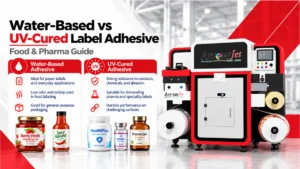
Table of Contents Water-Based vs UV-Cured Label Adhesive: Food & Pharma Guide Water-based adhesives suit dry, ambient containers; UV-cured hot melts suit cold, wet, curved