In-House Label Printing vs. Print on Demand: Cost by Volume
Table of Contents In-House Label Printing vs. Print on Demand: Cost by Volume In-house label printing vs. print on demand comes down to a cost-per-label

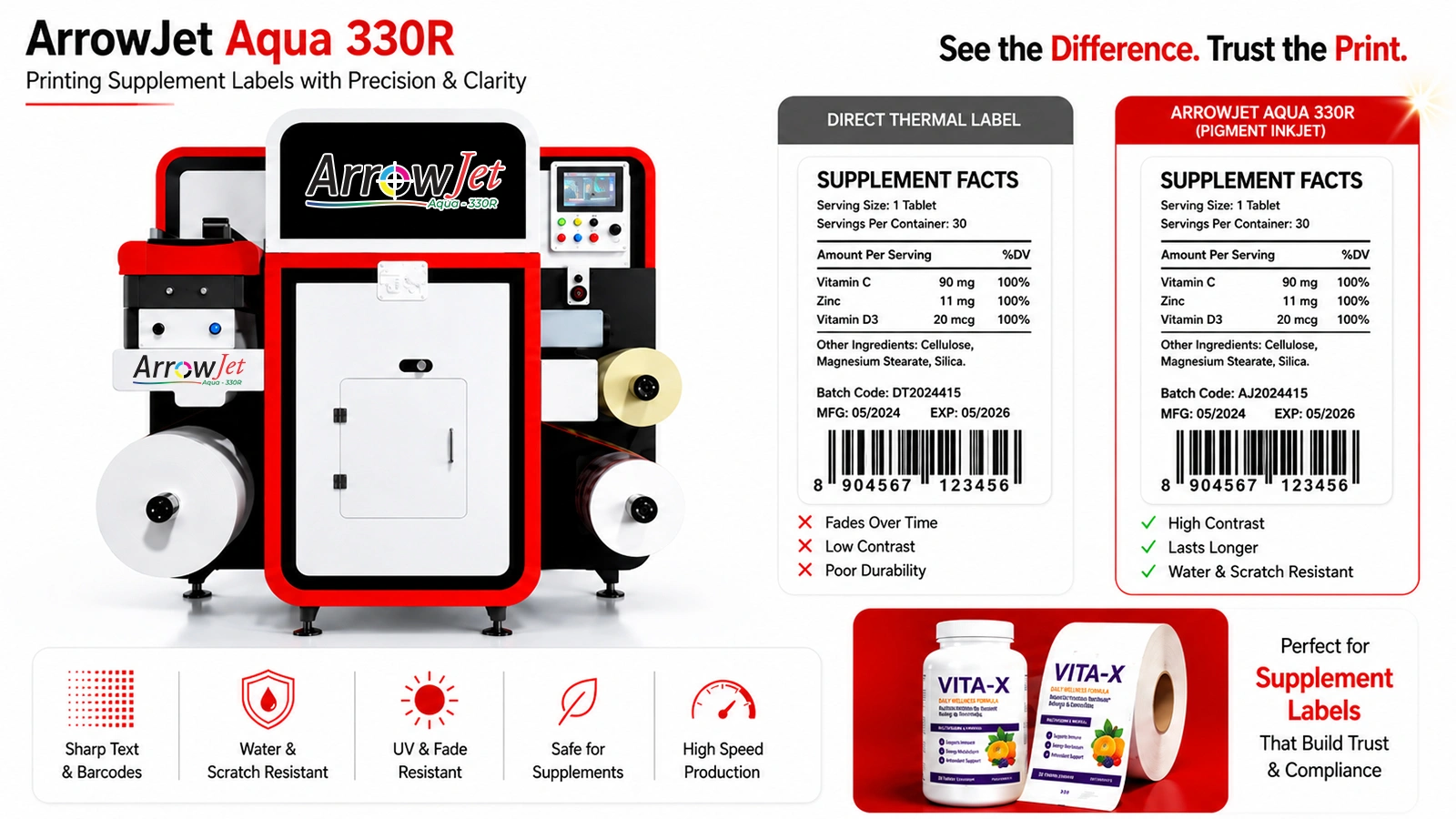
Pigment inkjet resists heat, UV, and moisture better than direct thermal, keeping supplement batch codes scannable through GMP supply chains.
Choosing between direct thermal vs inkjet supplement labels comes down to one question that outweighs consumable price: will your lot numbers, batch codes, and expiration dates stay legible and scannable after they leave your GMP facility?
Both technologies produce variable data, but the real difference shows up in durability, run flexibility, and total operational cost.
Factor | Direct thermal | Inkjet (pigment-based) |
Best fit | Short shelf-life, fast-moving products | Durable, full-color, variable-data GMP labels |
Consumables | No ink or ribbon | Ink; optional laminate |
Heat / light resistance | Vulnerable to fade over time | Better resistance when ink and substrate are matched |
Chemical / abrasion | Limited without overlaminate | Stronger, especially laminated |
The real question: how long must the label survive, and under what conditions, before the batch code becomes unreadable?
A thermal printhead applies controlled heat to a coated label, darkening the coating to form text and barcodes — with no ribbon and no ink involved.
For supplement batch code printing, that simplicity is appealing: fewer consumables to manage, fast setup for lot number printing, and clean, high-contrast barcodes when printed on quality media.
The tradeoff is inherent to the chemistry. Because the image is created by a heat-reactive coating, that same coating remains reactive after printing. Heat and light continue to affect it, which is the root of the well-known direct thermal label fade concern in GMP settings.
Digital color inkjet systems deposit ink onto the label substrate, printing the full label design plus variable data — lot numbers, batch codes, expiration dates — in a single pass.
For GMP supplement applications, this is generally pigment inkjet label printing rather than dye-based, since pigment chemistry is the configuration that holds up best against heat, UV, and moisture over the label’s shelf life.
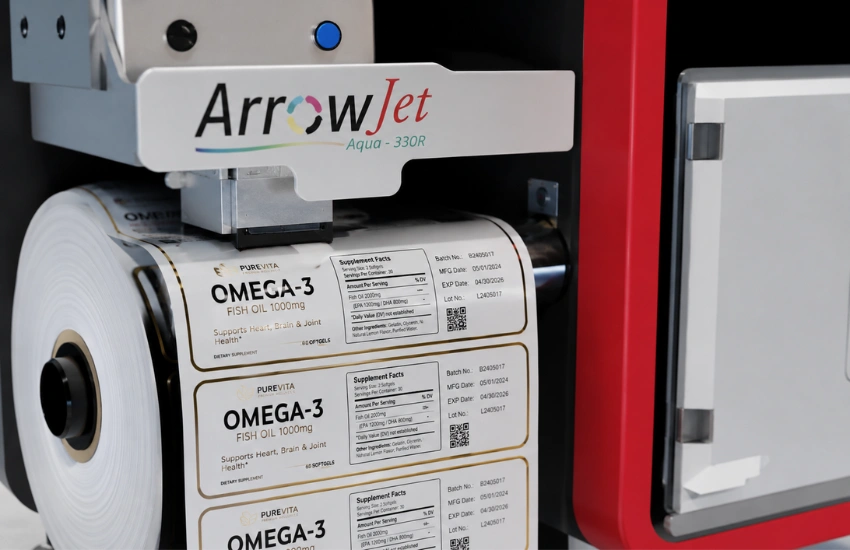
Ink chemistry matters
Dye-based inks offer vivid color but weaker durability. Pigment-based inks generally resist fade, UV, and moisture better — an important distinction for GMP labels.
Full variable data flexibility
Text, graphics, barcodes, and 2D codes can change label-to-label without stopping the press, supporting true variable-data supplement label workflows.
Substrate range
Inkjet supports paper and film substrates on digital label printers, and pairing with lamination can further protect batch code durability.
Because the image sits in or on the substrate rather than relying on a reactive coating, a properly configured inkjet label is generally less susceptible to darkening from ambient heat and light.
The heat-sensitive coating that creates a direct thermal image can continue to react after printing, which is a risk for labels that must stay legible for months.
Fade or darkening
Labels sitting in warm warehouse zones, near equipment, or in vehicles during transit can darken or lose contrast over time.
Reduced barcode contrast
Contrast loss over time increases the risk of failed scans at distribution.
Sensitivity to light exposure
Prolonged fluorescent or UV light exposure can further degrade legibility.
For a fast-turn product that ships and sells quickly, this may be acceptable. For supplements with long shelf lives, multi-month warehouse storage, or extended supply chains, the risk is that variable data — the exact information regulators and distributors rely on — degrades before the product is consumed. This is why direct thermal vs. inkjet GMP label decisions almost always center on time-to-illegibility, not initial print quality.
Nutraceutical labels rarely live in ideal conditions — the table below compares both technologies across the stressors that matter most for GMP supplement label durability.
Stressor | Direct thermal | Inkjet (pigment) |
Heat (warehouse, transit, seasonal swings) | Higher risk; heat can darken the coating and reduce contrast | Generally more stable, especially with a durable substrate and optional laminate |
UV and light exposure | Vulnerable; prolonged light can degrade legibility | Better UV resistance in many configurations, though no ink is fully immune |
Humidity and moisture (cold-chain condensation) | Moisture and abrasion can smear or lift the image on some media | Film substrates plus lamination help resist moisture and condensation |
Chemical and abrasion contact | Limited protection without an overlaminate | Laminated pigment labels typically offer stronger chemical and scuff resistance |
No technology is indestructible, but pigment inkjet with the right substrate and laminate tends to hold variable data longer under combined stress. Always validate against your own conditions rather than assuming a spec sheet applies to your supply chain.
High-mix nutraceutical operations live or die by changeover speed and data accuracy, which puts the variable data engine on equal footing with durability.
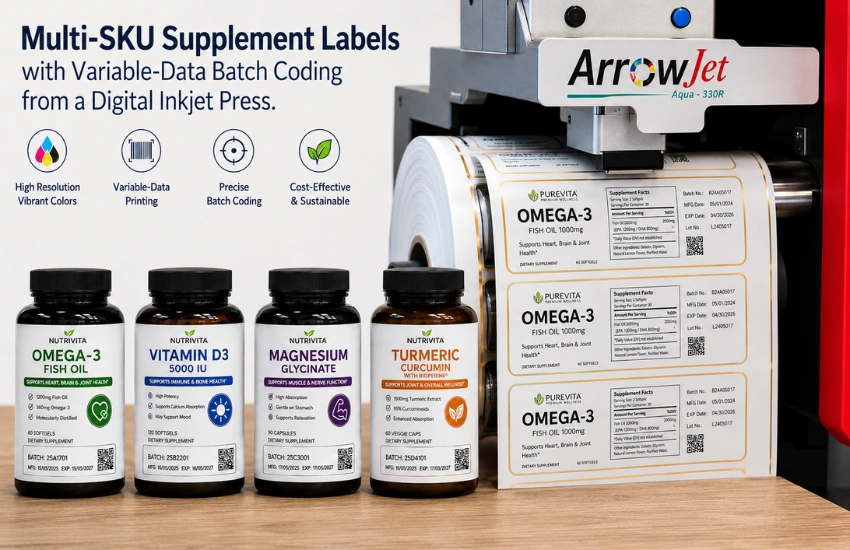
Printing variable data supplement labels at scale means the press engine matters as much as the ink chemistry — SKU count, changeover frequency, and file-handling speed all shape whether a technology keeps up with a growing product line.
Full-color labels plus variable data in one pass
Printing color and variable data together reduces the need for pre-printed stock and separate coding steps.
Fast SKU-to-SKU changeover
Changeover is driven by file updates rather than media or ribbon swaps.
On-demand production
Short, frequent runs are supported without overproduction or obsolete inventory.
Both technologies benefit from pulling lot numbers, batch codes, and expiration dates directly from a production file rather than typing them manually, which reduces mislabeling risk. Adding inline or vision-based verification — sourced from your own quality systems — creates a closed-loop check confirming codes are present, correctly formatted, and scannable before product moves downstream. This is where multi-SKU supplement label printing shifts from a bottleneck to a controlled, audit-ready capability.
Consumable price is the easiest number to compare and the least complete — a realistic GMP label printer comparison weighs cost per label against the operational cost of failures.
The following points are illustrative estimates only, not guarantees, and will vary by SKU mix, substrate, volume, and workflow:
Direct thermal consumable cost
Often lower per label because there is no ink or ribbon.
Inkjet consumable cost
Can be higher per label, but the gap often narrows once avoided reprints, reduced scrap, and eliminated pre-printed stock are factored in.
Failure costs dominate the math
A single unreadable batch code that causes a rejected shipment, chargeback, or production hold can erase months of consumable savings.
When you run the numbers on a cost per label supplement printing decision, model the full picture rather than the consumable line item alone:
Teams often see the durability-focused option pay off not through cheaper labels, but through fewer costly labeling incidents.
The ArrowJet Aqua 330R is a digital pigment inkjet label press that prints full-color labels and variable data — lot numbers, batch codes, and expiration dates — in a single pass for high-mix supplement runs.
Single-pass, full-color plus variable data printing
Using Memjet DuraFlex® inkjet technology, the ArrowJet Aqua 330R prints CMYK color and variable data together, so lot numbers, batch codes, and expiration dates change label-to-label without stopping the press or requiring separate coding equipment.
Aqueous pigment ink for GMP durability
The press runs water-based pigment inks rather than dye-based chemistry, which generally hold up better against heat, UV exposure, and moisture — the stressors most likely to degrade batch codes in warehouse and cold-chain conditions.
Speed and web width for high-mix production
The ArrowJet Aqua 330R prints across three speed tiers — 90, 150, and 195 ft/min — up to a 380 mm maximum media width, giving multi-SKU nutraceutical operations enough throughput to run frequent changeovers without sacrificing print quality.
File-driven changeovers, not plate changes
Because print data comes from a digital file rather than a physical plate or ribbon, moving from one SKU’s label to the next is a matter of loading a new job — supporting the frequent formulation and regulatory updates common in nutraceutical production.
As with any print technology, final batch code durability depends on matching substrate, ink configuration, and press settings to your specific products and GMP conditions, so validation against your real supply chain is recommended.
Arrow Systems manufactures label printing hardware. Arrow does not provide GMP compliance consulting, ERP integration, or label verification software as a service — any variable-data workflow, traceability system, or regulatory validation should be built and confirmed with your own quality, IT, and regulatory teams. For background on FDA labeling elements, see Arrow’s guide to supplement label printing requirements.
Use these five checkpoints to decide between direct thermal and pigment inkjet for your supplement labeling operation.
Step 1: Decide on time-to-illegibility first
Determine how long the batch code must stay scannable under your real storage and shipping conditions before choosing a technology.
Step 2: Match ink and substrate to stressors
Pair pigment inkjet with film and laminate where heat, UV, moisture, and abrasion are the dominant risks.
Step 3: Model total cost, not price per label
Include reprints, chargebacks, and obsolete pre-printed stock in the comparison rather than consumable cost alone.
Step 4: Pull variable data from your production file and verify inline
Reduce manual keystrokes and add inline or vision-based verification through your own quality systems for audit-ready traceability.
Step 5: Validate against your own supply chain
Pilot labels under your actual warehouse, transit, and cold-chain conditions before standardizing on either technology.
Common questions from nutraceutical operations, packaging, and quality leaders comparing direct thermal and inkjet for GMP batch coding.
It can. Direct thermal images are created by a heat-sensitive coating that remains reactive after printing, so prolonged heat and light exposure in warehouse storage may reduce contrast and legibility over time. For long shelf-life supplements, this is a real risk to barcode scannability. Fast-turn products are less exposed, but you should validate against your own storage conditions.
In most GMP scenarios, pigment-based inkjet — especially with a durable film substrate and optional laminate — offers stronger resistance to heat, UV, moisture, and abrasion than standard direct thermal. That generally translates to batch code durability that holds up longer through the supply chain. No ink is fully immune to degradation, so testing under your actual conditions is essential.
Often, yes. Inkjet supports full-color labels plus variable data in one pass, fast file-driven changeovers, and on-demand production that avoids obsolete pre-printed stock. It suits nutraceutical operations managing frequent SKU and regulatory changes across many active labels.
Do not stop at consumable price. Model total operational cost: reprints, scrap, failed scans, distributor chargebacks, inventory obsolescence, and labor recovered through faster changeovers. Direct thermal may win on raw consumable cost, but inkjet often wins on total cost once durability-related failures are included. Use your own volumes and SKU mix to run the numbers.
If your nutraceutical operation is weighing direct thermal against pigment inkjet for GMP batch coding, Arrow Systems offers a structured press assessment for packaging, operations, and quality teams.
The assessment reviews your SKU mix, substrate and ink requirements, and warehouse or shipping conditions to recommend a press configuration — including whether the ArrowJet Aqua 330R fits your variable-data and durability needs.
Table of Contents In-House Label Printing vs. Print on Demand: Cost by Volume In-house label printing vs. print on demand comes down to a cost-per-label
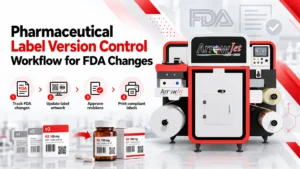
Table of Contents Pharmaceutical Label Version Control Workflow for FDA Changes A GMP label version control workflow moves an approved revision to the line: change
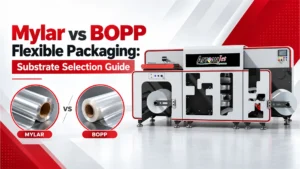
Table of Contents Mylar vs BOPP Flexible Packaging: Substrate Selection Guide PET (Mylar) leads on oxygen and aroma barrier and heat tolerance; BOPP leads on
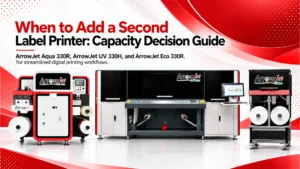
Table of Contents When to Add a Second Label Printer: Capacity Decision Guide Three measurable signals decide it — sustained utilization above your scheduling ceiling,
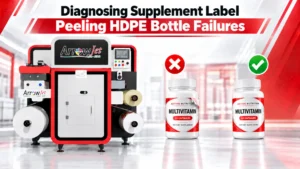
Table of Contents Diagnosing Supplement Label Peeling HDPE Bottle Failures HDPE label peeling traces to low surface energy, an adhesive mismatch, or moisture exposure —
Table of Contents Roll-to-Roll vs. Sheet-Fed Label Printing: Throughput & Cost Rolls win on cost per applied label with an automatic applicator; sheets win on