Table of Contents

Supplement Label Printing: FDA Rules, Materials & In-House Options

Supplement labels must satisfy eight FDA-mandated elements, use substrates matched to package format, and support fast revision cycles — without generating obsolete pre-printed inventory.

Dietary supplement labels require eight FDA-mandatory elements under 21 CFR 101.36, including a Supplement Facts panel, allergen declarations, and a structure/function claim disclaimer. Nutraceutical operations using digital inkjet presses — such as the ArrowJet Aqua 330R — print labels on demand, eliminating plate costs, reducing revision turnaround from weeks to hours, and removing the compliance risk of pre-printed label inventory that becomes obsolete when formulas or regulations change.

Key Takeaways

  • FDA requires eight mandatory elements on every supplement label, including a Supplement Facts panel, allergen declarations, and a structure/function claim disclaimer.
  • BOPP is the most common substrate for supplement bottles; polyester (PET) is recommended for cold-chain storage or products with aggressive ingredient profiles.
  • Digital inkjet printing is cost-competitive with flexographic printing at run lengths below approximately 5,000–15,000 labels and has no plate charges or minimum order quantities.
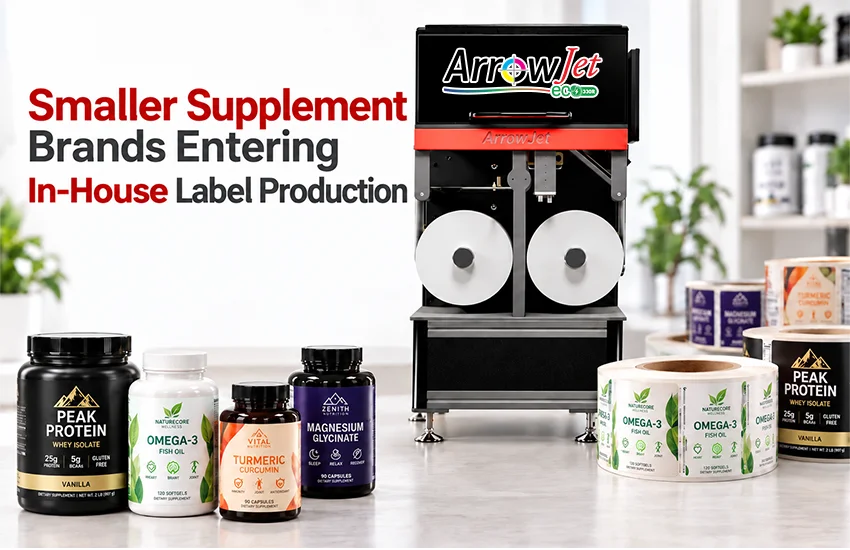
  • The ArrowJet Aqua 330R handles high-speed roll-label production for supplement bottles; the ArrowJet Eco 330R is designed for smaller brands entering in-house label production.
  • The ArrowJet Aqua 800M addresses flexible sachet and pouch labeling for nutraceutical packaging formats requiring film-substrate capability.

What the FDA Requires on Supplement Labels

Eight mandatory elements are required on every dietary supplement label under 21 CFR 101.36, including a Supplement Facts panel, allergen declarations, and a structure/function claim disclaimer.

The following is a practical reference — not legal advice. Always verify current requirements against the published CFR and consult qualified regulatory counsel for your specific products.

Required Element

What It Must Include

Label Location

Statement of identity

Must identify the product as a “dietary supplement” and include the common name of the dietary ingredient(s) or a description (e.g., “Vitamin D3 Dietary Supplement”).

Principal display panel

Net quantity of contents

Declared in both metric and U.S. customary units where applicable.

Principal display panel

Supplement Facts panel

Serving size, servings per container, each dietary ingredient, amount per serving, and percent Daily Value where established. Proprietary blend ingredients must be listed in descending order of predominance by weight within the blend.

Information panel

Other ingredients list

Non-dietary ingredients (excipients, binders, fillers, coatings, flavors, colors) listed by common name in descending order of predominance.

Information panel

Allergen declarations

Major food allergens declared per the Food Allergen Labeling and Consumer Protection Act (FALCPA), either within the ingredient list or in a separate “Contains” statement.

Information panel

Name and place of business

Manufacturer, packer, or distributor’s name and address.

Information panel

Structure/function claim disclaimer

“This statement has not been evaluated by the Food and Drug Administration. This product is not intended to diagnose, treat, cure, or prevent any disease.” Required whenever a structure/function claim appears on the label.

Proximate to the claim; anywhere on label

Adequate directions for use

Serving size or dosage instructions clearly stated.

Information panel

Note for operations teams: Every one of these elements is a potential revision trigger. Formula changes, supplier switches, regulatory updates, and new allergen declarations all require updated labels. When labels are pre-printed in bulk, each revision creates obsolete inventory that must be quarantined or destroyed.

Choosing Label Materials for Supplement Bottles

BOPP film with permanent adhesive is the standard choice for supplement bottles; polyester (PET) is recommended for cold-chain storage or products containing aggressive ingredients such as MCT oil or fish oil.

Substrate Options by Package Format

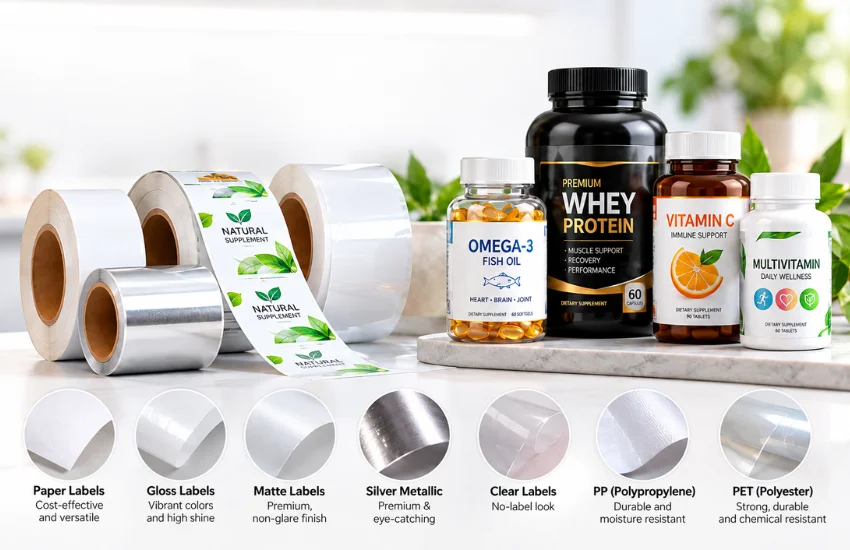
Three primary facestock materials cover most nutraceutical packaging applications, each with different performance characteristics across moisture exposure, oil contact, and temperature variation.

Paper (semi-gloss or matte)

Cost-effective for dry-stored products in controlled environments. Susceptible to moisture damage and oil absorption, making it unsuitable for softgel or liquid supplement products. Best suited for tablets and capsules in standard retail distribution conditions.

Polypropylene — BOPP

Excellent moisture and oil resistance with good conformability for curved bottle surfaces. Available in white, clear, and metallic finishes. The most widely used substrate for supplement bottles that may encounter humidity, condensation, or refrigerated distribution.

Polyester — PET

Superior durability, chemical resistance, and dimensional stability compared to BOPP. Appropriate for products requiring cold-chain storage or exposure to aggressive contents. Higher cost per square inch than BOPP, but justified when shelf conditions are demanding or ingredient contact risk is high.

Adhesive Selection by Storage and Distribution Condition

Adhesive selection must match both the package substrate material and the environmental conditions the label will encounter from filling through consumer use.

Permanent acrylic adhesives

Work well for most supplement bottles stored at room temperature. Industry-standard for stable, dry retail environments with standard HDPE, PET, or glass containers.

Cold-temperature adhesives

Required for products stored or shipped in refrigerated conditions. Standard acrylic adhesives can lose tack below 40°F, causing edge lift or full delamination in cold-chain distribution. Specify cold-temp adhesive for refrigerated probiotics, liquid supplements, and frozen products.

Oil-resistant adhesives

Prevent edge lift and delamination on bottles containing softgels, liquid capsules, or oil-based formulations. Essential where the container surface may carry residual contamination from the fill ingredient.

Flexible pouch and sachet adhesives

Must bond reliably to film surfaces — often PET/PE laminates or foil — and withstand the mechanical stress of filling and sealing operations. Different performance requirements than rigid bottle adhesives; do not assume interchangeability.

Testing note: A polypropylene label with permanent adhesive that performs well on an HDPE bottle may fail entirely on a foil-laminate sachet. Test adhesion on actual production substrates before committing to a material specification.

Digital vs. Pre-Printed Labels: Pros and Cons

Digital inkjet printing eliminates plate costs and minimum order quantities; flexographic pre-printing delivers lower per-label cost only at volumes above approximately 25,000–50,000 labels per SKU.

FactorFlexographic (Pre-Printed)Digital Inkjet (In-House)
Plate / setup cost$200–$800+ per color per SKUNone
Minimum order quantityTypically 5,000–25,000+ labels per run1 label minimum
Lead time — new orders2–4 weeksHours to same day
Revision turnaroundNew plates required; 2–4 additional weeksFile change; print immediately
Per-label cost at 1,000 labels~$0.15–$0.25 (with plate amortization)~$0.06–$0.12 (substrate and ink coverage dependent)
Per-label cost at 50,000+ labelsLower than digital at high volumeHigher than flexographic at scale
Obsolete inventory riskHigh — any formula or regulatory change strands stockNone — print only what is needed for each run
Color consistency across long runsExcellentGood; press and calibration dependent
GMP version controlDifficult — multiple label revisions may coexist in warehouseStraightforward — each run prints from the current approved file

For nutraceutical operations managing dozens of SKUs with frequent regulatory or formula revisions, the majority of label runs fall in the range where digital is more cost-effective on a total-cost basis. Elimination of obsolete inventory — which can represent thousands of labels per revision cycle — tips the equation further in digital’s favor.

ArrowJet Aqua 330R for High-Speed Supplement Roll Label Printing

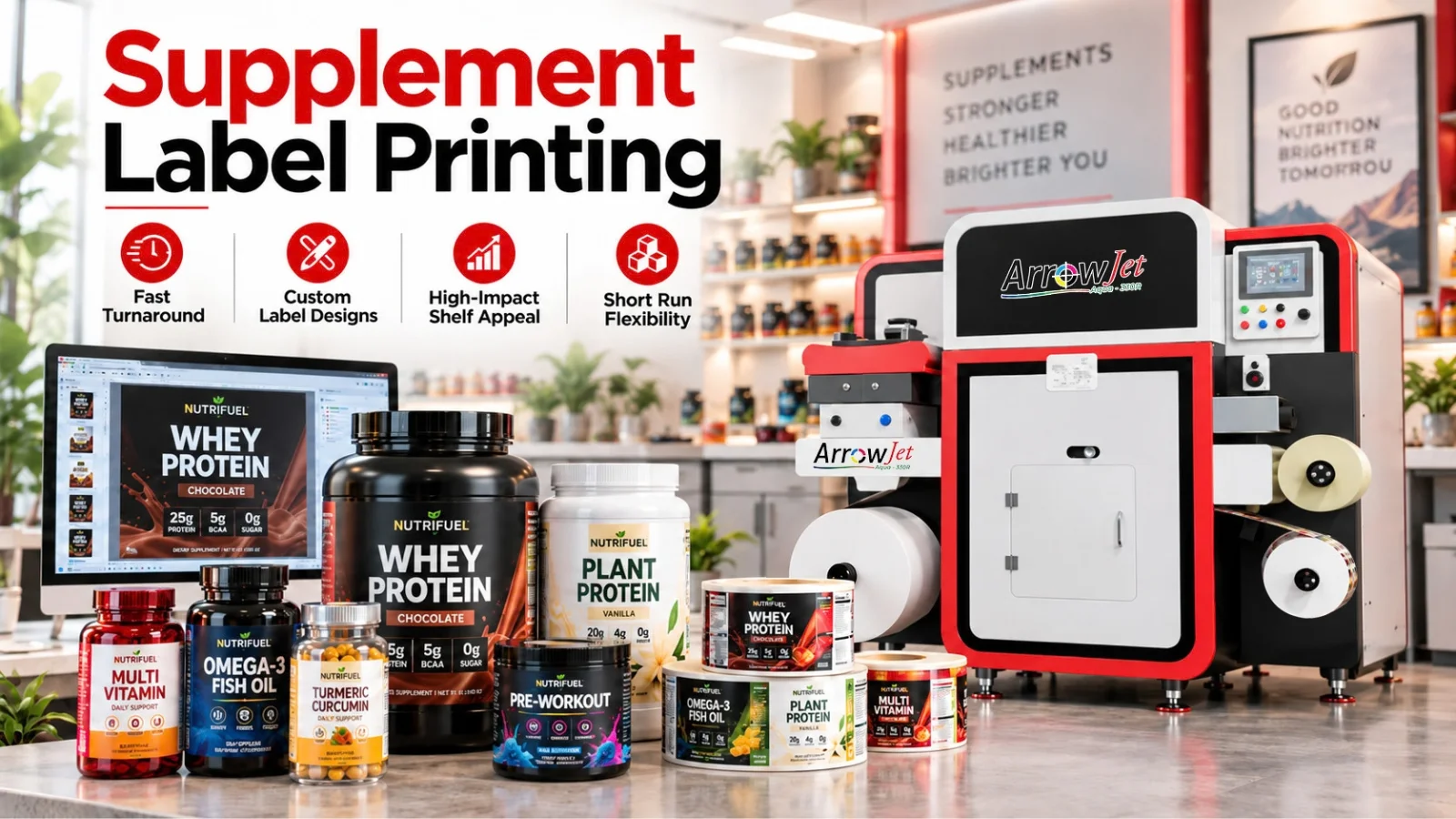
The ArrowJet Aqua 330R is a high-speed water-based inkjet press for pressure-sensitive roll label production — the standard format for supplement bottles — supporting on-demand short-to-high volume runs without plates or MOQ constraints.

Short-run economics

Print the exact quantity needed for each production run — from 300 labels for a limited-edition SKU to 10,000 for a core product line. No overproduction, no obsolete stock, no minimum order constraint.

Fast revision turnaround

When a Supplement Facts panel changes or an allergen declaration needs updating, the revised label can be in production within hours. The same change at a flexographic converter requires new plates and a 2–4 week lead time.

Water-based inkjet output

Produces labels without solvent-based inks, simplifying workplace safety compliance and aligning with the sustainability priorities many nutraceutical brands communicate to their retail and direct-to-consumer customers.

GMP-friendly workflow

Digital architecture supports repeatable, documented output. Every print run uses the same approved digital file, reducing the version-control risk inherent in managing pre-printed label rolls across multiple SKU revisions in a warehouse environment.

The Aqua 330R fits operations where label production is scheduled alongside manufacturing runs rather than managed through procurement lead times. For teams managing 50 or more bottle SKUs, the shift from inventory-based to demand-based label production eliminates a significant category of both waste and compliance risk.

ArrowJet Eco 330R for Smaller Supplement Brands Entering In-House Label Production

The ArrowJet Eco 330R is designed for smaller nutraceutical brands moving label production in-house for the first time — lower entry investment, straightforward operation, and immediate elimination of converter lead times for short-run SKUs.

In-house entry point for growing brands

For supplement brands producing lower label volumes across a manageable SKU count, the Eco 330R provides the core capability of digital on-demand label production — no plates, no MOQ, no converter dependency — at a lower system investment than high-throughput commercial presses.

Rapid response to formula and regulatory changes

Smaller nutraceutical brands are often more exposed to the costs of pre-printed label obsolescence because they lack the volume to negotiate flexible terms with converters. The Eco 330R eliminates this exposure: updated artwork is in production the same day the change is approved, not two to four weeks later.

Right-sized for a developing SKU portfolio

Brands launching a supplement line typically manage a concentrated set of SKUs that grow incrementally. The Eco 330R scales to that growth pattern — producing the exact label quantities needed per run without the capital commitment or operational complexity of an enterprise-class press.

Supports private label and co-manufactured products

Smaller brands operating under contract manufacturing arrangements can bring label production in-house on the Eco 330R while their formulation partner handles fill-and-finish. This separates label revision control from the contract manufacturer’s production schedule.

For supplement brands at an earlier stage of growth — typically those managing under 20 active label SKUs or producing fewer than 5,000 labels per week — the Eco 330R is the practical entry point into in-house digital label production, providing immediate control over revision cycles and print scheduling without over-investing in press capacity.

ArrowJet Aqua 800M for Flexible Sachet and Pouch Formats in Nutraceutical Packaging

The ArrowJet Aqua 800M is designed for flexible substrate label production — sachets, stick packs, and pouches — addressing the nutraceutical segment’s fastest-growing packaging formats with in-house digital capability.

Flexible substrate compatibility

Engineered to handle film-based materials — including PET/PE laminates and foil-based pouch substrates — that roll-label presses optimized for rigid bottle applications cannot reliably process. This makes the Aqua 800M directly applicable to single-serve sachet, stick pack, and stand-up pouch labeling in nutraceutical production environments.

Eliminated outsourcing dependency for flexible formats

Flexible packaging converters typically require high minimum order quantities and lead times of several weeks for short-run nutraceutical work. The Aqua 800M brings this capability in-house, removing MOQ constraints and collapsing the production timeline to the same day artwork is approved.

SKU agility across single-serve formats

Nutraceutical brands expanding into sachets and pouches frequently launch with multiple SKU variants — different flavors, dosages, or sample configurations. The Aqua 800M handles artwork changeovers without mechanical setup or plate costs, supporting rapid SKU iteration across a growing flexible packaging portfolio.

Consistent output for contract manufacturing environments

Contract manufacturers running private-label supplement pouches for multiple brand customers can switch between brand-specific artwork on the same production day, without plates or setup waste. This directly reduces scheduling complexity and per-run cost for multi-customer flexible packaging operations.

For nutraceutical operations where single-serve flexible packaging represents a significant or growing share of the product portfolio, the ArrowJet Aqua 800M provides the substrate capability and production flexibility that rigid-bottle label presses are not designed to deliver.

Frequently Asked Questions — Supplement Label Printing

Common questions from nutraceutical operations teams on FDA requirements, digital label printing economics, substrate selection, and GMP documentation.

There is no fixed update schedule. The FDA issues final rules, guidance documents, and enforcement updates on an ongoing basis. Significant changes — such as updated Supplement Facts panel formatting rules — can take years from proposed rule to enforcement deadline, but interim guidance and warning letter trends can shift compliance expectations faster. Operations teams should monitor FDA announcements and work with regulatory counsel to assess impact on current label inventory. This unpredictability is one of the strongest operational arguments for on-demand digital label printing rather than bulk pre-printed inventory.
Digital inkjet printing is generally cost-competitive with flexographic printing at run lengths below approximately 5,000–15,000 labels, depending on label size, ink coverage, and substrate. At very short runs — 200 to 2,000 labels — digital is almost always less expensive on a total-cost basis because there are no plate charges or setup waste. For nutraceutical operations managing many SKUs with frequent revisions, the effective breakeven shifts further in favor of digital when the cost of eliminated obsolete inventory and reduced warehousing are included in the comparison.
Polypropylene (BOPP) and polyester (PET) films paired with oil-resistant adhesives are the standard recommendation. Paper substrates absorb oils and degrade, leading to staining, delamination, and illegible print. For softgel bottles or liquid-filled capsule products, test the specific oil or carrier ingredient against both the facestock and adhesive before qualifying the material. Polyester with a chemical-resistant adhesive typically offers the best long-term performance for products containing aggressive ingredients such as MCT oil or fish oil.
Digital printing systems produce labels from controlled digital files, creating a direct link between the approved artwork version and the physical label output. This supports GMP documentation by establishing traceability: the print operator can verify which file version was used, when it was printed, in what quantity, and for which production run. Compared to managing pre-printed label inventory — where multiple label revisions may coexist in the same warehouse — digital on-demand production simplifies version control and reduces the risk of applying non-current labels to finished products.
It depends on the press and its substrate range. Roll-to-roll digital presses like the ArrowJet Aqua 330R are optimized for pressure-sensitive labels on rigid supplement bottles. Flexible substrate printing for sachets and pouches typically requires a system designed for film handling, such as the ArrowJet Aqua 800M. Smaller brands entering in-house production for the first time can evaluate the ArrowJet Eco 330R as a lower-investment starting point. The right configuration depends on your package format mix, substrate requirements, and production volumes — factors worth assessing before committing to a single-press strategy.

Get a Label Printing Assessment for Your Supplement Operation

If you’re managing frequent label revisions, carrying obsolete pre-printed inventory, or losing weeks to converter lead times, a structured evaluation can clarify your best path forward.

Arrow Systems offers label printing assessments tailored to your supplement packaging formats, SKU count, substrate requirements, and compliance workflow — helping you identify which ArrowJet system fits your production volume and operational goals.

Request Your Label Printing Assessment →