Pet Food Brand Label Supplier Problems: 5 Signs to Print In-House
Table of Contents Pet Food Brand Label Supplier Problems: 5 Signs to Print In-House Most pet food label supplier problems are a model mismatch: flexo’s
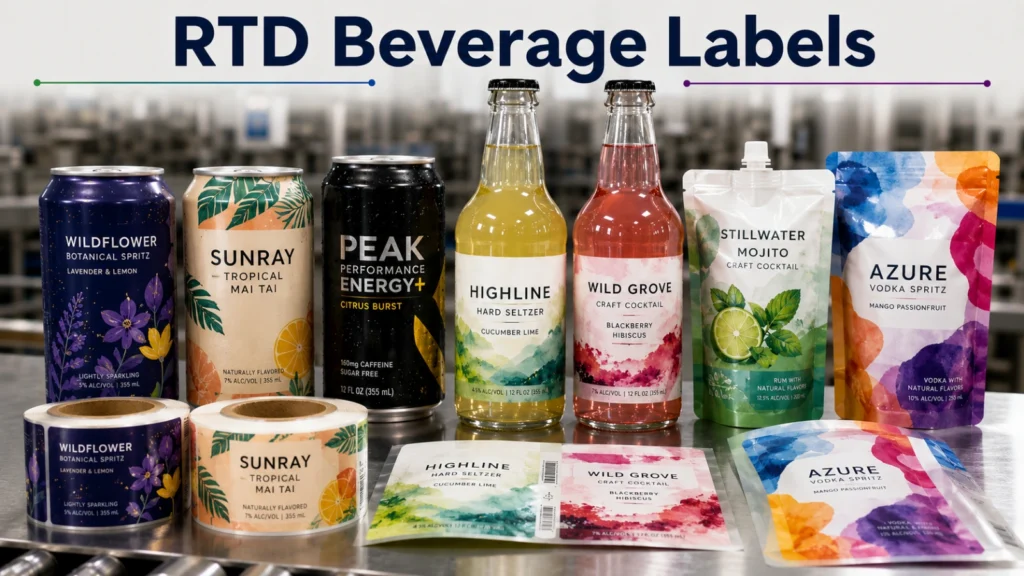
RTD beverage labels vary by container format — pressure-sensitive for bottles and cans, film-based for pouches — each with distinct substrate, compliance, and run-length requirements.
Ready-to-drink beverage labels fall into three format categories: pressure-sensitive roll labels for glass bottles and aluminum cans, shrink sleeves for full-wrap can coverage, and film-based labels for flexible pouches. Each format requires different substrate specifications, adhesive profiles, and — for spirits and malt beverages — TTB label compliance. Digital inkjet presses such as the ArrowJet Aqua 330R handle pressure-sensitive roll labels for short and mid-range runs; wide-web flexible presses such as the ArrowJet Aqua 800M address film-based pouch printing at up to 195 ft/min across a 25″ web.
RTD beverage packaging uses three label application methods — pressure-sensitive, shrink sleeve, and direct print — each suited to different container types and production volumes.
Pressure-Sensitive Labels
Pressure-sensitive (PS) labels are die-cut adhesive labels supplied on a liner roll and applied to the container surface by a label applicator. For RTD brands, PS labels are the most common format for glass bottles — including hard seltzer, canned cocktail, and energy drink bottles — and are used on aluminum cans where full-wrap coverage is not required. PS labels are well-suited for short runs, SKU variation, and brands managing seasonal or limited-release packaging, because artwork changes require no new tooling — only a revised print file. For a broader look at how digital printing is applied across the beverage segment, see the Arrow guide to digital printing for beverage labels.
Shrink Sleeve Labels
Shrink sleeves are printed on a flexible film tube and heat-shrunk onto the container using a steam or hot-air tunnel. Shrink sleeves provide 360-degree coverage, including the can lid and base if required, and are used extensively for canned cocktails, hard seltzers, and energy drinks where full-surface branding is a priority. Applying shrink sleeves requires a separate sleeve applicator and shrink tunnel — capital equipment that PS label production does not require. Artwork must also account for distortion during the shrink process. Brands evaluating short-run shrink sleeve options for limited releases should weigh applicator equipment costs against the branding benefit of full-wrap coverage before committing to this format.
Direct Print
Direct print refers to ink applied directly to the aluminum can body during the can manufacturing process — not to a label applied by the beverage brand. This method is used by large-volume beverage manufacturers with dedicated can supply agreements. It is not a practical option for most RTD brands at typical production volumes, and it is not relevant to in-house label printing.
For the majority of RTD brands producing seasonal releases, regional SKUs, or limited batches, digital pressure-sensitive label printing is the most operationally flexible format — no plates, no minimum order quantities, and label revisions that go from file change to production the same day.
Container format determines label substrate — BOPP and PE for cans, BOPP or PET for glass bottles, and PET or foil-laminate film for flexible pouches.
Container Format | Recommended Label Substrate | Key Requirement | Common Applications |
Aluminum cans | Biaxially oriented PP (BOPP) or PE film | Adhesive must conform to curved metal surface; moisture resistance for cooler condensation | Hard seltzers, canned cocktails, energy drinks |
Glass bottles | BOPP (standard), PET (cold-chain) | Permanent adhesive for glass; PET preferred for refrigerated or wet-environment products | RTD spirits, kombucha, premium hard seltzer |
Flexible pouches (stand-up, flat, spouted) | PET film, BOPP, or foil-laminate film | Film substrate compatible with seal zone; offline pre-treatment required before press loading for ink adhesion | RTD cocktail pouches, protein shakes, cold-brew coffee pouches |
Adhesive selection matters as much as face material. A BOPP label with a permanent acrylic adhesive performs well on dry glass at room temperature but can fail on a metal can surface condensing from refrigeration. Verify adhesive specifications against your container material, environment, and storage conditions before committing to a substrate specification.
Film substrates used in flexible pouch printing — including PET, BOPP, and foil laminate — typically require offline corona or flame pre-treatment to achieve sufficient surface energy for ink adhesion. This pre-treatment step occurs before the substrate is loaded onto the press and is separate from the print process itself.
RTD seasonal and limited-release labels are a natural fit for digital printing — no plates, no MOQ, and same-day artwork changeovers eliminate the lead time and waste of conventional flexo runs.
The ready-to-drink category runs heavily on seasonal and limited-edition SKUs. Canned cocktail labels for summer releases, holiday hard seltzer variety packs, and regional energy drink campaigns all share the same production challenge: the run lengths are short, the artwork changes frequently, and the turnaround window between concept approval and retail shelf is tight. The operational dynamics of short-run label production apply directly to RTD seasonal programs, where per-SKU quantities rarely justify conventional minimum order commitments.
Conventional flexographic printing addresses this poorly. Plate costs of $200–$800 or more per color per SKU make short runs cost-prohibitive. Minimum order quantities — often 5,000 to 25,000 labels per run — force brands to either over-order or consolidate SKUs in ways that limit marketing flexibility. And a four-week lead time for new plates means that a label revision triggered by a COLA amendment or a label design change extends the production schedule by weeks.
Digital inkjet eliminates all three constraints. Run lengths start at one label. Artwork changes — even mid-week revisions prompted by regulatory feedback — require only a file update. A production run that would take four weeks to set up with flexo can be on press the same day artwork is approved.
Factor | Flexographic (Pre-Printed) | Digital Inkjet |
Plate / setup cost | $200–$800+ per color per SKU | None |
Minimum order quantity | 5,000–25,000+ labels per run | No minimum |
Lead time — new artwork | 2–4 weeks (plate production) | Same day file change |
Revision turnaround | New plates required; 2–4 weeks | File update; print immediately |
Variable data / versioning | Not practical without reprinting | Supported; no additional cost |
Obsolete inventory risk | High — design or compliance changes strand stock | None — print only what is needed per run |
For RTD brands running four or more seasonal releases per year, or managing more than six active label SKUs in parallel, digital label printing consistently delivers a lower total cost of label production than flexographic — even when the per-label cost at maximum volume favors flexo. The savings come from eliminated plate costs, reduced overstock, and zero waste from labels made obsolete by artwork revisions or COLA amendments. Brands evaluating the economics of switching from flexographic to digital printing will find the RTD seasonal label use case among the clearest total-cost arguments in favor of digital.
For craft and small-batch RTD producers — regional hard seltzers, local canned cocktail brands, or startup energy drink operations — label volumes are often too low to justify a high-throughput production press at the outset. The ArrowJet Eco 330R is designed for this entry point: a compact industrial single-pass press running on single-phase power with no air compressor required, producing labels at up to 20 m/min at 1600×1600 dpi across a 324mm (12.75″) print width. It handles the same BOPP, PET, and coated paper substrates used for RTD bottle and can labels, with no minimum run length and no plate costs — giving small-batch producers the same artwork agility as larger operations at a lower system investment.
RTD spirits and malt beverages entering interstate commerce require a TTB Certificate of Label Approval (COLA) — a label-review process that directly affects when and how labels can be produced.
The Alcohol and Tobacco Tax and Trade Bureau (TTB) regulates labels on distilled spirits, wine, and malt beverages sold in the United States. For the RTD category specifically, two product types are subject to COLA requirements: ready-to-drink spirits (distilled spirit cocktails, hard liquor-based RTDs) and malt-based beverages (hard seltzers, flavored malt beverages, hard ciders classified as malt beverages). Beer labels are regulated under similar TTB authority.
Certificate of Label Approval (COLA)
A COLA is a federal approval required before alcohol beverage labels can be applied to bottles or cans entering interstate commerce. RTD brands must submit label artwork to the TTB for review and receive an approved COLA before the labeled product can be distributed across state lines. The TTB review process typically takes several weeks; expedited review is available in some cases.
Mandatory label elements for malt beverages and distilled spirits RTDs
TTB regulations require specific elements on every approved label, including the brand name, product class and type, alcohol content (percentage by volume), net contents, name and address of the responsible party, and applicable government warning statement. RTD spirits labels must also carry the standard Surgeon General’s alcohol warning. Exact placement and format requirements vary by product class.
Label revision and COLA implications
Any material change to an approved label — including changes to alcohol content, product name, responsible party, or net contents — typically requires a new COLA submission. Non-material changes (color, design elements, label size within approved parameters) may qualify for a Certificate of Exemption from Label Approval (COLA Exemption) instead. Brands should verify classification with TTB counsel before making label revisions.
Practical implication for label production timing
Because COLA approval must precede interstate distribution, RTD brands commonly submit label artwork for TTB review before committing to a large print run. Digital label printing is well-suited to this workflow: a brand can produce a small label run for initial market distribution or tasting events under a COLA-approved design, then adjust non-material design elements for subsequent runs without triggering a new approval cycle.
Arrow Systems manufactures digital label printing hardware. The TTB and COLA information in this section is provided as factual context for the label production workflow — it is not regulatory or legal guidance. Brands should consult TTB regulations directly and work with qualified regulatory counsel to confirm label compliance requirements for their specific product classifications.
The ArrowJet Aqua 330R is a high-speed roll-to-roll digital inkjet press for pressure-sensitive label production, printing at up to 150 ft/min at 1600×1600 dpi on a 12.75″ print width.
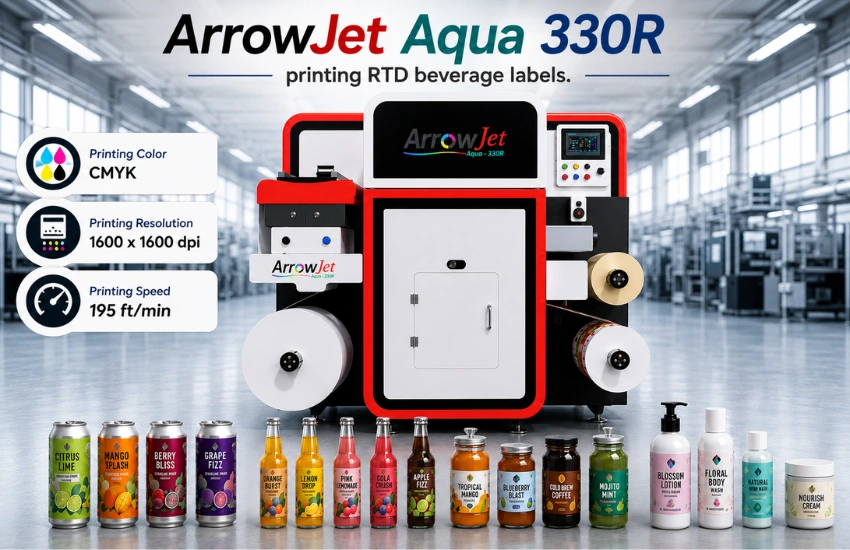
For RTD brands producing pressure-sensitive labels for glass bottles and aluminum cans, the ArrowJet Aqua 330R delivers high-speed roll-label production without the plate costs, minimum order quantities, or extended lead times that define conventional label printing. For a detailed overview of considerations specific to bottle label production, including shape, adhesive, and substrate guidance, the Arrow bottle labels guide covers the full decision set. The Aqua 330R uses Memjet DuraFlex technology with CMYK water-based pigment inks, producing full-color label output at 1600×1600 dpi resolution across a 12.75″ (324mm) print width.
Print speed and throughput
The Aqua 330R prints at 90 ft/min at full 1600×1600 dpi resolution and up to 150 ft/min at 1600×954 dpi — with the optional NIR drying module enabling speeds up to 195 ft/min. For RTD label operations running multiple SKUs per shift, this throughput allows same-day completion of multiple production orders without scheduling conflicts between seasonal and standard runs.
Substrate compatibility for RTD applications
The press handles BOPP, PET, PP, PVC, Mylar, coated paper, and inkjet-treated substrates within a thickness range of 2 mil (0.05mm) to 13.75 mil (0.35mm). For RTD canned beverage and glass bottle label production, BOPP film with permanent acrylic adhesive is the standard substrate choice. The 15″ (385mm) maximum media width accommodates standard beverage label roll widths used by most label applicator configurations.
Short-run and SKU agility for seasonal releases
Because the Aqua 330R operates without plates or dies for the print process, artwork changeovers between RTD SKUs — such as switching from a standard hard seltzer label to a holiday variety pack label — require only a file change in the RIP software. There is no plate setup time, no minimum run length, and no waste from label stock associated with discontinued SKU artwork.
Nestle Guidance compliance
The Aqua 330R’s water-based pigment inks meet Nestle Guidance compliance standards, which is relevant for RTD food and beverage label production where ink migration and food-contact adjacent safety requirements apply. Brands with specific compliance requirements should verify against their regulatory framework.
Ink capacity options
The press is available with 2L or 10L CMYK bulk ink tank options. The 10L tank is recommended for RTD operations with higher label volumes or extended uninterrupted run requirements, reducing the frequency of ink replacement interruptions during production shifts.
RTD brands producing pressure-sensitive labels for glass bottles, aluminum cans, and similar rigid beverage containers can explore the full specification and configuration options for the ArrowJet Aqua 330R on the product page.
The ArrowJet Aqua 800M is a 25″ wide-web flexible packaging press printing at up to 195 ft/min, designed for film-based RTD pouch formats including PET, BOPP, PP, and Mylar substrates.
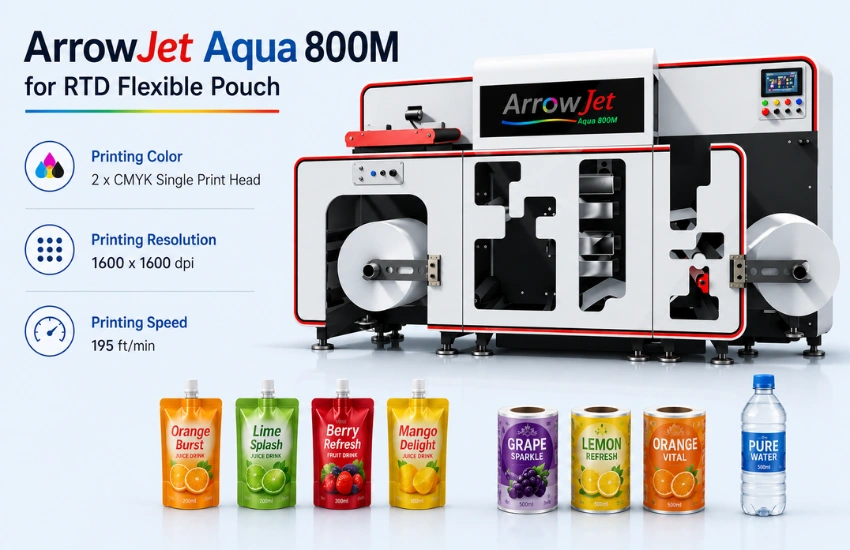
The RTD category’s growth into flexible pouch formats — including stand-up pouches, spouted pouches, and flat-pack single-serve formats — introduces label and packaging printing requirements that roll-label presses designed for rigid containers are not built to address. The ArrowJet Aqua 800M is a dedicated wide-web flexible packaging press engineered for film-based substrate production, operating at production speeds and web widths appropriate for commercial RTD pouch printing.
Web width and throughput
The Aqua 800M supports a maximum media width of 800mm (31.5″) with a maximum print width of 638mm (25.1″) — approximately double the print width of narrow-web label presses. Print speeds range from 90 ft/min at full 1600×1600 dpi resolution to 195 ft/min at 1600×640 dpi, supporting high-volume flexible packaging runs for RTD pouch formats.
Film substrate compatibility
The press is designed to run film-based substrates including PP, PET, PVC, BOPP, and Mylar, in addition to coated papers, Tyvek, and laminate materials. These are the primary substrate types used in RTD flexible pouch construction. Film substrates require offline pre-treatment — such as corona treatment — prior to press loading to achieve the surface energy required for reliable ink adhesion. This pre-treatment step is performed before the film roll is mounted on the press and is separate from the printing process.
Print quality for flexible pouch graphics
RTD pouch packaging frequently requires vivid, high-contrast graphics — including brand color matching, nutritional panels at small point sizes, and barcode symbology — that must remain legible after the pouch is filled, sealed, and subjected to handling and retail display. The Aqua 800M’s Memjet DuraCore™ print platform delivers 1600×1600 dpi resolution, producing the color accuracy and fine-detail rendering that RTD pouch artwork typically demands.
SKU agility for RTD pouch variety packs
RTD pouch brands frequently launch with multiple flavors, sizes, or formats simultaneously. The Aqua 800M supports artwork changeovers without tooling or plate changes — a significant operational advantage for RTD variety pack launches where multiple pouch SKUs must be produced in short succession and total run lengths per SKU are relatively low at launch.
Ink capacity
The Aqua 800M is available with 2L or 10L CMYK tank options. For continuous flexible packaging production runs — typical in commercial RTD pouch operations — the 10L bulk ink configuration reduces production interruptions between extended runs.
RTD brands and flexible packaging converters working with pouch and film-based beverage formats can review the full specification for the ArrowJet Aqua 800M on the product page.
Common questions from RTD beverage brands and converters on label formats, compliance, substrate selection, and press fit for cans, bottles, and pouches.
Pressure-sensitive labels and shrink sleeves are the two primary formats for RTD cans. Pressure-sensitive labels apply directly to the can body and are well-suited for short runs and variable artwork. Shrink sleeves wrap the full can surface and require a separate heat-shrink applicator line. Direct-print is used by large aluminum can manufacturers but is not practical for beverage brands at typical production volumes.
Yes. RTD spirits and malt beverages sold in the United States require a Certificate of Label Approval (COLA) from the Alcohol and Tobacco Tax and Trade Bureau (TTB) before labels can be applied to products entering interstate commerce. Brewers and distillers typically submit artwork for COLA review prior to committing to a label print run — making short-run digital printing a practical approach for managing revision cycles during the approval process.
RTD flexible pouches typically use polyester (PET), BOPP, or foil-laminate film substrates. These materials provide the barrier properties, seal compatibility, and moisture resistance required for beverage pouch formats. Film substrates used on wide-web presses like the ArrowJet Aqua 800M require offline pre-treatment prior to press loading to ensure ink adhesion.
Generally, no. Roll-to-roll pressure-sensitive label presses — such as the ArrowJet Aqua 330R — are optimized for rigid package formats including glass bottles and aluminum cans. Wide-web flexible packaging presses like the ArrowJet Aqua 800M are designed for film-based substrates used in pouches, sachets, and stand-up formats. Operations with both package types typically run each format on a dedicated press.
Arrow Systems manufactures digital label presses and wide-web flexible packaging equipment for beverage brands and label converters. Explore the ArrowJet Aqua 330R for pressure-sensitive can and bottle labels, or the ArrowJet Aqua 800M for RTD flexible pouch production.
Table of Contents Pet Food Brand Label Supplier Problems: 5 Signs to Print In-House Most pet food label supplier problems are a model mismatch: flexo’s
Table of Contents Coffee Roaster Flexible Pouch Printing Workflow: Roll to Bag In-house coffee pouch printing runs five stages — substrate loading, queue setup, the
Table of Contents Overlaminate vs. Varnish Labels: How to Choose Protection Film overlaminate protects against immersion, wash-down, and solvents; UV and aqueous varnish suit retail
Table of Contents Blade vs. Laser Label Die Cutting: Accuracy, Speed, and Cost per Label Blade die-cutting suits simple shapes and long runs; CO2 laser
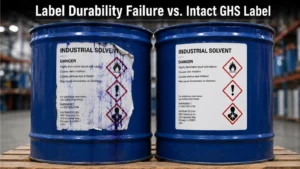
Table of Contents GHS Label Durability Failure: 4 Causes and Practical Fixes GHS label durability failures trace to four causes: aqueous ink chemistry, paper face
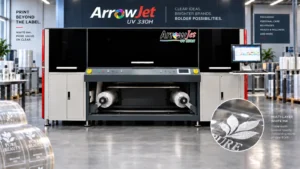
Table of Contents White Ink Clear Label Printing: When You Need It and Why White ink under clear film keeps brand color, mandatory copy, and