Pet Food Brand Label Supplier Problems: 5 Signs to Print In-House
Table of Contents Pet Food Brand Label Supplier Problems: 5 Signs to Print In-House Most pet food label supplier problems are a model mismatch: flexo’s
CR cannabis packaging is certified under CPSC 16 CFR §1700.20 — and certification attaches to the finished package, not to film stock or closures in isolation.
CR certification is evaluated at the finished-package level — substrate, closure, ink, lamination, and print process all influence pass or fail, making every production change a potential re-evaluation trigger.
Most cannabis operators know child-resistant packaging is required. Fewer treat it as an operations workflow problem. Certification attaches to a specific finished-package SKU as it was tested — not to the packaging category in general. Every artwork revision, substrate swap, or new converter relationship is a potential re-evaluation trigger. Operators who do not build a workflow around those boundaries tend to over-order pre-printed CR pouches and scrap them when strains rotate, or make changes that put certification at risk without realizing it. Arrow’s guide on reducing cannabis operations costs covers how workflow discipline around packaging intersects with SKU management.
CPSC’s 16 CFR §1700.20 panel test protocol defines federal CR packaging performance; state cannabis programs add their own requirements on top — and both layers must be satisfied independently.
Poison Prevention Packaging Act (PPPA)
The federal statute governing child-resistant packaging, enforced by the CPSC. It requires that certain product categories be sold in packaging significantly difficult for children under five to open, while remaining accessible to adults.
16 CFR §1700.20 — the test protocol
The CPSC standard defining the panel test methodology for CR packaging. The protocol uses children aged 42–51 months and senior adults aged 50–70 under controlled conditions. It evaluates the complete finished package — closure, substrate, ink, and any applied elements included. A CR film or zipper on its own does not satisfy this standard; the finished-package configuration must pass the test.
State cannabis CR requirements
Most state programs incorporate the CPSC standard by reference and add their own rules: opacity, resealability mandates, retail exit-bag requirements, and symbol or marking mandates. Some states require both primary CR packaging and a CR exit bag; others accept a single compliant primary package. Verify directly with your state cannabis regulator before any format change.
This guide is informational and does not constitute legal or compliance advice.
Several flexible pouch formats commonly achieve CR certification for cannabis flower, edibles, and pre-rolls — but certification is closure-and-configuration specific, not format-generic.
Child-resistant zipper pouches
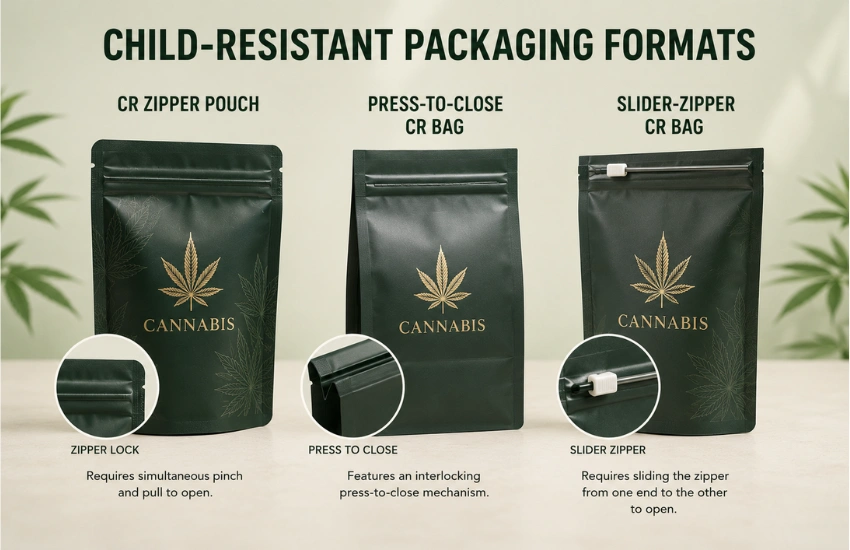
Use a reinforced press-to-close zipper requiring a simultaneous pinch-and-pull motion difficult for young children to coordinate. Both the zipper design and the pouch film configuration must be part of the tested and certified package. Widely used for flower, pre-rolls, and multi-gram edible formats, including custom Mylar pouches for cannabis.
Slider-zipper CR bags
Add a sliding mechanism over the zipper track with a child-resistant release function. Slider alignment is critical — distortion from heat sealing or heavy ink coverage near the slider zone is a common re-test trigger. Used for flower and multi-use pack formats.
Press-to-close CR pouches
Rely on closure tension and alignment cues that defeat simple finger pulls. Popular for single-dose edibles and sample formats. Closure-zone ink coverage is the primary print-related re-test trigger.
Exit bags vs. primary CR packaging
Exit bags are CR pouches applied at point of sale for non-CR products. In states that permit it, an exit bag may satisfy CR requirements for certain categories; in others, the primary product package must itself be certified. The distinction is state-specific — verify with your state cannabis regulator.
The operative rule: anything that touches the closure mechanism — or the zone immediately surrounding it — is a potential re-test trigger. Establish and document the closure-zone boundary before production begins, and include it in your change-control process.
Flexible CR pouches and hard-container formats use entirely different closure mechanisms, print approaches, and re-test triggers — use this table as a configuration planning reference.
Format | Common Cannabis Use | CR Mechanism | Print Approach | Primary Re-Test Trigger |
CR zipper pouch | Flower, pre-rolls, edibles | Press-to-close reinforced zipper; simultaneous pinch-and-pull required | Direct digital inkjet on flexible film | Ink or laminate change in or near closure zone |
Slider-zipper CR bag | Flower, multi-use packs | Sliding mechanism with child-resistant release | Direct digital inkjet on flexible film | Slider alignment distortion or seal-zone ink coverage |
Press-to-close CR pouch | Small-format edibles, samples | Closure tension and alignment cues defeating simple finger pulls | Direct digital inkjet on flexible film | Heavy ink coverage in closure-zone proximity |
Glass jar with CR cap | Flower, concentrates | Push-and-turn or squeeze-and-turn cap | Pressure-sensitive label on container body | Label overlap across closure seam or bulk in cap interface |
Pop-top vial | Pre-rolls, concentrates | Squeeze-and-pop closure | Pressure-sensitive label on vial body | Label bulk in squeeze zone interfering with closure |
Exit bag | Retail point-of-sale carry | CR closure on outer bag (not primary packaging) | Direct digital inkjet on flexible film | State rule on primary vs. exit bag sufficiency |
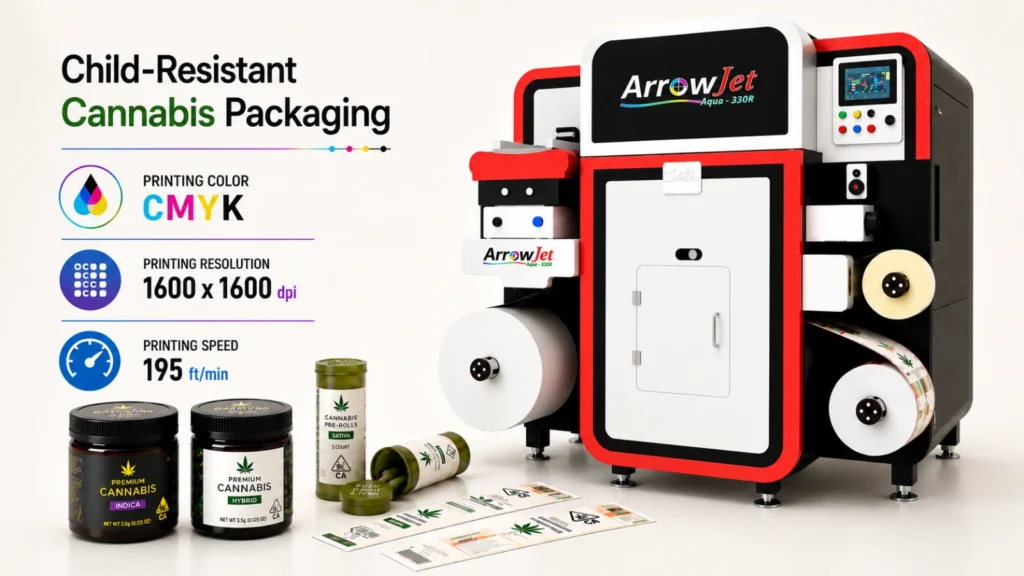
The ArrowJet Eco 330R is a compact industrial single-pass digital press for short-run, variable-data printing on flexible film and pouch stock — designed for the high-SKU volatility of cannabis packaging workflows.
Cannabis SKU counts move faster than traditional packaging supply chains were built for. Strain rotations, limited drops, and state-by-state compliance variants create constant churn that strands pre-printed CR pouch inventory the moment artwork changes. The Eco 330R lets operators print smaller batches of CR-compatible pouches on demand — without committing working capital to inventory that may be obsolete within the quarter. For a full ROI breakdown on in-house digital printing for cannabis, see Arrow’s in-house cannabis label printing ROI guide.
ArrowJet Eco 330R — specifications for cannabis flexible packaging
Single-pass digital inkjet using Memjet DuraFlex® engine. CMYK water-based pigment inks. Max print width: 324 mm. Speed: up to 20 m/min. Resolution: 1600 × 1600 dpi. Single-phase 230V — no air compressor required. Supports PP, PET, PVC, BOPP, Mylar, and flexible film substrates. Optional IR dryer available.
Substrate and ink discipline for CR compliance
Film and laminate structure must remain consistent with the certified package configuration — switching suppliers or laminate grades mid-program is a change-control event requiring evaluation before proceeding. Closure-zone clearance must be enforced in the artwork template as a design constraint, not corrected post-press. Water-based pigment inks used by the Eco 330R have a well-established compatibility profile with common flexible packaging substrates and lamination systems.
Variable data and compliance automation
Strain name, THC/CBD content, batch ID, harvest date, and state compliance fields can all be driven from a controlled data source and printed differently on each run without a plate change. When artwork release is tied to seed-to-sale data, variable data printing materially reduces mislabeling risk — one of the most frequent triggers for state enforcement action.
The ArrowJet Aqua 330R is a water-based digital label press for short-run, multi-SKU pressure-sensitive label production — purpose-built for cannabis operators managing large active label libraries across CR jar, vial, and hard-container SKUs.
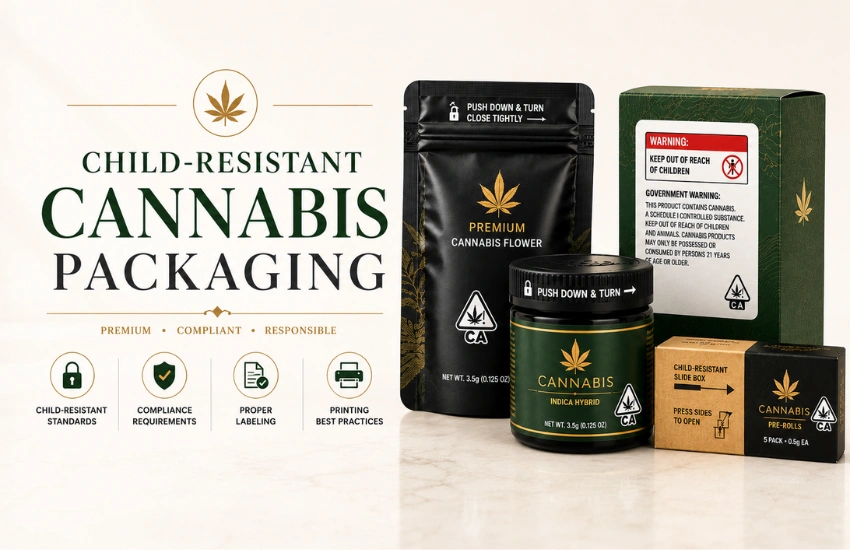
Glass jars, pop-top vials, and CR-closure plastic containers dominate certain cannabis categories — flower, concentrates, tinctures, and capsules. These containers carry pressure-sensitive labels, and their production challenges center on large active SKU libraries, frequent compliance field updates, and the need for short runs that do not generate obsolete inventory.
Short-run label production for multi-SKU cannabis menus
The ArrowJet Aqua 330R lets operators print exactly the quantity needed per run — no plate changes, no minimum orders, no stranded inventory. State-required compliance fields (batch ID, harvest date, THC/CBD content, warning statements) change with every production lot and can be driven from a controlled variable data source on every run. For a broader overview of digital cannabis label printing options, see Arrow’s dedicated guide.
Label placement constraints for CR hard containers
A label that wraps across a closure seam, interferes with the press-and-turn alignment of a CR cap, or adds bulk to a squeeze-and-twist zone can compromise certified closure function. Label die lines and adhesive selection must account for the closure mechanism before artwork is approved — these are pre-production specification constraints, not press-level constraints.
CR testing evaluates the complete finished package under 16 CFR §1700.20 — documentation of the certified configuration and a disciplined change-control process are the operational foundation of a defensible compliance program.
The 16 CFR §1700.20 panel test uses children aged 42–51 months and senior adults aged 50–70 under controlled conditions to evaluate the finished package as the consumer receives it. Substrate, ink, lamination, and closure are all part of what is evaluated. A CR zipper or CR film on its own does not satisfy the requirement — only the tested and documented finished-package configuration does.
For audit readiness, maintain documentation of: the certification status and test report for each CR SKU; the specific substrate, closure, ink system, and laminate used in the certified configuration; change-control records for any post-certification modifications; and state-level registration records where required.
Substrate or laminate change
A new film supplier, laminate grade change, or modified pouch-wall construction — even from the same supplier — may alter the flex characteristics evaluated in the original test.
Closure component change
A different zipper, slider, or cap mechanism — even a nominally equivalent substitute — requires evaluation before the existing certification can be assumed to still apply.
Ink system or significant artwork change
Changes that materially alter ink coverage in or near the closure zone, or introduce a new ink chemistry not part of the certified configuration, are re-test triggers.
Converter or print process change
Moving to an in-house digital workflow is a configuration change that should be evaluated against the certification record. In-house digital printing is compatible with CR certification discipline; the evaluation is about whether the output configuration matches the certified one.
When in doubt, consult the certification holder or testing laboratory before proceeding. Arrow Systems sells digital printing hardware and does not provide regulatory or certification advisory services.
Common questions from packaging engineers, compliance leads, and operations managers evaluating CR formats and in-house digital printing options.
Not automatically — but it can. Certification belongs to a finished-package configuration, so any change affecting the closure zone, substrate flex, or laminate structure may require re-evaluation. Printing within the certified ink system on the certified substrate and outside the closure-zone boundary is generally compatible with maintained certification — confirm with the certification holder before any configuration change.
It depends on the state. Some programs accept a CR exit bag for products not in primary CR packaging; others require the primary package to be CR-certified regardless. Verify directly with your state cannabis regulator before relying on exit bags as your compliance strategy.
Yes, in principle — provided the in-house process is part of a certified finished-package configuration with a controlled, documented ink system and substrate. What matters is the configuration, not the location of the press.
CPSC does not mandate a fixed re-test interval. Re-testing is triggered by material package changes — substrate, closure, ink system, or laminate. State-level cannabis rules may impose their own intervals; verify with your state regulator.
CPSC certification under 16 CFR §1700.20 is the federal performance standard. State programs typically reference that standard and add their own requirements — opacity, resealability, exit-bag rules, or marking mandates. A CPSC-compliant package can still fall short of a state rule; both layers must be reviewed independently before deploying a new CR format across state markets.
Arrow Systems offers a structured assessment for cannabis packaging and operations teams evaluating digital printing for CR flexible pouches, pressure-sensitive labels, or both. The assessment maps your SKU mix, CR formats, and state compliance footprint against the right configuration: flexible packaging printing via the ArrowJet Eco 330R, label production via the ArrowJet Aqua 330R, or a combination of both.
Table of Contents Pet Food Brand Label Supplier Problems: 5 Signs to Print In-House Most pet food label supplier problems are a model mismatch: flexo’s
Table of Contents Coffee Roaster Flexible Pouch Printing Workflow: Roll to Bag In-house coffee pouch printing runs five stages — substrate loading, queue setup, the
Table of Contents Overlaminate vs. Varnish Labels: How to Choose Protection Film overlaminate protects against immersion, wash-down, and solvents; UV and aqueous varnish suit retail
Table of Contents Blade vs. Laser Label Die Cutting: Accuracy, Speed, and Cost per Label Blade die-cutting suits simple shapes and long runs; CO2 laser
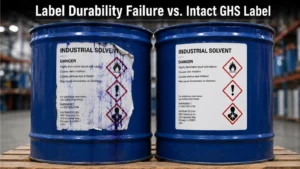
Table of Contents GHS Label Durability Failure: 4 Causes and Practical Fixes GHS label durability failures trace to four causes: aqueous ink chemistry, paper face
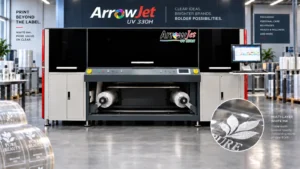
Table of Contents White Ink Clear Label Printing: When You Need It and Why White ink under clear film keeps brand color, mandatory copy, and