
Table of Contents
Beauty Product Labels: INCI Names, Formatting & FDA Rules
Beauty product labels must list every ingredient by INCI name in descending order of weight, meet FDA type-size rules under 21 CFR Part 701, and now comply with MoCRA.
Key Takeaways
- List every cosmetic ingredient by INCI name in descending order of weight — with three explicit exceptions: ingredients at 1% or less (any order after the above-1% group), color additives (any order at the end), and fragrance/flavor (umbrella declaration).
- The FDA’s type-size floor under 21 CFR Part 701 is 1/16 inch (1.6 mm) for standard packages, approximately 1/32 inch for very small packages — text must still be conspicuous, legible, and in distinct contrast to the background at either size.
- MoCRA did not rewrite the on-pack ingredient declaration rules but raised the operational stakes: your INCI list must align with your facility registration and product listing data, and fragrance allergen disclosure requirements are coming via FDA rulemaking.
- EU fragrance allergen disclosure rules are already in effect for exported products — brands selling into EU markets must list specified allergens by name above defined concentration thresholds, not under the “Fragrance” umbrella.
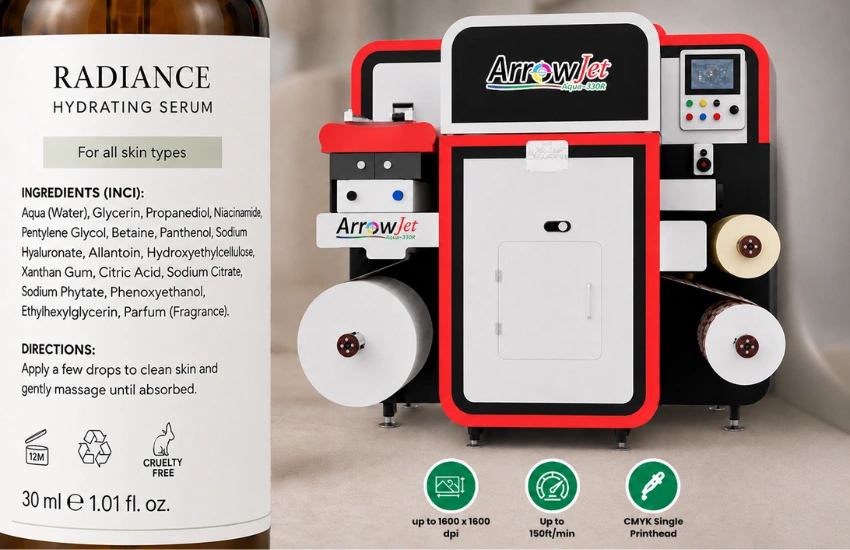
- On-demand digital label printing with the ArrowJet Aqua 330R eliminates pre-printed inventory exposure when INCI lists change — reformulation cycles go from weeks to days when the update is a digital file, not a plate order.
What Are INCI Names and Why Do They Appear on Beauty Product Labels?
INCI names are the globally standardized identifiers for cosmetic ingredients — mandated on U.S. labels so regulators, retailers, and consumers can reliably interpret what a product contains.
INCI stands for International Nomenclature of Cosmetic Ingredients — a standardized naming system used globally to identify ingredients in cosmetic products. The system is maintained by the Personal Care Products Council (PCPC), which publishes and updates the INCI dictionary used as the reference source by brands, manufacturers, and regulators worldwide.
INCI names provide a consistent reference layer: “water” reads as Aqua, “vitamin E” reads as Tocopherol, and a botanical extract carries a precise Latin binomial plus the plant part — the same way across every market. That consistency is what makes cosmetic ingredient labeling enforceable and what allows consumers, allergy sufferers, and regulators to interpret a label reliably, regardless of brand or origin.
The Three INCI Ordering Rules: Descending Weight Plus Exceptions
The core rule is descending order of predominance by weight — highest concentration to lowest. Three defined exceptions modify where specific categories may be placed:
Descending order of predominance by weight (primary rule)
All cosmetic ingredients are listed from highest to lowest concentration by weight in the finished formulation. This is the foundational rule under 21 CFR Part 701. Your formulation records and your labeling team need a single verified source for each ingredient’s weight percentage — this is where INCI compliance most frequently breaks down in multi-SKU operations.
One-percent threshold exception
Ingredients present at 1% or less by weight may be listed in any order, provided they appear after all ingredients present above the 1% threshold. The 1% cutoff comes from the formulation master — it must be documented and verifiable, not estimated. As formula complexity grows, managing this threshold across multiple SKUs requires a controlled ingredient record, not an ad hoc process.
Color additive ordering exception
FDA-approved color additives may be listed in any order at the end of the ingredient declaration, regardless of their actual concentration in the formulation. This applies only to colorants that have received FDA approval for the specific cosmetic use — unapproved colorants may not be used at all, regardless of listing position.
Fragrance and flavor umbrella declaration
The components of a fragrance or flavor blend are typically grouped under a single declaration — “Fragrance,” “Parfum,” “Flavor,” or “Aroma” — rather than listed individually. MoCRA is introducing requirements to disclose specific fragrance allergens separately; see the Fragrance and Allergen section below for the current state of that rulemaking.
FDA Rules for Cosmetic Ingredient Declarations Under 21 CFR Part 701 and MoCRA
U.S. cosmetic labeling is governed by 21 CFR Part 701 and the Fair Packaging and Labeling Act; MoCRA (2022) added facility registration and product listing obligations that must align with the printed label.
In the U.S., cosmetic labeling requirements are established under the Federal Food, Drug, and Cosmetic Act, the Fair Packaging and Labeling Act, and the regulations at 21 CFR Part 701 (and Part 740 for warning statements). The Modernization of Cosmetics Regulation Act (MoCRA) of 2022 added new obligations around facility registration, product listing, safety substantiation, and adverse event reporting — without rewriting the on-pack ingredient declaration structure already in Part 701.
Required Elements of a Compliant Cosmetic Label
Product identity statement — Principal Display Panel (PDP)
Identifies what the product is (e.g., “moisturizing lotion,” “eye shadow”). Must appear on the PDP — the portion of the label most likely to be displayed, presented, or examined by the consumer at the point of retail sale.
Net quantity of contents — PDP
Must appear on the PDP in both U.S. customary and metric units. Minimum type size for the net quantity statement scales with the area of the PDP and is larger than the minimum for the ingredient declaration.
Name and place of business
Name and principal address of the manufacturer, packer, or distributor responsible for the product. Must appear on an information panel or another label panel where it is likely to be read at the point of sale.
Material facts and required warnings
Required wherever absence of the information could deceive the consumer, or where specific warnings are mandated — for example, flammability warnings for aerosol products, or use cautions for products intended for the eye area.
Ingredient declaration
All cosmetic ingredients listed by INCI name in descending order of predominance by weight, placed on an information panel or another label panel where the declaration can be read at the point of sale. The declaration may not be placed on an interior panel hidden inside carton packaging at the point of purchase.
How MoCRA Changes the Operational Stakes
MoCRA does not rewrite the on-pack ingredient declaration rules in Part 701, but it raises the operational stakes significantly for cosmetic brands and contract manufacturers.
Alignment between regulatory submission and printed label
Under MoCRA’s facility registration and product listing requirements, the ingredient data submitted to FDA should align with what appears on your label. Drift between your regulatory submission, your formulation master, and your printed artwork is exactly the kind of inconsistency that creates problems in an FDA inspection. Treat your INCI list as a controlled record — not a marketing asset with a flexible revision cycle.
Fragrance allergen disclosure rulemaking
MoCRA requires disclosure of certain fragrance allergens on the label, with the specific allergen list to be determined through FDA rulemaking. Brands should monitor the rulemaking timeline and build artwork update capacity into their label production process. Pre-printed label inventory is directly exposed to that regulatory change; on-demand digital printing is not.
This section is general informational guidance, not legal or regulatory advice — work with qualified regulatory counsel for product-specific compliance decisions. Arrow Systems sells label printing hardware and does not provide regulatory or compliance advisory services.
Font Size, Placement, and Format Requirements for Ingredient Lists
FDA type-size minimums under 21 CFR Part 701 are specific and frequently missed on small primary containers — 1/16 inch standard, 1/32 inch for very small packages, with legibility required at both.
FDA cosmetic label font size and legibility requirements are among the most common sources of compliance failures on small primary containers, particularly in skincare and cosmetic categories where high ingredient counts compete with limited label real estate.
Minimum Type-Size Requirements
Label Element | Minimum Type Size | Notes |
Ingredient declaration (standard package) | 1/16 inch (approx. 1.6 mm) | General Part 701 requirement for letter height; applies to the majority of cosmetic packages |
Ingredient declaration (very small package) | Approximately 1/32 inch | Allowed where total labeling surface is under roughly 12 sq in; legibility standard still applies — reduced size does not mean unreadable |
Net quantity statement (PDP) | Scales with PDP area | Minimum size is larger than the ingredient list minimum; tied to the area of the principal display panel |
Text must be in distinct contrast to the background and presented so that it is conspicuous and legible to the typical consumer at the point of sale. Reduced type size is a regulatory accommodation, not a license to make the declaration unreadable in practice.
Formatting Expectations for Ingredient Declarations in Practice
Continuous ingredient block format
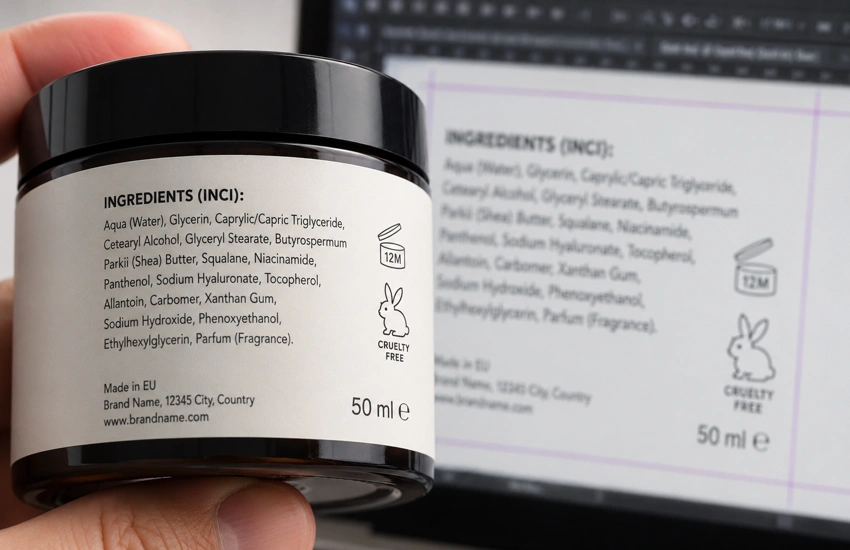
List all ingredients in a single continuous block separated by commas, using their full INCI names. Do not break an ingredient name across lines in a way that obscures or fragments it — a split name can create a legibility compliance issue and confuse consumers performing an ingredient search.
Placement on the label
The ingredient declaration must be placed where it can be read at the point of sale — typically the information panel adjacent to the PDP. It may not be hidden inside interior carton packaging where a consumer would need to open the product to read it. Plan panel placement during packaging development, before the design is finalized.
Capitalization consistency
INCI names may appear in title case or all caps. What matters is uniformity across the full declaration — inconsistent capitalization within a single ingredient list can create legibility concerns and flag in retailer compliance reviews. Choose a convention and apply it throughout.
Label real estate planning for small containers
A 40-ingredient serum declaration on a 30 mL bottle will exceed the standard type-size floor using a standard label layout. The time to solve this is during formula development — when the ingredient count is known but the packaging is not yet committed. Changes made after tooling is complete are significantly more expensive than those made at the brief stage.
Fragrance, Allergen, and Color Additive Disclosure: Special Labeling Rules
Fragrance, color additives, and allergen disclosure operate under rules separate from the standard descending-weight INCI declaration — each category has specific placement, threshold, and approval requirements.
Three areas trip up otherwise complete ingredient declarations: fragrance components, color additive certification and placement, and allergen disclosure. Each one requires handling that differs from the standard descending-weight INCI listing.
Fragrance and flavor umbrella declaration (current FDA rule)
The specific components of a fragrance or flavor blend are typically considered trade secrets under current FDA rules. They may be declared on the label simply as
“Fragrance” or “Parfum” — and “Flavor” or “Aroma” for oral products — rather than listed individually by INCI name. This practice is in transition as MoCRA’s fragrance allergen disclosure requirements move through rulemaking.
MoCRA fragrance allergen disclosure (pending FDA rulemaking)
MoCRA introduced a requirement for on-pack disclosure of certain fragrance allergens, with the specific allergen list to be established by FDA rulemaking. Brands should track this rulemaking actively and build artwork update capacity into their label production process. When the final allergen list and effective date are confirmed, brands running pre-printed label inventory face a hard obsolescence event; those printing on-demand update a digital file.
EU fragrance allergen disclosure (currently in effect for exports)
The EU Cosmetics Regulation already requires individual on-pack disclosure of specified fragrance allergens above defined concentration thresholds — these allergens must be listed by INCI name, not grouped under “Fragrance.” If your products are sold in EU markets, your EU-market INCI ingredient list must be prepared separately from your U.S. label artwork. Managing market-specific artwork variants is operationally straightforward on a digital press and significantly more costly on pre-printed flexo stock.
Color additive FDA approval and batch certification
Color additives in cosmetics are tightly controlled: only colorants approved by the FDA for the specific intended use (general cosmetic, eye area, lip products) may be used. Many require batch certification — FD&C and D&C colors are the most common categories requiring this. Using an unapproved colorant or an uncertified batch where certification is required is an adulteration violation, regardless of how the label is formatted.
Color additive placement in the ingredient declaration
Color additives are listed at the end of the ingredient declaration and may appear in any order — they do not need to be sorted by concentration. This exception applies to all color additives, regardless of whether they are present above or below the 1% threshold.
Multi-shade formulations: “+/-” and “may contain”
Decorative cosmetics sold in multiple shades from a single base formulation — lipsticks, eyeshadow palettes, multi-shade pressed powders — commonly use the “+/-“ symbol or the phrase “may contain” before the list of colorants that vary by shade. This signals that not every shade contains every listed colorant. Example: …Mica, Titanium Dioxide (CI 77891), +/- Iron Oxides (CI 77491, CI 77492, CI 77499), Red 7 Lake (CI 15850).
Allergens beyond fragrance
There is no FDA-mandated cosmetic allergen warning list equivalent to the food allergen labeling requirements. However, certain preservatives, essential oils, and botanical extracts are common sensitizers driving consumer reactions. Accurate INCI nomenclature is the foundation that enables sensitized consumers to self-screen — ingredient labeling accuracy and INCI precision are the primary safety communication tools available to them for cosmetics.
Printing Ingredient-Accurate Cosmetic Labels In-House with the ArrowJet Aqua 330R
The ArrowJet Aqua 330R is a water-based inkjet digital label press built for on-demand cosmetic label production — eliminating pre-printed inventory exposure when INCI lists, regulatory requirements, or formulas change.
Ingredient declarations change. A supplier swap, a preservative reformulation, a new MoCRA fragrance allergen disclosure requirement, a retailer-specific claim revision — each one can make thousands of pre-printed labels non-compliant. For brands running traditional flexo with long lead times and minimum order quantities, that exposure shows up as scrapped inventory, delayed product launches, and emergency reprint costs.
The ArrowJet Aqua 330R from Arrow Systems is a water-based pigment inkjet digital label press built for short-run, on-demand cosmetic and beauty label production. For operations and regulatory teams managing active revision cycles, the practical capabilities are direct:
Print exactly what you need — no minimum quantity
The ArrowJet Aqua 330R runs on digital files — no plates, no minimum order quantity enforced by plate amortization. Run 500 labels for a limited-edition seasonal shade or 50,000 for a core SKU from the same artwork file, without changeover costs that punish short runs.
Fast artwork updates when INCI lists change
When an ingredient list changes — a reformulation, a supplier substitution, a new regulatory requirement — push a new approved artwork file to the press. Time-to-shelf for reformulated products can compress from weeks (new plate, new press run, delivery) to the same working day. The revision cycle is limited by your internal approval process, not by a platemaking calendar.
Reduced obsolete label inventory
On-demand printing means the label is produced close to the production run that uses it — not warehoused for future use against a formula that may change. Pre-printed label inventory is directly exposed to every regulatory update, reformulation, and retailer revision. On-demand digital inventory is not.
Variable data at press speed
Batch codes, expiration dates, shade variants, lot numbers, and market-specific INCI variations (e.g., U.S. vs. EU allergen declarations) can be embedded in the print file and run at production speed. Variable data does not require a separate offline printing step or a manual application process.
Support operations automation
Connecting artwork management, approval gates, and the press to production scheduling standardizes how labels are released — fewer manual handoffs, less version drift between regulatory, packaging, and production.
For contract manufacturers serving multiple cosmetic brands with independent reformulation and revision cycles, bringing label production in-house on an on-demand digital press typically improves responsiveness on short-run SKUs and reduces the risk of holding non-compliant inventory at the point of a formula or regulatory change.
Pre-Printed Flexo vs. On-Demand Digital: Key Operational Differences for Cosmetic Labels
Factor | Pre-Printed Flexo (Long-Run) | On-Demand Digital (ArrowJet Aqua 330R) |
Minimum print quantity | Typically thousands — plates must be amortized over long runs | No plate minimum — print the quantity your production run requires |
INCI list revision response time | New plates required; days to weeks lead time before new labels are available | Push updated approved artwork file; same-shift turnaround is possible |
Regulatory update exposure | Pre-printed inventory becomes obsolete; scrapped at full label cost | No pre-printed inventory at risk; reprint from the newly approved file |
Variable data (batch codes, expiry dates, shade variants) | Separate offline step or manual application typically required | Handled natively within the digital print file at press speed |
Multi-market INCI variants (e.g., US vs. EU allergen rules) | Separate plate set required per regulatory market variant | Multiple market-specific artwork files managed within one production workflow |
SKU proliferation cost | Plate cost escalates with each new SKU, shade, or size variant | Flat digital workflow overhead regardless of SKU count or variant mix |
Frequently Asked Questions — Beauty Product Label Compliance
Common questions from cosmetic brand operators, contract manufacturers, and regulatory leads on INCI naming, FDA labeling rules, and managing label accuracy through reformulation cycles.
- Ingredients must be listed by INCI name in descending order of predominance by weight under 21 CFR Part 701. Ingredients present at 1% or less may be listed in any order after those present above the 1% threshold. Color additives may be listed in any order at the very end of the ingredient declaration, regardless of concentration. Fragrance and flavor components are typically grouped under an umbrella term rather than listed individually.
Ingredient declarations must use type at least 1/16 inch (approximately 1.6 mm) in letter height for standard packages under 21 CFR Part 701. A reduced minimum of approximately 1/32 inch applies on very small packages where total labeling surface is limited — but legibility remains required at that smaller size. Text must be conspicuous and in distinct contrast to the background regardless of which size floor applies.
Under current FDA rules, fragrance components may be declared under the umbrella term “Fragrance” or “Parfum.” MoCRA introduced requirements for disclosing certain fragrance allergens on-pack, with the specific list to be set through FDA rulemaking — brands should monitor that timeline. For products exported to EU markets, specified fragrance allergens must already be disclosed individually by INCI name above defined concentration thresholds under EU cosmetics regulation.
MoCRA (2022) did not overhaul the on-pack ingredient declaration rules under 21 CFR Part 701. It added facility registration, product listing, safety substantiation, and adverse event reporting obligations — and introduced pending fragrance allergen disclosure requirements. The practical effect is that your INCI ingredient list on-pack must align with your regulatory submissions, and managing that alignment becomes operationally harder as SKU counts, reformulations, and regulatory requirements all move simultaneously.
Pre-printed label inventory using the old INCI declaration becomes non-compliant and must be scrapped. The cost is the full unit cost of the unusable stock, plus the time and expense of ordering new plates and a new print run. Brands that have moved to on-demand digital printing — using a press like the ArrowJet Aqua 330R — update the digital artwork file and print from the new approved version, with no inventory to write off and no plate order to wait on.
Request an ArrowJet Aqua 330R Demo for Your Cosmetic Label Operation
If your brand or contract manufacturing operation is running pre-printed label inventory across a reformulation-active cosmetic SKU mix, on-demand digital printing removes the inventory exposure that regulatory and formula changes create.
Arrow Systems offers demos of the ArrowJet Aqua 330R tailored to your SKU mix, substrate requirements, and production volume — so you can evaluate what bringing label production in-house looks like for your specific operation before committing.
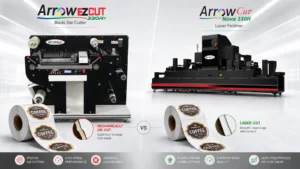
Blade vs. Laser Label Die Cutting: Accuracy, Speed, and Cost per Label
Table of Contents Blade vs. Laser Label Die Cutting: Accuracy, Speed, and Cost per Label Blade die-cutting suits simple shapes and long runs; CO2 laser
Custom Food Packaging: Key Questions Answered for Food Brands
Table of Contents Custom Food Packaging: Key Questions Answered for Food Brands Custom food packaging shapes how shoppers recognize, evaluate, and choose a product —
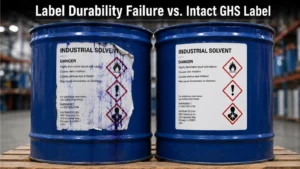
GHS Label Durability Failure: 4 Causes and Practical Fixes
Table of Contents GHS Label Durability Failure: 4 Causes and Practical Fixes GHS label durability failures trace to four causes: aqueous ink chemistry, paper face
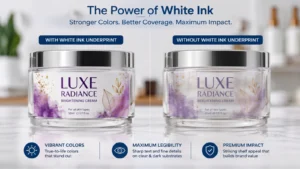
White Ink Clear Label Printing: When You Need It and Why
Table of Contents White Ink Clear Label Printing: When You Need It and Why White ink under clear film keeps brand color, mandatory copy, and
GHS Label Compliance: A Practical Guide for Chemical Label Printing
Table of Contents GHS Label Compliance: A Practical Guide for Chemical Label Printing GHS label compliance is a safety-critical requirement for any business that manufactures,
Cannabis MSO Label Printing: In-House or Outsource?
Table of Contents Cannabis MSO Label Printing: In-House or Outsource? Cannabis MSO label printing moves in-house when label versions outgrow converter minimums or batch data