Table of Contents
Specialty Coffee Packaging Trends Roasters Are Printing in 2026
In 2026, specialty coffee packaging tells the brand story that a brochure once did — in shorter runs, on better substrates, aligned to the roast calendar.
Key Takeaways
- Treat the coffee bag as a brand asset, not a procurement line item — substrate choice and producer storytelling now drive real differentiation on specialty shelves.
- Match substrate to a real end-of-life path your customer can act on; kraft-barrier, recyclable mono-material PE, and compostable films each have distinct tradeoffs for shelf life, recyclability, and roastery positioning.
- Expect more SKUs at shorter run lengths — traditional flexo MOQs increasingly mismatch specialty release calendars built around single-origin lots and seasonal harvests.
- Digital printing makes 500–2,500 bag runs, variable data (roast date, lot number, QR codes), and faster speed to shelf economically realistic without plates or MOQ penalties.
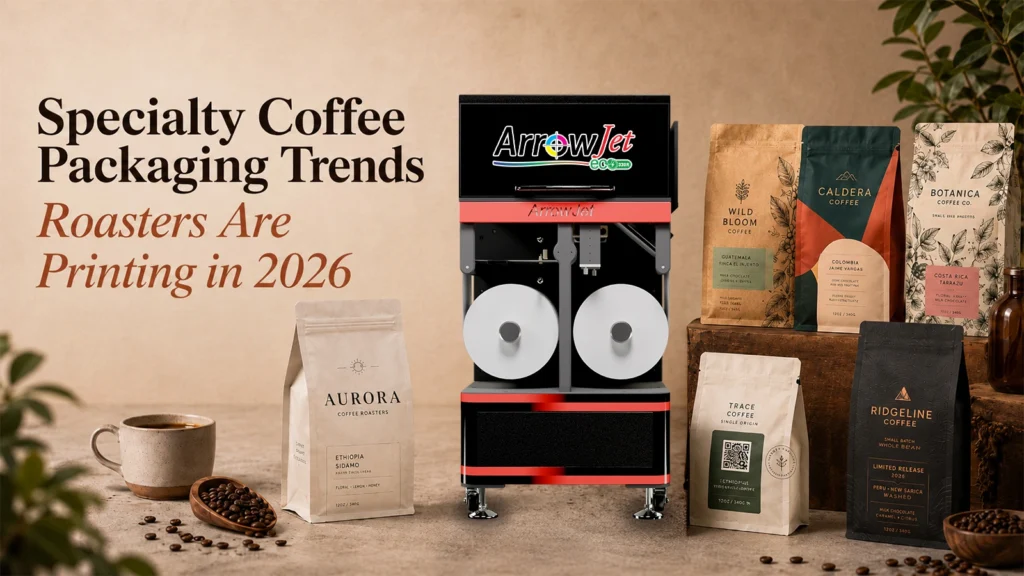
- For roasteries considering in-house production, the ArrowJet Eco 330R is a compact industrial digital press built for label and flexible packaging printing — including coffee bag formats — that runs on single-phase power with no air compressor required.
Why Specialty Coffee Packaging Is Evolving Faster in 2026
Three forces are compressing the specialty coffee packaging cycle simultaneously: SKU proliferation, sustainability scrutiny, and the misfit between flexo MOQs and specialty release calendars.
The three forces reshaping coffee packaging trends 2026 are converging simultaneously: rising SKU counts, heightened sustainability scrutiny, and a growing mismatch between flexo MOQs and specialty release calendars. Third-wave roasters are running more single-origin lots, micro-lots, seasonal blends, and collaboration releases than ever — each representing a small production run that traditional flexographic bag suppliers are structurally mismatched to serve economically.
Sustainability expectations have also matured. Cafés, wholesale buyers, and direct-to-consumer customers are asking sharper questions about substrates, end-of-life, and ink chemistry. A blanket “recyclable where facilities exist” claim gets scrutinized more carefully in 2026 than it did two years ago.
The combined effect: roasters need flexible packaging that tells a richer story, on better substrates, in smaller quantities, and faster — without the minimum order quantities and long lead times that mass-market bag suppliers impose.
Six Specialty Coffee Packaging Trends Roasters Are Adopting
The six trends reshaping specialty coffee bags in 2026 — from substrate choice and flavor-notes typography to scannable traceability and limited-edition art collaborations.
1. Substrate-Forward Design
The bag itself is part of the design language. Natural kraft, uncoated white kraft, recyclable mono-material polyethylene structures, and home-compostable pouches are showing up across specialty shelves. Roasters are leaning into the texture and tone of the substrate rather than masking it with full-coverage ink — expect more bags where the unprinted surface does most of the aesthetic work, with focused ink areas reserved for branding, origin, and flavor notes.
2. Flavor-Notes Typography and Tasting Cards
Flavor notes used to live in a small footer block. In 2026, they are headline content. Roasters are setting “blueberry, dark chocolate, jasmine” in large display type, sometimes occupying half the front panel. Some are running tasting-card layouts that mimic editorial design — score panels, brew ratios, and recommended methods printed directly on the bag rather than on an insert card.
3. Origin and Producer Storytelling
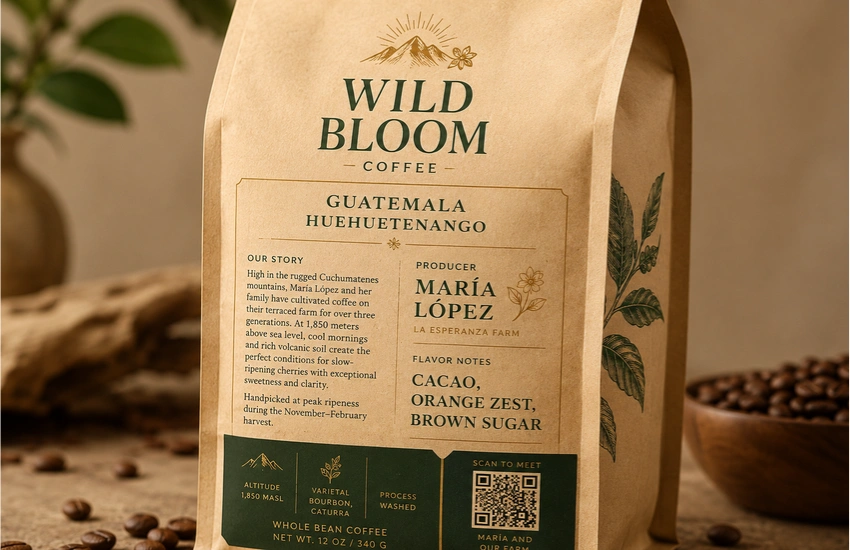
Specialty roaster packaging is increasingly farm-specific. Producer name, farm or washing station, region, altitude, varietal, and process (washed, natural, anaerobic, honey) are printed prominently. This is where single-origin coffee packaging diverges most sharply from grocery coffee: the bag credits the producer, not just the roaster.
4. Scannable Traceability
QR codes are moving from afterthought to design feature. Scans link to lot information, roast date, cupping scores, producer interviews, or brew guides. For roasteries with strong direct-trade relationships, the QR code is a way to make sourcing transparent without crowding the front panel — and a data touchpoint for post-purchase engagement.
5. Limited-Edition Art Collaborations
Artist collaborations, anniversary releases, festival drops, and competition lots are driving demand for limited-edition coffee packaging. These runs are often 200–2,000 bags — economically painful on flexo, and a natural fit for digital printing where there are no plates to set and no minimum order penalties.
6. Minimal Apothecary vs. Maximalist Illustrative
Two aesthetic poles are coexisting on specialty shelves. One is the minimal apothecary look: small type, negative space, single-color ink on kraft. The other is maximalist and illustrative: full-bleed artwork, layered typography, vivid color. Both work because both signal intent. What does not work in 2026 is the generic middle — stock beans, steam, and stylized cups.
Sustainable Coffee Bag Substrates: Kraft, Compostable, and Recyclable Options
Specialty coffee bag printing across kraft-barrier, recyclable mono-material PE, and compostable films involves different shelf-life, end-of-life, and aesthetic tradeoffs — the right choice depends on your roastery’s sustainability positioning and customer infrastructure.
The sustainable coffee bag conversation has matured. Roasters evaluating custom flexible packaging bag formats are asking sharper questions about what each substrate actually delivers — and buyers are applying greater scrutiny to the answers.
Substrate | Strengths | Tradeoffs | Best fit |
Kraft with barrier liner | Craft aesthetic, reasonable shelf life | Multi-layer structures often hard to recycle in standard streams | Roasters prioritizing look and feel |
Recyclable mono-material PE | Clearer end-of-life via store drop-off or specialized streams | Barrier performance varies by supplier; verify OTR/MVTR | Roasters with sustainability-forward positioning |
Home or industrial compostable | Strong end-of-life story where infrastructure exists | Shorter effective shelf life; regional composting access varies | Roasters whose customers can actually compost |
Kraft with barrier liner
Natural kraft paper laminated to a barrier film offers the look and feel buyers associate with craft, plus reasonable shelf life for both whole bean and ground. The tradeoff is that multi-layer structures can be difficult to recycle through standard curbside streams. Verify recycling pathway claims with your supplier before making end-of-life promises to customers.
Recyclable mono-material PE structures
Polyethylene-based mono-material pouches are designed to be recyclable through store drop-off or specialized streams. Barrier performance has improved significantly, but it varies by supplier and film structure. Verify oxygen and moisture transmission rates against your roast-to-consumption window before committing — especially for whole bean SKUs with a longer shelf-life expectation.
Compostable coffee pouches
Home-compostable and industrially compostable films are available in coffee-bag formats with degassing valves. Barrier performance is generally shorter-lived than conventional structures, which matters more for whole bean than for ground. Composting infrastructure varies widely by region — a “compostable” claim is only as meaningful as your customer’s ability to act on it in their area.
Honest messaging matters
Avoid blanket “eco” claims. Be specific about the substrate, the end-of-life path, and the conditions required. Before committing to a new substrate, request substrate samples to validate barrier performance and print compatibility against your specific bag format and roast-date window. Specialty buyers increasingly notice the difference between precise sustainability language and marketing gloss.
How Digital Printing Supports Limited-Edition and Seasonal Coffee Bags
Digital printing for coffee bags makes 500–2,500 bag runs viable without MOQ penalties, enables variable data on every bag, and compresses the timeline from artwork approval to printed bags from weeks to days.
For specialty roasters, digital printing for beverage labels changes what is economically possible at the SKU level — decoupling bag production from the minimum order floors and multi-week lead times that traditional flexo suppliers require.
Short runs without an MOQ penalty
A 500-bag run for a single micro-lot is viable. So is a 1,500-bag seasonal blend a roastery does not want to over-order. Digital printing removes the minimum order floor that makes short-run flexo uneconomical for specialty SKUs.
Variable data on every bag
Roast date, lot number, origin, batch ID, and individual QR codes can change bag to bag without stopping the press. This is particularly valuable for traceability and for limited-edition runs where each bag is numbered — capabilities that require a separate step or are simply not possible in traditional flexo production.
Faster speed to shelf
Designs move from artwork approval to printed bags in days rather than weeks. When harvest timing and green coffee availability drive the release calendar — as they do for most specialty roasteries — that compression matters operationally. Bags can respond to actual inventory rather than a forecast made four to six weeks earlier.
Lower obsolete inventory
When a single-origin sells out or a blend gets reformulated, a roastery printing on-demand is not sitting on tens of thousands of pre-printed bags. The waste reduction compounds when bag printing is loosely connected to roast scheduling and green coffee lot data.
What Differentiates Specialty from Mass-Market Coffee Packaging
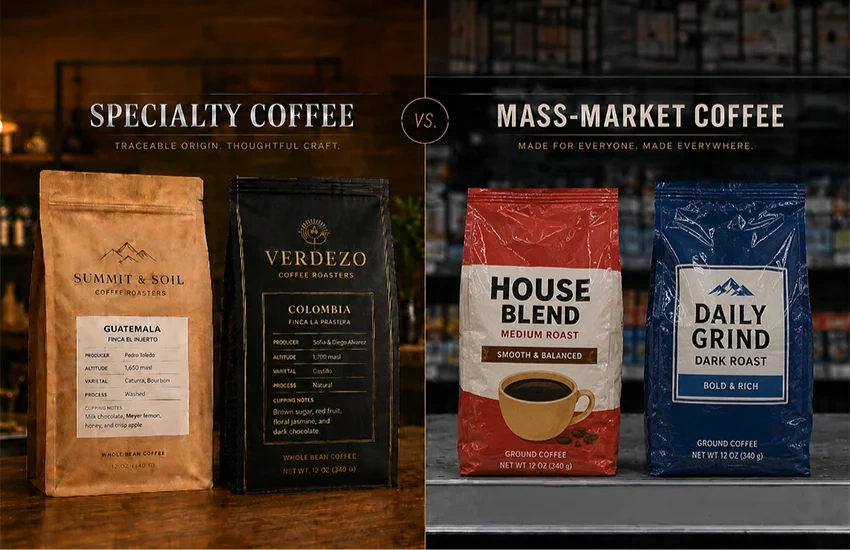
Specialty coffee packaging diverges from mass-market on five dimensions — design intent, run length, refresh frequency, substrate, and storytelling depth — and the gap widened in 2026.
Dimension | Specialty roaster packaging | Mass-market coffee packaging |
Design intent | Story that holds up at a café counter or unboxing | Shelf recognition across thousands of stores |
Run length | Hundreds to low thousands per SKU | Hundreds of thousands per SKU |
Refresh frequency | Seasonal artwork multiple times a year; new origins almost monthly | Designs may hold for years |
Substrate | Craft-signaling, sustainability-aligned | Cost-optimized films |
Storytelling depth | Producer, process, altitude, varietal, cupping detail | Roast level and a generic flavor descriptor |
Specialty coffee packaging is a brand asset that earns its cost back through differentiation — not a commodity input optimized purely for unit economics. The roasteries treating it as the latter are the ones visually indistinguishable on a specialty shelf in 2026.
Printing Specialty Coffee Bags In-House: ArrowJet Eco 330R
The ArrowJet Eco 330R is a compact industrial digital press for label and flexible packaging production — including coffee bag formats — running on single-phase power with no air compressor required.
For growing roasteries exploring in-house label and packaging production, bringing a digital flexible packaging press like the ArrowJet Eco 330R into the roastery shifts bag production from a procurement timeline to a production timeline — where artwork, roast schedules, and lot data can be managed together.
Agility for single-origin drops
When a new lot lands, bags can be printed against actual green coffee inventory rather than a forecast made weeks earlier. The Eco 330R’s on-demand capability means a roastery can move from lot approval to labeled bags in the same production window — without waiting on a converter or committing to a minimum order.
Substrate flexibility for testing
Roasters can test kraft variants, recyclable mono-material structures, and compostable films without committing to thousands of bags on each substrate. The Eco 330R handles paper labels, coated papers, inkjet-treated substrates, and flexible packaging materials — supporting the substrate experimentation that specialty roasteries need as the market for sustainable coffee bags evolves.
Waste reduction through on-demand runs
On-demand production reduces both obsolete inventory — bags pre-printed for lots that sold out or blends that changed — and over-ordering buffers built into converter minimum orders. The waste reduction compounds when bag printing is loosely connected to the roast schedule rather than run as a separate procurement cycle.
Workflow control for version management
Bag artwork, roast schedules, and lot data live closer together when printing is in-house. This simplifies version control and reduces the risk of running outdated labels — a particular concern for roasteries managing multiple origins concurrently with different roast-date windows and traceability requirements.
Whether in-house printing fits depends on volume, SKU count, substrate mix, and team capacity. It is worth modeling honestly rather than assuming. For roasteries at higher volumes producing large flexible packaging runs, the ArrowJet Aqua 800M — a 25-inch wide-web digital press for flexible packaging — is the appropriate step up, supporting substrates including PP, PET, BOPP, Mylar, and woven materials at production speeds suited to larger-scale bag output.
Frequently Asked Questions — Specialty Coffee Packaging in 2026
Common questions from specialty roaster owners and production managers tracking coffee packaging trends in 2026 — covering substrate choices, digital print run economics, and in-house coffee bag printing options.
There is no single best answer. Kraft with a barrier liner remains popular for its craft aesthetic and reasonable shelf life. Recyclable mono-material polyethylene structures are gaining ground with roasters who want a clearer end-of-life story. Compostable pouches fit roasters whose customers have access to composting infrastructure. The right choice depends on your shelf-life window, sustainability positioning, and the substrates your printing setup can handle reliably.
Digitally printed runs in the low hundreds are feasible, though per-unit costs are higher at the very low end. Many specialty roasters find the economics work well for 500–2,500 bag runs per SKU, which aligns with typical single-origin and seasonal release volumes. Digital printing removes the plate costs and minimum order floors that make short-run flexo uneconomical for these SKUs.
Some can, but barrier performance varies significantly by film structure and supplier. Whole bean coffee is more sensitive to oxygen exposure than ground, and compostable structures generally have shorter effective shelf life than conventional barrier films. Validate oxygen transmission rates and run real-world freshness tests against your roast-to-consumption timeline before committing to a compostable structure for whole bean SKUs.
Flexographic printing uses physical plates, requires a minimum order quantity (often tens of thousands of bags), and has lead times measured in weeks. Digital printing uses no plates, has no minimum order floor, and can produce runs in the low hundreds to low thousands with turnaround measured in days. For specialty roasters managing rotating single-origins and seasonal releases, the absence of MOQs and the faster speed to shelf are the primary economic advantages of digital. Flexo remains cost-competitive at very high volumes with stable, unchanging artwork.
Yes. Digital presses print variable data bag to bag without stopping the press — roast date, lot number, batch ID, origin, and individual QR codes can all change within a single print run. This is a core capability for traceability-focused specialty roasters and for limited-edition bags that are individually numbered. Traditional flexo cannot produce true variable data without a separate digital overprint step.
Review Your Coffee Bag Printing Workflow with Arrow Systems
If you are evaluating whether in-house digital bag printing fits your roastery’s operation — including substrate options, run volumes, and press configuration — Arrow Systems offers a structured packaging workflow review for roastery owners and production managers.
The review covers your current bag spend, SKU count, substrate mix, and run-length patterns to assess whether a press like the ArrowJet Eco 330R (entry-level, single-phase, no air compressor) or the ArrowJet Aqua 800M (wide-web, high-volume flexible packaging) would sit productively alongside your existing roast and packaging operation.
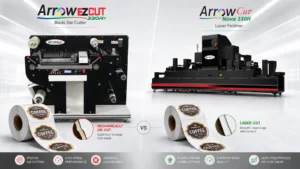
Blade vs. Laser Label Die Cutting: Accuracy, Speed, and Cost per Label
Table of Contents Blade vs. Laser Label Die Cutting: Accuracy, Speed, and Cost per Label Blade die-cutting suits simple shapes and long runs; CO2 laser
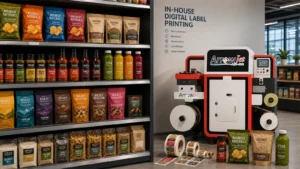
Custom Food Packaging: Key Questions Answered for Food Brands
Table of Contents Custom Food Packaging: Key Questions Answered for Food Brands Custom food packaging shapes how shoppers recognize, evaluate, and choose a product —
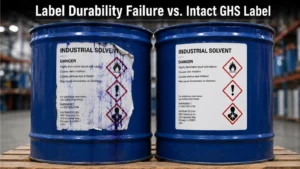
GHS Label Durability Failure: 4 Causes and Practical Fixes
Table of Contents GHS Label Durability Failure: 4 Causes and Practical Fixes GHS label durability failures trace to four causes: aqueous ink chemistry, paper face

White Ink Clear Label Printing: When You Need It and Why
Table of Contents White Ink Clear Label Printing: When You Need It and Why White ink under clear film keeps brand color, mandatory copy, and
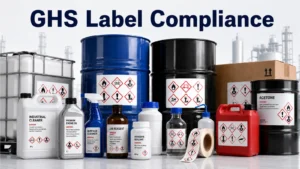
GHS Label Compliance: A Practical Guide for Chemical Label Printing
Table of Contents GHS Label Compliance: A Practical Guide for Chemical Label Printing GHS label compliance is a safety-critical requirement for any business that manufactures,
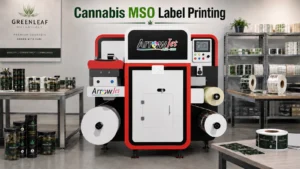
Cannabis MSO Label Printing: In-House or Outsource?
Table of Contents Cannabis MSO Label Printing: In-House or Outsource? Cannabis MSO label printing moves in-house when label versions outgrow converter minimums or batch data