Flexible Pet Packaging: Digital Printing for Pouches and Bags
Table of Contents Flexible Pet Packaging: Digital Printing for Pouches and Bags Flexible pet packaging — stand-up pouches and flat-bottom bags — is now the

What is your minimum order?
It is the first question small businesses ask when exploring custom printed tape. And traditionally, the answer was disappointing: 5,000 feet. 10,000 feet. Sometimes even 25,000 feet.
For a business shipping 50 packages per month, that is a multi-year supply. For a startup testing its branding, that is a massive commitment before you have proven product-market fit.
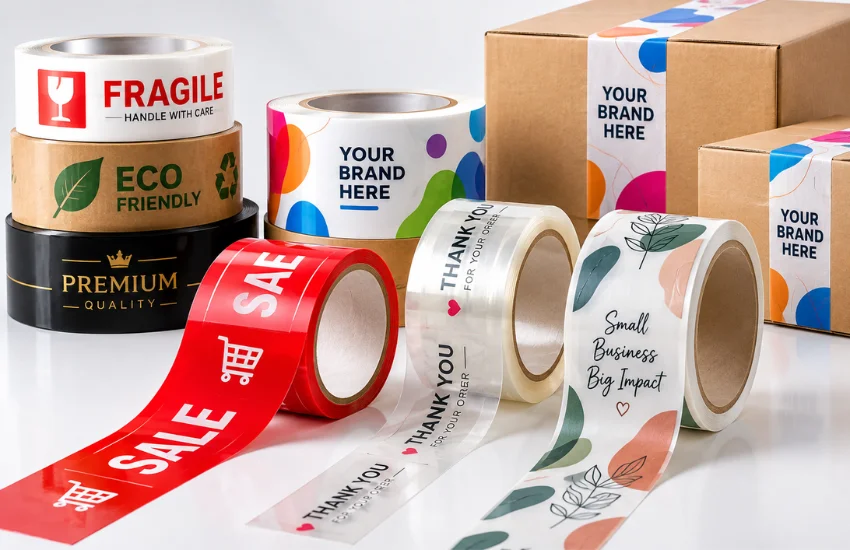
But the answer has changed. Digital printing technology has rewritten the rules. Today, the real minimum order for custom printed tape is whatever you need it to be — even if that is just one roll.
For decades, custom tape printing relied on flexographic technology. This process uses:
Physical printing plates (one per color)
Complex setup and calibration (wasting material during registration)
Long production runs (to amortize fixed costs)
Plate creation: 00–500 per color
Setup waste: 100–500 feet per job
Labor for setup: 1–2 hours
To make this economically viable, printers needed to spread these costs across thousands of feet of tape. Hence, high minimum order quantities (MOQs).
Large converters: 25,000–50,000 feet — Volume-focused business model
Mid-size printers: 10,000–25,000 feet — Setup costs require volume
Specialty shops: 5,000–10,000 feet — Limited plate capacity
For context: 10,000 feet of tape seals approximately 3,000–4,000 packages. If you ship 100 packages monthly, that is a 3–4 year supply.
Ordering 10,000 feet of tape might cost ,000–5,000 upfront. For a small business, that is capital tied up in inventory that could be used for marketing, product development, or operations.
10,000 feet of tape requires significant storage space:
Physical space in warehouse or office
Climate control (humidity affects gum tape adhesive)
Inventory management and tracking
Committing to 3–4 years of tape means:
Your branding cannot evolve
You cannot test different designs
You are stuck if you rebrand
You cannot run seasonal campaigns
Businesses change. Logos get updated. Taglines evolve. Companies pivot or rename. Mergers and acquisitions happen. With a 3-year supply, you are guaranteed to have obsolete inventory at some point.
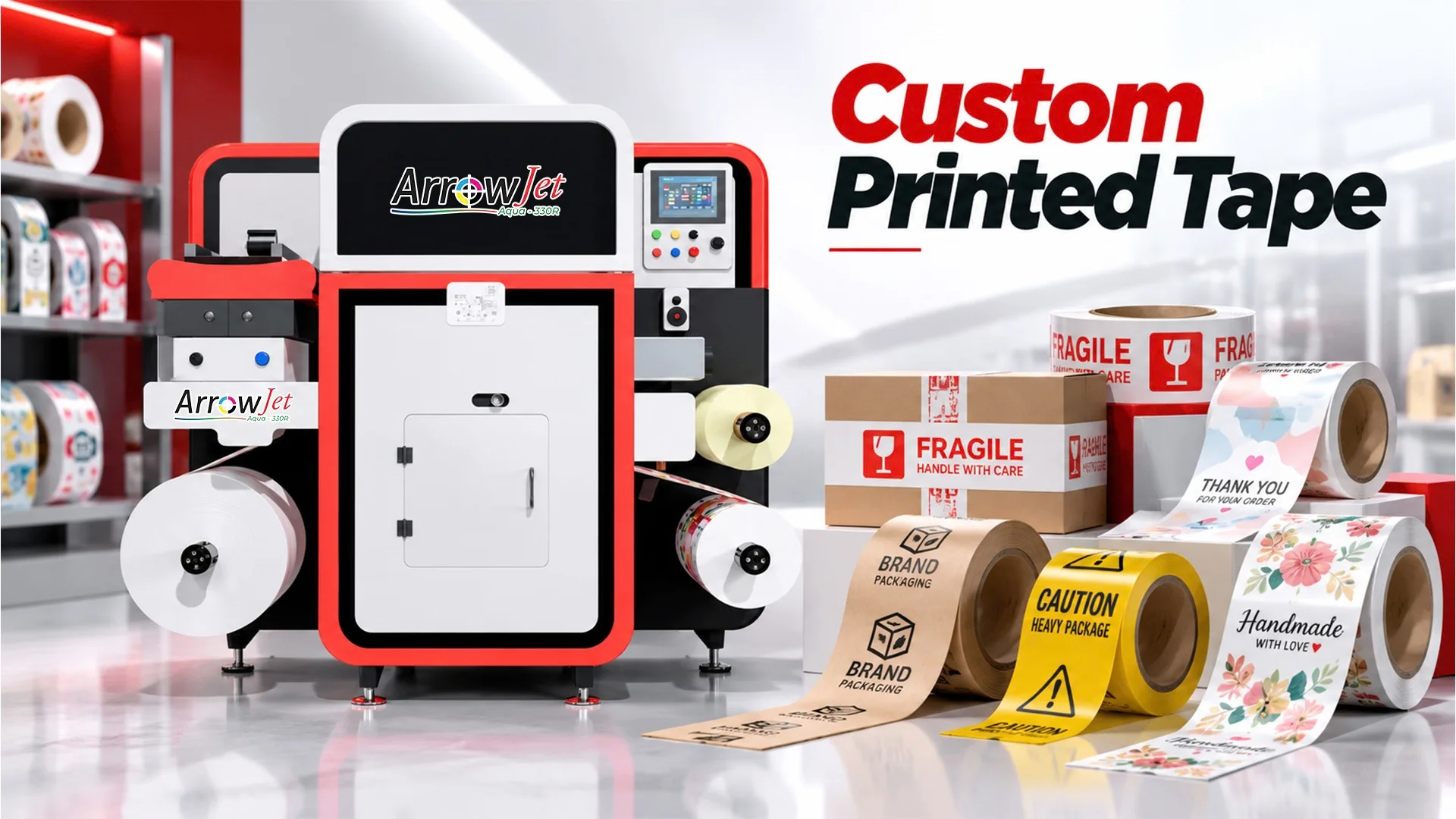
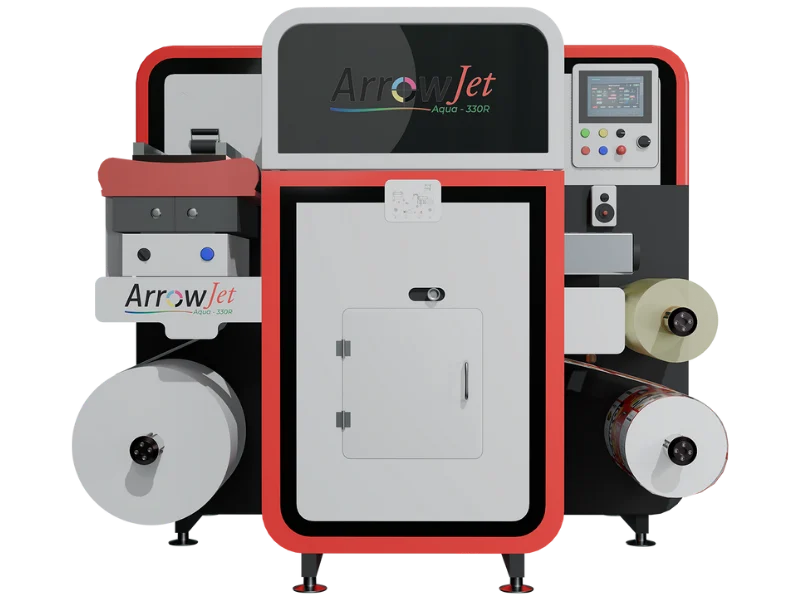
Digital inkjet printing, like the ArrowJet Aqua 330R Lite, uses a fundamentally different process:
No physical plates — artwork is digital from start to finish
Direct printing — ink is applied directly to the tape substrate
On-demand production — print exactly what you need, when you need it
Plate creation: sh
Setup waste: Minimal (5–10 feet for calibration)
Labor for setup: Minutes, not hours
Without fixed setup costs, there is no economic reason for minimum orders. You can print:
100 feet for a trade show sample
500 feet for a monthly supply
1,000 feet for a seasonal campaign
10,000 feet if you actually need that much
| Method | Practical Minimum | Cost for 500 Feet | Cost per 1,000 Feet |
|---|---|---|---|
| Flexographic | 5,000–10,000 feet | N/A (below MOQ) | 00–600 |
| Digital (ArrowJet) | 100 feet | 5–100 | 20–150 |
Note: Costs are estimates for comparison. Actual pricing varies.

Order 100–500 feet to verify print quality, test design variations, gather feedback, and refine before larger orders.
Case study: A jewelry brand ordered 200 feet with three different logo variations. Customer feedback favored one design, avoiding a costly long-term commitment.
Startup phase (0–50 orders/month):
Order 100–300 feet quarterly. No cash tied up.
Growth phase (50–200 orders/month):
Order 500–1,000 feet monthly. Test seasonal variations.
Scale phase (200+ orders/month):
Evaluate larger orders or hybrid approaches.
Holiday editions, summer campaigns, product launches, and event-specific packaging become viable.
Digital printing enables:
Customer segment messaging
Location-specific messaging
VIP personalization
A/B testing
Short runs enable creative uses:
Sample rolls for sales presentations
Trade show giveaways
Influencer kits
Press kits

Width: Up to 13 inches
Resolution: Up to 1600 × 1600 dpi
Speed: Production rates suitable for commercial short runs
Inks: Aqueous pigment (CMYK)
Reinforced water-activated tape
Non-reinforced water-activated tape
Various kraft paper weights and finishes
On-the-fly design changes
Variable data printing capability
Minimal setup waste
Immediate production start
| Cost Component | Flexographic | Digital (ArrowJet) |
|---|---|---|
| Setup/plates | 00–1,000 | sh |
| Waste/setup | 100–500 feet | 5–10 feet |
| Labor setup | 1–2 hours | 15–30 minutes |
| Per-foot printing | Lower at volume | Consistent |
| Design changes | New plates required | Digital file swap |
Under 5,000 feet: Digital is almost always cheaper
5,000–10,000 feet: Depends on complexity
Over 10,000 feet: Flexo may cost less but loses flexibility
Minimum: 100–300 feet
Best for: very small businesses with simple needs
Minimum: 100–500 feet
Best for: growing businesses with evolving needs
Minimum: 1 foot (theoretical)
Best for: businesses wanting full control and flexibility
Under 500 feet → External digital
500–2,000 feet → Evaluate in-house
Over 2,000 feet → In-house likely best
Rare → Flexographic
Seasonal → Digital external
Frequent → In-house digital
Limited → On-demand digital
Moderate → External digital
Strong → Consider equipment investment
Low → External printing
High → In-house production
No. The first foot and the 10,000th foot are identical.
Per-foot cost may be higher, but total cost is lower due to reduced waste and inventory risk.
Yes. The same high-quality tapes are available.
Consider quarterly ordering, negotiating shipping rates, or in-house production.
The concept of a minimum order is a relic of old printing technology. Digital printing has liberated businesses from arbitrary quantity requirements.
With the ArrowJet Aqua 330R Lite, the minimum order for custom printed tape is whatever serves your business:
100 feet to test a new design
500 feet for a monthly supply
1,000 feet for a seasonal campaign
10,000 feet if that is what you actually need
You should not have to commit to years of inventory to get professional branded packaging. You should not have to choose between custom tape and cash flow. You should not be stuck with obsolete designs because of a high minimum order.
The new answer to What is the minimum order? is simple:
There is not one.
Your business sets the minimum. Your needs determine the quantity. Your growth dictates the volume.
That is the power of digital printing.

Table of Contents Flexible Pet Packaging: Digital Printing for Pouches and Bags Flexible pet packaging — stand-up pouches and flat-bottom bags — is now the

Table of Contents GMP Label Printing for Supplements: A Manufacturer’s Guide to 21 CFR Part 111 GMP label printing for supplements means producing every bottle

Table of Contents Cannabis Gummy Packaging: Labels, Flexible Pouches, and State Compliance — A 2026 Brand Guide Cannabis gummy packaging must meet child-resistant standards, opaque-material

Table of Contents AAFCO Pet Food Label Requirements: 2026 Brand Guide AAFCO pet food label requirements define eight mandatory elements every dog and cat food

Table of Contents Vitamin Bottle Labels: Materials, Inks, and Compliance Guide HDPE supplement bottles require substrate, adhesive, ink, and workflow decisions that are compliance decisions

Table of Contents Custom Dog Treat Bags: In-House Printing for Pet Brands Pet treat brands bringing packaging in-house with digital presses eliminate 4–8 week converter