FSMA 204 Traceability: Food Label Requirements for 2026
Table of Contents FSMA 204 Traceability: Food Label Requirements for 2026 FSMA 204 is a recordkeeping rule, not a packaging mandate — but printing the

SKU proliferation packaging is the rapid expansion of product variations that creates complexity and cost for brands. You started with one product. One SKU. One sachet design. Then customers asked for caffeine-free. Then sugar-free. Then travel-size packs. Then a holiday edition. Then a collaboration with that influencer.
Now you have 47 SKUs. And a sachet printing nightmare.
Every new variation means new printing plates, new inventory, new storage, new complexity. Traditional sachet printing turns SKU proliferation into a profit killer. But it doesn’t have to be this way.
This proven guide explains how multi SKU printing with digital technology eliminates the penalties of SKU management CPG operations face daily.
With rotogravure or flexographic sachet printing, each SKU carries fixed costs that don’t scale with volume:
Per-SKU Fixed Costs:
The Math That Kills:
High minimum orders mean every SKU multiplies your inventory burden:
Example: 20 SKUs, 25,000-unit minimum each
This is why big CPG companies are constantly killing SKUs. The carrying costs devour profitability.
When changing a SKU requires new plates:
You’re locked into designs for years because changing them costs too much.
Modern consumers expect choice in SKU proliferation packaging:
E-commerce enables niche products:
Each niche is a potential SKU. But traditional sachet printing makes serving them unprofitable.
When competitors launch new variants, you must respond:
Without affordable flexible packaging short runs, you can’t compete.
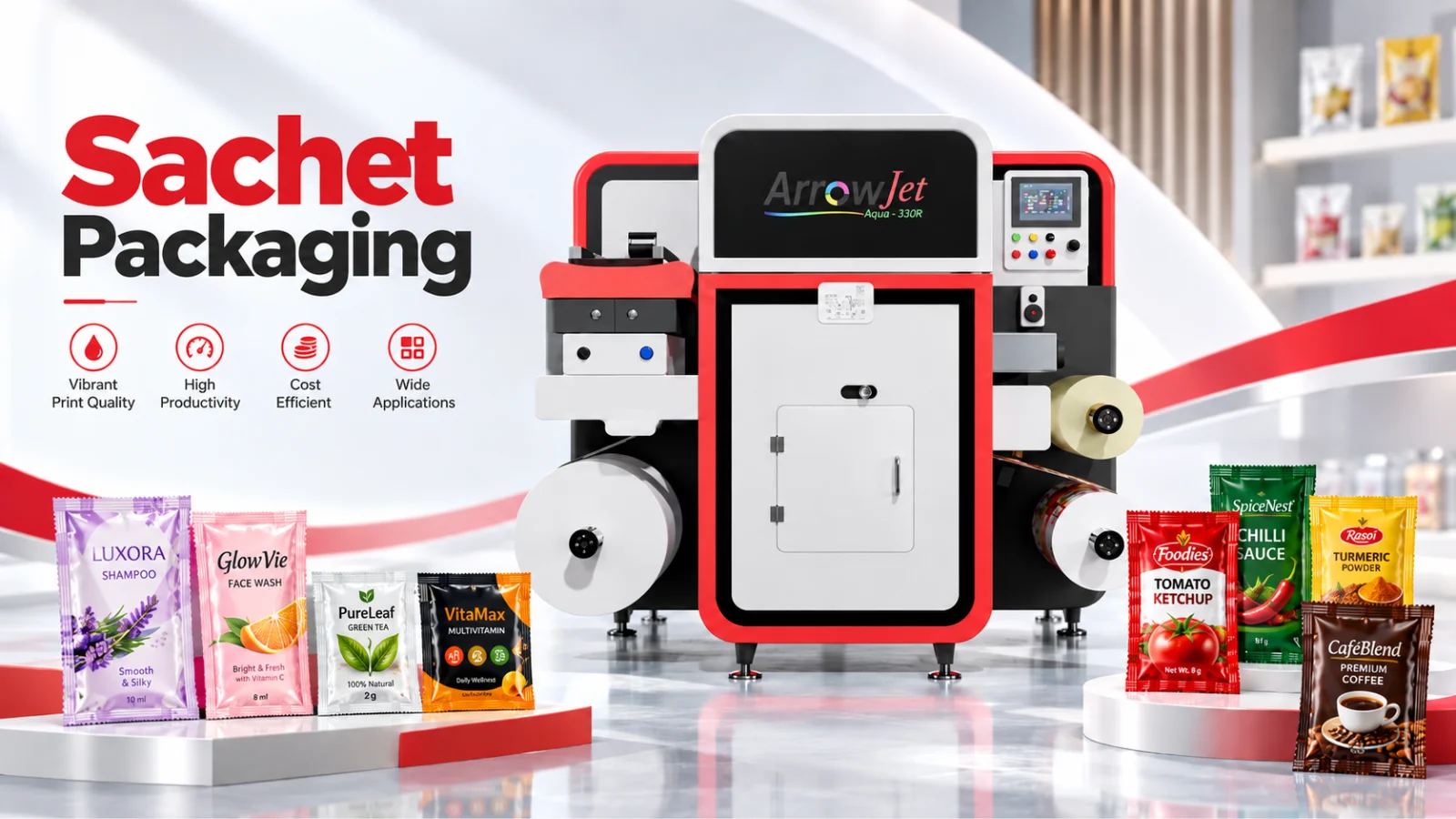
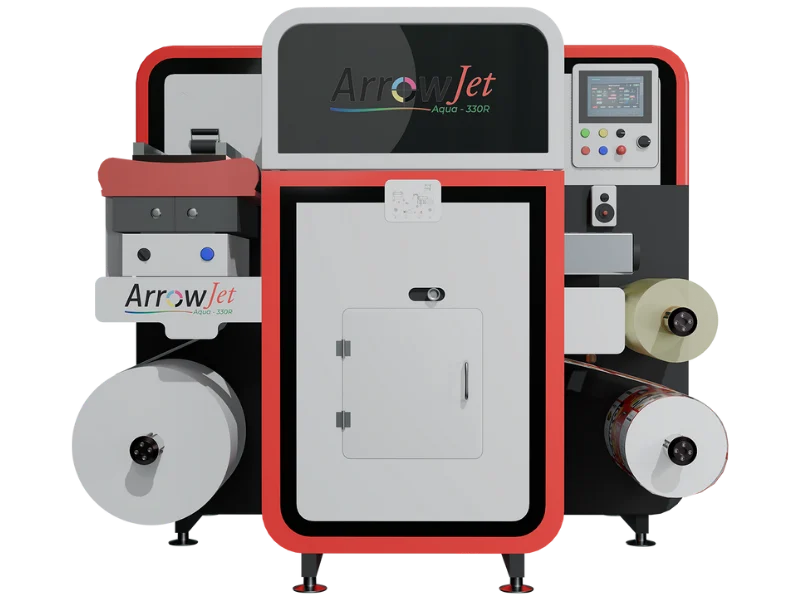
The ArrowJet Aqua 330R Lite uses digital inkjet technology that eliminates per-SKU setup costs for multi SKU printing:
Digital Economics:
The New Math:

Instead of stocking 25,000 units of each SKU:
Result: Same SKU variety, 90% less inventory.
When sales data shows:
You’re optimizing your SKU management CPG mix in real-time, not guessing 6 months ahead.
Challenge: Sports nutrition company wanted flavor variety as a competitive differentiator but couldn’t afford 40 sets of gravure cylinders.
Traditional Reality:
Digital Solution:
Result: 40-SKU portfolio, $0 obsolete inventory, data-driven product mix, acquired by major CPG within 2 years.
Challenge: Artisan tea brand wanted 12 seasonal blends (one per month) but couldn’t store 300,000 sachets (12 x 25,000).
Traditional Reality:
Digital Solution:
Result: Zero storage costs for sachets, always-fresh product, authentic seasonal positioning, 35% higher margins.
Challenge: Nutraceutical company discovered B2B opportunity (gyms, hotels, corporate wellness) but each client wanted private label.
Traditional Reality:
Digital Solution:
Result: B2B revenue grew from 5% to 45% of total sales, 60+ active private label relationships.
| Cost Category | Traditional Printing | Digital Sachet Printing |
|---|---|---|
| Setup costs | $100,000-300,000 | $0 |
| Initial inventory | $250,000 | $25,000 |
| Storage (annual) | $12,000 | $1,200 |
| Obsolescence (annual) | $25,000 | $2,500 |
| Total Year 1 | $387,000+ | $28,700 |
Assumes 20 SKUs, 25,000-unit traditional MOQ vs. 1,000-unit digital average
Beyond cost savings, flexible packaging short runs enable revenue opportunities:
Faster Time-to-Market:
Higher Hit Rate:
Premium Pricing:
A. Core SKUs (70% of volume)
B. Seasonal/Promotional (20% of volume)
C. Long Tail (10% of volume)
Weekly Review:
Monthly Optimization:
Quarterly Strategy:
The ArrowJet Aqua 330R Lite can print unique content on every sachet:
Batch/Lot Tracking:
Personalization:
A/B Testing:
80% of sales come from 20% of SKUs. With digital sachet printing:
Limit active SKUs per “decision point” to 3:
Use multi SKU printing to rotate options seasonally rather than carrying everything.
Define when to discontinue an SKU:
Digital sachet printing means killing SKUs doesn’t strand $50,000 in obsolete packaging.
Track SKU versions:
Digital makes version transitions seamless.
SKU proliferation packaging is the rapid expansion of product variations (flavors, sizes, formulations) that creates operational complexity and cost. In traditional sachet printing, each new SKU requires expensive plates or cylinders, making variety prohibitively expensive for small and mid-sized brands.
With traditional sachet printing, each SKU carries $5,000-15,000 in fixed setup costs for gravure cylinders or $500-2,000 per color for flexographic plates. Plus 1,000-5,000 units of setup waste. Digital printing eliminates these costs entirely.
Digital sachet printing with systems like the ArrowJet Aqua 330R Lite has no minimum order quantity. Print 100 units or 100,000 units—the setup cost is the same: $0. This enables true flexible packaging short runs.
Categorize SKUs into Core (70% volume, print 2,000-5,000 weekly), Seasonal (20%, print 500-2,000 as needed), and Long Tail (10%, print 100-500 to order). This SKU management CPG strategy maintains variety while minimizing inventory.
Yes. Digital multi SKU printing allows you to print SKU A for 30 minutes, switch files, and print SKU B immediately. No plate changes, no setup time, no waste. Perfect for flexible packaging short runs.
With digital sachet printing, design updates are instant. Upload the new file and the next sachet prints with the updated design. No new plates, no additional cost, no 4-6 week lead time.
Learn more about SKU proliferation packaging and flexible packaging short runs:
SKU proliferation packaging doesn’t have to be a cost center. With digital sachet printing, it becomes a competitive weapon:
The ArrowJet Aqua 330R Lite transforms SKU flexibility from a luxury only big brands can afford into a tool accessible to businesses of any size. Stop fighting SKU management CPG challenges. Harness them with flexible packaging short runs.
Ready to optimize your SKU portfolio? Contact Arrow Systems for a multi SKU printing assessment and ROI analysis tailored to your product mix.
Questions about flexible packaging? Call us at 1-888-697-2749

Table of Contents FSMA 204 Traceability: Food Label Requirements for 2026 FSMA 204 is a recordkeeping rule, not a packaging mandate — but printing the

Table of Contents White Space in Label Design: How to Use Negative Space Effectively White space — the open area around and between design elements

Table of Contents Cannabis Label Compliance in 2026: State Rules, Variable Data, and In-House Printing U.S. cannabis label compliance has no federal baseline — each

Table of Contents The American Bumper Sticker: A Brief History The American bumper sticker is a small adhesive label that became one of the most

Table of Contents Durable Equipment Labels: Polycarbonate vs Polyester vs Metal Polycarbonate and polyester each fail in predictable ways when misspecified — this guide maps

Table of Contents CBD Label Requirements: What Your Labels Must Say CBD labels must carry truthful product information, avoid medical or therapeutic claims, and comply