Natural Wine Label Printing: Design, Materials & In-House Options
Table of Contents Natural Wine Label Printing: Design, Materials & In-House Options Natural wine labels stand apart through bold illustration, farming values, and artistic identity
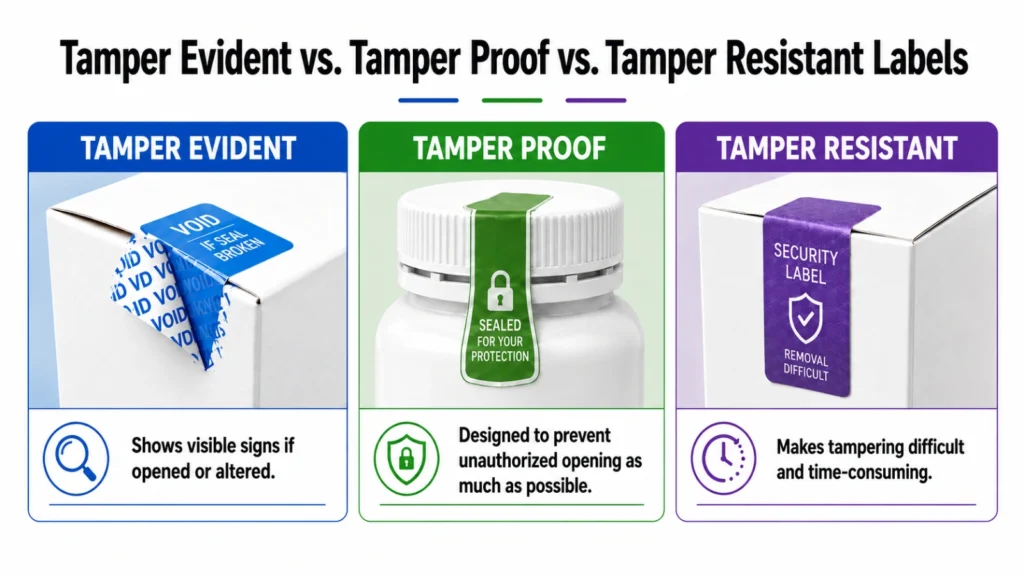
Tamper evident shows proof of access. Tamper resistant deters removal. Tamper proof combines both — the right choice depends on what the application actually requires.
A tamper evident label provides visible, irreversible proof that a product, package, or closure has been accessed or altered — its defining feature is evidence, not resistance.
The purpose is not simply to hold a package closed. It is to make any interference noticeable to the next person who handles the product. When someone attempts to remove a tamper evident label, the label breaks, separates, or visibly changes in a way that cannot be hidden without replacing the label entirely.
Common tamper evidence mechanisms include:
Tamper evident labels are standard across pharmaceuticals, food and beverage, nutraceuticals and supplements, cosmetics, medical devices, and secure document management — wherever evidence of access matters more than containment alone.
Tamper resistant labels make removal more difficult — but they do not always leave clear visual evidence that access occurred, which is a critical distinction in regulated industries.
The FDA draws a clear line between tamper evidence and tamper resistance: a tamper-evident seal cannot be removed without leaving clear visual evidence, whereas tamper-resistant packaging may deter interference without necessarily leaving obvious signs of removal.
A practical illustration: a sticker placed over a lid or cap may resist casual peeling. But if it can be removed and carefully reapplied without visible damage, it provides resistance without evidence. A shrink band or breakable seal that cannot be replaced once removed crosses into tamper evidence territory — interference becomes irreversible and detectable.
Use tamper resistant labels when deterrence is the primary goal. Where regulation or consumer safety requires proof that access occurred, tamper evident construction — or a combination — is necessary.
Tamper proof labels combine resistance and evidence in one construction — extremely difficult to remove cleanly, and designed to show clear signs when removal is attempted.
These labels are typically made with destructible materials: void polyester (which leaves a permanent “VOID” transfer on the substrate when peeled), destructible vinyl (which breaks apart into fragments that cannot be reconstituted), or holographic constructions that delaminate in ways that cannot be reversed. Many tamper proof labels are also waterproof and engineered to resist peeling in cold or wet conditions.
Common tamper proof label applications include:
A note on the phrase “tamper proof”: Few packaging choices can prevent every possible interference. “Tamper proof” is best understood as a high level of resistance and evidence combined — not an absolute guarantee. Define the specific performance level required for the application, then select a construction that meets that standard, and test it against the actual substrate and environment.
The three label security approaches differ on evidence, replaceability, typical materials, and the applications each is best suited to.
Label Type | Primary Purpose | Leaves Evidence of Removal? | Can Be Replaced Without Detection? | Common Materials |
Tamper Evident | Prove that access or alteration occurred | Yes — by design | No | Frangible paper, void polyester, holographic foil |
Tamper Resistant | Deter or slow removal attempts | Not always | Sometimes — depends on construction and care taken | High-tack adhesives, reinforced films, security overlaminates |
Tamper Proof | Prevent clean removal and confirm it was attempted | Yes | No | Destructible vinyl, void polyester, holographic constructions |
Label security performance is determined by the material and adhesive construction — not label design or printing alone.
A film construction where a hidden message — typically “VOID” or a repeating pattern — transfers permanently to the substrate surface when the label is peeled. The label face simultaneously loses the message, leaving evidence on both the label and the surface it covered. Used where surface damage is unacceptable but clear, permanent evidence of removal is required. Compatible with digital inkjet printing on specialty PET security stocks.
A brittle face material engineered to break into small, irregular pieces when removal is attempted. It cannot be peeled cleanly or transferred intact to another surface. Widely used in electronics, automotive, and asset management where preventing serial number transfer is the primary requirement. Standard paper-based digital presses can print on destructible vinyl provided the material thickness and surface treatment are within the press specification.
A brittle paper face that tears into multiple pieces if removal is attempted, leaving visible residue on both the label and the application surface. Typically lower in cost than film-based security options and suited to flat, smooth substrates. Not recommended for surfaces where adhesive residue creates a downstream problem.
Multi-layer labels incorporating a holographic foil element that deforms, tears, or separates visibly when removal is attempted. The holographic layer cannot be reconstituted or replicated without specialized manufacturing equipment. Used in brand authentication, high-value product protection, and anti-counterfeiting. UV inkjet presses — such as the ArrowJet UV 330H — can overprint on holographic PET and metallic label stocks, enabling customized security label production in-house.
High-tack or permanent adhesives increase bond strength and contribute to resistance, but they do not make a label tamper evident on their own. Combined with a frangible, void, or destructible face material, they significantly increase the difficulty of clean removal and raise the overall security performance of the label construction.
Security label requirements vary significantly by industry — driven by regulatory obligations, supply chain risk, consumer safety expectations, and brand protection strategy.
Industry | Primary Use Case | Typical Label Approach |
Pharmaceutical | Batch and lot integrity, anti-counterfeiting, patient safety compliance | Tamper evident / tamper proof |
Food and Beverage | Freshness seal integrity, consumer safety, packaging closure evidence | Tamper evident |
Nutraceuticals and Supplements | FDA compliance, consumer trust, anti-counterfeiting | Tamper evident / holographic |
Cosmetics and Personal Care | Package integrity, hygienic sealing, brand protection | Tamper evident / tamper resistant |
Electronics and Asset Tracking | Warranty voiding, serial number protection, asset identification | Tamper proof — void or destructible |
Automotive Parts | Manufacturer ID protection, counterfeit prevention, warranty management | Tamper proof — destructible vinyl |
Secure Document Management | Chain-of-custody evidence, closure integrity, record protection | Tamper evident |
Digital inkjet label presses can produce tamper evident and security labels on specialty substrates — giving operations teams direct control over print runs, serialization, and supply chain timing.
For brands and converters that produce security labels in-house, both the press and substrate compatibility determine what is achievable. Digital inkjet avoids the plate costs and minimum order quantities of conventional printing — enabling short runs, variable data (serialized lot numbers, QR codes, unique identifiers), and rapid changeover across SKUs without tooling changes.
Three ArrowJet presses cover the primary in-house security label production scenarios:
ArrowJet UV 330H — UV Inkjet for Specialty and High-Security Stocks
The UV 330H is a hybrid UV label press that prints on films, foils, metallic polyester, holographic PET, and synthetic substrates — the material range most commonly used in high-security label constructions. UV-cured inks provide strong adhesion to non-porous film surfaces and deliver scratch and chemical resistance directly off the press. For security label programs that include holographic or metallic stocks, or that require overprinting on pre-manufactured void polyester, the UV 330H is the appropriate starting point. It supports CMYK + White + Varnish configurations, enabling printing on clear and metallic substrates in a single pass.
ArrowJet Aqua 330R — Aqueous Pigment Inkjet for Paper and Coated Film Security Stocks
The Aqua 330R is a high-speed aqueous pigment inkjet label press built on Memjet DuraFlex technology, printing at up to 150 ft/min on paper and film substrates including BOPP, PET, and specialty coated stocks. For security label programs using paper-based frangible constructions or coated film security materials, the Aqua 330R delivers high-resolution production at industrial speeds. It handles variable data — barcodes, serial numbers, lot codes — natively through digital printing, making serialized security label runs operationally straightforward without plate changes.
ArrowJet Eco 330R — Compact In-House Entry Point for Security Label Production
The Eco 330R is a compact industrial single-pass digital press for operations scaling from outsourced or desktop label production into in-house manufacturing. It runs on single-phase power without an air compressor, reducing infrastructure requirements for smaller facilities. For operations producing moderate volumes of frangible or coated-stock security labels, the Eco 330R provides industrial press speed and resolution in a compact footprint. Confirm substrate compatibility with the Arrow team before specifying specialty frangible or void constructions.
Regulatory compliance for tamper-evident packaging — including FDA requirements for OTC pharmaceutical products, food safety standards, and industry-specific specifications — is the brand’s and converter’s responsibility and should be confirmed with qualified regulatory counsel. Arrow Systems sells label printing hardware; Arrow does not provide regulatory or compliance advisory services.
Start with the performance the label must deliver — evidence, resistance, or both — then work backward to material, adhesive, and press compatibility.
Is the goal to prove access occurred, to deter removal, to prevent counterfeiting, or to satisfy a specific regulatory requirement? Evidence and resistance are not interchangeable. Match the construction to the actual requirement, not to the broadest available label category.
Adhesion and evidence performance depend on the substrate. Curved, textured, or low-surface-energy surfaces (polyethylene, polypropylene, HDPE) require adhesives and face materials specifically engineered for those conditions. Test the complete label-substrate combination before committing to a specification — especially for frangible or void constructions where performance depends on controlled failure during removal.
Cold storage, wet or humid conditions, UV exposure, and chemical contact all affect label performance in service. Waterproof and laminated constructions handle harsh environments. Frangible paper and some adhesive systems behave differently at low temperatures. Confirm performance across the complete expected range before finalizing specifications.
If a legal or regulatory requirement calls for proof of access — not just deterrence — only a genuinely tamper evident construction qualifies. Tamper resistant construction alone is insufficient where visible, conclusive evidence of interference is a compliance requirement.
The FDA specifies requirements for OTC pharmaceutical tamper evidence that define acceptable mechanisms and labeling language. ASTM standards, ISO specifications, sector-specific guidelines, and retailer requirements may also define minimum performance criteria. Confirm which standards apply to the specific application before finalizing the label specification or press configuration.
Common questions from packaging, operations, and procurement teams evaluating security label options for product integrity and regulatory compliance.
No. Tamper evident labels show visible proof of access — they break, void, or visibly change when removal is attempted and cannot be replaced without that change being obvious. Tamper resistant labels make removal more difficult but may leave no clear evidence if someone removes and carefully replaces them. The FDA draws a regulatory distinction between the two that matters significantly in pharmaceutical and food packaging contexts.
Tamper proof labels are used for product security, brand authentication, serial number protection, and chain-of-custody record maintenance. Common applications include electronics (serial numbers that cannot be transferred), pharmaceuticals (lot labels requiring distribution-chain integrity), automotive parts (manufacturer ID that fragments on removal), and consumer goods where preventing clean label transfer to another surface is the core security requirement.
Common materials include void polyester (transfers a permanent VOID pattern to the substrate on removal), destructible vinyl (breaks apart into fragments when peeled), frangible paper (tears into multiple pieces on removal), and holographic constructions that delaminate visibly. Digital inkjet presses — including the ArrowJet UV 330H for film and holographic stocks and the ArrowJet Aqua 330R for coated paper and film — can print on a range of these security substrates in-house.
No. Labels provide evidence, deterrence, and risk reduction — not an absolute guarantee against all interference. The more productive question is: what specific level of evidence or deterrence does this application require? Choosing a construction that meets that defined standard — and testing it against the actual substrate and environment — is more reliable than seeking an absolute tamper proof outcome.
Pharmaceuticals, food and beverage, nutraceuticals and supplements, cosmetics and personal care, electronics, and secure document management are the most common users. Each industry has distinct regulatory requirements, consumer expectations, and performance standards that must be evaluated on an application-by-application basis rather than addressed with a single label specification.
If your operation is evaluating in-house security label production — or looking to print on void polyester, destructible vinyl, holographic, or other specialty security stocks — Arrow Systems can walk you through press and substrate compatibility for your specific application.

Table of Contents Natural Wine Label Printing: Design, Materials & In-House Options Natural wine labels stand apart through bold illustration, farming values, and artistic identity

Table of Contents Barcode Label Printing: What They Are, How They Work, and How to Print Them In-House A barcode label encodes product or tracking

Table of Contents Pet Food Label Design: AAFCO Compliance & Printing Guide Pet food labels must satisfy specific AAFCO label requirements — guaranteed analysis, net

Table of Contents Tamper-Evident Label Printing: Types, Applications & In-House Options Tamper Evident Label Printing provide visible proof of unauthorized opening — protecting consumers, brands,

Table of Contents Nutraceutical Packaging: Digital Printing for Short Runs Nutraceutical packaging digital printing eliminates plates, setup charges, and MOQs — so supplement brands and

Table of Contents Craft Beer Label Printing: TTB Approval, Design, and In-House Guide Craft beer labels must clear federal TTB COLA review before any product