Section 179 Label Printer Timing: Install Before December 31
Table of Contents Section 179 Label Printer Timing: Install Before December 31 A section 179 label printer purchase counts for 2026 only if the press
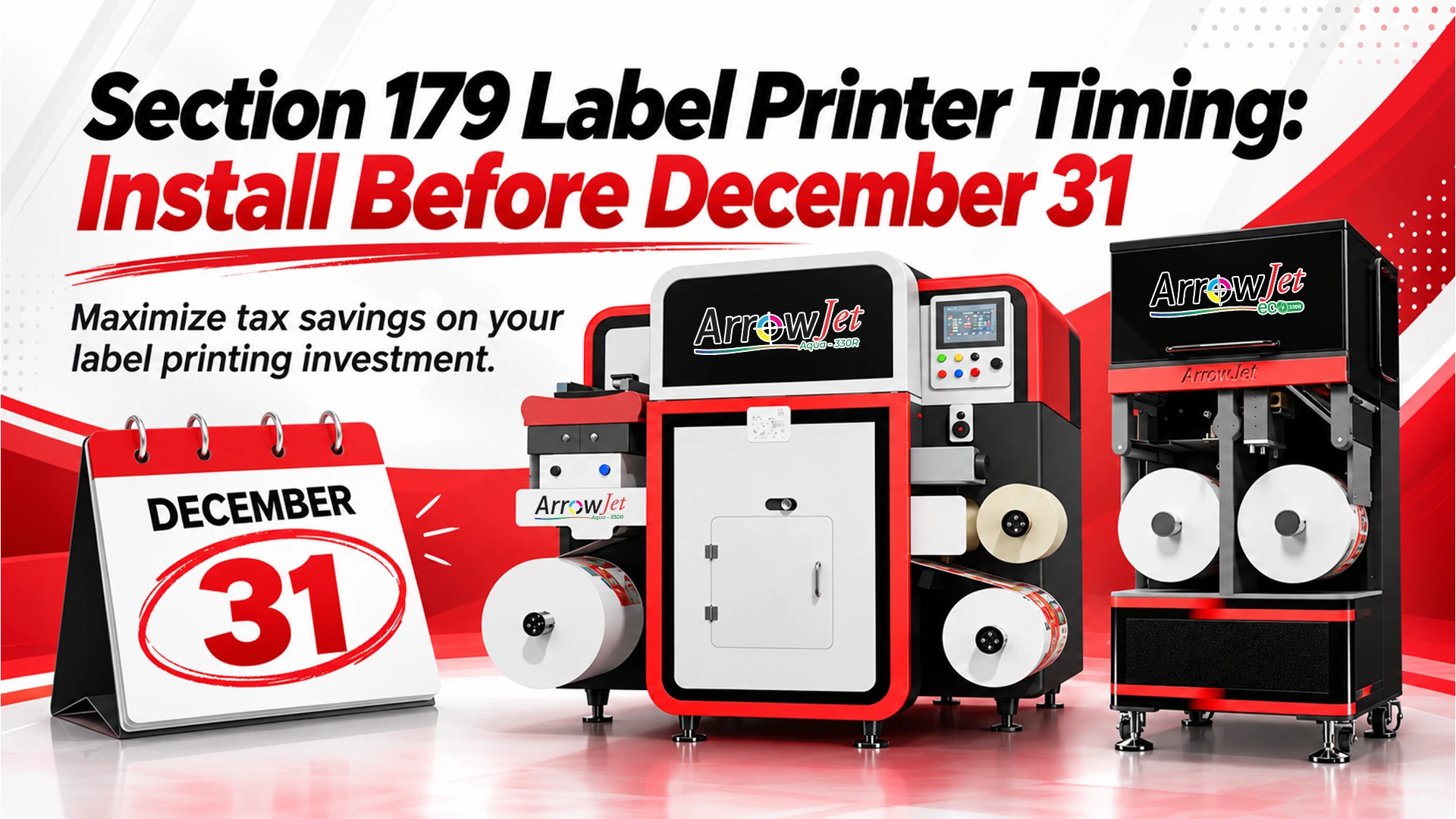
A section 179 label printer purchase counts for 2026 only if the press is placed in service, ready for use, by your tax-year end.
This guide is for operations, packaging, and finance leads planning a year-end equipment purchase and weighing in-house label printing in Q4. It covers label press purchase timing through a backward-scheduled installation timeline, a payback model that works without the tax effect, and the documentation your accountant will ask for. Bringing digital label printers in-house is also an operations automation step, because label output follows your production schedule instead of a converter’s queue.
Section 179 can let a business expense qualifying equipment in the year it is placed in service, subject to three limits.
Instead of depreciating the cost of tangible equipment over several years, Section 179 can let a business deduct that cost in the year the equipment is placed in service. Digital label presses and other Section 179 printing equipment are tangible property, so the definitions below decide whether a label press tax deduction lands in the current tax year.
Section 179 deduction
An election that lets a business expense the cost of qualifying tangible property in the year it is placed in service, rather than recovering the cost through depreciation over the asset’s recovery period.
2026 maximum Section 179 deduction
For tax years beginning in 2026, IRS Publication 946 sets the maximum Section 179 deduction at $2,560,000.
Phase-out threshold
The 2026 maximum is reduced dollar for dollar by the cost of qualifying Section 179 property placed in service during the year above $4,090,000.
Business income limitation
The Section 179 deduction is also limited by the business’s taxable income from the active conduct of a trade or business, so a qualifying purchase does not guarantee a full deduction in year one.
Placed in service
IRS Publication 946 treats property as placed in service when it is ready and available for a specific use, even if it is not yet being used. Accountants and lenders often record this date as the asset’s in service date. A label press sitting in crates on your dock generally does not meet that standard.
Tax-year deadline
December 31 is the placed-in-service deadline for calendar-year taxpayers. Fiscal-year businesses work to their own tax-year end.
Bonus depreciation
A separate accelerated depreciation provision that your accountant may compare against Section 179 for your situation.
Section 179 limits are set by law and have changed in recent years. Confirm the current figures against IRS guidance with your tax advisor before relying on them. Arrow Systems sells label printing hardware; Arrow does not provide tax or accounting advice.
Treat the December 31 deadline as a scheduling problem: a mid-October start leaves about 10 working weeks before holiday shutdowns.
Work backward from the deadline. The week targets and calendar windows below are illustrative planning targets, not commitments, and assume Week 1 starts Monday, October 19, 2026. Actual dates depend on configuration, freight, and facility readiness.
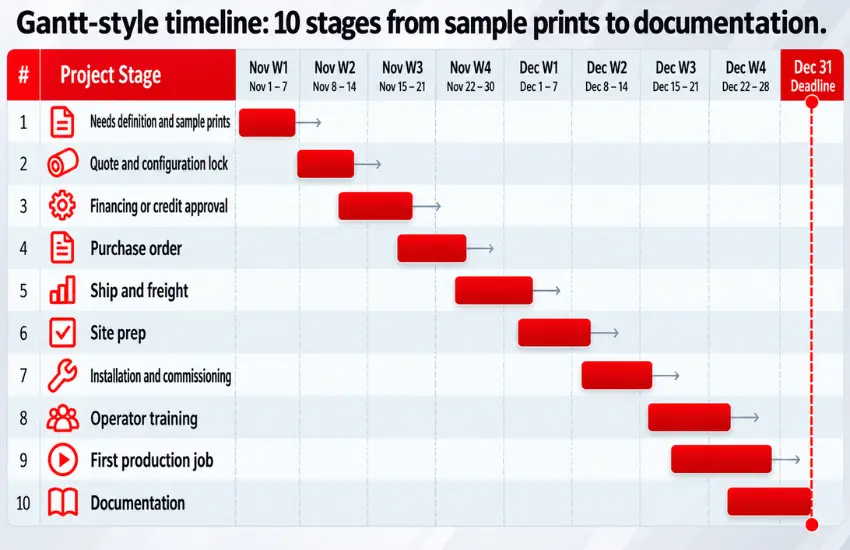
# | Stage | What must happen | Owner | Risk flag | Illustrative target | Example window (2026) |
1 | Needs definition and sample prints | Define label sizes, volumes, and substrates, then print samples on your own media. | Operations / Packaging | Untested substrates | Weeks 1–2 | Oct 19 – Oct 30 |
2 | Quote and configuration lock | Finalize the press, finishing, and RIP software. | Operations / Owner | Late add-ons | Weeks 2–3 | Oct 26 – Nov 6 |
3 | Financing or credit approval | Complete the credit application, lender review, and signatures. | CFO / Finance | Approval cycles stall in November | Weeks 3–4 | Nov 2 – Nov 13 |
4 | Purchase order | Issue the PO and confirm a ship window in writing. | Purchasing | PO waiting on financing | Week 4 | Nov 9 – Nov 13 |
5 | Ship and freight | Book a carrier and confirm dock and liftgate needs. | Purchasing / Receiving | Holiday freight congestion around Thanksgiving | Weeks 5–7 | Nov 16 – Dec 4 |
6 | Site prep | Complete electrical work, floor footprint, temperature and humidity control, network drop, and RIP workstation. | Facilities / IT | Electrician availability | Weeks 4–7 (in parallel) | Nov 9 – Dec 4 |
7 | Installation and commissioning | Set up, calibrate, and run test prints. | Vendor / Facilities | Site not ready on arrival | Week 8 | Dec 7 – Dec 11 |
8 | Operator training | Train at least two operators, including a backup. | Operations | Peak-season staffing gaps | Weeks 8–9 | Dec 7 – Dec 18 |
9 | First production job | Run a real job for a real SKU. | Production | No approved artwork ready | Week 9 | Dec 14 – Dec 18 |
10 | Documentation | Assemble invoice, delivery, sign-off, and job records. | Finance / Operations | Missing dates or signatures | Weeks 9–10 | Dec 14 – Dec 23 |
Schedule installation with buffer before your holiday shutdown weeks. A press that arrives on December 22 into a dark plant is a January installation, and a January installation generally moves the in-service date into the next tax year.
Financing approval
Credit approval often takes longer than the quote itself. Start the credit application while sample prints are still being evaluated, not after the configuration is locked.
Site prep
Site work is the most common hidden delay in a year-end label press installation. Confirm the required power supply, a level and clear footprint, and stable temperature and humidity before the freight date. If the configuration needs compressed air, plumb it before delivery, and have IT place the RIP workstation on the network.
Holiday shutdowns
Your plant, the equipment vendor, the freight carrier, and your electrician may each run a different holiday calendar. Align all four in writing before the PO is issued.
The legal test is readiness and availability for a specific use, so the records should prove the press was ready by your tax-year end. A signed commissioning record showing passed test prints and a training sign-off establish readiness. A dated log of a first production job printed for its intended use is the strongest supporting evidence, and it is the record accountants most often ask to see.
Standard configurations, pre-tested media, and a site ready before shipment are the lowest-risk path to a year-end installation.
Finishing add-ons
Lamination, die-cutting, or slitting modules add configuration, freight, and commissioning steps. If finishing is part of the plan, decide early whether it runs inline or offline; Arrow’s range of label finishing systems covers both approaches.
Custom configurations
Builds that differ from a standard configuration typically take longer to quote, assemble, and commission than a standard press.
Specialty substrates
Untested facestocks need print and adhesion testing before the configuration can be locked, which pushes every downstream stage.
Facility electrical work
New circuits, especially three-phase circuits that need permits, are the site-prep item most likely to slip into December.
Confirm current availability and installation scheduling directly with Arrow Systems, a digital label press and industrial label printer supplier, rather than assuming a ship date.
Sometimes delaying is the better choice. If ink type, finishing, or substrates are still under debate in late November, do not lock a configuration just to chase the calendar. A press that is wrong for your labels costs more than a deduction that shifts a year.
A label press purchase should pencil out on operating savings alone; an accelerated deduction mainly changes when the cost is recovered.
Costs you may avoid by printing in-house
Outsourced label spend, obsolete-label write-offs, rush and expedite fees, and overbuying driven by converter minimum order quantities.
New in-house costs
Consumables (ink and media), operator labor, and service.
Illustrative estimate only. This is not a quote or a tax projection.
Item | Annual amount (hypothetical) |
Outsourced labels avoided | $90,000 |
Obsolete write-offs avoided | $12,000 |
Rush fees avoided | $8,000 |
MOQ overbuying avoided | $10,000 |
Gross avoidable cost | $120,000 |
In-house ink and media | –$45,000 |
Labor | –$20,000 |
Service | –$7,000 |
Net annual savings | $48,000 |
Assume a hypothetical installed cost of $150,000. The table below compares payback with and without a hypothetical first-year tax benefit of $37,500, which your advisor would need to determine for your business.
Scenario (hypothetical) | Effective net cost | Net annual savings | Simple payback |
Without the tax effect | $150,000 | $48,000 | About 3.1 years |
With a $37,500 first-year tax benefit | $112,500 | $48,000 | About 2.3 years |
An accelerated deduction mainly changes timing, because regular depreciation would recover the same cost over later years. If the first scenario does not work for your operation, the second should not be what convinces you.
Beverage brand (hypothetical)
Seasonal SKUs rotate every quarter. In-house printing lets the brand print each flavor’s run close to filling instead of stocking a converter minimum for every flavor.
Nutraceutical company (hypothetical)
Every formula change scraps rolls of supplement facts labels. Printing to the production schedule shrinks the obsolete-label write-off line.
Specialty food or cosmetics brand (hypothetical)
Short runs of retailer exclusives carry high rush fees from outside converters. On-demand in-house output removes much of that premium.
Both presses use Memjet DuraFlex and water-based pigment ink; they differ most in speed, power, and compressed air needs.
For a year-end purchase, the site-prep requirements matter as much as print specifications, because electrical and air work are the items most likely to slip. The table below compares the two roll-to-roll presses on the factors that affect installation timing.
Factor | ArrowJet Eco 330R | ArrowJet Aqua 330R |
Print engine | Memjet DuraFlex® | Memjet DuraFlex® |
Ink | CMYK water-based pigment | CMYK water-based (aqueous) pigment |
Max print width | 324 mm (12.75 in) | 324 mm (12.75 in) |
Resolution | 1600 × 1600 dpi | Up to 1600 × 1600 dpi |
Max print speed | Up to 20 m/min (about 65 ft/min) | 90, 150, or 195 ft/min speed tiers |
Power | Single-phase 230V | Three-phase 220V / 400V |
Compressed air | Not required | 6 bar air supply |
Drying | IR dryer (optional) | NIR drying technology available for higher speeds |
Max roll at unwind | 350 mm diameter, 40 kg | 500 mm diameter, 100 kg |
Machine size and weight | 78 × 106 × 168 cm (L × W × H), 430 kg | Confirm with Arrow Systems for your configuration |
Year-end site-prep implication | No three-phase circuit or compressed air line to install | Start three-phase electrical and air work in parallel with financing |
ArrowJet Eco 330R: the shortest site-prep path
The ArrowJet Eco 330R is a compact, entry-level single-pass digital press for labels and flexible packaging. It runs on single-phase 230V power and does not need an air compressor, so the two site-prep items that most often delay a December installation are off the list. It prints CMYK water-based pigment ink at up to 20 m/min on paper labels, coated papers, inkjet-treated substrates, and flexible packaging, with gap and black mark sensors for pre-cut label registration. It fits teams moving short and medium runs in-house for the first time.
ArrowJet Aqua 330R: higher throughput with more site prep
The ArrowJet Aqua 330R is a high-speed aqueous pigment roll-to-roll press that prints labels and flexible packaging at up to 195 ft/min, with NIR drying for higher speeds and an upgrade path to a 10L bulk ink system. It is Nestlé Guidance compliant, which matters for food and beverage brands. It needs three-phase power and a 6 bar compressed air supply, so schedule that facility work in Week 4 alongside the purchase order rather than after delivery.
Durability and finishing
Both presses print water-based pigment ink. Labels facing moisture, abrasion, or chemical contact may call for lamination, a topcoat, or specific coated media, so include those finishing steps in the configuration you lock in Weeks 2–3.
For either model, confirm current availability, installation scheduling, compatible substrates for your application, and the operator training plan with Arrow Systems before issuing the PO.
Eligibility, deduction amount, state conformity, and financing treatment are tax decisions for your advisor, not your equipment vendor.
This article does not determine any of the following:
Document | What it supports | Typical owner |
Invoice | Cost basis of the label press and any included finishing or software | Finance |
Payment or financing terms | How the purchase was acquired and financed | Finance |
Bill of lading or delivery receipt | Date the press arrived on site | Receiving |
Signed installation and commissioning record | Date the press was installed and passed test prints | Operations / Vendor |
Training sign-off | Date operators were ready to run production | Operations |
First production job log, with date | Evidence the press was ready and available for its intended use | Production |
Common questions from operations and finance teams timing a label press investment before the tax-year end.
A digital label press is tangible business equipment, the general category Section 179 addresses. Whether a specific purchase qualifies depends on how the press is used and acquired, the business’s taxable income, and the current annual limits. A tax advisor makes that determination based on the full situation and current IRS guidance.
The in-service date generally counts. IRS Publication 946 treats property as placed in service when it is ready and available for a specific use, even if it is not yet being used. Signing a PO, paying an invoice, or receiving delivery does not establish that date on its own, so plan installation and commissioning before your tax-year end.
A press that is delivered but not yet installed and operational is generally not considered placed in service. For a calendar-year taxpayer, a January installation would generally move the in-service date into the following tax year. Confirm the treatment with your accountant, and schedule installation ahead of holiday shutdowns to reduce this risk.
It depends on the structure. Financed purchases and different lease types can be treated differently for tax purposes, and the specific agreement terms matter. Share the financing or lease documents with your tax advisor before signing so they can confirm the likely treatment for your business.
The deadline that matters is the in-service date, not the PO date. Work backward through financing, freight, site prep, installation, and training, keep the documentation tight, and make sure the payback works without the tax effect so the decision holds even if timing slips.
A year-end planning call with Arrow Systems tests whether your timeline is realistic. Confirm current ArrowJet Eco 330R and Aqua 330R availability, map a delivery-to-install schedule against your December 31 or fiscal-year target, review power and air requirements for your facility, and request sample prints on your own substrates. Bring your tax advisor’s questions: the call validates the operational timeline, and your accountant handles the tax side.
Table of Contents Section 179 Label Printer Timing: Install Before December 31 A section 179 label printer purchase counts for 2026 only if the press

Table of Contents Beer Label Curling in Cold Storage: Diagnose the Mismatch Beer label curling in cold storage signals a facestock, adhesive, or application mismatch
Table of Contents Paper vs. Film Labels: A Substrate Buyer’s Guide Paper wins on cost and aesthetics in dry, indoor conditions; film wins wherever moisture,

Table of Contents In-House Label Printing vs. Print on Demand: Cost by Volume In-house label printing vs. print on demand comes down to a cost-per-label
Table of Contents Pharmaceutical Label Version Control Workflow for FDA Changes A GMP label version control workflow moves an approved revision to the line: change
Table of Contents Mylar vs BOPP Flexible Packaging: Substrate Selection Guide PET (Mylar) leads on oxygen and aroma barrier and heat tolerance; BOPP leads on