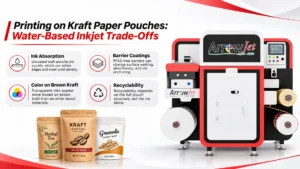
Printing on Kraft Paper Pouches: Water-Based Inkjet Trade-Offs
Table of Contents Printing on Kraft Paper Pouches: Water-Based Inkjet Trade-Offs Printing on kraft paper pouches with water-based pigment inkjet works when the print process
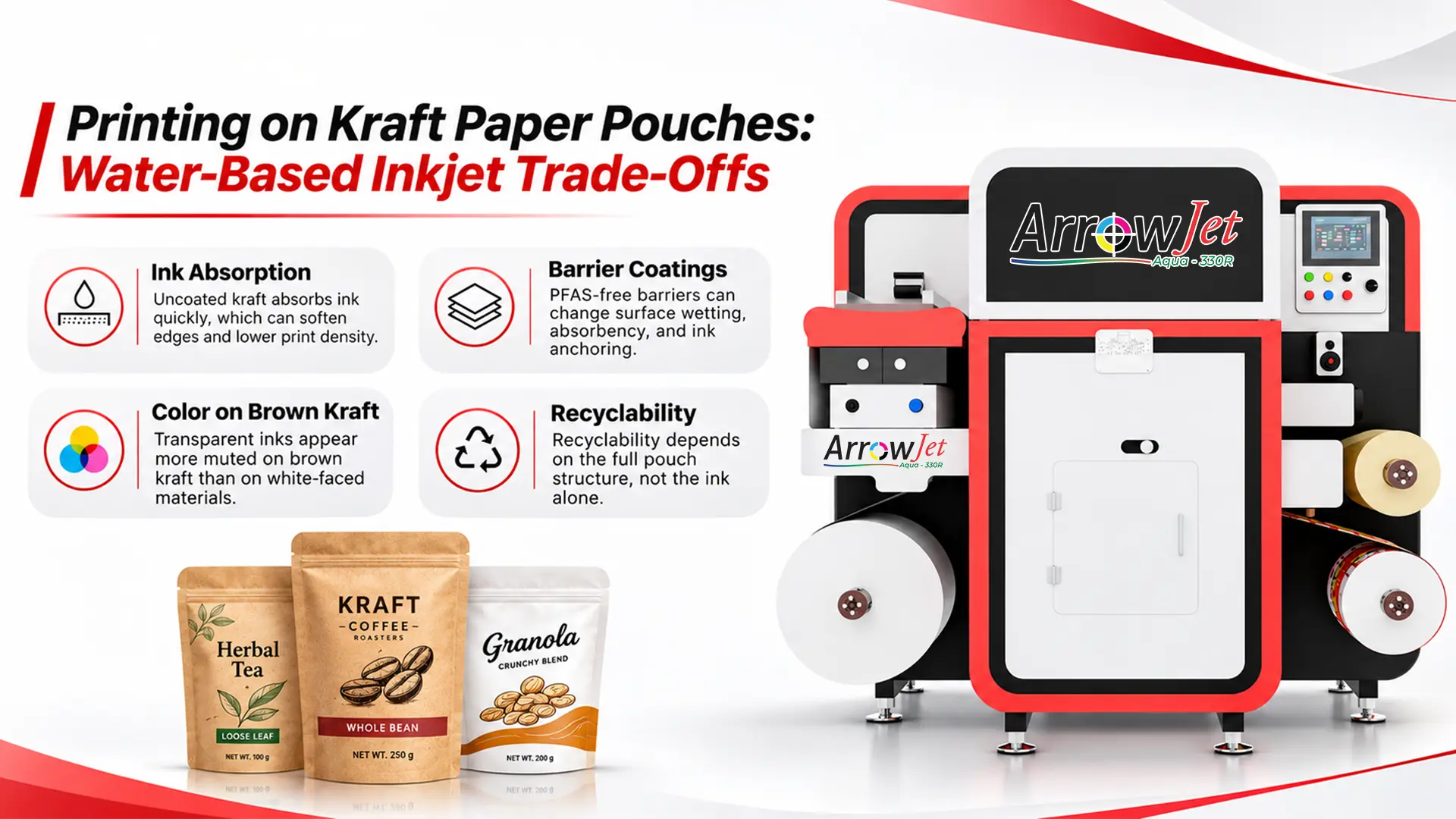
Printing on kraft paper pouches with water-based pigment inkjet works when the print process matches the paper grade, barrier coating, and laminate.
Packaging EPR fees, retailer plastic targets, and PFAS restrictions are pushing food brands to move pouches and wraps from plastic film to paper.
Packaging EPR laws and producer fees
Seven U.S. states have enacted packaging extended producer responsibility (EPR) laws: California, Colorado, Maine, Maryland, Minnesota, Oregon, and Washington. Oregon became the first state to implement its program in July 2025, with obligated producers paying fees to a producer responsibility organization that funds recycling. Many retailers layer their own plastic-reduction targets on top of these laws.
Paper as a procurement requirement
For many brands, a sustainable flexible packaging substrate is now a procurement requirement rather than a sustainability goal. That shift makes paper based flexible packaging printing a near-term engineering problem for packaging, QA, operations, and compliance teams.
FDA phase-out of PFAS grease-proofing agents
The FDA announced on February 28, 2024 that grease-proofing substances containing PFAS are no longer sold for food-contact use in the U.S. market. In January 2025, the agency determined that 35 food contact notifications for PFAS grease-proofing coatings on paper and paperboard are no longer effective.
State PFAS restrictions on paper food packaging
States add their own rules on intentionally added PFAS. Washington prohibits PFAS in paper food wraps since February 1, 2023, and in paper food bags and sleeves since May 1, 2024. Scope and timelines vary by state, so verify current obligations with counsel or your compliance team.
Products that suit paper pouches
Paper structures generally suit dry, shelf-stable products: dry snacks, whole-bean or ground coffee, confectionery, bakery wraps, and powdered beverages. High-moisture, high-fat, retort, or strongly oxygen-sensitive products usually still need a substantial film or foil barrier, which narrows both print options and recyclability claims.
Ink follows the print face: uncoated kraft absorbs and spreads ink, coated paper holds it near the surface, and laminates follow their paper grade.
In kraft pouch printing, as in most flexible packaging, the pouch is printed as roll stock first. The printed web is then laminated and converted into stand-up, pillow, or flat pouches, or run as wraps. That sequence sets where the ink sits relative to the food-contact side and which layers and processes the ink must survive.
How water based ink on kraft behaves
Uncoated kraft is highly absorbent, so water-based ink wicks along the fibers. The result is softened edges on text and line art, lower optical density, and mottling in large solids. Bleached kraft brightens the base, but it absorbs water-based ink on kraft fibers in much the same way.
Process levers for absorbent kraft
Four levers do most of the work on uncoated kraft: a primer or pre-coat, controlled ink laydown, drying and heat management, and a print mode tuned for absorbent stock.
Ink holdout on coated paper
Clay-coated and other coated grades hold ink near the surface, which produces sharper dots and stronger density. The finished look is cleaner but less natural than uncoated kraft.
Drying on coated paper
Water stays on a coated surface longer before it absorbs, so coated paper packaging inkjet work often needs adjusted dryer settings compared with uncoated kraft.
Print face of a paper laminate pouch
A paper laminate pouch pairs paper with PE or with a metallized or barrier film. Printing happens on the paper face, so ink behavior follows the paper grade.
Curl, web handling, and lamination
The film layer adds curl, web-tension sensitivity, and recyclability questions. When the web is printed before lamination, confirm the ink tolerates the laminating adhesive and lamination heat.
Food-contact note for outside print
Ink on the outside of the pack still needs attention to set-off in the roll, odor, and migration. Confirm suitability with your ink and substrate suppliers and your regulatory team.
Substrate | Ink holdout | Visual result | Barrier options | Recyclability considerations |
Natural (unbleached) kraft | Low; high absorption | Earthy, muted color; softer detail | Aqueous dispersion coatings | Typically fiber-dominant; check coating repulpability |
Bleached or white-faced kraft | Low to moderate | Brighter color; natural texture | Aqueous dispersion coatings | Similar to natural kraft; confirm coating behavior |
Clay-coated paper | Moderate to high | Sharper dots, stronger density | Barrier coatings on reverse or face | Coating type and weight affect repulping |
Paper/PE or paper/barrier film laminate | Depends on paper face | Depends on paper grade | Film, metallized, or barrier layers | Non-fiber layer weight and type are critical |
Treat this table as a starting filter, not a verdict. Final selection should be validated on your actual paper grade, barrier coating, and conversion path.
PFAS-free barrier coatings can change surface energy, absorbency, curl, and ink anchoring, so confirm the coated side before any print trial.
Most fluorochemical replacements are aqueous dispersion coatings or other water-based barrier chemistries. A PFAS-free barrier coating usually goes on the food-contact side, but some constructions coat both sides, and coating can bleed toward the print face during manufacture.
Non-fluorinated options for paper bags already exist. Washington’s 2022 alternatives assessment identified densified paper and wax-coated options as safer alternatives to PFAS in food bags and sleeves.
Confirm the coated side with the paper supplier before you set up a single print trial.
Barrier coatings can change four properties that affect printing:
Surface energy
Surface energy controls how well water-based ink wets the coated paper.
Absorbency
Absorbency controls print density and how fast the ink dries.
Curl
Coating-induced curl affects web handling through the press and the laminator.
Anchoring
Anchoring determines how firmly the ink bonds to the coated surface.
A material that passes grease testing can still fail a tape adhesion test or scuff after conveying and case packing. Request coated test rolls, not uncoated equivalents, and run tape, rub, and scuff checks on the actual material.
Sealing jaws expose printed areas near the seals to heat and pressure. After conversion, check graphics for gloss changes, ink pickoff, and cracking at folds and gussets.
Hypothetical example: A snack brand moves a grease-prone product to a paper laminate with a PFAS-free barrier. It prints test rolls, converts sample pouches, and finds acceptable color but marginal scuff resistance at the seal area. The team then evaluates a print-mode adjustment and an overprint option before approving the structure.
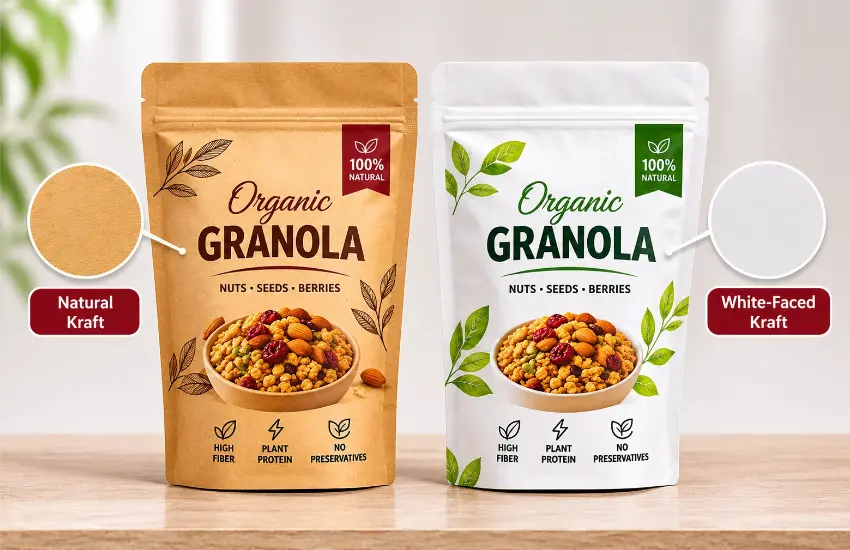
Transparent pigment inks take on the brown base, so natural kraft compresses the color gamut and caps brightness when no white ink is used.
Pigment inkjet inks are transparent. On kraft, the brown base shifts every color, compresses the available gamut, and caps brightness. Without white ink, a pastel or bright brand color designed for white film will not reproduce on natural kraft.
Build substrate-specific ICC profiles for each paper grade. Always proof on the actual production roll stock, never on white proof paper. Get brand and marketing sign-off on kraft-specific color targets early, before artwork for any kraft stand-up pouch print run is final.
Agree on any color tolerance with the brand owner. A Delta E target is an internal agreement between you and the brand, not an industry standard for kraft.
Hypothetical example: A specialty coffee roaster compares natural and white-faced kraft for a stand-up pouch. Natural kraft suits its earthy brand but dulls a signature orange. The roaster keeps natural kraft for the core line and specifies white-faced stock for a limited-edition SKU where the orange matters.
Recyclable paper pouch printing depends on fiber content, non-fiber layers, coating repulpability, and how inks and varnishes behave in repulping.
Paper-stream acceptance generally depends on four factors:
Fiber content
The share of paper fiber in the finished pouch sets the starting point for paper-stream acceptance.
Non-fiber layers
The weight and type of film, metallized, or barrier layers determine how much material a mill must screen out.
Coating repulpability
Barrier and functional coatings must separate or disperse cleanly when the paper is repulped.
Ink and varnish behavior
Inks and overprint varnishes must behave predictably during repulping and deinking.
No universal fiber percentage guarantees acceptance. Programs, mills, and regions apply their own criteria. The Sustainable Packaging Coalition’s paper recyclability testing guide frames laboratory and pilot testing around indicators that include repulpability, fiber yield, and the presence of contaminants.
Recyclable paper pouch printing depends on more than the ink. Heavy varnishes, some plastic-based coatings, and certain laminates can affect repulping even when the ink performs well.
How2Recycle’s Guide to Future Recyclability lists coated flexible papers and multimaterial flexible packaging among current recyclability-challenged formats. A paper pouch with a barrier coat or film layer therefore needs supporting test data before it carries a recyclable claim.
Check current guidance from How2Recycle, the AF&PA Design Guidance for Recyclability, or regional equivalents. Request repulpability test data from your paper, coating, and ink suppliers. Treat every recyclability claim as something to verify, not assume.
Run these eight steps on coated production roll stock before you commit artwork, material orders, or a recyclability claim.
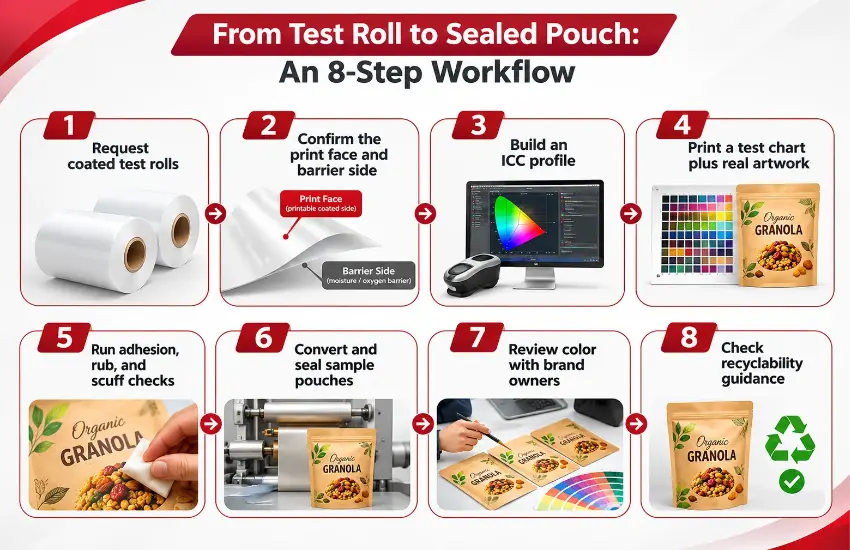
Step 1: Request coated test rolls
Ask the paper supplier for the exact grade with the production barrier applied, not an uncoated equivalent.
Step 2: Confirm the print face and barrier side
Document which side carries the barrier and which side takes ink before mounting the roll.
Step 3: Build an ICC profile
Create a profile specific to the paper grade and print mode, not a generic paper profile.
Step 4: Print a test chart plus real artwork
Include solids, fine text, barcodes, and brand colors so absorption, feathering, and scan grades all show up.
Step 5: Run adhesion, rub, and scuff checks
Test after full drying and again after roll storage to catch set-off and late adhesion loss.
Step 6: Convert and seal sample pouches
Inspect graphics at the seals, folds, and gussets for gloss change, ink pickoff, and cracking.
Step 7: Review color with brand owners
Approve against kraft-specific color targets on the production substrate, not on white proof paper.
Step 8: Check recyclability guidance
Match the final structure to program guidance and supplier repulpability data before making any claim.
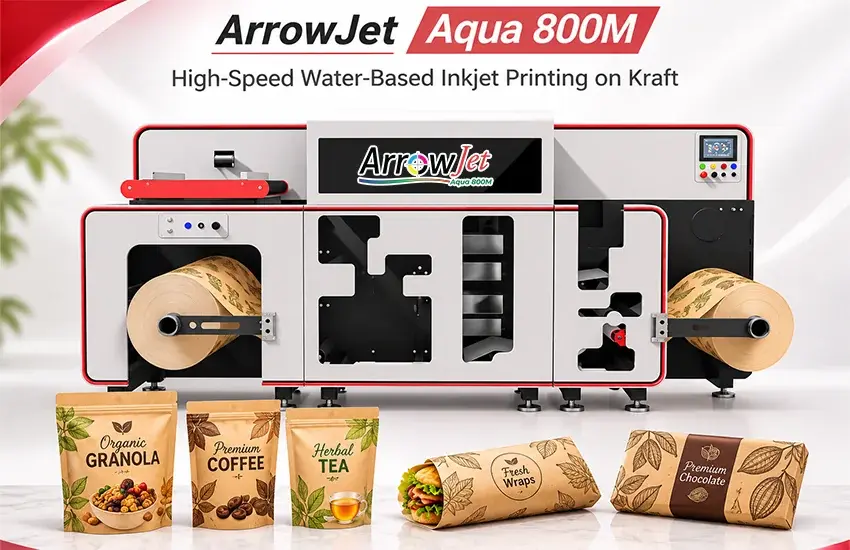
The ArrowJet Aqua 800M and ArrowJet Aqua 330R print water-based pigment ink on paper roll stock for in-house pouch and wrap production.
Arrow Systems, an industrial label and printer hardware integrator, builds both presses on Memjet water-based pigment inkjet technology, and both sit within Arrow’s range of digital flexible packaging printers. For paper-based flexible packaging printing, the right model depends mainly on web width and run profile.
ArrowJet Aqua 800M for wider pouch layouts and paper wrap printing
The ArrowJet Aqua 800M prints up to 638 mm (25.1 in) wide on media up to 800 mm wide, which suits wider pouch layouts and paper wrap printing for items such as bakery wraps. It runs a Memjet DuraCore print engine at 90, 150, or 195 ft/min, with full 1600 x 1600 dpi resolution at 90 ft/min, and includes an NIR dryer. Supported materials include coated paper, laminate papers, PP, PET, BOPP, Mylar, and Tyvek.
ArrowJet Aqua 330R for narrower webs, labels, and pilot runs
The ArrowJet Aqua 330R prints up to 324 mm (12.75 in) wide on a Memjet DuraFlex print engine at the same 90, 150, and 195 ft/min speed tiers, with NIR drying. It suits narrower roll-to-roll work such as labels, smaller pouches, and pilot runs on coated paper, PP, PET, PVC, BOPP, Mylar, and Tyvek.
Lower primer coats and uncoated stocks
Both presses use pigmented inks that need lower coating weights than water-based dye inkjet, and both are compatible with lower primer coats and some uncoated stocks. On kraft, primer weight affects material cost, color, and how much of the natural paper look survives.
Ink compliance documentation
Memjet’s water-based pigment inks list compliance with California Proposition 65, REACH, and the EUPIA Exclusion Policy, adherence to Model Toxics in Packaging Legislation, and partial alignment with GMP guidelines, the Swiss Ordinance, and Nestlé Guidance. Ink documentation is one input; food-contact suitability still depends on the full pouch structure.
Specification | ArrowJet Aqua 800M | ArrowJet Aqua 330R |
Maximum print width | 638 mm (25.1 in) | 324 mm (12.75 in) |
Print engine | Memjet DuraCore | Memjet DuraFlex |
Print speed tiers | 90, 150, and 195 ft/min | 90, 150, and 195 ft/min |
Resolution | 1600 x 1600, 1600 x 954, and 1600 x 640 dpi | 1600 x 1600, 1600 x 954, and 1600 x 640 dpi |
Substrate thickness | 0.05 to 0.35 mm | 0.05 to 0.35 mm |
Maximum roll diameter | 600 mm (23.6 in) | 500 mm (19.7 in) |
Drying | NIR dryer | NIR dryer |
Best fit for paper packaging | Wider pouch layouts and paper wrap printing | Narrower pouch webs, labels, and pilot runs |
Kraft pouch digital printing removes printing plates from the equation. That makes it practical to trial several paper grades or support seasonal SKUs without committing to large flexo orders, and a brand can run many SKUs at short run lengths without plate costs for each variant.
Printing roll stock to the production schedule, rather than to minimum order quantities, reduces obsolete pre-printed inventory when artwork, regulatory copy, or the SKU mix changes.
Common questions from packaging, QA, and operations teams moving food pouches and wraps from plastic film to kraft and paper laminates.
Yes, with trade-offs. Uncoated kraft absorbs water-based pigment ink quickly, so fine text can feather and solids may print lighter or mottled. A primer or pre-coat, lower ink laydown, tuned drying, and an absorbent-stock print mode usually improve results. Test on the actual roll stock before approving artwork.
They can. Aqueous barrier coatings change surface energy and absorbency, and a coating on or near the print face can cause poor wetting or anchoring. Confirm which side carries the barrier, request coated test rolls, and run tape adhesion, rub, and scuff tests after sealing heat exposure.
You generally cannot match white-film brightness, because transparent inks take on the brown base. Design for kraft instead: dark, high-contrast colors, bold line art, and visible fiber as a design element. Where brand colors are critical, use bleached or white-faced kraft or coated panels, and proof on production roll stock.
It depends on the full structure, not the ink alone. Acceptance generally depends on fiber content, the weight and type of film or coating layers, coating repulpability, and how inks and varnishes behave in repulping. How2Recycle lists coated flexible papers and multimaterial flexible packaging among recyclability-challenged formats, so request repulpability test data from suppliers before making a claim.
Primary regulatory and recyclability sources used in this guide; check each for updates before relying on it for a specific structure.
Regulatory and recyclability validation, including state PFAS restrictions, EPR obligations, food-contact suitability, and recyclable claims, is the brand’s responsibility and should be confirmed with qualified regulatory counsel. Arrow Systems sells printing hardware; Arrow does not provide regulatory or compliance advisory services.
Before moving a pouch or wrap to paper, confirm the print face and barrier side, proof color on production kraft against brand-approved targets, run adhesion, rub, and scuff checks after conversion and sealing, and verify recyclability against program guidance and supplier repulpability data.
Send Arrow Systems your candidate kraft, coated paper, or paper laminate roll stock, including PFAS-free barrier-coated grades, for a sample print evaluation on the ArrowJet Aqua 800M or ArrowJet Aqua 330R. A short consultation maps your run lengths, SKU mix, and web width to the right press before you commit to artwork or large material orders.
Table of Contents Printing on Kraft Paper Pouches: Water-Based Inkjet Trade-Offs Printing on kraft paper pouches with water-based pigment inkjet works when the print process
Table of Contents Multi-Site Label Printing Standardization: A Fleet Press Guide Multi-site label printing standardization means one press model, one finisher model, one substrate list,
Table of Contents GS1 Sunrise 2027 2D Barcode Labels: Fix Verification Failures GS1 Sunrise 2027 2D barcode labels usually fail verification for four print-side reasons,
Table of Contents Textured Label Printing: Embossed-Look Labels Without Dies Textured label printing stacks clear UV varnish in layers on a digital press to build
Table of Contents Digital Label Converter Equipment for Short-Run Brand Accounts Winning short-run brand accounts takes a matched stack: a right-sized digital press, fitted finishing,
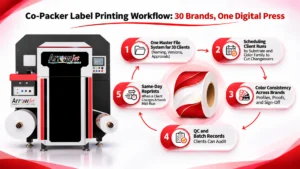
Table of Contents Co-Packer Label Printing Workflow: 30 Brands, One Digital Press A co-packer label printing workflow lets one digital press run labels for dozens