GS1 Sunrise 2027 2D Barcode Labels: Fix Verification Failures
Table of Contents GS1 Sunrise 2027 2D Barcode Labels: Fix Verification Failures GS1 Sunrise 2027 2D barcode labels usually fail verification for four print-side reasons,

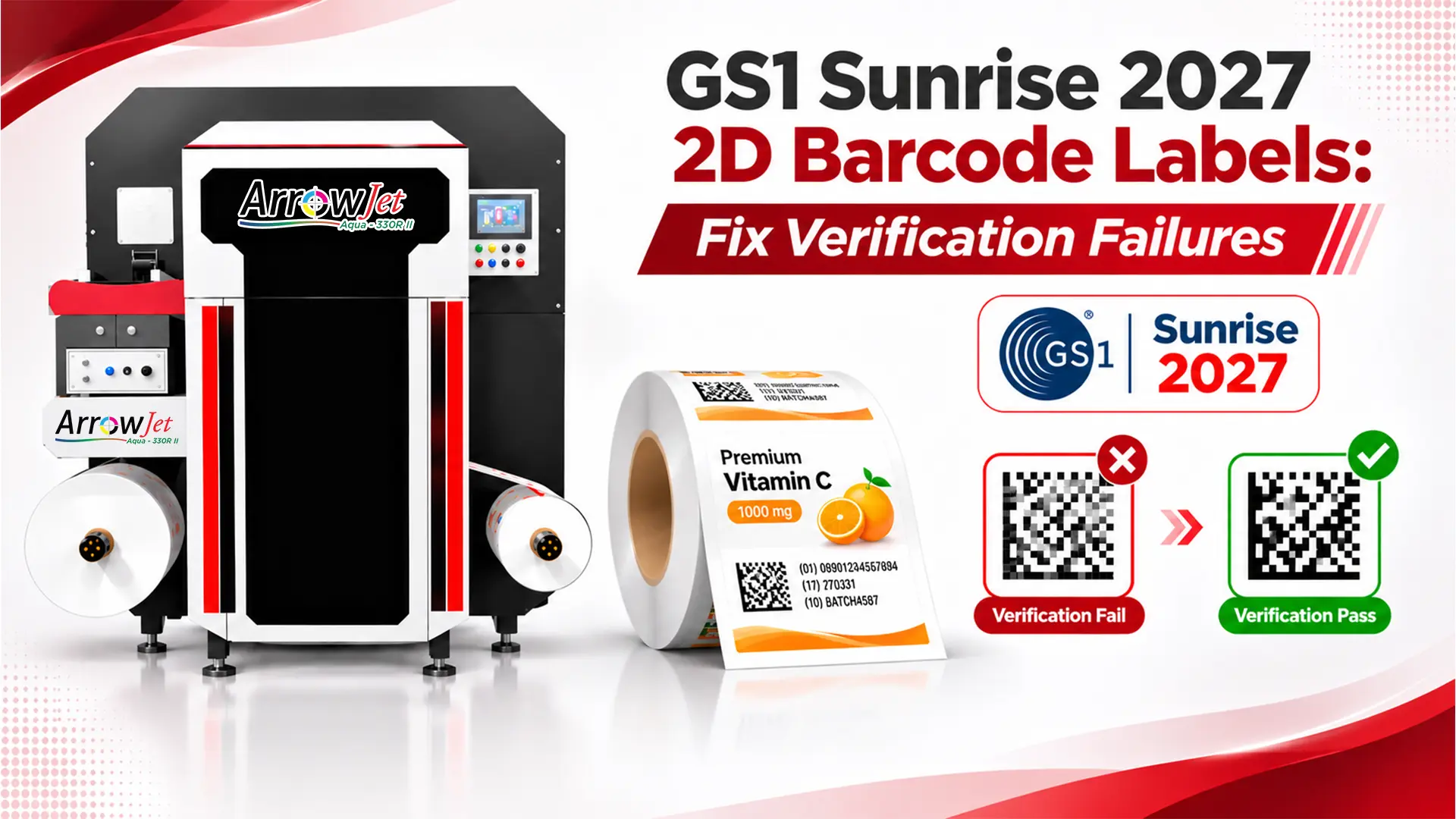
GS1 Sunrise 2027 2D barcode labels usually fail verification for four print-side reasons, rarely because the encoded data is wrong.
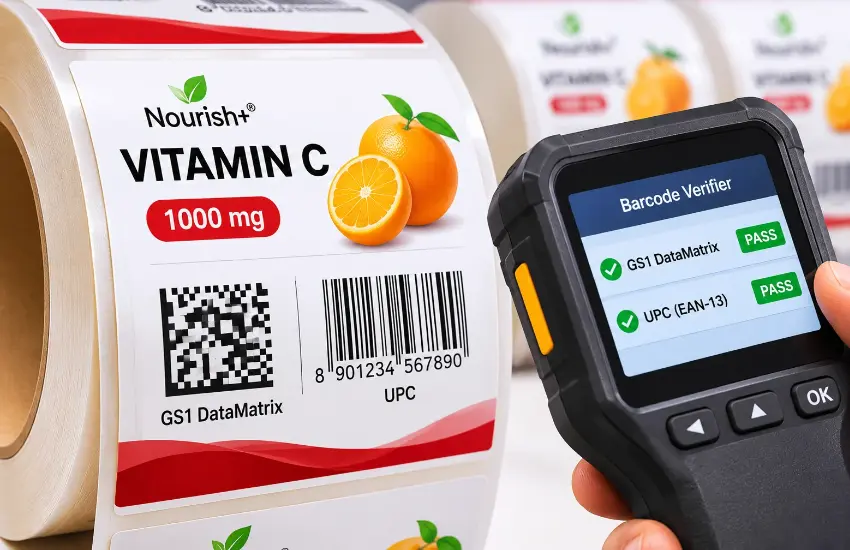
Sunrise 2027 aims for retail checkouts to scan 2D barcodes by the end of 2027, with 2D codes printed next to the UPC, not instead of it.
This guide is for packaging, QA, and label-room teams that print 2D barcodes in house on digital presses. Today a low grade usually surfaces in a retailer audit or a customer complaint. As checkout scanners gain 2D capability, the same low grade can cause slow scans, rescans, and bad data at the register.
GS1 Sunrise 2027
A GS1 US industry initiative, not a government regulation, that aims for retail point-of-sale systems to scan 2D barcodes by the end of 2027. Retailers upgrade on their own timelines, so confirm expectations with each trading partner.
Ambition 2027
GS1’s global name for the same goal: retail POS scanning that reads the GTIN from both existing linear barcodes and 2D barcodes by the end of 2027.
Dual-marking during the transition
GS1 guidance says a product carrying a 2D barcode must also carry a POS linear barcode (EAN/UPC or GS1 DataBar) until 90% of POS scanning solutions can read GS1 2D barcodes.
2D placement rule
The 2D barcode should sit within 50 mm (1.97 in) of the center of the linear barcode, so cashiers keep their target pace of 40 to 70 items per minute.
Why brands add 2D codes
A 2D code can carry batch or lot numbers, expiration dates, and serial numbers alongside the GTIN. A GS1 Digital Link URI in a QR code can also connect shoppers to product information online.
Three 2D symbols are approved for retail POS, and a QR code at point of sale must carry a GS1 Digital Link URI. All three share the same size and quality specification; only the quiet zone differs.
Symbol | Typical use | X-dimension (min / target / max) | Quiet zone | Minimum quality |
GS1 DataMatrix | Compact lot, expiry, and serial data in GS1 element string syntax | 0.396 / 0.495 / 0.990 mm | 1 module on all four sides | 1.5/12/660 |
Data Matrix with GS1 Digital Link URI | Compact symbol carrying a web-resolvable product URI | 0.396 / 0.495 / 0.990 mm | 1 module on all four sides | 1.5/12/660 |
QR Code with GS1 Digital Link URI | Consumer-facing retail packs and web-resolvable product data | 0.396 / 0.495 / 0.990 mm | 4 modules on all four sides | 1.5/12/660 |
Values for trade items scanned at general retail POS (GS1 symbol specification table 1, addendum 2). 2D X-dimensions are set at 1.5 times the equivalent linear barcode X-dimension. Regulated healthcare and direct part marking use separate tables.
Pharma and medical device teams already work this way. FDA’s DSCSA product identifier uses a 2D data matrix barcode on each prescription drug package, and FDA’s UDI rule (21 CFR 801.40) requires every UDI label to show the identifier in both plain text and automatic identification and data capture (AIDC) form. Food and CPG label rooms can adopt the same verification discipline.
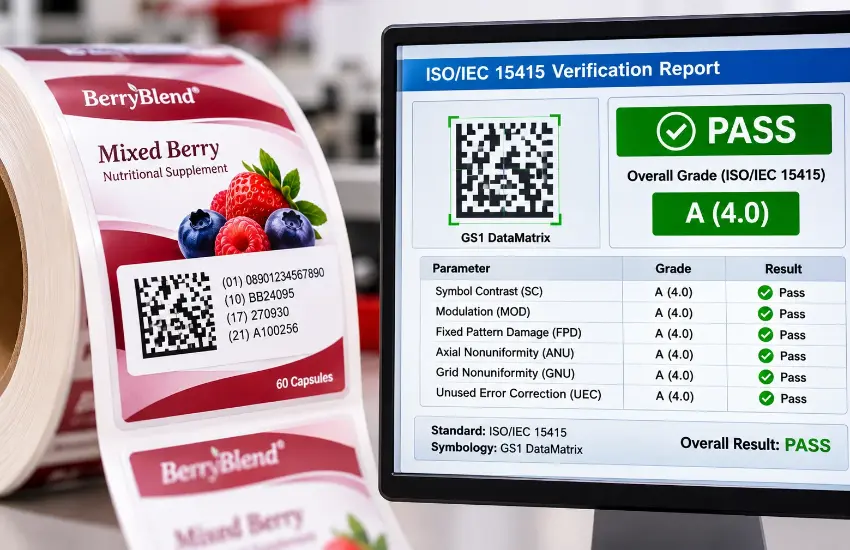
A verifier grades print quality under controlled light and aperture; a phone only proves the code decodes under forgiving conditions.
Smartphone apps are built to be forgiving. They use aggressive decoding, make many attempts per second, and adapt to whatever lighting is available. A barcode verifier does the opposite: it measures the symbol against ISO/IEC 15415 (often shortened to ISO 15415) using a defined aperture and 660 nm red light, the same wavelength as retail POS scanners. The verifier itself should conform to ISO/IEC 15426-2.
Decode
Whether the symbol decodes with the reference algorithm. A failed decode grades 0 (F) regardless of every other parameter.
Symbol Contrast
The difference in reflectance between the light and dark areas of the symbol. Low Symbol Contrast points to substrate, ink color, or background problems.
Modulation and Reflectance Margin
How uniform the dark and light modules are relative to overall contrast, and how clearly each module falls on the correct side of the light/dark threshold. The 2024 edition of ISO/IEC 15415 reports these as one combined parameter; older verifiers list them separately.
Fixed Pattern Damage
Damage to the finder pattern, timing patterns, and quiet zone. Crowded artwork and scuffed ink both show up here.
Axial Nonuniformity
Whether modules are stretched more in one direction than the other, a typical sign of uneven dot rounding or web-speed variation.
Grid Nonuniformity
How far module positions drift from an ideal grid across the symbol.
Unused Error Correction
How much error-correction capacity remains after decoding. A low value means the code is already spending its safety margin on print defects.
Print Growth
Whether modules print larger or smaller than nominal, measured in both directions. The 2024 edition of ISO/IEC 15415 grades Print Growth; earlier editions such as ISO/IEC 15415:2011 only reported it.
ISO 15415 grading works parameter by parameter: each parameter is graded from 4.0 down to 0, which maps to A through F, and the 2024 edition reports grades to one decimal place. The overall symbol grade equals the lowest parameter grade. One weak parameter fails the whole code, even if every other parameter scores an A.
A GS1 DataMatrix print quality grade is only meaningful with the aperture and light it was measured under, which is why GS1 writes the requirement as three numbers.
1.5: minimum overall grade
The lowest acceptable overall symbol grade, equal to a C. A code grading 1.4 fails the specification even if it scans.
12: measuring aperture
The aperture reference number, meaning a 0.30 mm (0.012 in) diameter measuring aperture. Set the verifier to this aperture, or grades will not be comparable with your retailer’s.
660: light wavelength
Illumination at 660 nm, a narrow-band red light that matches retail POS scanners. This is why ink color choice matters so much for 2D codes.
When a module is not a whole number of printer dots, rounding prints some modules one dot wider than others and the grid goes uneven.
What the verifier shows
Low Axial Nonuniformity, low Grid Nonuniformity, and sometimes weak Modulation.
Why it happens
A digital press places ink only on a fixed dot grid. If the X-dimension is not a whole number of dots, the RIP rounds each module, and the error lands unevenly across the symbol. Percentage scaling makes it worse: shrinking a code to 87% in design software almost guarantees fractional modules.
Why resolution matters
At the 0.495 mm GS1 target X-dimension, one dot is about 8.6% of a module at 600 dpi but about 3.2% at 1600 dpi. A finer grid makes each rounding error a smaller share of the module, which matters most on small codes near the 0.396 mm minimum. Note that a 10 mil (0.254 mm) module, common in older healthcare examples, is below the retail POS minimum.
The table shows how many printer dots a module spans at common X-dimensions. Whole numbers print cleanly; fractions force rounding.
X-dimension | 600 dpi | 1600 × 1600 dpi | 1600 × 960 dpi (down-web) | 1600 × 640 dpi (down-web) | Fit |
0.495 mm (19.5 mil), GS1 target | 11.69 | 31.18 | 18.71 | 12.47 | Fractional on every grid |
0.508 mm (20 mil) | 12 | 32 | 19.2 | 12.8 | Whole at 600 dpi and 1600 × 1600 dpi |
0.635 mm (25 mil) | 15 | 40 | 24 | 16 | Whole on every grid listed |
0.762 mm (30 mil) | 18 | 48 | 28.8 | 19.2 | Whole at 600 dpi and 1600 × 1600 dpi |
Dots per module at nominal resolution. For the 1600 × 960 and 1600 × 640 dpi modes, the figure is the down-web direction; cross-web stays at 1600 dpi. All X-dimensions shown are inside the GS1 retail POS range of 0.396 to 0.990 mm.
Presses that offer faster, lower down-web resolution modes add a second trap. A module that is whole cross-web but fractional down-web prints taller than it is wide on some rows, which shows up as Axial Nonuniformity even when the artwork is perfect.
How to fix it:
The quiet zone is part of the symbol; text, tints, or a label edge inside it can fail a code that otherwise prints perfectly.
What the verifier shows
Decode failures, or low Fixed Pattern Damage when the verifier evaluates the quiet zone.
Why it happens
How to fix it:
Under 660 nm red light, the substrate and ink color decide contrast; clear films, foils, kraft, and red inks are the usual culprits.
What the verifier shows
Low Symbol Contrast and low Modulation or Reflectance Margin.
Clear BOPP or PET
The “light” background becomes whatever sits behind the label, such as dark liquid, powder, or an amber bottle.
Metallic films
Specular reflection bounces verifier lighting unpredictably, so light areas can read as dark.
Colored or kraft stocks
These lower background reflectance before any ink goes down.
Red and warm-colored dark modules
Retail scanners and verifiers use 660 nm red light, under which red dark modules reflect like the background and read as light. GS1 advises avoiding red for 2D barcodes.
How to fix it:
Modules that grow, smear, or scuff after printing fail Print Growth, Modulation, or Fixed Pattern Damage, often after the label leaves the press.
What the verifier shows
High Print Growth, lower Modulation, and Fixed Pattern Damage that appears after handling.
Why it happens
How to fix it:
Press choice directly affects two of the four failure modes: how modules land on the dot grid, and how much contrast the substrate allows.
Arrow Systems, a manufacturer and integrator of digital label printers, builds presses aimed at each of these two problems. A high resolution label printer and white ink do not replace good artwork, but they give a label room more working room.
ArrowJet Aqua 330R II: module precision at 1600 × 1600 dpi
The ArrowJet Aqua 330R II prints up to 1600 × 1600 dpi on a Memjet DuraCore™ engine with water-based pigment ink, across a 12.69 in (322 mm) print width. In its full-resolution mode, which runs at 90 ft/min, a 0.495 mm module spans about 31 dots in both directions, so each rounding error is about 3% of the module. That supports Axial and Grid Nonuniformity scores on small pharma, nutraceutical, and food labels where X-dimensions sit near the low end of the GS1 range.
ArrowJet Aqua 330R II: matching code size to the speed mode
The press also runs faster 1600 × 960 and 1600 × 640 dpi modes, which trade down-web resolution for speed. For jobs carrying 2D codes, run the 1600 × 1600 dpi mode or set the X-dimension to a value such as 0.635 mm (25 mil) that is a whole number of dots in all three modes.
ArrowJet Aqua 330R II: drying before rewind
The press dries its water-based ink with adphos aNIR® near-infrared drying technology. Confirm the ink is fully dry at your production speed and substrate before rewinding, since smearing in the roll shows up later as Fixed Pattern Damage.
ArrowJet UV 330H: white underprint for contrast
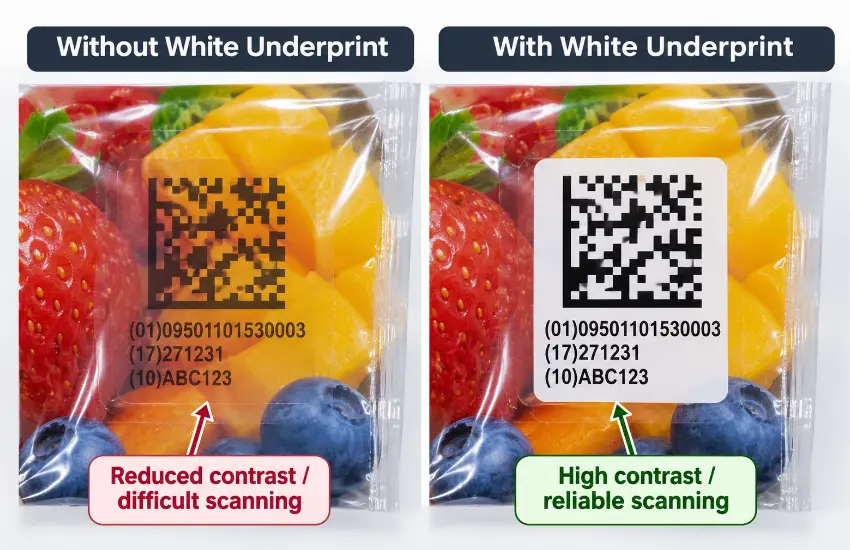
The ArrowJet UV 330H is a hybrid roll-to-roll and flatbed UV press available in CMYK + White, CMYK + Varnish, and CMYK + White + Varnish configurations. Its opaque white lets you print a white flood directly behind the code on clear, metallic, and dark substrates, which creates a controlled light background regardless of the product, liquid, or foil behind the label. That addresses the most common cause of low Symbol Contrast on high-impact SKUs.
ArrowJet UV 330H: varnish and the code area
Spot varnish and clear ink add gloss that can change how the verifier reads the code. Keep varnish off the code area, or include it in first-article verification so the grade reflects the finished label. See the full range of ArrowJet UV label printers for white ink and varnish options.
On any press, stable 2D barcode grades come from a repeatable workflow built into the job ticket, not from checks after a complaint.
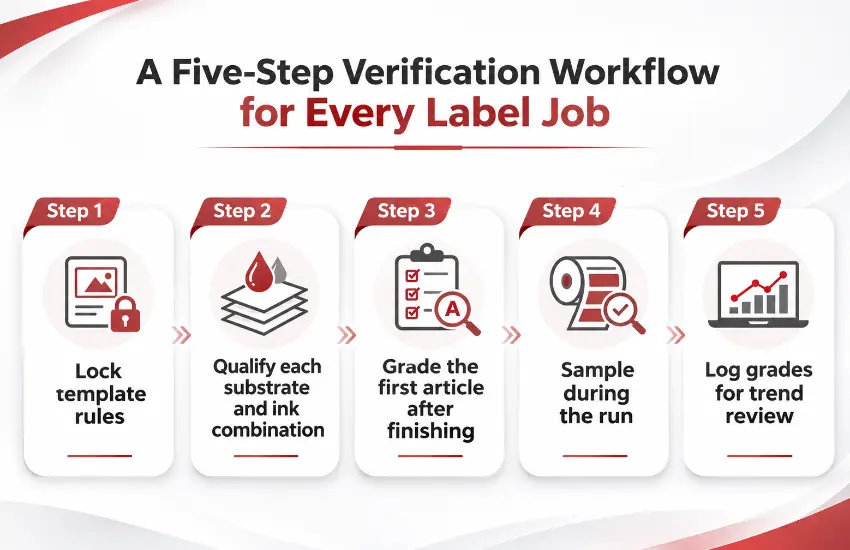
Step 1: Lock template rules
Fix the X-dimension, quiet zone, and keep-out zones in every label template. Use a whole-dot X-dimension inside the GS1 range of 0.396 to 0.990 mm, and lock 1 module of clearance for GS1 DataMatrix or 4 modules for QR Code plus a die-tolerance margin.
Step 2: Qualify each substrate and ink combination
Verify every substrate and ink pairing before release, including clear, metallic, and colored films, with the finishing it will receive.
Step 3: Grade the first article after finishing
Grade the first finished labels with an ISO/IEC 15426-2 conformant verifier set to the 0.30 mm aperture and 660 nm light, and check the code’s position against the die line.
Step 4: Sample during the run
Pull and verify samples at a defined interval, so drift in drying, cure, or registration is caught before the roll ships.
Step 5: Log grades for trend review
Record overall and parameter grades by job, lot, and substrate. A falling Modulation or rising Print Growth trend warns you before a code drops below 1.5.
Common questions from packaging, QA, and label-room teams preparing 2D barcodes for retail point of sale.
No. Sunrise 2027 is a GS1 US industry initiative that aims for retail point-of-sale systems to scan 2D barcodes by the end of 2027. It is not a government regulation. Retailers may set their own timelines and placement rules, so confirm 2D code requirements directly with each trading partner. Separate FDA rules do require 2D or machine-readable codes on prescription drug packages (DSCSA) and medical device labels (UDI).
Yes. GS1’s 2D Barcodes at Retail Point-of-Sale Implementation Guideline says products carrying a 2D barcode must also carry a POS linear barcode until 90% of POS scanning solutions can read GS1 2D barcodes. Plan layouts for dual-marking, and place the 2D code within 50 mm (1.97 in) of the center of the linear barcode.
No. Phones and scanners only show whether a code decodes under forgiving conditions. A verifier conforming to ISO/IEC 15426-2 grades the symbol against ISO/IEC 15415 using a defined aperture and 660 nm light. Only a verifier reports parameters such as Modulation, Grid Nonuniformity, and Print Growth, which show where print quality is slipping before a code stops scanning.
For trade items scanned at general retail POS, GS1 specifies a minimum of 1.5/12/660: an overall grade of 1.5 (C) or better, measured with a 0.30 mm aperture under 660 nm light, at an X-dimension between 0.396 mm and 0.990 mm. Regulated healthcare and direct part marking use separate GS1 symbol specification tables, and some retailers or customers ask for a higher grade, so confirm the requirement for each application.
Primary standards and regulatory documents used in this guide; check each for updates before locking label templates.
GS1 conformance, retailer requirements, and FDA labeling obligations are the brand’s responsibility and should be confirmed with GS1, each trading partner, and qualified regulatory counsel. Arrow Systems sells label printing hardware; Arrow does not provide barcode verification, GS1 certification, or regulatory advisory services.
If your label room is preparing GS1 DataMatrix or GS1 Digital Link QR codes for Sunrise 2027, Arrow Systems offers a structured, no-obligation press assessment for packaging, QA, and operations teams.
Share artwork and the substrates behind your highest-volume and hardest SKUs, such as clear, metallic, and colored films. The assessment maps your code sizes, quiet zones, and contrast needs to an ArrowJet Aqua 330R II or ArrowJet UV 330H configuration, and you can request sample prints on your own substrate to grade with your own verifier.
Table of Contents GS1 Sunrise 2027 2D Barcode Labels: Fix Verification Failures GS1 Sunrise 2027 2D barcode labels usually fail verification for four print-side reasons,
Table of Contents Textured Label Printing: Embossed-Look Labels Without Dies Textured label printing stacks clear UV varnish in layers on a digital press to build
Table of Contents Digital Label Converter Equipment for Short-Run Brand Accounts Winning short-run brand accounts takes a matched stack: a right-sized digital press, fitted finishing,
Table of Contents Co-Packer Label Printing Workflow: 30 Brands, One Digital Press A co-packer label printing workflow lets one digital press run labels for dozens
Table of Contents Digital Label Press Total Cost of Ownership: A 5-Year Breakdown Digital label press total cost of ownership is the five-year cost to
Table of Contents Cannabis Label Smudging: Why Pre-Roll and Vape Labels Fail Cannabis label smudging on pre-roll tubes and vape carts has four causes: unprotected