Multi-Site Label Printing Standardization: A Fleet Press Guide
Table of Contents Multi-Site Label Printing Standardization: A Fleet Press Guide Multi-site label printing standardization means one press model, one finisher model, one substrate list,
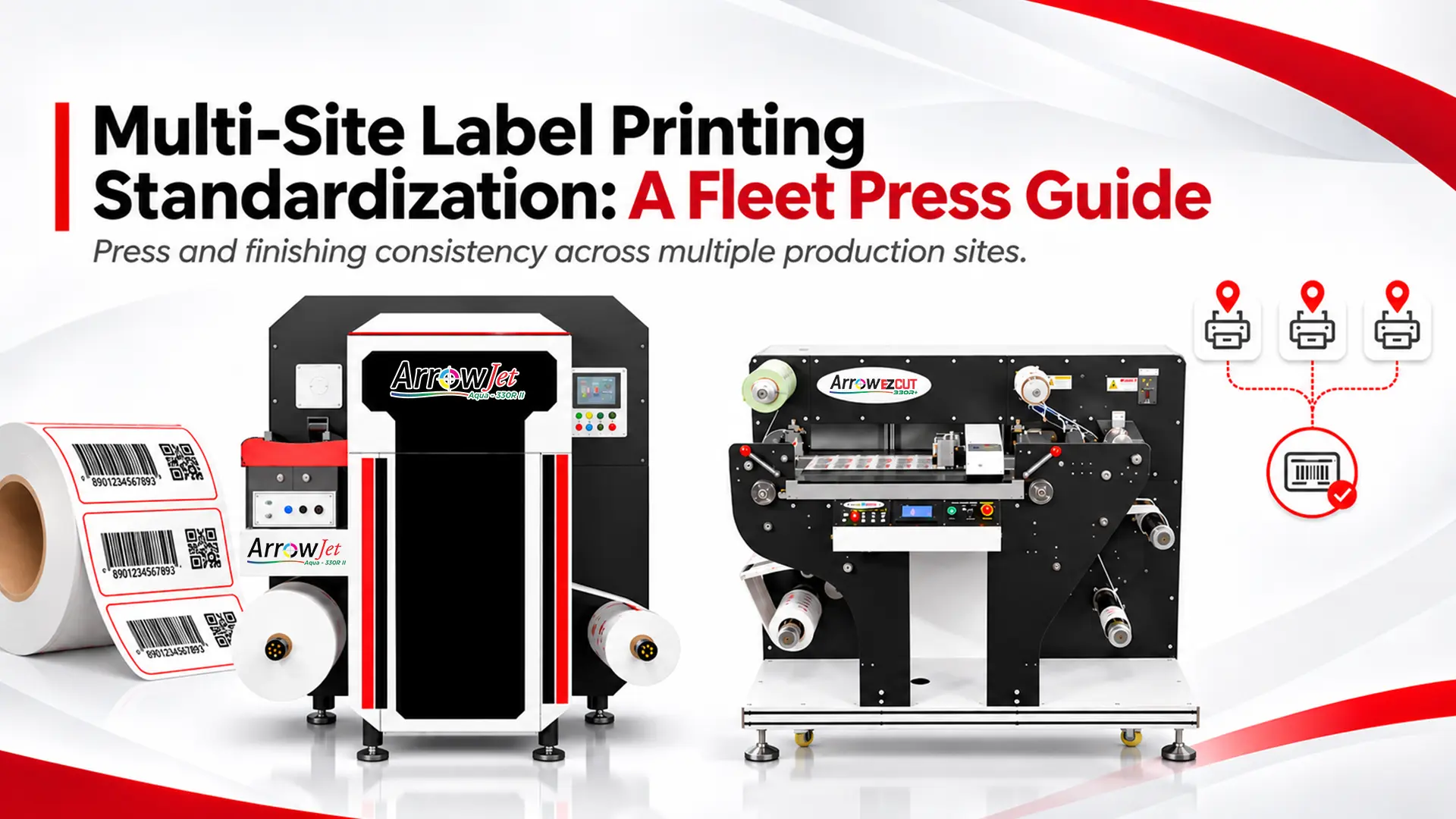
Multi-site label printing standardization means one press model, one finisher model, one substrate list, and one template library at every plant.
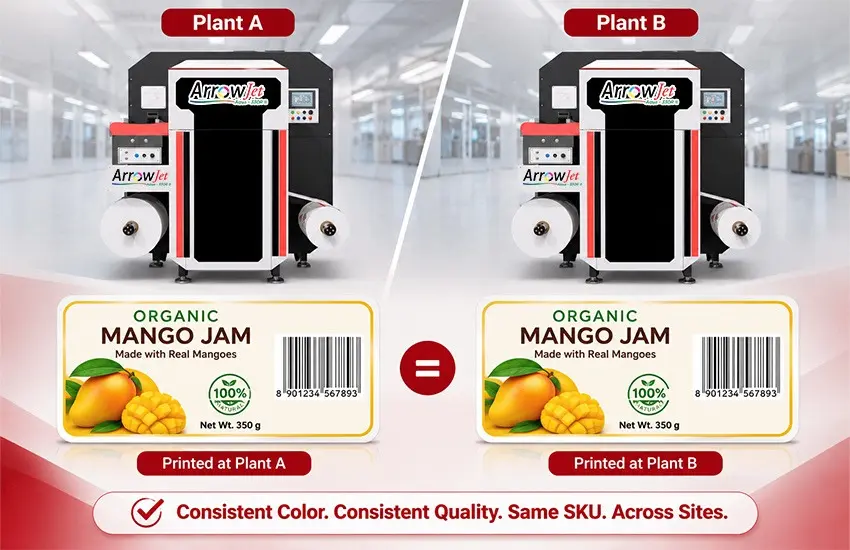
Plants drift apart through years of reasonable local decisions, until the same SKU ships with different color, fonts, and durability.
Picture a distributor opening two cases of the same SKU, one from Ohio and one from Texas. The brand red differs, the ingredient-panel font has shifted, and one label scuffs at the corners. This guide is for operations, engineering, quality, compliance, and packaging leaders who already print labels in-house at more than one location, and for the executive who approves the capital.
Staggered equipment purchases
Each site bought whatever press made sense when it needed one, so the network now runs several ink sets and several RIP or software workflows.
Local substrate buying
Buyers at each plant source face stock and laminate from different vendors, often to save a little on price, which changes how color and durability behave.
Copied templates
Artwork gets emailed, saved locally, and edited “just this once,” so plants end up printing from different template versions.
Site-specific operator habits
Operators develop their own setup tricks, color tweaks, and workarounds that never get written into a shared SOP.
Three hypothetical examples show how this plays out. A beverage brand’s retail buyer notices two shades of red on the same shelf. A coatings maker prints GHS labels in three states, each from a different template copy. A cosmetics producer needs an ingredient-panel revision live at every plant on the same day, and one site misses it.
A standardized fleet usually wins on total cost and risk because most multi-plant label costs show up between sites, not inside them.
Choosing the best press per site optimizes each plant on its own. Label press fleet standardization optimizes the whole network. The per-site approach can win on a single plant’s spec sheet; the fleet approach usually wins on total cost of ownership, because re-proofing, duplicate spares, and retraining are network costs.
Factor | Best Press Per Site | Standardized Fleet |
Color | Different ink sets and profiles at each site; matching relies on manual adjustment | Same print engine at every site, so master color profiles can be shared |
Templates and software | Multiple workflows and file formats | One template library and one workflow |
Substrates | Each site qualifies its own stocks | One approved-substrate list for every plant |
Spare parts | Separate parts lists for each machine | One parts list and a poolable critical-spares kit |
Training | Site-specific skills | One curriculum, with operators who can move between sites |
Equipment support | Several vendor relationships and knowledge bases | One equipment vendor and shared troubleshooting |
Production portability | Moving a SKU means re-proofing and re-qualifying | SKUs can move between plants with limited requalification |
A per-site exception can still be justified, but treat it as a documented exception, not the default. If one plant prints a truly unique application, such as a specialty format no other site touches, it may need different equipment.
Fleet configuration
The locked combination of one press model, one finisher model, color profiles, substrate list, and SOPs that every plant in the network runs.
Master color profile
One centrally owned color profile per approved substrate. Plants pull it and print with it; they do not edit it locally.
Approved-substrate list
The shared spec defining face stock, adhesive, and laminate for each application, used by every plant’s buyers.
Documented exception
A recorded, justified departure from the fleet configuration for one site’s unique application, reviewed instead of left to drift.
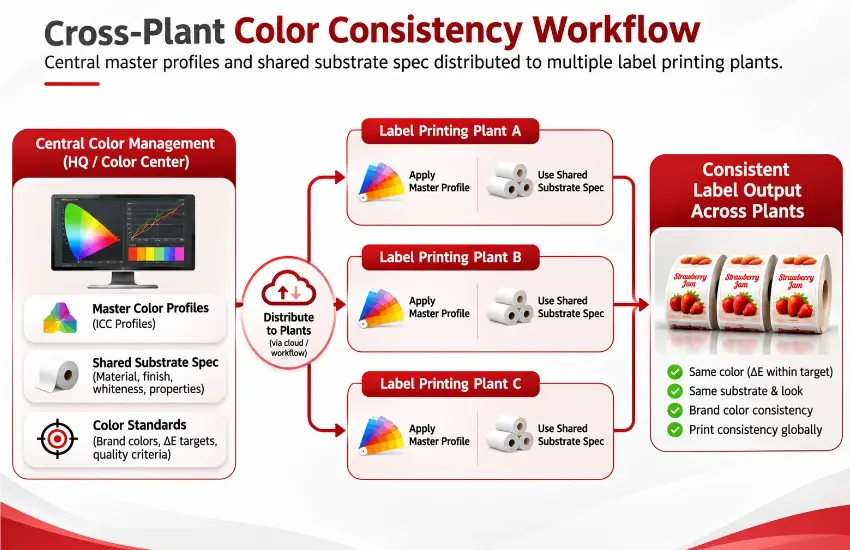
Running the same label press at multiple facilities is the foundation of color consistency; the workflow around the press delivers it.
One master profile per approved substrate
Build and approve one color profile for each substrate and hold it centrally. Plants pull the profile and do not edit it locally. Any change goes back through the central owner, not through a site operator.
A shared substrate spec across plants
The shared substrate spec defines the face stock, adhesive, and laminate for each application. If a plant wants to qualify a cheaper alternative, it goes through the same central approval, and an approved alternative is added to the list for every site, not just one.
Cross-plant color verification routine
Each site keeps a reference proof or target swatch under controlled lighting and checks production against it at a defined frequency. Quality periodically compares samples from all plants side by side against the master.
Matching press models and substrates makes consistency far easier to achieve and maintain, but it does not make output identical. Humidity, temperature, maintenance state, and media lot variation still need active control at every plant.
Centralized artwork with distributed printing gives every plant one version-locked library and gives quality one audit record.
Under a centralized artwork, distributed printing model, artwork, templates, and regulatory text live in one controlled library, and each plant prints from it without altering it. Version-locked templates, print logs by site, and recorded approvals give quality teams one consistent record of what was printed, where, from which version, and who signed off.
Depending on your vertical, that record may need to support FDA labeling requirements, OSHA HazCom/GHS requirements, California Prop 65 warnings, or other state-level rules. A standardized fleet simplifies audit readiness, but it does not guarantee compliance. Confirm specific requirements with your regulatory and compliance teams.
OSHA’s 2024 update to the Hazard Communication Standard (29 CFR 1910.1200) aligns US chemical labels with Revision 7 of the GHS, and its compliance dates apply to the company, not to whichever plant updates first. A January 15, 2026 final rule extended each compliance date by four months. For more on GHS label content, see the guide to printing GHS labels.
Who | Requirement | Extended Compliance Date |
Manufacturers, importers, distributors (substances) | Comply with all modified HCS provisions, including labels | May 19, 2026 |
Employers (substances) | Update alternative workplace labeling, hazard communication program, and training | November 20, 2026 |
Manufacturers, importers, distributors (mixtures) | Comply with all modified HCS provisions, including labels | November 19, 2027 |
Employers (mixtures) | Update alternative workplace labeling, hazard communication program, and training | May 19, 2028 |
A coatings maker that formulates mixtures and prints shipped-container labels at three plants needs revised labels live at all three by November 19, 2027. That deadline is a template release problem: one approved version, one effective date, and print logs proving every site switched over.
Centralized job queues and automatic print logging replace manual check-ins and spreadsheet tracking, which quality teams notice quickly.
This section is general information, not legal advice. Regulatory validation, including FDA, OSHA HazCom, and state-level labeling requirements, is the brand’s responsibility and should be confirmed with qualified regulatory counsel. Arrow Systems sells label printing and finishing hardware; Arrow does not provide regulatory or compliance advisory services.
Spare parts commonality is where fleet standardization becomes tangible for finance: one parts list and a poolable critical-spares kit.
With one press model and one finisher model, the network maintains one parts list. Plants can build a pooled critical-spares kit and ship parts between sites when one plant goes down.
Illustrative example: three plants running three different printers might stock three separate consumables and wear-part lists. Standardizing collapses that to one list, and the plants can share coverage for slow-moving critical parts.
One SOP set and training curriculum
Every site trains operators against the same procedures, so a new hire at any plant learns the fleet configuration once.
Portable operators
Trained operators can cover vacations, turnover, or peak season at another plant without relearning a different machine.
Shared troubleshooting knowledge
A fix found at one plant applies at every plant, because every plant runs the same press and finisher.
One equipment vendor
Parts, technical support, and escalation run through one equipment vendor instead of several vendors with separate escalation paths.
Teams often find operator portability is the hardest benefit to quantify, and the one they value most during a capacity crunch.
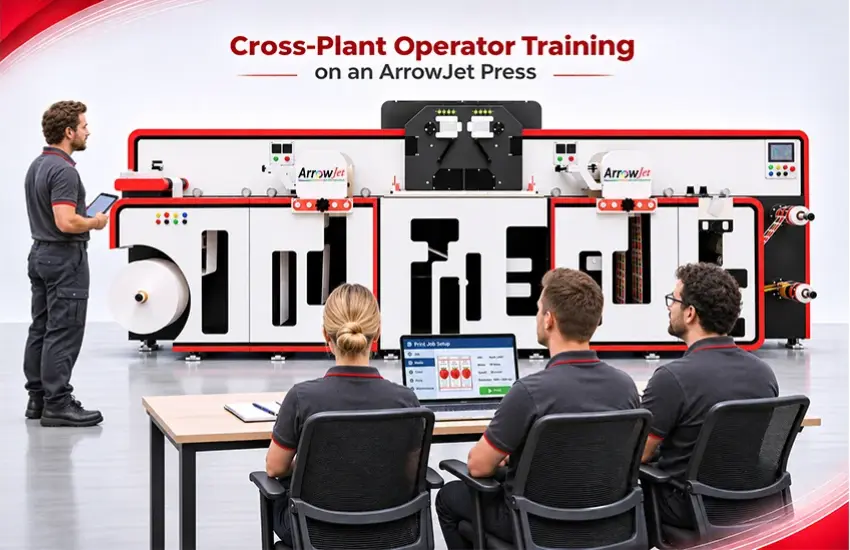
Arrow Systems offers two 330R-class press options and two finisher options to evaluate as fleet building blocks.
Once you decide to standardize label printers across plants, the next decision is which configuration to replicate. Arrow Systems builds digital label printers and label finishing systems that pair as a single fleet configuration. Base the choice on your network’s label mix, not on which machine looks more impressive in a demo.
ArrowJet Aqua 330R II
The ArrowJet Aqua 330R II runs on the Memjet DuraCore engine with three speed tiers of 90, 150, and 220 ft/min and a 12.69-inch (322 mm) print width. It dries with adphos aNIR near-infrared drying technology. It fits a fleet whose busiest plant’s roll label volume sits within 220 ft/min.
ArrowJet Bolt 330R Hybrid Pro M
The ArrowJet Bolt 330R Hybrid Pro M runs on the Memjet DuraBolt engine with dual ThunderBolt printheads at speeds up to 450 ft/min. It includes inline primer and varnish stations with an NIR dryer. It fits a fleet where the busiest plant needs higher throughput, or where the shared label mix needs priming or varnish at the press.
Arrow EZCut 330R+
The Arrow EZCut 330R+ is a flatbed and roll-to-roll hybrid blade die cutter that cuts from digital PLT files, with ±0.1 mm cutting accuracy, up to 150 cuts per minute, and a 100–350 mm cutting media width. It includes cold lamination, automatic matrix removal and rewinding, and slitting with 4 blades standard, expandable to 15. It runs on 220–240V AC at 500W.
ArrowCut Nova 330R
The ArrowCut Nova 330R is a CO₂ laser die-cutter that laminates, die-cuts, removes matrix, slits with up to 5 knives, and rewinds inline, roll-to-roll or roll-to-part. It handles up to 350 mm (13.7-inch) media, finishes up to 10,000 labels per hour once set up, and cuts labels up to 3.9 feet long without physical dies.
Both finishers cut from digital files rather than steel dies. For a multi-site fleet, that means cut files can live in the central library next to the artwork, and no plant waits for a die to be duplicated and shipped.
Shared Fleet Requirement | Configuration Direction |
Busiest plant’s roll label volume fits within 220 ft/min | ArrowJet Aqua 330R II as the fleet press |
Busiest plant needs throughput above 220 ft/min, up to 450 ft/min | ArrowJet Bolt 330R Hybrid Pro M as the fleet press |
Shared label mix needs inline primer or varnish at the press | ArrowJet Bolt 330R Hybrid Pro M as the fleet press |
Plants mix roll labels with flatbed specialty cutting and need cold lamination | Arrow EZCut 330R+ as the fleet finisher |
Plants run frequent new shapes, short runs, perforations, or labels longer than 500 mm | ArrowCut Nova 330R as the fleet finisher |
Treat this table as a starting filter, not a verdict. Request current spec sheets from Arrow Systems and confirm the choice against your real substrates, label sizes, durability needs, run lengths, and variable data requirements.
Profile every site’s label mix, size the fleet to the toughest shared need, pilot at one plant, lock the configuration, then replicate it.
Step 1: Profile the label mix across all sites
List label sizes, substrates, durability needs, run lengths, variable data, and finishing steps at every plant. This network-wide profile is the input to every later decision.
Step 2: Fit the toughest requirement most sites share
Identify the most demanding requirement that most sites share and choose the press that meets it. Choose the finisher that covers your finishing steps and your busiest plant’s peak throughput. Document any justified per-site exceptions instead of letting them reset the whole decision.
Step 3: Pilot at one site
Run the configuration at one plant while the others keep their current equipment. Validate color profiles, approved substrates, templates, and SOPs against real production.
Step 4: Lock the configuration, profiles, and SOPs
Freeze the press and finisher models, the master profiles, the substrate list, and the procedures. Changes from this point go through the central owner.
Step 5: Replicate the locked configuration plant by plant
Install during planned downtime or lower-volume periods, and keep legacy equipment available as backup until each new site completes first-article approval.
Common questions from operations, quality, and engineering leaders evaluating label press fleet standardization across plants.
Usually, yes. Standardization means common equipment, profiles, and workflows, not identical output at every site. Profile all label types across the network and choose a press and finisher that cover the most demanding shared requirement. If one plant has a genuinely unique application, document it as a controlled exception instead of abandoning fleet standardization.
Hold one master color profile per approved substrate centrally, and use the same face stock, adhesive, and laminate at every site. Keep a reference proof at each plant and run periodic cross-site comparisons. Matching equipment makes consistency much easier to maintain, but environment, maintenance, and media lots still need active control.
Pilot at one site while the other plants keep running their current equipment, and validate profiles, substrates, templates, and SOPs. Then lock the configuration and replicate it plant by plant, ideally during planned downtime or lower-volume periods. Keep legacy equipment available as backup until each new site completes first-article approval.
Choose the Aqua 330R II when the busiest plant’s roll label work fits within 220 ft/min and a 12.69-inch print width. Choose the Bolt 330R Hybrid Pro M when the busiest plant needs throughput up to 450 ft/min, or when the shared label mix needs inline primer and varnish at the press. Size the choice to the toughest requirement most sites share, then confirm it with a pilot run on your approved substrates.
Primary federal sources for the HazCom example; check each for updates before relying on it for a specific label.
If your operation prints labels at two or more facilities and is weighing a standard press and finisher configuration, Arrow Systems offers a structured, no-obligation fleet assessment for operations, engineering, quality, and procurement leaders.
The assessment reviews the label mix, substrates, run lengths, and finishing needs at every facility, then recommends a fleet configuration (ArrowJet Aqua 330R II or ArrowJet Bolt 330R Hybrid Pro M, paired with the Arrow EZCut 330R+ or ArrowCut Nova 330R) along with a pilot-site-first rollout plan. You can also request sample prints on your own approved substrates to compare against your current output.
Table of Contents Multi-Site Label Printing Standardization: A Fleet Press Guide Multi-site label printing standardization means one press model, one finisher model, one substrate list,

Table of Contents GS1 Sunrise 2027 2D Barcode Labels: Fix Verification Failures GS1 Sunrise 2027 2D barcode labels usually fail verification for four print-side reasons,
Table of Contents Textured Label Printing: Embossed-Look Labels Without Dies Textured label printing stacks clear UV varnish in layers on a digital press to build
Table of Contents Digital Label Converter Equipment for Short-Run Brand Accounts Winning short-run brand accounts takes a matched stack: a right-sized digital press, fitted finishing,
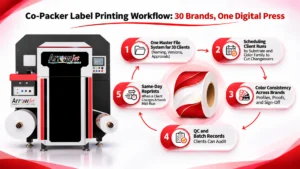
Table of Contents Co-Packer Label Printing Workflow: 30 Brands, One Digital Press A co-packer label printing workflow lets one digital press run labels for dozens
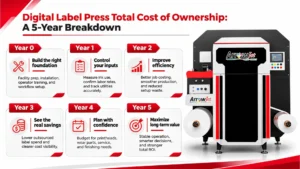
Table of Contents Digital Label Press Total Cost of Ownership: A 5-Year Breakdown Digital label press total cost of ownership is the five-year cost to