UV vs. Aqueous Inkjet for Custom Cosmetic Labels: A Buyer’s Guide
Table of Contents UV vs. Aqueous Inkjet for Custom Cosmetic Labels: A Buyer’s Guide UV and aqueous inkjet serve different cosmetic label scenarios — UV

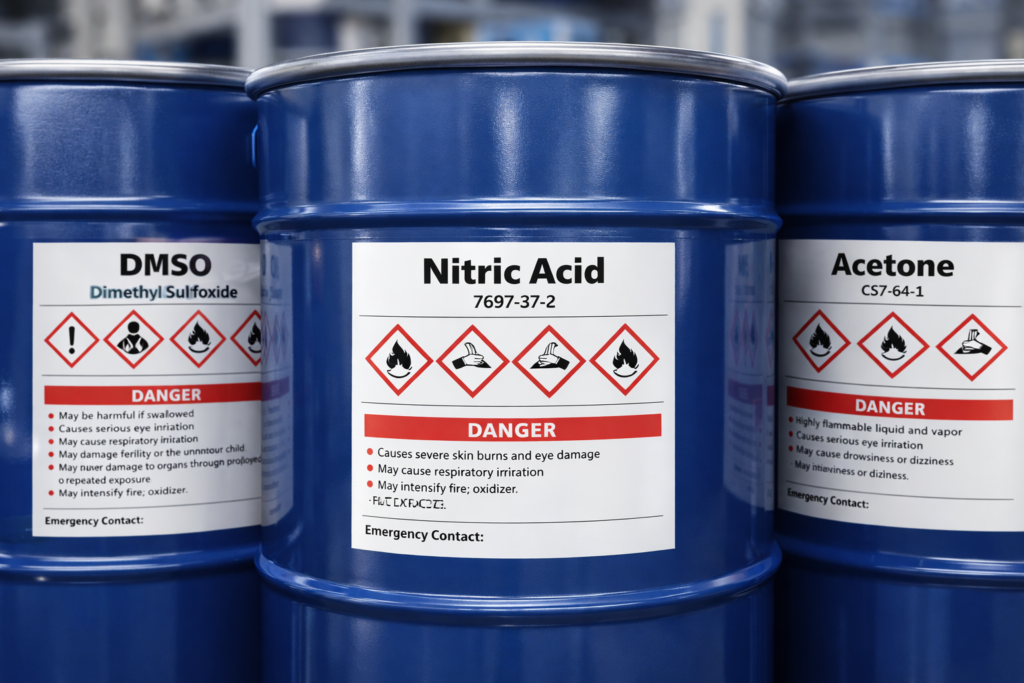
GHS labeling (Globally Harmonized System) is an international standard for classifying and communicating chemical hazards through standardized pictograms, signal words, and safety information on product labels. Required by OSHA since 2012, GHS labels ensure consistent hazard communication across countries and industries.
GHS labels are required for any chemical shipped or used in the workplace, and the penalty for non-compliance can reach $15,625 per violation. This guide explains the six required GHS label elements, OSHA specifications for durability and size, and how to choose a GHS-compliant label printer that produces chemical-resistant, UV-stable labels for drums, bottles, and totes. Whether you’re a chemical manufacturer, distributor, or end-user, understanding GHS requirements protects your workers and your business.
GHS Label Printers are the best specialized printing systems designed to produce compliant chemical safety labels that meet Globally Harmonized System (GHS) standards. For chemical manufacturers, understanding how to print GHS labels in-house is easy when you have the right equipment—and it’s about protecting workers, avoiding costly fines, and ensuring your products can be sold in global markets.
The Globally Harmonized System (GHS) of Classification and Labeling of Chemicals is an internationally standardized approach to defining and communicating chemical hazards.
GHS labels serve as the critical communication link between chemical producers and end users. They provide essential safety information through standardized pictograms, signal words, hazard statements, and precautionary measures.
Whether you’re producing industrial solvents, cleaning chemicals, or specialty chemical products, GHS compliance is mandatory for market access. This comprehensive guide covers everything you need to know about GHS label compliance in 2026, including how to print GHS labels, recent regulatory updates, and cost-saving strategies.
Every GHS-compliant chemical label must include these six core elements — missing any one of them constitutes a compliance violation:
Element | Requirement | Specs | Example |
Product Identifier | Chemical name or code | Matches SDS Section 1 | “Sodium Hydroxide Solution” |
Signal Word | Indicates hazard severity | “Danger” or “Warning” — one only, all caps | “DANGER” |
Hazard Pictograms | Symbols indicating hazard type | Red diamond border, min. 10mm × 10mm | Flame, skull, corrosion symbols |
Hazard Statements | Standardized phrases describing hazards | As defined in GHS classification | “Causes severe skin burns” |
Precautionary Statements | Measures to minimize adverse effects | P-codes as required by hazard class | “Wear protective gloves” |
Supplier Information | Name, address, telephone number | Legible, permanently adhered | Manufacturer contact details |
OSHA’s Hazard Communication Standard sets clear durability expectations that standard office printers simply cannot meet:
Application | Recommended Material | Why |
Drums / Totes | Polyester (PET) or BOPP | Chemical resistance + permanent adhesive for large containers |
Bottles | Vinyl or polyester | Conforms to curved surfaces, resists moisture |
Outdoor Storage | UV-stable vinyl or metallized PET | Fade-resistant up to 12+ months outdoor exposure |
Chemical Exposure | Laminated synthetic stock | Overlaminate adds chemical and abrasion barrier layer |
Small Containers (<100ml) | Pull-out / fold-out / tag labels | Maintains full GHS compliance on limited surface area |
Not all printing technologies meet GHS durability requirements. Here’s how the main options compare:
Technology | Durability | Speed | Cost | Best For |
Pigment Inkjet | Excellent | Fast | Medium | Production runs, multi-SKU, variable data |
Laser / Toner | Very Good | Medium | Medium | Office volumes, indoor-only applications |
Thermal Transfer | Excellent | Slow | Low | One-off labels, low-volume compliance |
UV Inkjet | Superior | Fast | High | Harsh outdoor/chemical environments, BS5609 |
OSHA’s Hazard Communication Standard aligns with GHS requirements but includes specific provisions for the U.S. market:
Key OSHA Requirements:
Chemical manufacturers should be aware of these recent changes to GHS label regulations:
Outsourced GHS label production creates several cost disadvantages:
| Cost Factor | Outsourced | In-House with GHS Label Printers |
|---|---|---|
| Per-label cost | $0.25-$0.85 | $0.04-$0.12 |
| Minimum order | 1,000-5,000 labels | No minimum |
| Setup fees | $200-$500 per order | $0 |
| Lead time | 2-4 weeks | Same day |
| Revision costs | $150-$300 per change | $0 |
Proven result: A chemical manufacturer producing 50 SKUs with quarterly chemical label updates saves approximately $18,000 annually by learning how to print GHS labels in-house.
Real-World Success: Cleartech Industries, a valued Arrow Systems customer for over 10 years, recently expanded their finishing capabilities with our equipment. This demonstrates the long-term reliability and ROI of our GHS label printing solutions.
Chemical safety labels must withstand harsh environments:
The most effective solution: Pigment-based inkjet printing on synthetic substrates (BOPP, PET) provides superior durability compared to laser or thermal transfer methods.
Many manufacturers select GHS pictograms based on general hazard categories rather than specific classification criteria. Each pictogram has precise triggering criteria—using the wrong one can result in OSHA compliance violations and safety risks.
Precautionary statements must match the hazard classification level. Generic statements or incomplete P-statements (P264, P280, etc.) are common OSHA hazmat label violations.
Containers under 100ml present unique chemical label compliance challenges. The solution: Use pull-out labels, fold-out labels, or tag-style labels that maintain full GHS compliance while fitting small surfaces.
GHS labels and Safety Data Sheets (SDS) must align perfectly. Changes to one require updates to the other within 3-6 months depending on jurisdiction.
Standard office printers lack the durability needed for chemical environments. Only GHS Label Printers with pigment-based inks can produce compliant, long-lasting labels.
Water-based pigment inks offer critical advantages for GHS label compliance:
Chemical manufacturers often manage hundreds of SKUs with varying chemical label requirements:
Variable data printing enables single-template workflows where one design file + data spreadsheet = unlimited SKU variations. Change a chemical concentration or update a formula? Update the data file, not the artwork.
For global chemical distribution, GHS labels often require:
Variable data printing handles multi-language how to print GHS labels for chemical products requirements efficiently—print English labels for domestic shipments, Spanish labels for export, all from the same template.
Stay informed about the latest developments in GHS label requirements:
Q: What is GHS labeling and who needs it?
A: GHS (Globally Harmonized System) labeling is required by OSHA for any hazardous chemical manufactured, shipped, or used in the workplace. All chemical producers, distributors, and employers handling hazardous chemicals must comply — including downstream users who transfer chemicals into secondary containers.
Q: What are the six required GHS label elements?
A: The six required elements are: (1) Product Identifier — chemical name or code matching SDS Section 1; (2) Signal Word — ‘Danger’ or ‘Warning’; (3) Hazard Pictograms — visual symbols in red diamond border; (4) Hazard Statements — standardized risk descriptions; (5) Precautionary Statements — P-codes for prevention, response, storage, and disposal; and (6) Supplier Information — name, address, and telephone number.
Q: What is a GHS label printer?
A: A GHS label printer is a specialized printing system designed to produce chemical safety labels that comply with GHS standards. These printers use durable pigment-based inks and synthetic substrates to create labels that withstand harsh chemical environments while displaying required hazard pictograms, signal words, and precautionary statements — unlike standard office printers which lack the necessary chemical and UV resistance.
Q: How to print GHS labels that are OSHA compliant?
A: To print OSHA-compliant GHS labels: (1) Use a pigment-based inkjet printer for durability; (2) Print on synthetic substrates (BOPP, PET, or polypropylene); (3) Include all six required GHS elements; (4) Ensure pictograms have red borders on white backgrounds at minimum 10mm × 10mm; (5) Use minimum 6pt font for body text; (6) Include supplier contact information; (7) Validate labels against OSHA’s Hazard Communication Standard 1910.1200.
Q: How long do GHS labels need to last?
A: GHS labels must remain legible throughout the entire use period of the chemical, including exposure to the chemical itself, UV light, weather, temperature extremes, and normal handling. For outdoor-stored drums this typically means 12–24 months of chemical and UV exposure resistance minimum.
Q: Can I print GHS labels in-house?
A: Yes. With the right printer (pigment inkjet or thermal transfer) and durable synthetic label stock, you can produce OSHA-compliant GHS labels in-house at $0.04–$0.12 per label compared to $0.25–$0.85 outsourced. Most chemical manufacturers recover the investment within 12–18 months.
Q: What is the minimum size for GHS pictograms?
A: GHS pictograms must be at least 10mm × 10mm (approximately 0.4″) on the label. Larger containers require proportionally larger pictograms — on a standard 55-gallon drum label, pictograms are typically 25–50mm. Pictograms that are too small to be clearly visible from a normal viewing distance are a compliance violation.
Q: What label material is best for chemical drum GHS labels?
A: Polyester (PET) or polypropylene (BOPP) with a permanent aggressive adhesive provides the best chemical resistance and durability for drum labeling. For drums stored outdoors, add an overlaminate for additional UV and abrasion protection. Avoid paper-based labels on chemical containers — they degrade quickly under chemical splash.
Q: Do secondary workplace containers need GHS labels?
A: Yes. Any container holding a hazardous chemical in the workplace must have a GHS label — or at minimum a workplace label with the product identifier and hazard information. Exemptions exist only for containers that will be used immediately and by the person who transferred the chemical.
Q: What are the OSHA penalties for non-compliant GHS labels?
A: As of 2026, OSHA can fine up to $15,625 per serious violation and $156,259 per willful or repeat violation for GHS non-compliance. Penalties apply per container — a shipment of 100 non-compliant drums could generate $1.5M in fines.
Q: Can I use color laser printers for GHS labels?
A: Color laser printers work for indoor applications with limited chemical exposure, but inkjet with pigment inks or thermal transfer typically offers better durability for chemical and outdoor exposure. For BS5609 marine-grade compliance required for international chemical shipping, only pigment inkjet or UV inkjet systems qualify.
Q: How do I choose the right GHS label size?
A: Minimum label sizes vary by container: small bottles (3–100ml) require pull-out or fold-out labels with all six elements; 1–5 gallon containers typically use 4″ × 6″ labels; 55-gallon drums use 8.5″ × 11″ or larger. The key requirement is that all six GHS elements must be legible at the chosen size using a minimum 6pt font.
Q: How much does a GHS label printer cost?
A: GHS label printers range from $15,000 to $50,000 depending on features and production volume. The ArrowJet Aqua 330R offers industrial-grade GHS label printing at a mid-market price point, with most manufacturers recovering their investment within 12–18 months through reduced per-label costs and eliminated minimum order requirements.
✓ Six Required Elements: Product ID, Signal Word, Pictograms, Hazard Statements, Precautionary Statements, Supplier Info
✓ Durability Critical: Labels must survive the container’s entire use lifecycle including chemical, UV, and abrasion exposure
✓ Pictogram Size: Minimum 10mm × 10mm dimension required — larger containers need proportionally larger pictograms
✓ Best Printer Technology: Pigment inkjet or thermal transfer on synthetic stock (BOPP, PET) for maximum compliance durability
✓ Penalty Risk: Up to $15,625 per serious violation and $156,259 per willful violation for GHS non-compliance
GHS label compliance is non-negotiable for chemical manufacturers, but it doesn’t have to be a bottleneck or cost center. Investing in the right GHS Label Printers and learning how to print GHS labels in-house with pigment-based inkjet technology provides:
The ArrowJet Aqua 330R delivers industrial-grade GHS label production capabilities without industrial-scale infrastructure requirements. For chemical operations ready to take control of their labeling compliance, the business case is compelling—and the operational benefits extend far beyond cost savings.
Ready to achieve GHS label compliance? Arrow Systems provides free label compliance assessments and can help you implement a cost-effective in-house GHS Label Printer solution.
Need GHS-compliant labels? Click Here to Get a Free Sample Pack
Questions about GHS requirements? Call us at 1-888-697-2749

Table of Contents UV vs. Aqueous Inkjet for Custom Cosmetic Labels: A Buyer’s Guide UV and aqueous inkjet serve different cosmetic label scenarios — UV

Table of Contents Vintage Label Design Styles: A Reference Guide for Producers and Brand Owners Vintage label design draws from a specific visual history. The

Table of Contents Label Adhesive Types, Properties & Selection Guide The right label adhesive depends on the surface, temperature, shape, and conditions of the application

Table of Contents Label Trends: Minimalist Label Design Minimalist label design removes clutter — nude palettes, gradients, transparent labels, and smart-labels let the product speak

Table of Contents Tamper-Evident Label Printing: How to Choose the Right System Match tamper-evident label type — void, breakaway, or destructible — to product risk,

Table of Contents Skincare Label Printing: Materials, Inks & FDA Rules Skincare labels must withstand moisture, oils, friction, and aggressive formulation actives while meeting FDA