Cosmetic Label Printing: FDA Requirements for Beauty Brands
Table of Contents Cosmetic Label Printing: FDA Requirements for Beauty Brands U.S. cosmetic labels must satisfy 21 CFR Part 701, the FPLA, and MoCRA 2022
In the chemical and industrial sectors, labeling is a legal and safety-critical responsibility. From manufacturing and storage to transportation and workplace handling, Globally Harmonized System (GHS) label compliance ensures that chemical hazards are communicated clearly and consistently across the supply chain.
Incorrect or incomplete labeling can result in workplace accidents, regulatory penalties, shipment delays, and serious reputational damage. That’s why businesses handling hazardous chemicals must understand GHS requirements—and have the right digital label printing solution to stay compliant and agile.
The Globally Harmonized System of Classification and Labelling of Chemicals (GHS) was developed by the United Nations to create a globally standardized approach for identifying chemical hazards and communicating them through labels and Safety Data Sheets (SDS).
In the United States, GHS principles are implemented through the Hazard Communication Standard (HCS) enforced by OSHA. While OSHA does not govern GHS globally, it requires that hazardous chemicals in U.S. workplaces follow GHS-aligned labeling and documentation standards.
This alignment allows chemical manufacturers, distributors, and employers to maintain consistency across domestic and international markets.
GHS labels are designed to deliver instant hazard recognition—even in fast-paced or emergency situations. Proper compliance helps organizations:
Protect workers from chemical exposure and accidents
Enable faster emergency response and safer handling
Meet OSHA and international regulatory requirements
Avoid fines, recalls, and shipment rejections
Build trust with customers and regulatory bodies
In short, accurate GHS labels save lives and protect businesses.
Every GHS-compliant label must include all six required elements. Missing any one of these can result in non-compliance.

The chemical name or product name, exactly matching the Safety Data Sheet (SDS).
Indicates the severity of the hazard:
Danger – for more severe hazards
Warning – for less severe hazards
Standardized descriptions of the chemical’s hazards (for example, flammable, corrosive, toxic). These statements typically begin with the letter “H” and must align with the SDS.
Guidance on prevention, response, storage, and disposal to minimize risk. These statements usually begin with the letter “P”.
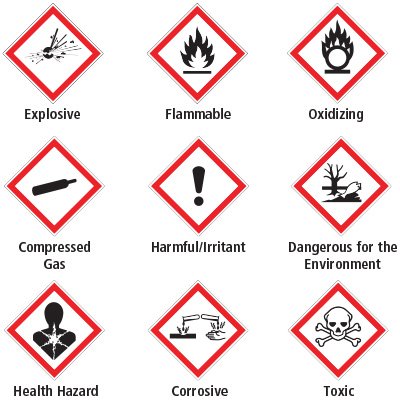
Recognizable symbols enclosed in red diamond borders that visually communicate the type of hazard.
The manufacturer or responsible party’s name, address, and contact number.
GHS requirements apply based on hazard classification, not just physical form.
Articles that do not release hazardous chemicals under normal use may have limited labeling requirements after initial shipment.
Hazardous chemicals—including liquids, powders, and reactive substances—must be labeled on every container, such as bottles, drums, and intermediate bulk containers (IBCs).
Each container must display a complete and legible GHS-compliant label at all times.
For chemicals shipped internationally, especially via marine transport, BS 5609 certification may also be required. This standard ensures labels remain readable after exposure to water, salt spray, abrasion, and harsh environments.
Achieving BS 5609 compliance typically requires:
Durable substrates such as PET or BOPP
High-quality inks
Precise printing and finishing
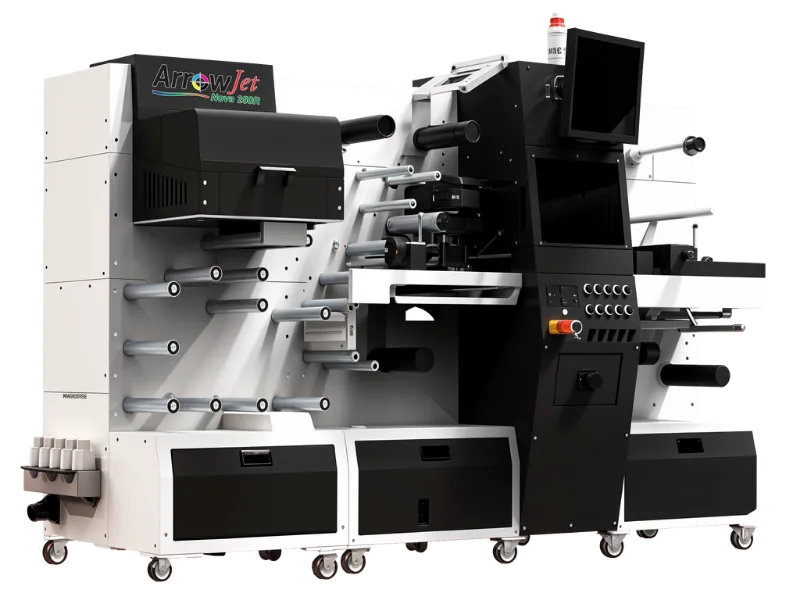
For companies that need fast, accurate, and compliant GHS label production, the ArrowJet Nova 250R Inline Digital Printer and Laser Die Cutter is a powerful in-house solution.
Designed for industrial and chemical labeling workflows, the Nova 250R combines high-resolution digital printing with inline laser die-cutting, allowing you to print and finish GHS-compliant labels in a single, continuous process.

Inline print & cut workflow
Print full-color GHS labels and laser-cut them to shape in one pass—no secondary finishing required.
High-resolution output
Delivers sharp text, clear pictograms, and precise barcodes essential for hazard communication and regulatory clarity.
Flexible, on-demand production
Perfect for short runs, variable data, and frequent label updates when formulations or regulations change.
Durable label compatibility
Supports high-quality substrates suitable for chemical environments and BS 5609-compliant applications.
Reduced waste and downtime
Digital production eliminates plates, long setups, and excess inventory of outdated labels.
By bringing GHS label production in-house with the ArrowJet Nova 250R, businesses gain speed, accuracy, and full control over compliance.
GHS label compliance is not just a regulatory requirement—it is a commitment to safety, accountability, and operational excellence. Clear, standardized labels protect workers, support emergency response, and ensure smooth movement of hazardous materials across borders.
With a robust digital printing solution like the ArrowJet Nova 250R Inline Digital Printer and Laser Die Cutter, businesses can confidently produce accurate, durable, and regulation-ready GHS labels, while staying flexible as standards evolve.

Table of Contents Cosmetic Label Printing: FDA Requirements for Beauty Brands U.S. cosmetic labels must satisfy 21 CFR Part 701, the FPLA, and MoCRA 2022

Table of Contents Flexible Pet Packaging: Digital Printing for Pouches and Bags Flexible pet packaging — stand-up pouches and flat-bottom bags — is now the

Table of Contents GMP Label Printing for Supplements: A Manufacturer’s Guide to 21 CFR Part 111 GMP label printing for supplements means producing every bottle

Table of Contents Cannabis Gummy Packaging: Labels, Flexible Pouches, and State Compliance — A 2026 Brand Guide Cannabis gummy packaging must meet child-resistant standards, opaque-material

Table of Contents AAFCO Pet Food Label Requirements: 2026 Brand Guide AAFCO pet food label requirements define eight mandatory elements every dog and cat food

Table of Contents Vitamin Bottle Labels: Materials, Inks, and Compliance Guide HDPE supplement bottles require substrate, adhesive, ink, and workflow decisions that are compliance decisions