Lansen Label Wins National Quality Award in Guyana — Powered by the ArrowJet Aqua 330R
Lansen Label Wins National Quality Award in Guyana — Powered by the ArrowJet Aqua 330R Lansen Label has proudly secured the National Quality Award 2025

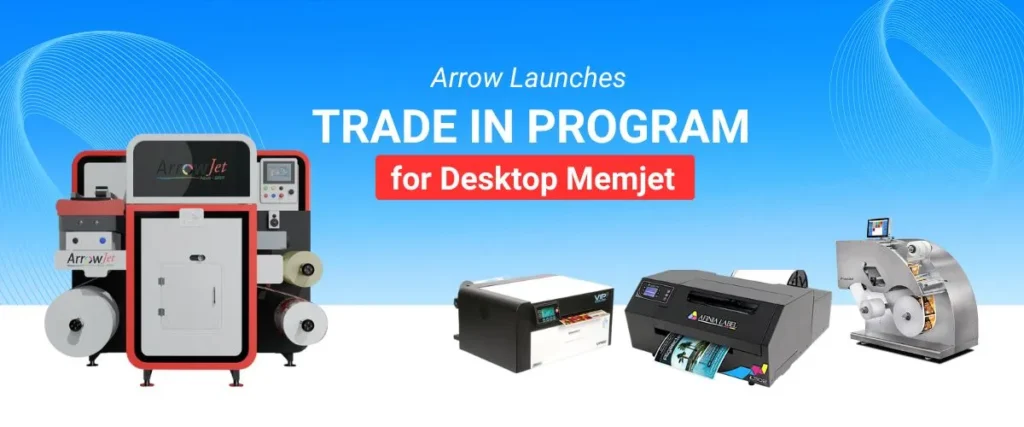
Let’s be honest, your old Afinia, VIPColor, or Trojan printer has probably earned its keep. It’s printed thousands of labels, powered countless jobs, and maybe even helped you land your first big client. But here’s the truth no one likes to say out loud: what got you here won’t get you there.
The market is faster, sharper, and more demanding than ever. Now, the real question isn’t whether your printer still works, it’s whether it’s still working for you.
This blog will help you navigate:

Let’s identify the pain-points of staying with older inkjet label printing machines:
The older style, desktop printers were designed for a different market than what we see today. As jobs shift to faster turnarounds, higher volumes, more variable data, and an increasing demand for eco-friendly solutions, the older style printers can become a problem.
The older, desktop Memjet printers just do not offer the same speeds, roll-handling, or finishing throughput as newer models. The ArrowJet uses a Siemens PLC to enable the machine to run up to 150’/min versus the slower 18-27’/min of the desktop styles.
Brand owners expect sharper print, richer color, more premium finishes, faster turnarounds. If you’re using a machine that struggles with newer substrates (say premium metallic films, flexible packaging, or specialty applications) or slower drying, you may lose premium jobs or face re-prints or outsourcing.
Technology evolves: manufacturers may stop support for older models, parts become scarce and more expensive, service becomes slower. Some trade-in programs highlight exactly this risk. For example, one vendor warns that outdated printers can pose network security risk and slow productivity.
If the device you own is nearing end-of-service, the risk of failure, compatibility issues, or inability to print new materials increases.
If your competitors have upgraded to newer machines with faster speed, better substrate compatibility, and lower running costs, you may find yourself losing jobs on price (to offset your higher cost) or losing jobs on inability to offer premium finishes.
Here’s how a well-structured trade-in upgrade program solves those challenges:
By upgrading to a modern ArrowJet system, you gain:
A trade-in program gives you value for your older assets and smooths transition cost. Many vendors run such program (for example, trade-in of old printers for cash rebates) to encourage customers to upgrade.
By doing so you reduce capital expenditure, maintain cash flow, and move to higher productivity quicker.
While the upfront cost of a new machine may be higher, the operational savings, higher yield, less downtime, less waste, higher margin jobs combine to improve TCO. Plus you open doors to new premium jobs, which boosts revenue!
With upgraded equipment you can market yourself as “high-speed digital label converter with premium inks” rather than “legacy-printer operator”. That helps you win new clients, higher value jobs, and clearly differentiate.
Here are actionable steps to design or engage with a trade-in program:
At Arrow Systems, we understand the entire ecosystem: from printer hardware (trade-in for older Afinia, Trojan, VIPColor machines) to substrate (premium film) to finishing workflows. Here’s what we bring:
While it may still print, you might be leaving productivity, substrate flexibility, margin on the table. The upgrade gives you new capabilities, new market opportunities, and better ROI. The trade-in credit also softens the cost.
With proper planning (old machine runs until new machine validated, trial runs on substrates, training ahead of production), transition can be smooth. The long-term gains in productivity justify the short-term planning.
Even if your current job mix is “standard”, the ability to handle premium jobs gives you optionality. The market is evolving; early adoption keeps you ahead rather than catching up. Plus the new machine will likely handle your existing jobs better, so you’re improving now even before premium jobs come.
Being “good enough” is no longer enough in digital Label printing. If you are still operating legacy inkjet label printers like Afinia L801/L901, VIPColor or Trojan T2-C, you’re likely facing hidden cost-leaks, substrate limitations, reduced ability to capture premium jobs and potential obsolescence.
A well-structured trade-in upgrade to an ArrowJet system gives you the speed, substrate flexibility, finishing capability, reduced waste and future-proofing you need while the trade-in credit softens the investment.
At Arrow Systems we’re ready to partner with you, assess your current equipment, help you select the right upgrade, plan the transition, and support you with substrate and finishing ecosystems so you hit the ground running.

Lansen Label Wins National Quality Award in Guyana — Powered by the ArrowJet Aqua 330R Lansen Label has proudly secured the National Quality Award 2025
Table of Contents Arrow Systems, Inc. joins forces with Wolff Poligrafia to ignite a wave of digital label & pouch innovation across Poland In a

Table of Contents Breaking News: Arrow Systems Partners with BUSINESSWARE to Transform Digital Printing Across Greece & Cyprus Arrow Systems, Inc. is excited to announce

Table of Contents Sid Sistemas de Impresión in Spain Installs ArrowJet Aqua 330R and DPR Taurus to Bolster Label Production Arrow Systems, Inc., in collaboration

Table of Contents Step Inside Innovation: Arrow Systems New Experience Center Opens in Ontario, Canada. If there’s one thing the printing industry thrives on, it’s

Table of Contents Arrow Launches Trade In Program for Desktop Memjet Printers Let’s be honest, your old Afinia, VIPColor, or Trojan printer has probably earned