

Table of Contents
Packaging and Labels as Advertising: How Great Label Design Wins at the Shelf
Labels reach buyers at the exact moment of choice — the shelf, counter, or unboxing moment where purchase decisions are made.
Key Takeaways
- Labels work as advertising because they appear at the “moment of truth” — when the buyer is actively comparing options with purchase intent already established.
- A 2016 Lumen Research eye-tracking study found that a significant share of digital ads were never viewed, and only a small fraction held a viewer’s attention for more than one second.
- Effective label advertising communicates category, quality, benefit, and trust cues in seconds — often before the buyer has read any other marketing material from the brand.
- Digital inkjet label printing enables brands to iterate on label designs quickly and produce short runs without minimum order quantities or plate charges, lowering the barrier to better label advertising.
- Packaging and digital advertising serve different stages of the buyer journey and work best when they reinforce each other — digital builds awareness, labels convert at point of decision.
Why Digital Ads Struggle to Hold Attention
Digital advertising competes for attention in an environment where consumers are exposed to thousands of ad impressions daily — and have learned to filter most of them out.
When thinking about digital media, it is easy to feel surrounded. Advertisements appear on every website, in every social media feed, before and during every video, and on nearly every imaginable platform. The volume of advertising exposure has grown to the point where conscious filtering has become a learned behavior for most consumers.
A 2016 study by the eye-tracking research firm Lumen Research illustrated this attention gap precisely. When participants were exposed to a large sample of digital ads, a significant share were never actually viewed — and of those that were, only a small fraction held a viewer’s gaze for more than one second. Digital advertising platforms continue to improve targeting and format quality, but the underlying attention environment remains competitive and expensive.
This is not an argument against digital advertising. It is context for understanding where a different kind of advertising — the label on a physical product — has a structural advantage.
The Moment of Truth: Where Packaging Does Its Best Work
The “moment of truth” is the instant a buyer is physically deciding between competing products — and it is the moment where a label does its most important advertising work.
Former Procter & Gamble CEO A.G. Lafley introduced the phrase “moment of truth” to describe the critical instant when a consumer stands in front of two or more competing products and chooses one. In that moment, the brand is not present to make its case directly. The label has to do it.
At the shelf, the counter, the trade show table, or the unboxing moment, the buyer is already paying attention to the product. They are not scrolling past it. They are not distracted by other content. They are holding it or looking directly at it with active purchase intent. This is the attention environment where label design operates — and it is a very different environment from a display ad on a news website.
Moment of Truth
The instant a potential buyer is physically choosing between competing products — at the shelf, counter, delivery box, or unboxing moment. Coined by A.G. Lafley, former CEO of Procter & Gamble. In this moment, packaging and label design function as the primary sales conversation.
Point of Decision
The physical or digital location where a purchase decision is made. For physical consumer products, this is typically the retail shelf, an e-commerce product page, or the unboxing experience for subscription and direct-to-consumer shipments.
Label as Advertising
The use of label design — color, material, copy, finish, and format — to communicate the product’s category, quality, primary benefit, and brand personality at the point of decision, before the buyer reads a website, product description, or marketing material.
Shelf Presence
The visual impact a product creates when displayed alongside competing products. Strong shelf presence means the label helps the product stand out, communicate relevance, and encourage pick-up without requiring the buyer to read detailed copy first.

What Makes a Label Work as Advertising
A label works as advertising when it communicates relevance, quality, and differentiation to the intended buyer in the first few seconds of visual contact.
The label is not an afterthought appended to the product design. It is the primary communication layer at the point of decision. Every element — color, material, copy hierarchy, and finish — either helps or hurts the product’s ability to be noticed, understood, and selected.
Six characteristics separate labels that function as effective advertising from labels that are merely present on the shelf:
Instant Recognition
The product category and brand should be readable at a glance, without requiring the buyer to pick up the product or read detailed copy. Shape, color blocking, and logo placement all contribute to recognition speed.
Benefit Clarity
The label should communicate the product’s primary value proposition in one visible line — not buried in small print. A buyer who cannot identify why this product is relevant to them within a few seconds will move on to the next option.
Audience Match
The visual language, tone, and material choices on the label should match the expectations and sensibilities of the target customer. A premium craft spirit and a value-price cleaning product require entirely different label vocabularies, even if both use the same substrate.
Intentional Color, Material, and Finish
Color influences category perception (natural, premium, clinical, playful). Material selection — BOPP, matte paper, clear film, textured stock — communicates tactile quality cues even before the buyer touches the product. Finish choices such as spot gloss, soft-touch matte, or foil accents add visual differentiation on a crowded shelf. For in-house operations that require these specialty finishes — including spot UV varnish, white ink on clear film, and matte/gloss contrast effects — the ArrowJet UV 330H adds premium shelf-differentiation capability to the digital label production workflow.
Competitive Differentiation
The label must create enough visual distinction to separate the product from adjacent competitors in the same shelf section. This does not require a radical redesign — it requires conscious awareness of what the competitive set looks like and deliberate choices that make this product identifiable as distinct.
Clarity Over Clutter
Labels that try to communicate too much — multiple benefit claims, excessive regulatory text in large fonts, competing visual hierarchies — slow down the buyer’s decision. Clutter is not neutral; it actively reduces purchase confidence.
Labels vs. Digital Advertising: Different Jobs, Different Strengths
Labels and digital ads perform best at different stages of the buyer journey — understanding where each format is strongest prevents the mistake of evaluating them as direct substitutes.
Neither label design nor digital advertising is categorically superior. They address different buyer states and serve different functions in the overall purchase journey. The table below compares the primary performance characteristics of each format:
Characteristic | Label / Packaging | Digital Advertising |
Buyer state at contact | Active decision — comparing options with purchase intent | Variable — often passive browsing or content consumption |
Attention environment | Product-focused — buyer is looking at the product | Competitive — attention shared with primary content |
Primary function | Convert interest into a product selection at the point of decision | Build awareness and drive interest among broad audiences |
Channel cost model | One-time production cost; scales with label volume | Ongoing spend; impression delivery stops when budget stops |
Targeting mechanism | Implicit — buyer self-selects by being in the product category aisle or searching for the product type | Explicit — demographic, behavioral, and interest targeting parameters |
Message longevity | Persists for the life of the physical product on shelf or in the buyer’s possession | Active only while campaign is running |
Physical touchpoint | Yes — buyer handles the product | No — screen-based only |
Best suited for | Physical products sold at retail, farmers markets, trade shows, subscription boxes, direct-to-consumer shipments | Awareness campaigns, retargeting, driving traffic to e-commerce product pages |
How In-House Label Printing Supports Better Label Advertising
The practical barrier to using labels as effective advertising has traditionally been production — minimum order quantities, plate costs, and long lead times made label design iteration expensive and slow.
When a brand is forced to commit to a large pre-printed label run before a product reaches the market, design decisions become conservative. Changing a label after the fact means discarding existing inventory, re-entering the print queue, and waiting for the new version to arrive. The result is that many labels stay unchanged long after the design has stopped performing — because changing them is too costly.
Digital inkjet label printing removes that constraint. A digital press prints directly from a file, with no physical printing plates, no make-ready waste, and no minimum quantity. A label design change can go from artwork file to finished roll in a production run. Short-run variants — seasonal labels, regional versions, limited editions — become operationally practical instead of cost-prohibitive.
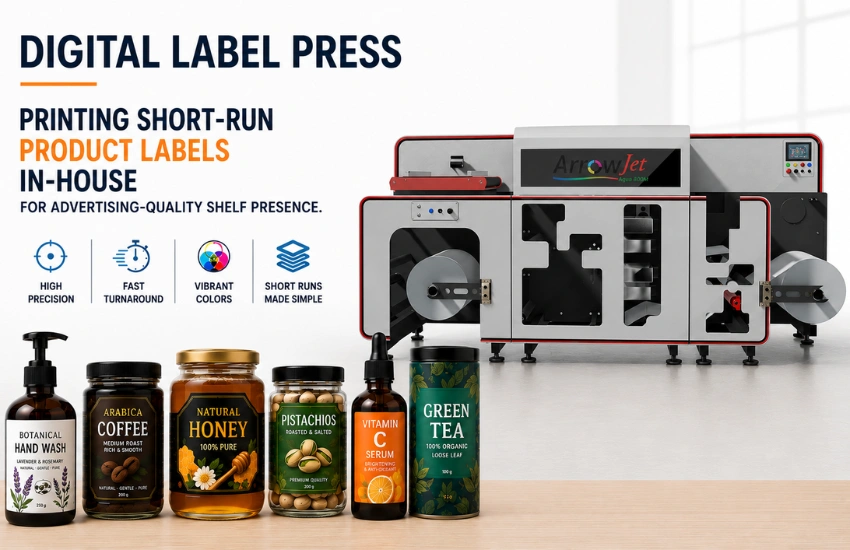
Arrow Systems’ digital label presses are designed for exactly this kind of production environment. The ArrowJet Aqua 330R handles high-resolution roll-label production for brands that need advertising-quality output at a range of run lengths — from short-run design trials to full production volumes. For smaller brands or operations entering in-house label production for the first time, the ArrowJet Eco 330R is a compact industrial press that delivers the same label quality at an accessible entry point, without requiring an air compressor or large production footprint.
For brands whose packaging range extends beyond pressure-sensitive labels to flexible formats — pouches, sachets, and stick packs — packaging design operates as advertising in exactly the same way as label design does. The flexible packaging substrate is the first thing a consumer sees and handles at the point of decision. The ArrowJet Aqua 800M is Arrow’s 25-inch wide-web digital press built for flexible packaging production, enabling in-house printing of film-based pouches and sachets with the same design flexibility and short-run capability that makes digital label printing a practical advertising strategy. For operations producing both labels and flexible packaging formats, managing both under one in-house production workflow eliminates the external converter lead times that have traditionally made packaging design iteration cost-prohibitive.
The practical outcome is that in-house digital label printing aligns the economics of label production with the strategic logic of label advertising: design is a variable, not a fixed cost. Labels can be tested, refreshed, and optimized — the same discipline that governs digital campaign management can now be applied to the physical product experience at the shelf.
Explore the full Arrow digital label printer range to find the right configuration for your production volume and substrate requirements.
Packaging and Digital Advertising: Better Together
The strongest brands do not choose between packaging and digital advertising — they use each format where it performs best and ensure the two reinforce the same brand message.
Digital advertising excels at reach. It introduces a product or brand to buyers who have not encountered it before, and it can place a message in front of highly targeted audiences at scale. Social media, display retargeting, and search advertising all serve this awareness-building function effectively.
Packaging closes the loop. A buyer who has seen a digital ad for a product and later encounters that product on a retail shelf is already primed — but the label still has to convert that awareness into a selection. If the label does not match the promise of the digital creative, or if it fails to communicate quality and relevance at the point of decision, the digital investment underperforms.
The integrated model — digital advertising for awareness, label design for conversion — is the approach used by the most consistent consumer brands across food, beverage, personal care, and specialty retail. The label is not the end of the marketing funnel. It is the final and often decisive step in it.
Frequently Asked Questions
- It depends on the goal. Digital advertising is effective for building reach and awareness across broad audiences. Packaging and labels are effective at influencing buyers at the physical point of decision — the shelf, counter, or unboxing moment — where purchase intent is already high. For physical products, both formats play important roles and work best when they reinforce the same brand message.
A label works as advertising when it quickly communicates relevance, quality, and differentiation to the intended buyer. It should make the product easy to recognize at a glance, clarify the main benefit or use case, match the visual expectations of the target customer, and use color, material, and finish intentionally to stand apart from competing products.
The moment of truth is the instant a buyer is physically deciding between competing products — at the shelf, counter, or point of delivery. The concept was popularized by former Procter & Gamble CEO A.G. Lafley. In that moment, the label functions as the primary sales conversation, communicating category, quality, and trust cues before the buyer reads any other marketing material from the brand.
In-house digital label printing allows brands to iterate on label designs quickly, produce short test runs without plate costs or minimum order quantities, and keep shelf presence current without holding pre-printed inventory that becomes obsolete after a redesign. Digital inkjet presses such as the ArrowJet Aqua 330R and ArrowJet Eco 330R eliminate the production barriers that traditionally made label design updates expensive and slow.
Yes. They serve different stages of the buyer journey and perform best when coordinated. Digital channels are effective for building awareness and driving interest. Label design converts that interest into a purchase at the point of decision. The strongest brands use both — digital to reach buyers where they are browsing, and label design to close the sale when the buyer is ready to choose.
Ready to Make Your Labels Work Harder at the Shelf?
Arrow Systems manufactures digital inkjet label presses for brands and converters that want to produce advertising-quality labels in-house — with the flexibility to iterate on designs, run short quantities, and keep shelf presence current without committing to large pre-printed runs.
Explore the ArrowJet Aqua 330R | Explore the ArrowJet Eco 330R | View All Digital Label Printers at arrsys.com
Pet Food Brand Label Supplier Problems: 5 Signs to Print In-House
Table of Contents Pet Food Brand Label Supplier Problems: 5 Signs to Print In-House Most pet food label supplier problems are a model mismatch: flexo’s
Coffee Roaster Flexible Pouch Printing Workflow: Roll to Bag
Table of Contents Coffee Roaster Flexible Pouch Printing Workflow: Roll to Bag In-house coffee pouch printing runs five stages — substrate loading, queue setup, the
Overlaminate vs. Varnish Labels: How to Choose Protection
Table of Contents Overlaminate vs. Varnish Labels: How to Choose Protection Film overlaminate protects against immersion, wash-down, and solvents; UV and aqueous varnish suit retail
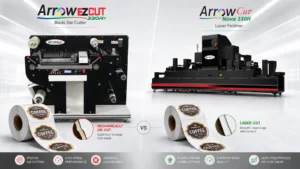
Blade vs. Laser Label Die Cutting: Accuracy, Speed, and Cost per Label
Table of Contents Blade vs. Laser Label Die Cutting: Accuracy, Speed, and Cost per Label Blade die-cutting suits simple shapes and long runs; CO2 laser
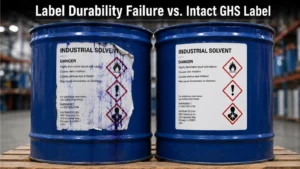
GHS Label Durability Failure: 4 Causes and Practical Fixes
Table of Contents GHS Label Durability Failure: 4 Causes and Practical Fixes GHS label durability failures trace to four causes: aqueous ink chemistry, paper face
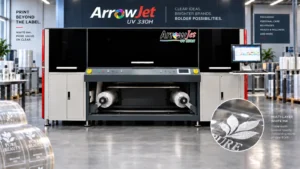
White Ink Clear Label Printing: When You Need It and Why
Table of Contents White Ink Clear Label Printing: When You Need It and Why White ink under clear film keeps brand color, mandatory copy, and