
Table of Contents
How Packaging Changes Boost Sales: Design, Strategy and Execution
Packaging changes boost sales by improving shelf visibility, communicating product value clearly, and giving customers a reason to choose one product over a visually similar alternative.
Key Takeaways
- Packaging is a primary purchase-decision factor — differentiation from category norms creates measurable contrast at the point of sale.
- Small interactive or surprising design details — a hidden message, a collectible variant, a texture change — increase product memorability without requiring a full structural redesign.
- Upcyclable and reusable packaging adds perceived value and appeals to environmentally conscious buyers when the reuse path is specific and realistic.
- Trend-aware packaging does not mean chasing every fad — it means aligning materials, finishes, and visual hierarchy with evolving customer expectations.
- In-house digital printing removes the cost and lead-time barriers that make packaging redesigns risky: no plates, no MOQs, same-day artwork-to-press capability.
- Seasonal and limited-edition packaging — typically expensive with traditional print methods — becomes practical and low-risk with short-run digital production.
Move Away from Category Defaults
Most product categories settle into packaging conventions — similar materials, shapes, and label structures — that make products blend together on shelves rather than compete on identity.
Category norms often emerge for good reasons: efficient production, proven consumer familiarity, reliable supply chains. But those same conventions create an opportunity. When most products in a category look alike, a packaging choice that breaks the visual pattern draws attention without requiring a product reformulation or price change.
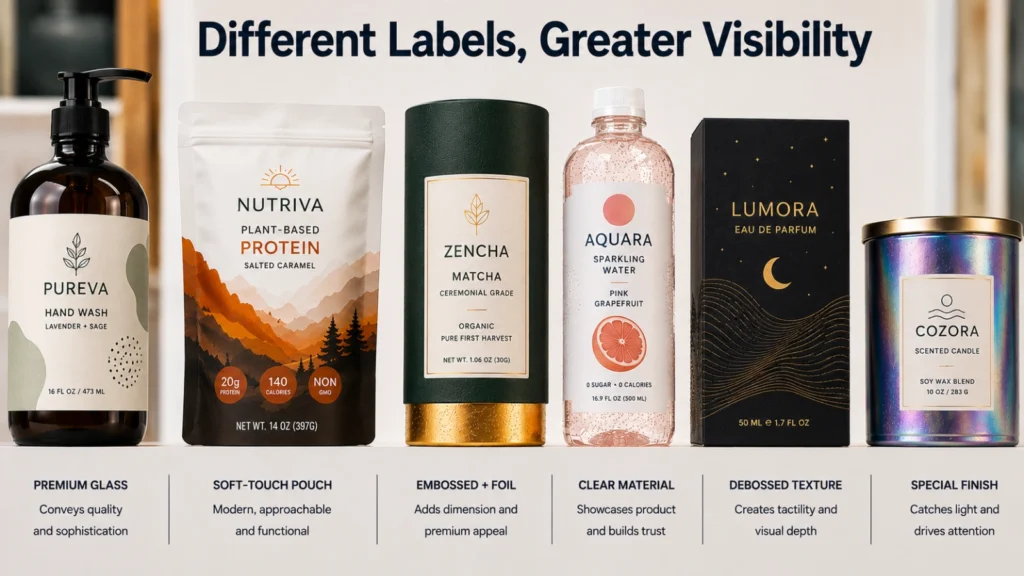
The simplest version of this is a material swap: a category dominated by glossy plastic bottles may offer contrast to a brand using matte labels with a texture finish. A food category built around flat printed pouches may allow a brand using a rigid windowed container to stand out on the same shelf.
Differentiation does not require novelty for novelty’s sake. A packaging change works best when it is rooted in a genuine brand positioning — not just a visual stunt — and when it is still practical to produce, stock, and ship at the required volume.
Category differentiation
The deliberate choice to use packaging materials, finishes, shapes, or visual structures that deviate from the dominant convention in a product category. Effective differentiation creates a perceptual gap between a brand’s product and similar alternatives on the same shelf, increasing the probability that a browsing customer notices and evaluates the product.
Packaging visual hierarchy
The priority order in which a customer reads and processes information on a package — brand name, product descriptor, key benefit, usage instruction. A packaging refresh often improves sales not through a full redesign but by restructuring hierarchy: moving the most compelling claim to a more prominent position and reducing visual noise from secondary copy.
Add Interactive or Memorable Design Elements
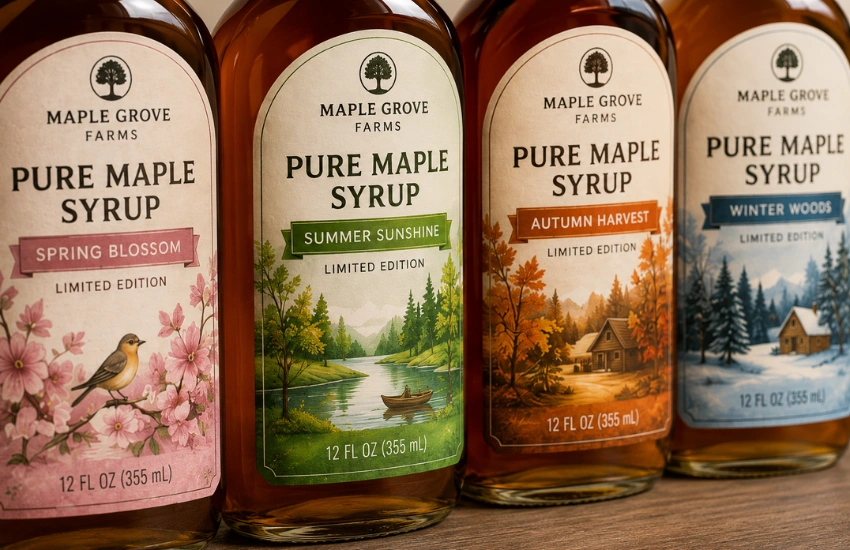
Small interactive details — a hidden message, a riddle inside the cap, a collectible variant label — increase product memorability and create a reason for customers to engage beyond the point of purchase.
Packaging that gives customers something to discover, collect, or share creates a layer of brand interaction that the product experience alone often does not. Consumer brands have used hidden-reveal printing, riddles on inner packaging surfaces, and collectible label series to drive repeat engagement. The format matters less than the principle: give the customer a reason to look twice.
For brands evaluating this approach, the practical starting points are low-cost and low-risk. A label redesign that introduces a seasonal variant, a collectible numbered edition, or a fun fact relevant to the product category adds perceived value without changing the product structure. Interactive elements work best when they are consistent with the brand voice — a premium brand might use a sophisticated reveal, while a youth-oriented brand might use humor or trivia.
The other practical consideration is execution speed. Collectible variants and seasonal editions require the ability to produce multiple label versions affordably. With traditional converter-based printing, plate costs and minimum order quantities make multi-variant label programs expensive. With digital in-house printing, those barriers disappear: each design variant costs the same per label as the standard run.
Design for Reuse and Upcycling
Upcyclable packaging — designed for a practical second life after the original product is consumed — adds perceived value and appeals to environmentally conscious buyers when the reuse path is clear and honest.
The shift in consumer behavior around packaging sustainability is well documented. Beyond recyclability, a growing segment of buyers actively considers whether packaging has post-use utility: a glass jar that functions as food storage, a tin that can hold small items, a bag with a resealable closure that works for home storage after the original contents are gone.
Designing for reuse does not require engineering a new container. It often means communicating reuse potential that already exists: a label redesign that highlights the container’s second-life utility, instructions for repurposing included on the packaging, or a campaign element built around customer-submitted reuse ideas. The packaging itself may not change significantly — the repositioning does.
Any sustainability or upcycling claim should be specific and achievable. Vague language about environmental responsibility increasingly signals inauthenticity to informed consumers. If packaging is genuinely reusable, the claim should describe exactly how: “Resealable for pantry storage,” “Glass jar suitable for canning,” or “Film bag rated for 50+ reuses.” Overclaiming damages brand trust faster than under-promising.
Upcyclable packaging
Packaging designed or marketed so the container can be repurposed into something of equal or greater usefulness than recycling alone. Examples include glass jars reused for food storage, tins repurposed as planters or organizers, and flexible pouches with closures functional for household storage. Distinct from recyclable packaging, which is processed into raw material rather than used directly.
Sustainable packaging claim
Any statement on packaging asserting environmental benefits — recyclability, compostability, reusability, or reduced material use. The FTC Green Guides provide guidance on substantiation requirements for environmental marketing claims in the United States. Claims should be specific, qualified, and supported by verifiable evidence; general terms such as “eco-friendly” without qualification are considered potentially misleading under current FTC guidance.
Stay Current with Packaging Trends
Packaging trends move faster than product formulations — which means a label or flexible packaging refresh can keep a product competitive without any change to the product itself.
Consumer expectations around packaging shift across several dimensions simultaneously: materials (sustainable substrates, reduced plastic content, compostable films), aesthetics (minimalism, matte finishes, natural textures), convenience (resealability, portability, opening experience), and information hierarchy (clarity of ingredients, transparency of sourcing). A brand that has not refreshed packaging in two or more years may be inadvertently signaling that the product itself is dated.
The practical challenge for most brands is that trend responsiveness has historically required large minimum order quantities and long lead times from commercial converters. A packaging trend that peaks and fades in 18 months does not justify tooling costs for a rigid container redesign. But it may easily justify a label redesign — particularly when that redesign can be produced digitally in short runs, tested in one or two retail channels, and scaled only if the market response supports it.
Trend-aware packaging does not mean redesigning at every market shift. It means monitoring the gap between current packaging and customer expectations across materials, visual standards, and sustainability signals — and closing that gap when the delta becomes commercially meaningful.
|
Packaging Trend Area |
What Customers Are Responding To |
Practical Refresh Path |
|
Sustainable materials |
Reduced plastic content, recyclable films, compostable substrates, honest environmental claims |
Label substrate swap; add material information to label copy; transition to film-based flexible formats with recyclability certification |
|
Minimalist design |
Clean visual hierarchy, fewer competing elements, white space, clear ingredient transparency |
Label redesign reducing secondary copy, restructuring hierarchy so primary claim is dominant |
|
Matte and soft-touch finishes |
Premium tactile signals, contrast against glossy shelf neighbors, perceived quality uplift |
Substrate or overlaminate swap on existing label format; no structural change required |
|
Resealable convenience |
Portability, portion control, reduced waste, functional post-use storage |
Transition from non-resealable to resealable flexible format (pouches, stand-up bags); supported by flexible packaging presses |
|
Transparent ingredient communication |
Simpler ingredient lists, clearer sourcing claims, visible product through window packaging |
Label redesign with simplified copy hierarchy; windowed pouch or container formats |
The In-House Printing Advantage: Testing Redesigns Without the Risk
In-house digital printing removes the cost and lead-time barriers that make packaging redesigns risky — enabling short-run testing, seasonal variants, and rapid iteration without plate charges or large minimum orders.
For most brands, the practical barrier to packaging refresh is not creative — it is operational. A label redesign that must be ordered in 10,000-unit minimums from a commercial converter is a significant inventory commitment before a single data point on customer response is available. A flexible packaging change that requires new tooling for a rigid format change can cost more than the annual label budget for a mid-size brand.
Digital label and flexible packaging presses address both barriers directly. There are no plate costs because the design lives in a digital file. There are no minimum order quantities because the press does not require a setup run to reach production quality. A brand considering a packaging refresh can produce 300 labels in a new design, place them on shelf or run a targeted e-commerce test, measure response, and scale — or pivot to a different direction — within the same production week.
Arrow Systems manufactures digital label printers and flexible packaging presses designed for exactly this kind of iterative, in-house production. The range covers entry-level label printing through high-throughput label and flexible packaging systems.
ArrowJet Aqua 330R for Label Redesign and Short-Run Variant Testing
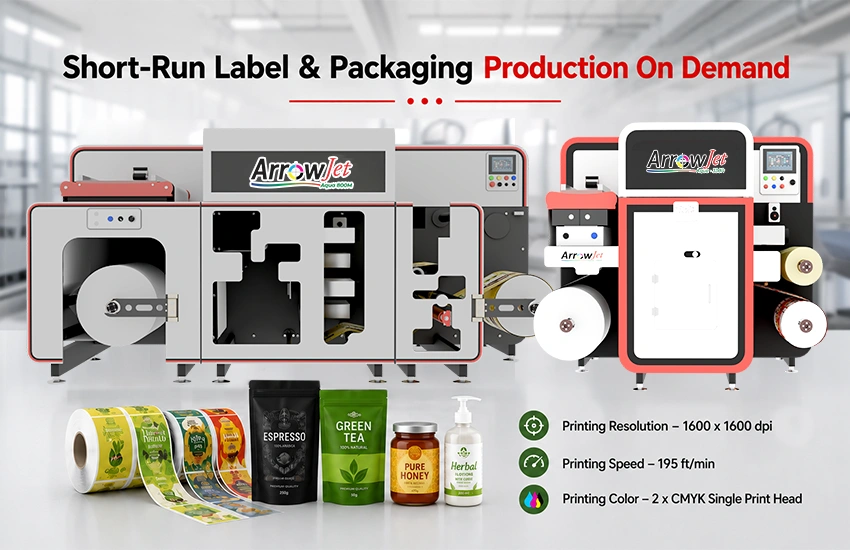
The ArrowJet Aqua 330R is a roll-to-roll digital label press designed for brands producing pressure-sensitive labels in-house. For packaging redesign applications, the key capability is artwork flexibility: design files can be updated and sent to press the same day a change is approved, with no plate charges, no tooling costs, and no minimum run length. Seasonal packaging programs, limited-edition variant labels, and design tests can all be executed as individual short runs on the same press and in the same production workflow as standard label production.
ArrowJet Eco 330R for Smaller Brands Entering In-House Label Production
The ArrowJet Eco 330R is an entry-level digital label press suited for brands managing smaller label volumes and a concentrated SKU portfolio. For brands considering their first packaging redesign on an in-house printing platform, the Eco 330R provides the core capabilities — on-demand production, no plates, same-day artwork-to-press — at a lower initial investment than high-throughput commercial systems. It is particularly well-suited for testing a redesigned label in a single retail channel or geographic market before committing to a full-scale rollout.
ArrowJet Aqua 800M for Flexible Packaging Format Changes
The ArrowJet Aqua 800M is designed for flexible substrate printing — pouches, sachets, stand-up bags, and other film-based formats that roll-to-roll label presses are not built to handle. For brands whose packaging redesign involves a transition from rigid bottle or label-only formats toward flexible packaging, the Aqua 800M enables that format expansion in-house. Short-run testing of a new stand-up pouch design, a seasonal sachet variant, or a flexible format trial for an existing product becomes a production-day decision rather than a multi-week converter engagement.
Packaging Refresh Tactics: An Evaluation Checklist
These six tactical areas cover the most practical and lowest-risk entry points for a packaging refresh — ordered from least to most structural investment.
|
Tactic |
What It Addresses |
Structural Change Required? |
Testable with Short-Run Digital Print? |
|
Update label visual hierarchy |
Ensure the most compelling benefit is the first thing customers read on the package |
No — label redesign only |
Yes ✅ |
|
Change label substrate or finish |
Signal premium, natural, or modern positioning through tactile and visual material choices |
No — material swap on existing format |
Yes ✅ |
|
Add an interactive or collectible design element |
Create post-purchase engagement and brand memorability through a label-level design feature |
No — label redesign only |
Yes ✅ |
|
Introduce seasonal or limited-edition packaging |
Drive purchase urgency and shelf contrast during high-traffic retail periods |
No — label redesign; no change to container |
Yes ✅ |
|
Communicate reuse or upcycle potential |
Add post-purchase utility value; align with sustainability expectations |
Minor — may require label copy update and possible container selection |
Partially — label element testable; container selection is separate |
|
Transition to flexible packaging format |
Enter growing flexible format categories (pouches, sachets) or reduce material usage per unit |
Yes — format change; requires flexible packaging press capability |
Yes ✅ (with flexible packaging press) |
Frequently Asked Questions — Packaging Changes and Sales Performance
Common questions from brand managers, product teams, and operations leads evaluating whether and how to refresh product packaging.
- Yes — packaging directly influences attention, perceived value, and purchase confidence. Research consistently shows that packaging is a primary decision factor at the point of purchase, particularly in categories where products are visually similar. A packaging change does not guarantee a sales lift on its own, but it is one of the few product-level changes that can be tested and iterated quickly — especially when using digital in-house printing that removes minimum order quantities and plate costs.
Packaging should be aware of trends without being controlled by them. The most effective changes reflect the brand’s positioning and customer expectations — not just what is visually current. Trends around sustainable materials, minimalist hierarchy, and convenience features can signal modern brand values when applied thoughtfully. The key is matching trend adoption to operational reality: a redesign that can be tested with a short digital print run is lower risk than one requiring full tooling commitment.
Upcyclable packaging is designed so the container can be repurposed or given a practical second life after the original product is consumed — glass jars for food storage, tins as organizers, resealable bags for home use. Upcyclability adds perceived value and resonates with environmentally conscious buyers. Any sustainability or reuse claim should be specific and achievable; vague environmental messaging is increasingly counterproductive with informed consumers.
Digital label printing eliminates the plate costs and minimum order quantities that make seasonal or limited-edition packaging expensive with traditional flexographic printing. A brand can produce a limited run of holiday labels or a test batch of a new design without committing to thousands of units. Artwork changes are made digitally and go to press the same day approval is received, making it practical to test multiple design variants in real retail conditions before selecting a permanent refresh direction.
Arrow Systems manufactures digital label and packaging presses across multiple product lines for in-house production. The ArrowJet Aqua 330R handles high-speed roll label production for brands redesigning adhesive labels on rigid packaging. The ArrowJet Eco 330R is an entry-level digital label press suited for smaller brands testing new designs at lower volumes before scaling. The ArrowJet Aqua 800M is designed for flexible substrate printing — pouches, sachets, and stand-up bags — for brands whose packaging refresh involves film-based flexible formats. All three eliminate plate charges and support on-demand short-run production.
See How In-House Digital Printing Can Support Your Packaging Refresh
Packaging redesigns move faster and cost less when artwork changes go directly to press — no plates, no minimum orders, no converter lead times. Whether you are refreshing an adhesive label, testing a limited-edition design, or evaluating a move into flexible packaging formats, Arrow Systems’ digital presses are built for exactly this kind of iterative, in-house production.
Arrow Systems is a hardware manufacturer. We sell label and flexible packaging printing equipment — not printing services. Our team can walk you through system capabilities, substrate compatibility, and production workflows to help you identify the right press configuration for your volume and format requirements.
Pet Food Brand Label Supplier Problems: 5 Signs to Print In-House
Table of Contents Pet Food Brand Label Supplier Problems: 5 Signs to Print In-House Most pet food label supplier problems are a model mismatch: flexo’s
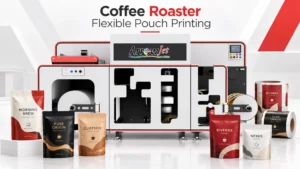
Coffee Roaster Flexible Pouch Printing Workflow: Roll to Bag
Table of Contents Coffee Roaster Flexible Pouch Printing Workflow: Roll to Bag In-house coffee pouch printing runs five stages — substrate loading, queue setup, the
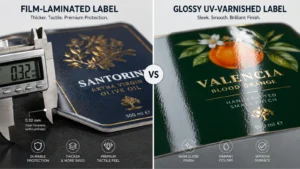
Overlaminate vs. Varnish Labels: How to Choose Protection
Table of Contents Overlaminate vs. Varnish Labels: How to Choose Protection Film overlaminate protects against immersion, wash-down, and solvents; UV and aqueous varnish suit retail
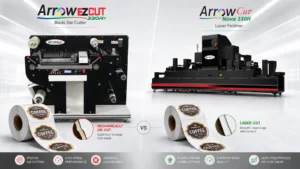
Blade vs. Laser Label Die Cutting: Accuracy, Speed, and Cost per Label
Table of Contents Blade vs. Laser Label Die Cutting: Accuracy, Speed, and Cost per Label Blade die-cutting suits simple shapes and long runs; CO2 laser
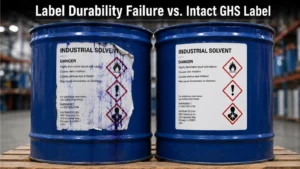
GHS Label Durability Failure: 4 Causes and Practical Fixes
Table of Contents GHS Label Durability Failure: 4 Causes and Practical Fixes GHS label durability failures trace to four causes: aqueous ink chemistry, paper face
White Ink Clear Label Printing: When You Need It and Why
Table of Contents White Ink Clear Label Printing: When You Need It and Why White ink under clear film keeps brand color, mandatory copy, and