Table of Contents
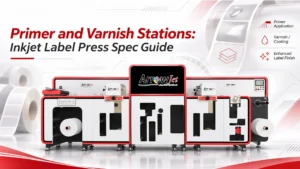
Primer and Varnish Stations: Inkjet Label Press Spec Guide
Primer and varnish stations prime film before inkjet printing and protect it after, so a hybrid press can print untreated film in one pass.
Key Takeaways
- Water-based pigment ink needs an ink-receptive surface on non-porous film, because low and variable surface energy makes droplets bead up and fail tape and rub tests.
- Converters can supply that surface three ways: pre-coated inkjet stock, offline pre-treatment on a separate coater, or inline primer and varnish stations on the press.
- Inline stations combine priming, printing, drying, and varnishing in one pass, but add anilox changeovers, coating consumables, and station cleanup.
- Inline coating is not automatically cheaper: long runs on a single qualified film may favor pre-coated stock or batched offline coating.
- The ArrowJet Aqua 330R Hybrid Pro M and Bolt 330R Hybrid Pro M fit mixed label work on varied films; the ArrowJet Aqua 800M fits wide film for pouches using offline pre-treatment.
Why Water-Based Pigment Ink Needs a Receptive Surface
Non-porous films have low, variable surface energy, so water-based pigment ink beads up and fails tape tests without a primer.
A common failure looks like this. A short run of clear BOPP beverage labels and a batch of launch pouches both look sharp coming off the dryer. Then QC runs a tape test and the ink lifts, a thumb rub smears the black, and the pouch film shows mottled solids. The ink is usually working as designed; the film simply lacks an ink-receptive surface.
This guide is for converter owners, production managers, and press operators evaluating water-based inkjet on film. It compares three ways to supply that receptive surface and ends with a trade-off table and a 10-point spec checklist to use before talking to any press vendor.
Surface energy on non-porous film
Paper absorbs water, but non-porous films such as BOPP, PET, and PE do not. These films also have low surface energy that can vary from roll to roll and even across a single web. When surface energy is too low for the ink, droplets bead up instead of spreading, producing mottled solids, inconsistent dot gain, and color shifts between jobs.
Corona treatment
Corona treatment raises film surface energy, but it is often not enough on its own for water-based pigment ink. Treatment levels decay during storage, and a corona-treated surface still may not anchor pigment well enough to pass tape or rub tests. As general industry practice, converters check surface energy before printing and confirm the actual targets with their ink and substrate suppliers.
Primer
A primer is a coating that creates a controlled, ink-receptive layer on the film. It helps water-based ink wet out evenly, holds dot shape, improves color consistency, and anchors the pigment to the substrate. That is why film adhesion with water-based ink so often depends on the primer rather than on the ink itself.
Overprint varnish
An overprint varnish protects the printed label after the ink dries. Because dried pigment sits on the surface, a varnish adds resistance to scuff, moisture, and chemicals, and it lets the converter set a gloss or matte finish. Where a laminate is preferred instead, it is applied on the press or on dedicated label finishing systems after printing.
NIR drying
Drying is the third variable in printing water-based ink on film. Water has to leave the ink film quickly without overheating heat-sensitive films that can stretch or distort. An inline near-infrared (NIR) dryer targets the ink layer efficiently, which can limit the heat transferred into the substrate.
Option 1: Pre-Coated Inkjet Label Stocks (No Priming Needed)
Pre-coated inkjet stock arrives topcoated with a receptive layer, making it the simplest start on paper and qualified films.
What pre-coated inkjet label stock is
Pre-coated inkjet label stock is a paper or film face stock that the material supplier has already topcoated with an inkjet-receptive layer. No priming happens at the converter.
Best-fit jobs for pre-coated stock
Pre-coated stock suits paper labels, standard filmic labels from a supplier’s inkjet-qualified range, and converters starting on their first water-based inkjet press.
Advantages of pre-coated stock
Pre-coated stock offers the simplest start-up path, with no coating chemistry to manage and fewer variables at the press.
Limitations of pre-coated stock
Pre-coated stock costs more per square unit than untreated equivalents. Substrate selection is narrower, which limits what sales can quote, and supplier lead times apply. Coated rolls also cannot easily be repurposed for other print processes.
Pre-Coated Stock Workflow
- Order qualified pre-coated inkjet label stock.
- Receive and store the stock under the supplier’s recommended conditions.
- Print and dry.
- Laminate or varnish if the end use requires it, then die-cut and finish.
Option 2: Offline Pre-Treatment Before Printing
Offline pre-treatment primes film on a separate coater before printing, opening up untreated film at the cost of an extra pass.
What offline pre-treatment is
Offline pre-treatment is a separate coating pass, on a coater or dedicated unit, that primes film before it reaches the inkjet press. It is common for wider flexible packaging rolls.
Best-fit jobs for offline pre-treatment
Offline pre-treatment suits wider film webs, pouch and wrap work on digital flexible packaging printers, operations that already run coating equipment, and shops that can batch pre-treatment ahead of print.
Advantages of offline pre-treatment
Offline pre-treatment opens up lower-cost untreated films and keeps coating units out of the print engine’s web path. It also lets a shop pre-treat in bulk during off-peak shifts.
Limitations of offline pre-treatment
Offline pre-treatment adds an extra pass and more roll handling to every job. It creates WIP storage for primed rolls, scheduling friction between coating and printing, and a second set of coating QC checks. Primed rolls may also have a usable window, which should be confirmed with the coating supplier.
Offline Pre-Treatment Workflow
- Mount the untreated roll on the coater.
- Apply primer and dry.
- Run QC on the coated roll.
- Rewind, label, and stage the roll as WIP.
- Print on the inkjet press.
- Overcoat or laminate, then slit, convert, or pouch.
Option 3: Inline Primer and Varnish Stations on the Press
Inline primer and varnish stations prime, print, dry, and protect film in one pass on a hybrid label press.
What inline primer and varnish stations are
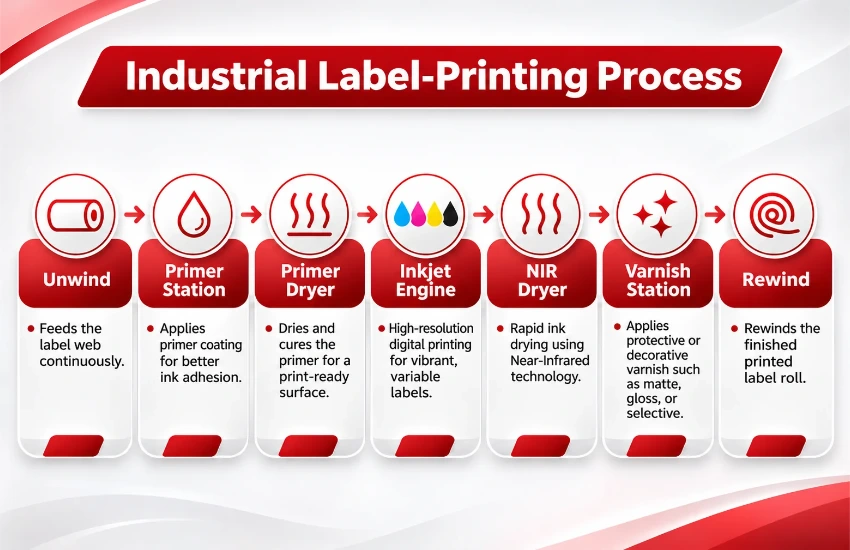
Inline primer and varnish stations are flexo coating units positioned before and after the inkjet engine on a hybrid label press. Priming happens on the digital press in the same pass as printing. The flexo units apply primer and varnish while the inkjet engine prints the image, which is the main difference from a conventional inline flexo printing machine that prints the image itself from flexo plates. You will find this setup on the hybrid models in Arrow Systems’ range of digital label printers.
Best-fit jobs for inline stations
Inline stations suit high-mix roll-to-roll label work across papers and varied films, untreated BOPP inkjet printing, and short runs where an offline pass would take longer than the print itself.
Advantages of inline stations
Inline stations give flexibility on untreated or lower-cost stocks, with fewer roll touches and no primed-roll WIP. Finished durability comes off the press in a single pass, and coat weight and finish can be adjusted per job.
Limitations of inline stations
Inline stations add press complexity and a larger footprint. They bring anilox and coating changeovers, coating consumables, and station cleanup. Each inline coating station also adds variables to manage, which raises the required operator skill.
Inline Primer and Varnish Workflow
- Load the untreated roll.
- Prime at the pre-print flexo station.
- Dry the primer.
- Print with water-based pigment ink.
- Dry the ink with NIR.
- Apply varnish at the inline varnish station.
- Cure or dry the varnish.
- Rewind, or move on to inline finishing.
Speed, Labor, and Consumable Trade-Offs Between the Three Approaches
Inline stations cut passes and WIP, while pre-coated stock and offline coating keep the press simpler. Labor touches separate them most.
Factor | Pre-Coated Stock | Offline Pre-Treatment | Inline Stations |
Substrate flexibility | Low to medium | High | High |
Cost per job driver | Premium stock price | Extra pass labor and coating | Coating consumables and press complexity |
Passes per job | One (plus finishing) | Two or more | One |
Labor touches | Low | High | Low to medium |
WIP and storage | Coated stock inventory | Primed-roll WIP | Minimal |
Changeover considerations | Stock swaps only | Coater and press setups | Anilox, coating, and cleanup |
Durability options | Requires separate lamination or varnish | Separate overcoat step | Inline varnish, gloss or matte |
Best-fit job mix | Paper-heavy work and standard films | Wide film, pouches, and batched work | Mixed labels on varied films |
Labor and handoffs are where the three approaches separate most clearly. Combining priming, printing, drying, and varnishing into one controlled pass removes handoffs between departments, reduces manual scheduling, and eliminates the “where is that primed roll?” problem.
Illustrative estimate: if offline pre-treatment adds one extra pass and one roll changeover per job, a shop running many short jobs per week multiplies that handling time across every job. Inline priming removes that step but replaces it with anilox and coating changeovers at the press. Model both against your actual job counts rather than a vendor’s averages.
Inline coating is not automatically cheaper. Long runs on a single qualified film may favor pre-coated stock or batched offline coating.
How to Spec a Press with Inline Primer and Varnish Stations
Run these ten checks before talking to any press vendor, from a substrate audit to a trial on your own films and artwork.
Step 1: Audit your substrate list and job mix
Separate labels from pouches and films from papers, and record typical run lengths for each group.
Step 2: Define durability requirements by end use
List the resistance each product needs. Common requirements include scuff, moisture, chemical, and freezer resistance.
Step 3: Set the number and position of coating stations
Specify whether you need a pre-print primer, a post-print varnish, or both.
Step 4: Check anilox and coat-weight flexibility
Confirm how easily anilox rolls can be swapped to change coat weight between jobs.
Step 5: Confirm coating chemistry and drying or curing method
Review primer and varnish chemistry, and how each layer is dried or cured, with your ink and coating suppliers.
Step 6: Match drying capacity to real running speeds
Size drying, including NIR, to the speeds you actually run on your most heat-sensitive films.
Step 7: Check web width and web path
Confirm the maximum media width and printing width cover your largest label and pouch formats.
Step 8: Walk through changeover and cleanup
Review the full changeover workflow, including station washup and coating storage.
Step 9: Address food-contact or low-migration needs
Check coating and ink suitability with your suppliers and qualified counsel, because press hardware alone cannot guarantee compliance.
Step 10: Run a trial on your own substrates and artwork
Before purchase, print your real films and files and run tape, rub, and end-use tests on the results.
Food-contact and low-migration suitability depends on your ink and coating chemistry, so confirm it with your suppliers and qualified regulatory counsel. The Arrow Systems team can help you choose and trial the press, while compliance sign-off stays with your suppliers and counsel.
ArrowJet Aqua 330R Hybrid Pro M and Bolt 330R Hybrid Pro M (Inline Primer + Varnish + NIR) vs. ArrowJet Aqua 800M (Offline Pre-Treatment for Film)
The Aqua 330R Hybrid Pro M and Bolt 330R Hybrid Pro M prime and varnish inline; the Aqua 800M prints wide film pre-treated offline.
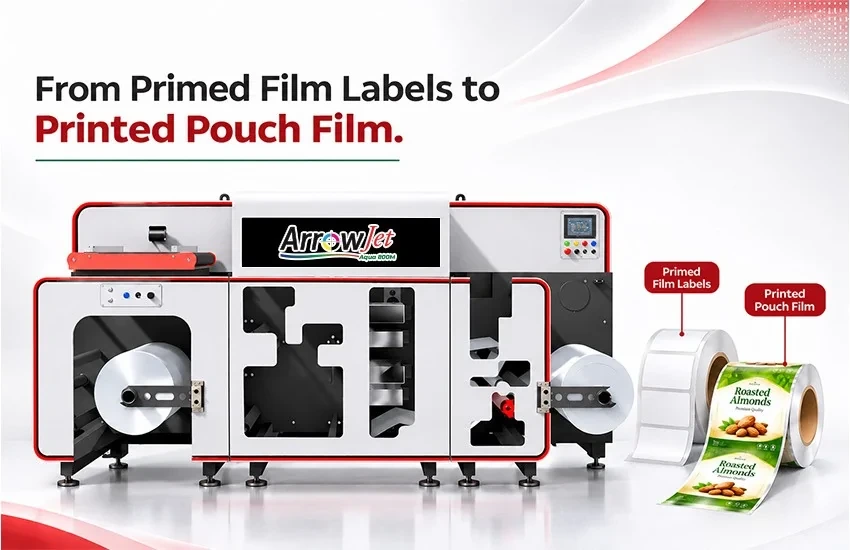
ArrowJet Aqua 330R Hybrid Pro M and Bolt 330R Hybrid Pro M: inline primer, varnish, and NIR drying
If your job mix shifts between paper, clear film, and white film within a week, the ArrowJet Aqua 330R Hybrid Pro M and the ArrowJet Bolt 330R Hybrid Pro M let you prime, print, NIR-dry, and varnish roll-to-roll in a single pass. You can run untreated or lower-cost stocks and still protect finished labels without a separate lamination step.
ArrowJet Aqua 800M: offline pre-treatment for wider film
The ArrowJet Aqua 800M suits you if most of your work is wider flexible packaging, such as pouch and film jobs. You pre-treat film offline in batches ahead of print, which keeps the press web path simple.
Factor | ArrowJet Aqua 330R Hybrid Pro M and Bolt 330R Hybrid Pro M | ArrowJet Aqua 800M |
Film priming approach | Inline primer station | Offline pre-treatment before printing |
Protection and drying | Inline varnish and NIR drying in the same pass | Coating handled off the press, keeping the print path simple |
Production style | Single-pass roll-to-roll label production | Batched pre-treatment ahead of print |
Best-fit job mix | Mostly narrow labels on varied substrates | Mostly wider film for pouches |
If you print mostly narrow labels on varied substrates, start with the 330R Hybrid Pro M models. If you print mostly wider film for pouches, start with the 800M workflow. For full specifications on either path, check each press’s product page or ask the Arrow Systems team about your substrates and formats.
Choosing the Right Approach for Your Job Mix
Paper-heavy work, wide film, and mixed labels on varied films each point to a different way of priming and protecting the print.
Mostly paper and qualified films
Start with pre-coated inkjet stock to keep variables low while your team learns water-based inkjet, then revisit inline coating as film demand grows.
Wide film and flexible packaging
Offline pre-treatment makes sense when work is batched and wide, provided you plan for primed-roll WIP and scheduling.
Mixed label work on varied films
Inline primer and varnish stations offer the most flexibility and put substrate strategy under your control in a single pass.
Any path
Qualify the approach with tape, rub, and end-use tests on your own substrates before committing capital.
Frequently Asked Questions: Primer and Varnish Stations on Inkjet Label Presses
Common questions from converters evaluating priming, varnishing, and drying for water-based inkjet on film.
In most cases, yes. Untreated or lightly treated BOPP typically does not give water-based pigment ink enough wetting or anchorage to pass tape and rub tests consistently. A primer creates a receptive layer, supplied through pre-coated stock, offline pre-treatment, or an inline station. Confirm the right primer with your ink supplier.
Sometimes. Labels on dry, low-handling products may perform acceptably without protection. Because dried pigment sits on the surface, labels facing condensation, chemicals, shipping abrasion, or freezer storage usually need an overprint varnish or laminate. Test unprotected samples against your customer’s actual end-use conditions before quoting them without a protective layer.
It depends on your job mix. Pre-coated stock is simpler and suits paper-heavy work or a small set of qualified films. Inline priming typically pays off when you quote many different films, want lower-cost untreated stocks, or need to avoid stocking coated inventory. It also adds press complexity, coating consumables, and changeover work your team must manage.
A near-infrared (NIR) dryer delivers energy that water-based ink absorbs efficiently, driving off water quickly. Because it concentrates heat in the ink layer, it can help limit substrate heating on thin or heat-sensitive films. Match drying capacity to your real running speeds, coverage levels, and substrates, and verify it during a trial.
Book a Substrate Trial Consultation with Arrow Systems
Ready to test your toughest substrates? Send Arrow Systems your substrate list, job mix, run lengths, and durability requirements, and the team will recommend the approach that fits.
That may be a substrate and artwork trial on the ArrowJet Aqua 330R Hybrid Pro M or Bolt 330R Hybrid Pro M, or a workflow review for the ArrowJet Aqua 800M with offline pre-treated film.
Primer and Varnish Stations: Inkjet Label Press Spec Guide
Table of Contents Primer and Varnish Stations: Inkjet Label Press Spec Guide Primer and varnish stations prime film before inkjet printing and protect it after,
Batch Coding Technology Comparison: Food Labels & Industrial
Table of Contents Batch Coding Technology Comparison: Food Labels & Industrial CIJ suits wet and curved packs, TTO suits film and barcodes, laser suits permanent

Cosmetic Label Color Consistency: Diagnosing Batch Shifts
Table of Contents Cosmetic Label Color Consistency: Diagnosing Batch Shifts A polyimide label substrate is a high-temperature film construction that stays bonded and scannable through
Polyimide Label Substrate for Aerospace and Industrial Use
Table of Contents Polyimide Label Substrate for Aerospace and Industrial Use A polyimide label substrate is a high-temperature film construction that stays bonded and scannable
Entry-Level Label Printer for a Supplement Brand: Readiness Guide
Table of Contents Entry-Level Label Printer for a Supplement Brand: Readiness Guide A supplement brand is ready for an entry-level label printer when it passes
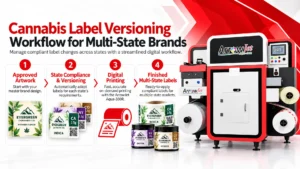
Cannabis Label Versioning Workflow for Multi-State Brands
Table of Contents Cannabis Label Versioning Workflow for Multi-State Brands A cannabis label versioning workflow produces state-specific labels from one master template by moving state-variable