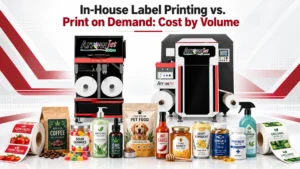
In-House Label Printing vs. Print on Demand: Cost by Volume
Table of Contents In-House Label Printing vs. Print on Demand: Cost by Volume In-house label printing vs. print on demand comes down to a cost-per-label
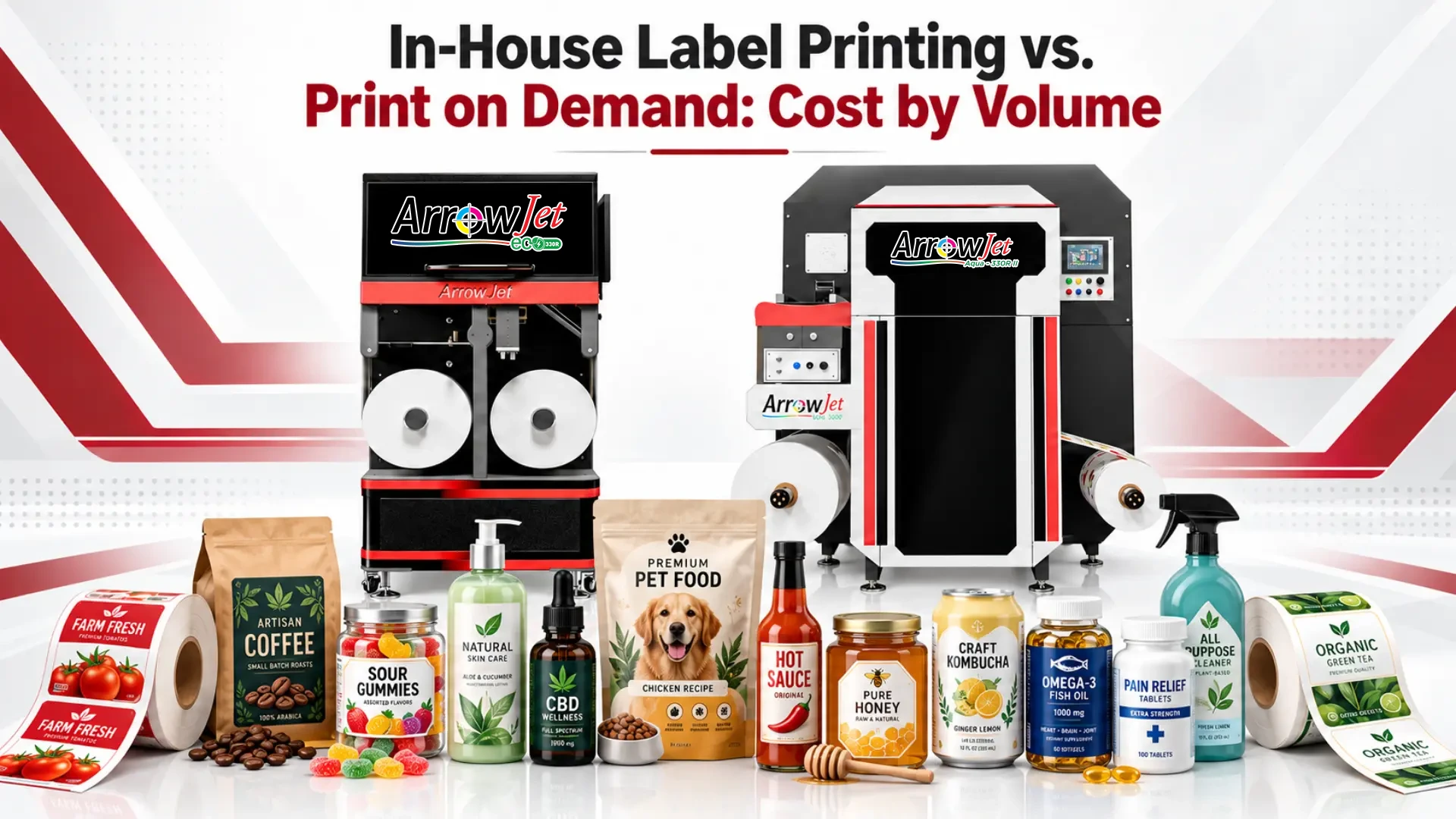
In-house label printing vs. print on demand comes down to a cost-per-label question: compare your fully loaded in-house cost to the outsourced landed cost at your real volume.
POD pricing is tiered by quantity, but the quoted price excludes freight, overbuy, and obsolescence costs you absorb internally.
Quoting mechanics
Print on demand label printing cost is typically quoted in tiers by quantity, with a per-SKU minimum order. Depending on the process, you may also see one-time setup, plate, or die charges — digital runs often avoid plates but still carry setup and tooling for the cutting step. Because pricing improves at higher tiers, buyers frequently order past actual demand to reach a better break.
Typical workflow
Artwork submission, prepress review, digital or physical proof, approval, production queue, print, finishing, QC, freight, then dock receipt and put-away. Each handoff adds elapsed time, and most of that time is queue time rather than press time.
Where lead time and cost actually accumulate
Proof cycles are the most common source of slippage, especially when regulatory or brand review adds a round trip. Queue position, freight transit, and receiving inspection consume the rest. Print on demand label turnaround is rarely limited by how fast the press runs.
The quoted price per label also excludes several costs you absorb internally:
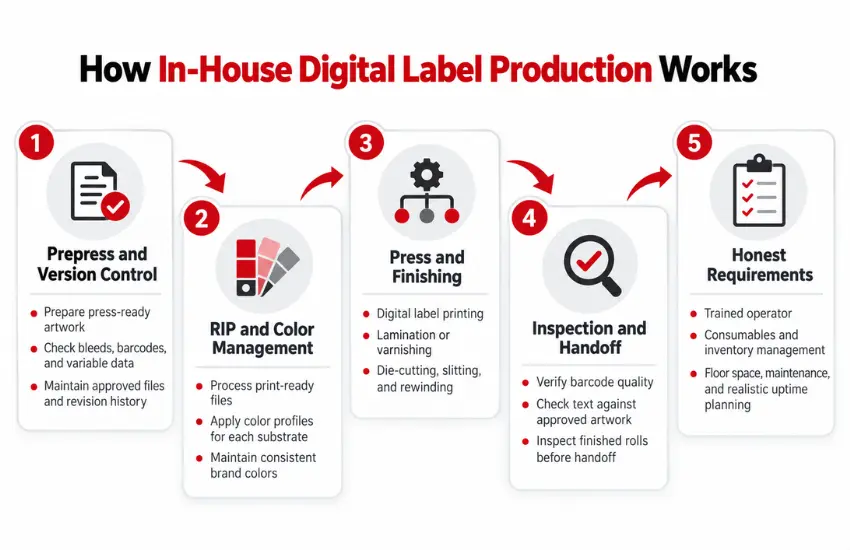
In-house production spans prepress, RIP and color management, press and finishing, and inspection — plus real operating requirements.
Prepress and version control
Artwork is normalized to press-ready files with defined bleeds, barcodes, and variable-data fields. Version control is the discipline that makes in-house printing pay off: one approved master per SKU, with revision history and a documented release step. Regulated label content should still route through your internal quality or regulatory review before release.
RIP and color management
The RIP drives the press and applies profiles for each substrate. Repeatable brand color across runs and substrates requires calibrated profiles and periodic verification, not just a capable printer.
Press and finishing
A digital label printer (inkjet or toner) prints the web. Finishing then applies laminate or varnish, cuts the shape by rotary die or laser, slits to width, and rewinds to spec with the correct core and wind direction. Finishing capability — not print capability — is usually what limits format flexibility.
Inspection and handoff
Operators verify barcode grade, copy accuracy against the approved version, and roll construction before the roll moves to the application line.
Honest requirements
In-house production needs a trained operator, consumable inventory management, floor space for press and finishing, scheduled maintenance, and realistic uptime assumptions. Uptime, waste rate, and operator skill are the three variables that most often break an optimistic model. For teams sizing that first press, a compact, single-phase inkjet label press such as the ArrowJet Eco 330R — no air compressor required — is built specifically to keep these floor-space and utility requirements modest while still delivering true industrial single-pass output.
Two formulas — one for outsourced landed cost, one for in-house fully loaded cost — reveal where the real crossover volume sits.
Outsourced landed cost per label
(Quoted price × labels purchased) + freight + expedite fees + obsolescence write-off + inventory carrying cost + PO/receiving labor, divided by labels actually applied. Watch the denominator: labels applied, not labels purchased. That single change is what exposes MOQ overbuy and obsolescence.
In-house fully loaded cost per label
Substrate + ink or toner + finishing consumables (laminate, die or laser, cores) + (direct labor per hour ÷ labels per hour) + maintenance or service contract ÷ annual volume + waste and setup scrap + equipment amortization ÷ annual volume.
Illustrative comparison — replace every figure with your own quotes and rates.
Input (illustrative only) | LOW volume | MEDIUM volume | HIGH volume |
Annual labels applied | 500,000 | 3,000,000 | 12,000,000 |
Quoted POD price/label | $0.045 | $0.032 | $0.024 |
Freight, expedite, PO/receiving per label | $0.006 | $0.004 | $0.003 |
Overbuy + obsolescence + carrying per label | $0.008 | $0.007 | $0.005 |
POD landed cost/label | $0.059 | $0.043 | $0.032 |
In-house variable cost (substrate, ink, finishing consumables) | $0.014 | $0.013 | $0.012 |
In-house labor per label at assumed throughput | $0.020 | $0.007 | $0.003 |
Maintenance + waste/scrap per label | $0.008 | $0.004 | $0.003 |
Equipment amortization per label | $0.048 | $0.008 | $0.002 |
In-house fully loaded cost/label | $0.090 | $0.032 | $0.020 |
The pattern matters more than the placeholder numbers. In-house variable cost stays fairly flat, while labor and amortization per label collapse as volume rises. The same equipment looks expensive at low volume and cheap at high volume, so fully loaded cost per label at your volume — not list price — should drive the decision.
Inputs to collect before you decide:
Same-day turnaround, single-version inventory, and late-stage variable data are where in-house production earns its keep.
Turnaround in hours instead of days
With prepress and finishing under one roof, a roll can be produced the same day it is needed. That removes expedite fees and the short-shipping scramble during launches.
Only the current version prints
There is no pre-printed inventory to reconcile against a revision. When a panel changes, the next roll reflects it, which structurally shrinks the obsolescence line in the POD formula.
Late-stage variable data
Lot codes, dates, promotional versions, and regional or language variants can be applied at print time instead of planned months ahead. High-mix operations often find this is the real value, not the unit cost.
Short-run, pilot, private-label, and co-pack SKUs
Any SKU that cannot consume a supplier’s minimum order is a candidate. Contract packagers running dozens of client artworks feel this most acutely.
Operations automation
The larger gain arrives when label production is triggered from the production schedule or ERP: the run releases, the label job releases with it, and rolls are made just in time for that order. Labeling stops being a procurement lead-time risk and becomes a scheduled production step.
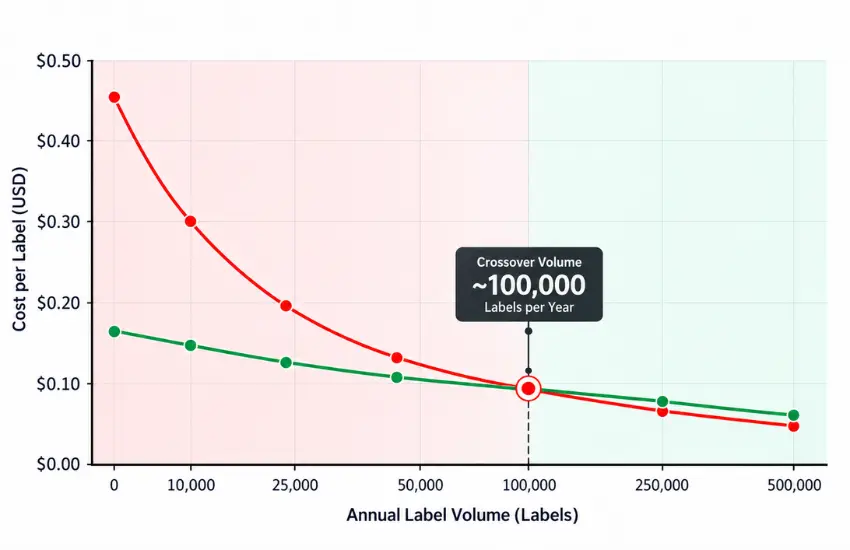
Outsourcing still wins for low stable volume, long product lifecycles, specialty substrates, and seasonal surge capacity.
Outsourcing remains the better answer in several legitimate scenarios:
Crossover is a range, not a single number — compute both cost formulas, compare them, then stress-test the assumptions.
Knowing when to buy a label press starts with computing both formulas at your real volume, then comparing where they meet.
Step-by-step method:
Step 1: Compute blended POD landed cost per label
Use labels applied as the denominator, not labels purchased.
Step 2: Compute fully loaded in-house cost per label
Use your realistic annual volume: realistic uptime, realistic throughput, realistic waste rate — not the vendor’s best-case numbers.
Step 3: Compare the two, then solve for the volume at which they converge
That convergence point is your crossover volume.
Step 4: Re-run the model at several volumes
This shows how wide the indifference band is around your crossover point.
Sensitivity tests to run, at minimum:
Crossover is a range, not a single number. Every input above moves it. In practice, SKU count and revision frequency often move crossover more than raw volume, because they drive MOQ overbuy and obsolescence on the outsourced side while adding only setup time in-house. Two plants with identical annual volume can land on opposite sides of the line.
Recommended hybrid split. Most mid-market operations do better with a hybrid label printing model than with picking just one approach. Run high-mix, short-run, high-revision, and variable-data SKUs in-house, where turnaround and version control matter most — on a press and finishing line sized to that mix, such as an entry-level digital press paired with the Arrow EZCut 330R+ blade die cutter for standard shapes and the ArrowCut Nova 330R laser finisher for short-run or custom-shape jobs. Keep long-run, stable, and specialty-decoration SKUs with an outsourced converter, where tier pricing and process capability win.
Decision traps to avoid:
Common questions from operations, packaging, and procurement leads comparing in-house label production to print-on-demand.
There is no universal threshold. Build both formulas with your own rates, then find where fully loaded in-house cost meets blended outsourced landed cost. Plants with many SKUs and frequent revisions often reach that point at lower volumes than expected, because MOQ overbuy and obsolescence inflate the outsourced side well beyond the quoted price.
Outsourced turnaround is usually measured in days to weeks, driven mostly by proof cycles, queue position, and freight rather than press time. In-house production is typically measured in hours once prepress is approved and consumables are on hand. Actual timing depends on your approval workflow, staffing, and finishing capacity.
Yes, and it is often the strongest answer. Segment the portfolio by run length, revision frequency, and decoration requirements. Keep long-run and specialty SKUs with a converter, and bring short-run, high-revision, and variable-data SKUs in-house. The hybrid also preserves an outside source as backup capacity during maintenance or demand spikes.
Pull twelve months of label spend, SKU count, and lead time first — that’s roughly 80% of the crossover model.
Run your own numbers first. Pull your last 12 months of label spend, active SKU count, revisions per SKU, and average lead time — that is roughly 80% of the model, and it will tell you quickly whether this is worth pursuing. Plug those figures into the in-house label printing cost formula above and compare it to your blended outsourced landed cost.
Operational takeaways:
Results depend on your actual volumes, rates, and mix; no savings or payback outcome is guaranteed. Arrow Systems manufactures digital label printing and finishing equipment; Arrow does not print or supply labels on a customer’s behalf.
Arrow Systems can pressure-test these inputs in a structured, no-obligation label cost and volume assessment for your operation.
The assessment builds a side-by-side per-label comparison of your current outsourced landed cost against a modeled in-house cost, identifies the likely crossover range for your SKU mix, recommends a hybrid split, and sizes a digital printing and finishing configuration to your substrates, formats, and throughput — including how label production could be triggered from your production schedule.
Table of Contents In-House Label Printing vs. Print on Demand: Cost by Volume In-house label printing vs. print on demand comes down to a cost-per-label
Table of Contents Pharmaceutical Label Version Control Workflow for FDA Changes A GMP label version control workflow moves an approved revision to the line: change
Table of Contents Mylar vs BOPP Flexible Packaging: Substrate Selection Guide PET (Mylar) leads on oxygen and aroma barrier and heat tolerance; BOPP leads on
Table of Contents When to Add a Second Label Printer: Capacity Decision Guide Three measurable signals decide it — sustained utilization above your scheduling ceiling,
Table of Contents Diagnosing Supplement Label Peeling HDPE Bottle Failures HDPE label peeling traces to low surface energy, an adhesive mismatch, or moisture exposure —
Table of Contents Roll-to-Roll vs. Sheet-Fed Label Printing: Throughput & Cost Rolls win on cost per applied label with an automatic applicator; sheets win on