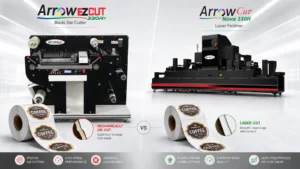
Blade vs. Laser Label Die Cutting: Accuracy, Speed, and Cost per Label
Table of Contents Blade vs. Laser Label Die Cutting: Accuracy, Speed, and Cost per Label Blade die-cutting suits simple shapes and long runs; CO2 laser
Blade die-cutting suits simple shapes and long runs; CO2 laser suits intricate shapes and short runs — it’s a cost decision, not a preference.
Blade and CO2 laser die-cutting solve different production problems — the right choice depends on shape, substrate, run length, and cost per label.
Blade finishing fits standard-to-moderate shapes, mixed substrates, and long repeat runs, where mechanical cutting is predictable and consumables are cheap. CO2 laser finishing fits intricate outlines, tight inside radii, and high-mix short runs, where die-free flexibility outweighs simplicity. Neither is a universal answer — the fit depends on what is actually running through your finishing line. In practice, the blade vs laser die cutting decision comes down to four variables, not a blanket preference for one machine over the other.
This guide is written for label converters, in-plant label rooms, and the operations, engineering, and QA leads who sign the equipment approval. Four variables decide the purchase: shape complexity, substrate behavior, throughput at your real run lengths, and loaded cost per label. What follows is a side-by-side comparison table, an itemized cost model you can populate with your own rates, and a pre-purchase checklist.
Decision rule
If a meaningful share of your die library has inside radii a blade cannot hold, or your typical run length sits in the hundreds, laser takes the first slot. If your shapes are simple and your repeats are long, blade takes it.
Blade finishers cut with a driven knife following a vector path; CO2 lasers vaporize material along the same path with no blade contact.
A blade finisher cuts with a driven knife — usually a drag knife or a tangential (steered) blade — following a vector path generated from your die line. Depth and pressure are set per substrate so the cut penetrates face stock and adhesive without severing the liner. That single distinction drives most of the setup work:
Kiss-cut
Face and adhesive are cut, and the liner stays intact. This is the standard cut for pressure-sensitive rolls applied by machine or by hand.
Through-cut
The blade fully penetrates the material. This is used for sheeted or specialty work where the liner is not needed.
Set depth too shallow and the matrix tears during stripping. Set it too deep and you score the liner, which causes web breaks under tension. Liner caliper consistency matters more than most buyers expect, especially when a thin PET liner is swapped for a heavier glassine. Deciding kiss-cut vs through-cut is the first setup call on any blade job, since it determines the depth and pressure recipe before the roll ever moves.
Digital blade finishers like the EZCut 330R+ and EZCut 350R are die-free: the cut path comes from a file, so a new shape costs nothing in tooling. Some shops still pair a semi-rotary die station for very long repeat runs of one simple shape, where mechanical cutting is hard to beat.
Where blade hits its limit: very sharp inside corners, fine serrations, small text cutouts, and tight radii. The blade has mass, so it must decelerate into every corner and re-accelerate out of it. Complex paths slow the machine and can round or soften detail. A tangential head handles corners better than a drag knife, but geometry remains the constraint.
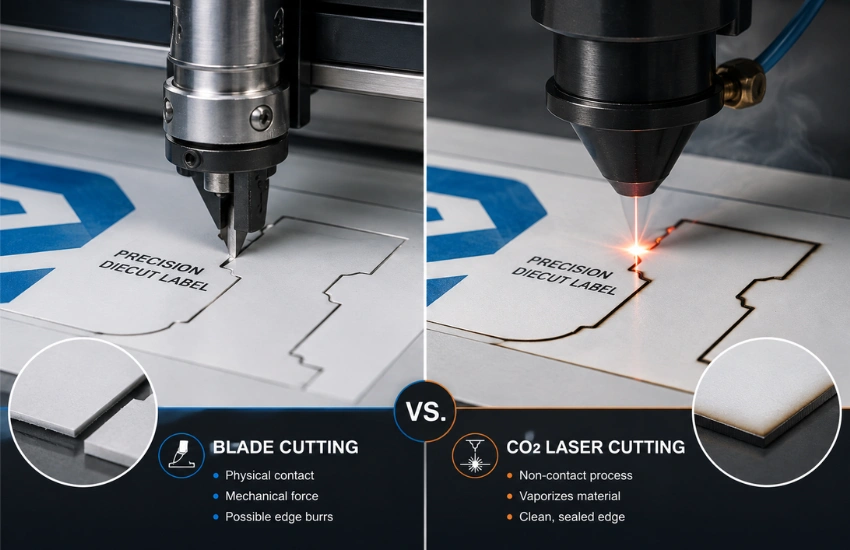
Laser die cutting for labels works by focusing a CO2 beam to a small spot and vaporizing the face stock along the vector path. There is no tooling, no blade contact, and no mechanical corner penalty — a filigree outline for a personal care bottle carries the same tooling cost as a rounded rectangle for an industrial asset tag: none. Key operating variables:
Kerf and focal spot
The beam removes a narrow band of material. Focus height and lens condition determine how tight and clean that kerf stays.
Power vs. speed
Cut quality is a balance. Too much power or too slow a traverse increases discoloration and residue; too little leaves incomplete cuts.
Edge behavior
Laser edges are sealed, which many converters prefer on filmic stocks. On some papers and coated materials the edge can darken, and odor or dust is possible depending on substrate chemistry.
Extraction and filtration
Laser finishing requires fume extraction, appropriate filter media, and a filter replacement plan. Treat this as a facility requirement, not an option.
Optics upkeep
Lenses and mirrors need routine cleaning. Contamination degrades cut consistency before QC catches it.
Substrate suitability is the gate on any laser die cutting label job. Some materials cut cleanly, some discolor, and chlorinated films should be excluded. Check the material supplier’s technical data sheet and the laser OEM’s documented material guidance, then test your actual stocks rather than a generic material class.
Blade and CO2 laser die-cutting differ across shape, substrate range, tooling, and run length — use this table as a starting filter.
Factor | Blade Die-Cutting | CO2 Laser Die-Cutting |
Shape complexity | Standard to moderate; simple curves and rounded corners | High; intricate outlines, cutouts, fine detail |
Minimum inside radius | Limited by blade geometry and corner deceleration | Limited mainly by kerf and focus, so much tighter |
Substrate range | Broad, including many stocks that respond poorly to heat | Broad but must be validated; some films excluded |
Edge quality | Clean mechanical edge, no discoloration | Sealed edge; possible darkening or odor on some stocks |
Tooling / die requirement | Die-free; optional rotary tooling for long repeats | Die-free by design |
Setup time | Short; depth and pressure trial cuts per substrate | Short; power and speed recipe per substrate |
Speed vs. run length | Favors long repeats of simple shapes | Holds pace on complex shapes and high mix |
Consumables | Blades, cutting strips and mats | Optics cleaning supplies, lenses, filter media |
Maintenance | Mechanical: blade wear, holder, drive upkeep | Optical and extraction: lens, mirrors, filters |
Best-fit run length | Short-to-mid and mid-to-long repeats | Very short to mid, high SKU count |
Treat this table as a starting filter, not a verdict. Final selection should always be validated on your actual shapes, substrates, and run-length distribution — not on generic benchmarks. Whether a label laser die cutting machine or a blade system belongs on your floor first becomes clear once shapes and volumes are mapped against these rows.
A sub-millimeter positioning spec is a machine capability figure measured under controlled conditions — not a promise about your finished roll.
Systems in this class are typically specified with positioning tolerances in the sub-millimeter range. Read that figure for what it is: a machine positioning specification measured under controlled conditions, not a promise about how your labels look at the end of a long roll. Perceived label die-cutting accuracy in production is the sum of several variables:
Registration method
Eye-mark sensing, camera, or vision-based cut-to-print alignment. Vision systems compensate for print placement drift; a single mark at job start cannot.
Substrate stability
Filmic stocks stretch differently than paper, and liner caliper variation shifts the cut plane.
Web tension and liner integrity
Tension changes across a roll move artwork relative to the cut path.
Temperature and humidity
Paper in particular moves with plant conditions.
Artwork bleed and die-line discipline
A generous bleed hides far more variation than a hairline registration to a printed border.
Operator setup
Trial cuts, focus or depth verification, and reliable recipe recall.
To verify accuracy properly, ask for a sample cut on your own stock, at your label size, over a meaningful roll length. Then measure the last labels, not the first ten.
Rated speed is not shift throughput — changeover time, first-good-label time, and unplanned stops decide real output on both technologies.
Neither technology has a single speed. Blade throughput is governed by path length plus acceleration and deceleration at every corner. Laser throughput is governed by material, available power, and path length, so a complex shape and a simple shape of similar perimeter cut at similar rates — that is why laser holds its pace as die lines get busy. Output in a real shift is set by:
Changeover time
Time between jobs, including substrate recipe changes.
First-good-label time
How long until registration and depth or power settings are dialed in.
Stripping and matrix handling
Reliability of waste removal at speed.
Unplanned stops
Blade changes, lens cleaning, or web breaks that interrupt the run.
On a nutraceutical line running 25 SKUs of 1,500 labels each, changeovers dominate. On a food and beverage repeat order of 80,000 simple ovals, cut speed dominates. Operations automation is the tiebreaker: job presets and recipe recall, cut-file handoff straight from prepress, and barcode or job-ticket driven setup are what let either machine approach its rated numbers in a real eight-hour shift.
Build an itemized cost model instead of chasing a headline number — the crossover point depends entirely on your own rates.
Modeling die cutting cost per label starts with loading every line item into the model:
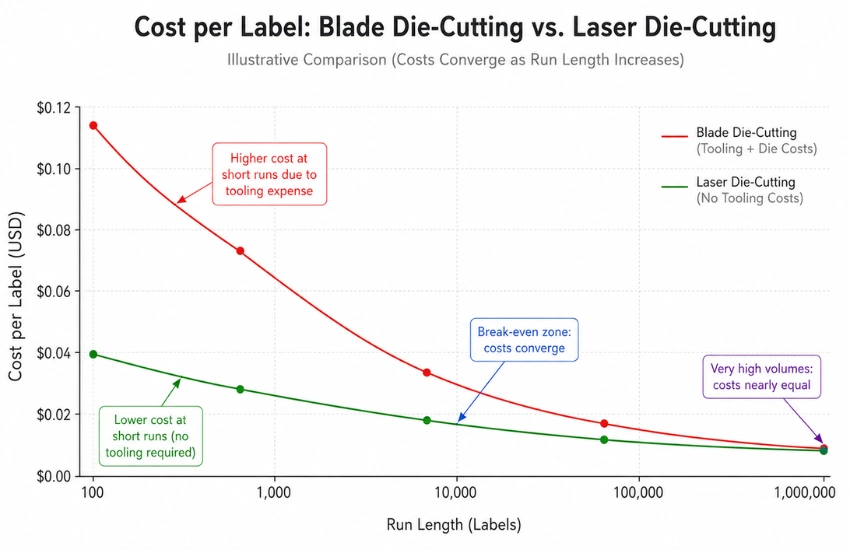
Illustrative estimate — model it with your own rates. Assume a loaded machine-plus-labor rate of $75 per hour and 20 minutes of setup. That setup carries roughly $25 of cost. Spread across a 500-label job it adds about $0.05 per label; across 5,000 labels, about $0.005; across 50,000, effectively nothing. Add a hypothetical $300 rotary die on the repeat path: $0.60 per label at 500, about $0.006 at 50,000. These figures are illustrative and exist to show the shape of the curve, not to quote costs.
Three brackets teams often observe, again illustrative:
Very short runs (under roughly 1,000 labels)
Setup and tooling dominate. Die-free wins clearly, and laser shape freedom is nearly free.
Short-to-mid runs (roughly 1,000–15,000 labels)
The curves converge. Shape complexity and changeover count decide it.
Mid-to-long repeats (roughly 15,000 labels and up)
Mechanical cutting or rotary tooling on simple shapes usually pulls ahead on cost per label.
Hidden costs buyers miss: die inventory and physical storage, die lead time on rush jobs, re-cut and rework labor, and consumable cadence — blades and cutting strips on one path, filter media and lenses on the other.
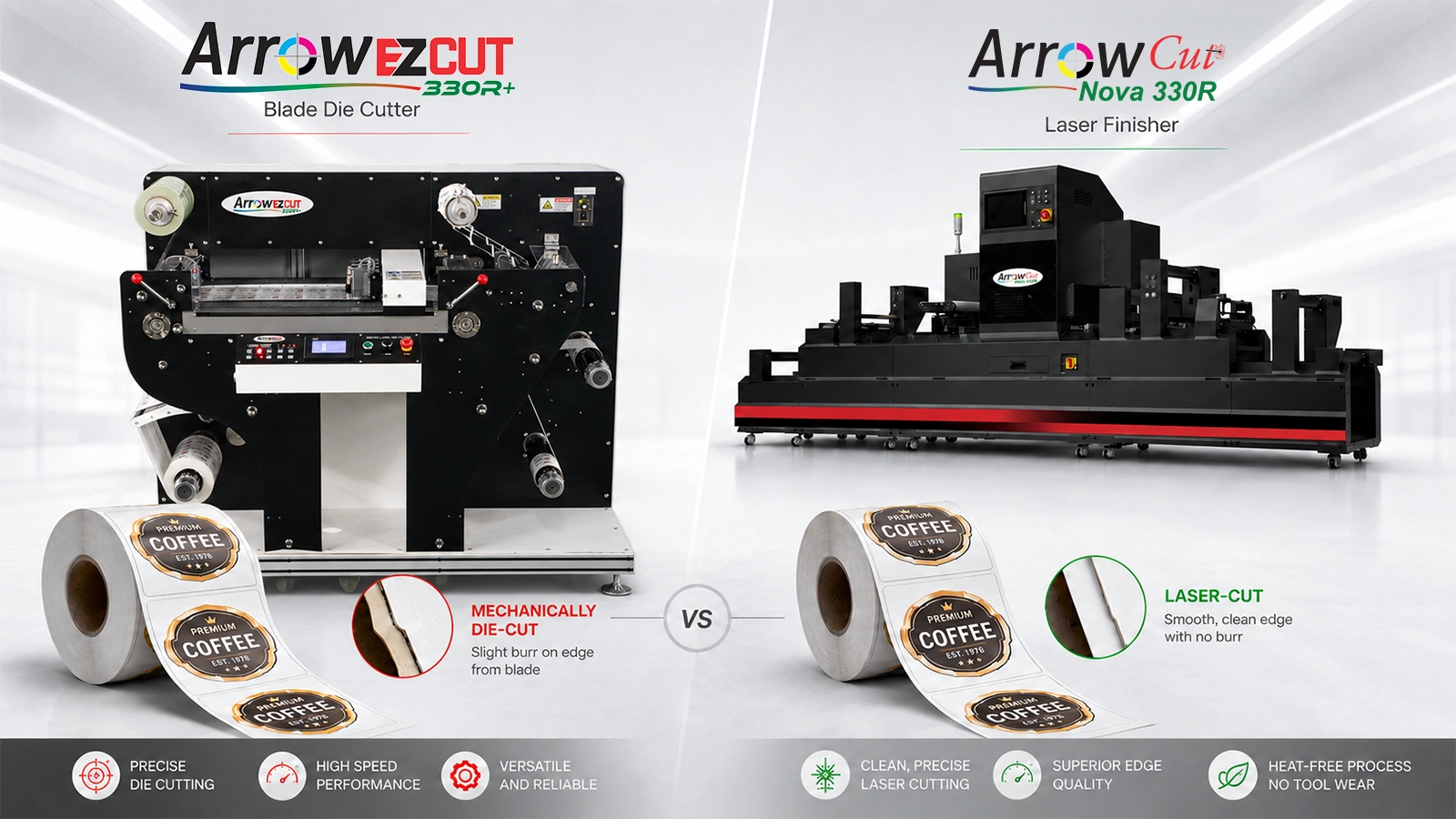
Arrow manufactures both finishing paths — EZCut blade cutters and ArrowCut Nova / Taurus CO2 laser finishers — fit the equipment to your die library.
Arrow Systems builds digital label finishing systems across both technologies, so the choice comes down to your shape library, substrate mix, and run-length distribution rather than what a single product line happens to support. Every digital label finisher on this page — blade or laser — is built for roll-fed production, not sheet-fed office use.
Arrow EZCut 330R+ — flatbed and roll-to-roll hybrid blade die cutting
The EZCut 330R+ is a flatbed and roll-to-roll hybrid blade die cutter with a cutting media width of 100–350 mm, a maximum label width of 350 mm, cutting accuracy of ±0.1 mm, and a maximum speed of 150 cuts per minute. It ships with two cutting heads, expandable to four, and supports self-adhesive, PP synthetic, aluminum plastic film, PET, PVC, white card, and other flexible materials. It is the pragmatic choice when most of your die library is rounded rectangles, ovals, and modest custom shapes across mixed substrates, tool-free.
Arrow EZCut 350R — higher-throughput multi-blade roll-to-roll cutting
The EZCut 350R is a dedicated multi-blade roll-to-roll cutter with up to six cutting heads, a working speed of 9 m/min, die-cutting precision of 0.1 mm, and slitting speed up to 100 m/min across a maximum label width of 330 mm. Where the 330R+ suits operations mixing roll and flatbed jobs, the 350R is built for higher-throughput consistent label shapes at volume, with automatic head-distance adjustment and inline sheeting for multi-SKU runs.
ArrowCut Nova 250R — compact CO2 laser finishing
The ArrowCut Nova 250R is a compact laser die cutting machine for labels, built around a 125W CO2 Galvano laser, a maximum media width of 250 mm, and a maximum web speed of 25 m/min. It performs full cuts, kiss cuts, perforation, etching, hatching, and marking in a single pass, in a footprint compact enough for a small production space. It is the accessible entry point into die-free laser finishing for narrower-web operations.
ArrowCut Nova 330R — production-grade CO2 laser finishing
The ArrowCut Nova 330R is a modular production laser finisher with a 150W CO2 Galvano laser, a maximum media width of 13.7″ (348 mm), a web guide tolerance of ±0.02 mm, and rated throughput up to 10,000 labels per hour. It handles paper, PET, PP, BOPP, Lexan, and more, with inline lamination, matrix removal, slitting, and rewinding. Beyond web width, the 330R’s higher laser power and rated throughput make it the production-scale option versus the compact 250R.
Taurus Laser Finisher — high-power CO2 laser for the highest-volume laser jobs
The Taurus Laser Finisher is a high-power laser label cutting machine that steps beyond the ArrowCut Nova line with a 350W sealed CO2 laser, a web width of up to 13.78″ (350 mm), and cutting speeds up to 70 m/min on the Plus configuration. It performs kiss cuts, full cuts, perforation, and engraving on printed or unprinted paper and film, and requires a water chiller and fume extractor as standard accessories. Where the ArrowCut Nova 250R and 330R cover compact-to-production laser finishing, Taurus is the option when die-free flexibility needs to hold pace at both higher mix and higher run length at the same time.
Four buyer profiles
High-mix short-run converters — many SKUs, small quantities, unpredictable shapes — put laser first, typically the ArrowCut Nova 250R or 330R. Brand-owner in-plant label rooms with a defined SKU set and mostly repeat work put blade first. Mid-volume contract printers with repeat SKUs typically run blade as the workhorse, then add laser once complex-shape quotes are being declined or subcontracted. Converters running an ArrowCut Nova 330R at capacity, where job mix stays complex but daily volume keeps climbing, are the candidates for Taurus.
Hybrid trigger point
Add the second technology when the first is either turning away work or blocking the queue; step up from ArrowCut Nova to Taurus when laser capacity itself becomes the bottleneck rather than shape complexity. The payback comes from quoted work recovered, not from speed. Confirm current specifications, web widths, options, and substrate suitability with Arrow Systems, and validate with cut samples on your own materials before purchase.
Run this checklist against your own production data before comparing spec sheets — shape library decides more than rated speed.
Common questions from label converters, in-plant label rooms, and the operations and QA leads evaluating blade versus CO2 laser die-cutting.
Not inherently. Both technologies in this class are specified with sub-millimeter positioning tolerances, and both depend on the same external variables: registration method, web tension, substrate stability, and plant conditions. Laser usually produces better fidelity on intricate geometry because no blade mass has to decelerate at corners, so fine detail reproduces more faithfully. On simple shapes, a well-set blade system is equally consistent. Judge accuracy by measuring sample labels cut on your own stock over a full roll, not by comparing spec sheets.
Chlorinated films such as PVC should be excluded. Some coated papers, metallized stocks, and specialty laminates can discolor, char, or generate odor at the cut edge, and adhesive chemistry also affects residue and edge appearance. No universal list exists, because performance varies by supplier, caliper, and topcoat. The reliable method is material testing: send your actual face stocks, adhesives, and liners for sample cutting, then evaluate edge appearance, odor, dust, and dispensing behavior in hand before you commit.
It depends on your rates, not a universal number. As an illustrative pattern, setup and tooling costs dominate below roughly 1,000 labels, the two paths converge somewhere in the low thousands, and mechanical cutting on simple shapes tends to pull ahead as runs move into the tens of thousands. The crossover shifts with your labor rate, machine amortization, scrap rate, and consumable pricing. Build the itemized model with your own figures, then test it against your actual run-length distribution.
A CO2 laser finisher such as the ArrowCut Nova 250R or ArrowCut Nova 330R covers the widest shape range on suitable substrates, so it is often the better single-machine choice for high-mix work with complex die lines. The tradeoffs are substrate restrictions, extraction requirements, and edge appearance on certain stocks. A blade system such as the EZCut 330R+ covers a broader substrate range but caps shape complexity. Many converters run one machine until quoting patterns expose the gap, then add the second. Shared job presets and cut-file handoff keep a two-machine line from doubling setup labor.
Shape library first: inside-radius requirements decide blade versus laser faster than any speed figure. Substrate list second: validate every face stock, adhesive, and liner with real cut samples before purchase. Model cost per label at your median run length, not your best-case volume, and count changeovers per shift — setup time, not rated speed, sets shift output.
Arrow Systems manufactures both finishing paths — EZCut 330R+ and EZCut 350R blade die cutters, and ArrowCut Nova 250R, ArrowCut Nova 330R, and Taurus CO2 laser finishers — so you can judge accuracy and edge quality on your own materials rather than a spec sheet.
Table of Contents Blade vs. Laser Label Die Cutting: Accuracy, Speed, and Cost per Label Blade die-cutting suits simple shapes and long runs; CO2 laser

Table of Contents Custom Food Packaging: Key Questions Answered for Food Brands Custom food packaging shapes how shoppers recognize, evaluate, and choose a product —
Table of Contents GHS Label Durability Failure: 4 Causes and Practical Fixes GHS label durability failures trace to four causes: aqueous ink chemistry, paper face

Table of Contents White Ink Clear Label Printing: When You Need It and Why White ink under clear film keeps brand color, mandatory copy, and

Table of Contents GHS Label Compliance: A Practical Guide for Chemical Label Printing GHS label compliance is a safety-critical requirement for any business that manufactures,
Table of Contents Cannabis MSO Label Printing: In-House or Outsource? Cannabis MSO label printing moves in-house when label versions outgrow converter minimums or batch data