Table of Contents
When to Bring Label Printing In-House: A Decision Guide
Bring label printing in-house when lead times, MOQs, and single-vendor risk start dictating launch dates — not unit cost.
Key Takeaways
- Cost symptoms (rising per-roll prices, plate charges, expedite fees) are visible on invoices; constraint symptoms (slipped launches, missed promotions, scrapped runs) are harder to see but are the real signal.
- Five specific triggers justify a switch: lead-time delays, MOQ-driven overproduction, slow artwork/version turnaround, single-supplier dependency, and growing short-run/variant SKU demand.
- Bringing printing in-house is a workflow and version-control change first, an equipment purchase second — most teams start with their highest-pain SKUs rather than internalizing 100% of volume on day one.
- Digital printing often becomes cost-competitive with flexo at a few hundred to a couple thousand labels per run, but the honest ROI case accounts for material waste, carrying cost, expediting, and downtime — not just per-roll price.
- The right ArrowJet entry point depends on SKU mix and revision frequency: the ArrowJet Eco 330R for emerging multi-SKU brands, the ArrowJet Aqua 330R for standard-volume operations, the ArrowJet Aqua 330R Hybrid Pro M for mid-size manufacturers needing inline finishing, and the ArrowJet UV 330H for high-mix contract operations (see the full breakdown below).
The Signs Label Outsourcing Is Limiting Your Business — Not Just Costing You Money
There is a meaningful difference between a cost symptom and a constraint symptom, and most teams only track the first.
Cost symptoms are visible on invoices: rising per-roll prices, plate charges, expedite fees. Constraint symptoms are harder to see because they show up as things that didn’t happen on time — a launch that slipped, a promotion that missed its window, a run that got scrapped.
The label outsourcing vs in house printing decision hinges on recognizing the constraint symptoms early. Watch for these operational warning signals:
- Product launches wait on label delivery rather than the other way around.
- Reformulations sit in a queue behind converter lead times.
- Labels are routinely over-ordered to clear a minimum order quantity.
- Obsolete label stock accumulates every time artwork or regulatory content changes.
- Expediting has become a normal part of the workflow, not an exception.
- A single converter effectively controls the production schedule and pricing leverage.
- Short-run and variant SKUs are growing faster than the supplier can economically serve them.
If several of these sound familiar, the label production bottleneck isn’t a pricing problem that can be negotiated away. It’s a structural one.
The Five Specific Triggers That Tell You It's Time to Switch
Use these five triggers as a checklist — the more that apply, and the more acute they are, the stronger the case for bringing label printing in-house.
Trigger 1: Lead Times Delay Launches and Reformulations
This is the most common and most expensive trigger. When a formula changes — a new ingredient, an updated claim, a revised nutrition or drug facts panel — the finished label has to follow. If a converter needs three weeks from approved artwork to delivered rolls, every reformulation carries a built-in three-week delay before the updated product can ship. Multiplied across a busy revision calendar, that label version change lead time adds up to weeks of cumulative delay per year, sitting entirely outside the brand’s control.
Trigger 2: MOQs Force Overproduction and Obsolescences
Traditional flexographic printing carries setup costs that only make sense across large runs. That is why minimum order label printing quantities of 5,000, 10,000, or more are standard — even when a given SKU will realistically consume 2,000 units before its next revision. The excess does not just sit in a warehouse; it becomes label inventory cost in storage, handling, version tracking, and eventual scrap. Every artwork or regulatory update turns a shelf of “current” labels into obsolete stock overnight.
Trigger 3: Version and Artwork Change Lead Time Is Too Long
Some manufacturers can tolerate long lead times for stable products; the problem is variability. If artwork changes frequently — new claims, seasonal designs, retailer-specific variants, regulatory updates — each change restarts the converter clock. When the time between “we need to update this label” and “the updated label is on the line” is measured in weeks, market responsiveness is capped by the supplier’s queue.
Trigger 4: Single-Supplier Dependency Creates Schedule Risk
Label supplier dependency is a quiet risk until it isn’t. A single converter handling most of a brand’s volume means their capacity constraints, equipment downtime, staffing issues, and pricing decisions become the brand’s problem too. A missed converter lead time can idle a filling line that is otherwise ready to run. Concentration also erodes negotiating leverage — when one vendor controls the labels, price increases are hard to challenge without a disruptive supplier switch.
Trigger 5: Short-Run and Variant Demand Is Growing
If SKU count is climbing — new flavors, sizes, dosages, private-label variants, limited releases — the economics of outsourcing get worse, not better. Short run label production is exactly where converters are least efficient and MOQs bite hardest. Short run labels carry the highest relative setup cost on a flexographic converter’s line, which is precisely why this trigger compounds so quickly as SKU count grows.
A growing high-mix, low-volume portfolio is often the clearest signal that the current outsourced model has run out of headroom.
What the Transition Actually Involves (and What It Doesn't)
Bringing printing in-house is an operational change, not just an equipment purchase — the common mistake is treating it as a tool-first decision.
Workflow design
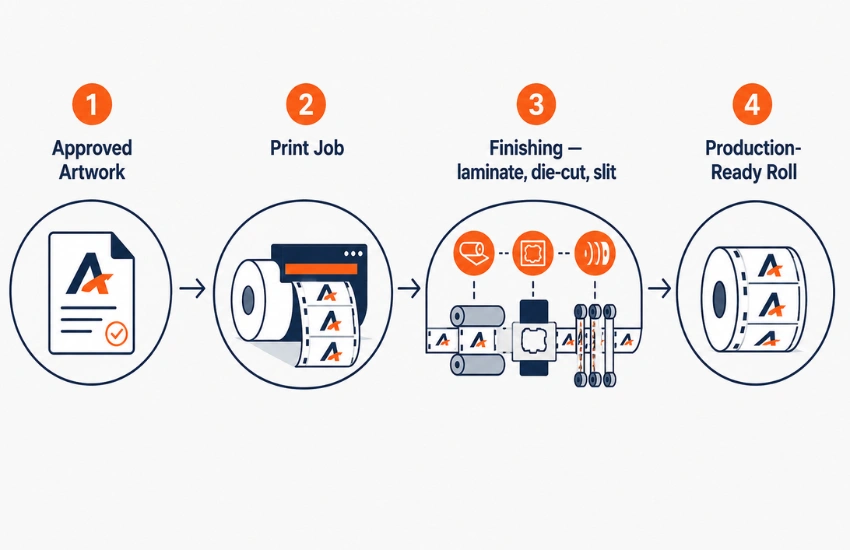
Taking ownership of the path from approved artwork to finished, application-ready rolls means defining who triggers a print job, who approves it, and how it feeds the production line.
Artwork and version control
This is the discipline that used to live at the converter. A controlled process is required so operators always print the current, approved version — not last quarter’s file.
Finishing
A printed web is not a usable label until it is laminated, die-cut, slit, and rewound. In-house programs pair digital label printing equipment with the finishing steps needed to produce production-ready rolls — see the finishing section below for specific hardware options.
Integration with production scheduling
The biggest gains come when label printing is driven by the production plan rather than managed as a separate task. Connecting print jobs to ERP and scheduling tools means labels are produced just in time for each run, not batched and stored.
What it doesn’t require:
- It doesn’t mean printing 100% of labels on day one — most teams start with the highest-pain SKUs (frequent revisions, short runs, low volume) and keep long, stable runs outsourced until the case grows.
- It doesn’t require replacing the entire operation — digital printing slots into existing workflows.
- It doesn’t eliminate discipline — digital removes many error sources, but weak version control will still cause problems. The approval process needs to be solid before go-live.
Volume Thresholds: When the Math Clearly Favors In-House
There is no universal breakeven number — digital printing often becomes cost-competitive with flexo at a few hundred to a couple thousand labels per run, depending on label size, substrate, and complexity.
What follows is an illustrative framework, not a promise — use it to structure your own analysis rather than treating any single figure as a guarantee. The more SKUs a brand runs and the more often they are revised, the further the breakeven shifts in favor of in-house production.
An honest in house label printing ROI picture accounts for the full cost of outsourcing — not just the per-roll price:
Direct material waste
Waste generated from MOQ overproduction and obsolescence as artwork or regulatory content changes.
Inventory carrying cost
Storage and handling cost for label stock across every SKU in the portfolio, not just the highest-volume items.
Expediting fees
Fees paid to compress converter lead time when a launch or reformulation is at risk of slipping.
Downtime cost
Cost incurred when production lines wait on labels or run the wrong version because current stock was not on hand.
Revision frequency
How often artwork changes force reorders and scrap — the single biggest driver of where the in-house breakeven actually lands.
The table below summarizes which factors push the decision in each direction.
Factor | Shifts Toward In-House | Favors Staying Outsourced |
SKU count | High, growing mix | Small, stable set |
Revision frequency | Frequent artwork changes | Infrequent changes |
Obsolescence | Significant scrap per revision | Little to no obsolescence |
Run length | Short runs | Long, stable runs |
Expedite charges | Recurring | Rare |
Teams with high-mix portfolios often see the strongest case. Payback ranges commonly discussed for digital label systems tend to fall somewhere between roughly 12 and 24 months — though the actual figure depends entirely on volume, waste, and revision profile. Run the numbers on your own operating data before committing.
Entry Points by Business Type — Which ArrowJet Model Fits Your Situation
The right entry point depends less on a single volume number and more on SKU mix, revision frequency, and whether finishing needs to run inline.
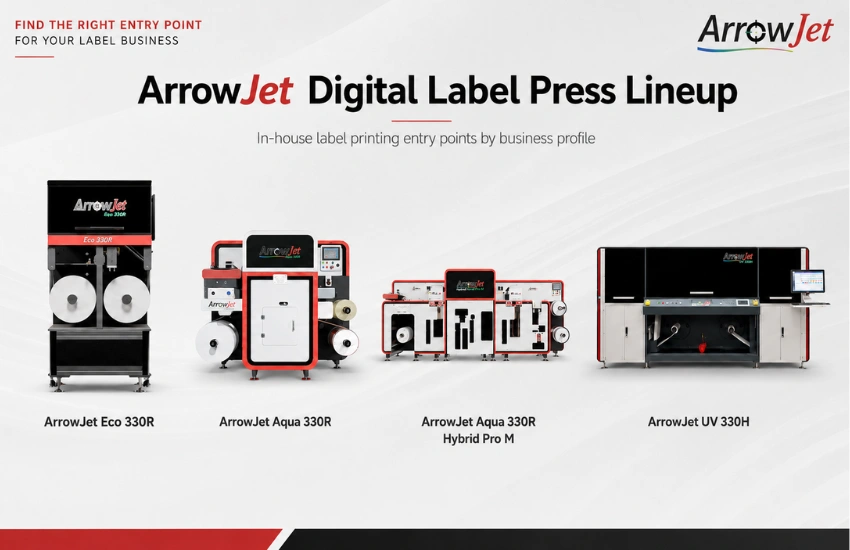
Emerging multi-SKU brand — ArrowJet Eco 330R
For brands growing fast, revising often, and getting hurt by MOQs, the ArrowJet Eco 330R is a compact, single-pass digital press built as a step up from desktop printers without the complexity of a large press. It runs on single-phase power, requires no air compressor, and prints up to 20 m/min at up to 324 mm width and 1600 × 1600 dpi — prioritizing agility and low overhead over peak speed.
Standard-volume operation — ArrowJet Aqua 330R
For brands running a consistent, moderate SKU count on a steadier production cadence, the ArrowJet Aqua 330R is a high-speed, aqueous pigment, roll to roll digital label printing machine using Memjet DuraFlex technology — printing up to 150 ft/min (45.7 m/min) at 1600 × 1600 dpi across a 12.75″ (324 mm) print width, on three-phase power.
Mid-size manufacturer — ArrowJet Aqua 330R Hybrid Pro M
For a substantial SKU count with a mix of steady and variable demand, the Hybrid Pro M pairs the same DuraFlex print engine with inline primer and varnish stations, an inline dryer, and an optional inline rotary slitter or lamination module — letting a manufacturer internalize high-revision SKUs while keeping finishing in the same production pass, at web speeds up to 45.7 m/min.
High-mix contract manufacturer — ArrowJet UV 330H
For operations serving many brands with independent artwork, compliance needs, and schedules, the ArrowJet UV 330H is a true hybrid UV label press combining roll-to-roll and flatbed printing in one platform, with variable-data printing support for barcodes and QR codes, CMYK + White/Varnish configurations, and rigid media handling up to 50 mm thickness in flatbed mode — built for complexity rather than raw throughput.
The ArrowJet line spans these profiles — from a compact entry-level digital label printing machine to a high-mix hybrid platform. The goal isn’t to pick the biggest system — it’s to match volume, label formats, substrate needs, and finishing requirements to a realistic entry point.
Finishing: Completing the In-House Label Workflow
A printed web isn’t a usable label until it’s laminated, die-cut, slit, and rewound — label finishing equipment is what turns an in-house press into a production-ready workflow.
Arrow EZCut 330R+ — flatbed and roll-to-roll blade die cutting
The Arrow EZCut 330R+ is a flatbed die cutter and roll-to-roll hybrid digital label die cutting machine with a maximum cutting speed of 150 cuts per minute and cutting accuracy of ±0.1 mm, supporting self-adhesive, PP synthetic, PET, PVC, aluminum plastic film, and other flexible materials. Cold lamination is available inline — a fit for operations that need to switch between standard roll-fed label runs and specialty short-run formats without a second machine.
ArrowCut Nova 330R — die-free laser finishing for short-run and variant SKUs
The ArrowCut Nova 330R is a CO₂ laser label finisher that cuts without physical dies, enabling custom shapes, perforations, kiss cuts, and etching. Because there is no die tooling cost to amortize, laser finishing is well suited to exactly the scenario described in Trigger 5 above — growing short-run and variant SKU demand where a blade die’s setup cost cannot be justified across the run length.
The same in-house-versus-outsourced calculus that applies to label printing applies to finishing. Brands running a press in-house but still sending rolls out to third-party custom die cutting services for lamination and shape-cutting recreate the same lead-time and MOQ exposure described in the triggers above — often because their finishing step still runs on a flexo die cutting machine built around fixed steel-rule tooling rather than a digital process. Pairing an in-house press with commercial digital die cutting machine equipment keeps die cutting equipment costs proportional to run length instead of requiring a new physical die for every SKU revision.
Arrow’s full range of label finishing systems — spanning blade and laser digital label finishing equipment — covers lamination, die-cutting, and slitting for in-house programs at any of the entry points above. The finishing decision does not have to be made in isolation from the press decision.
Frequently Asked Questions — Bringing Label Printing In-House
Common questions from ops, engineering, and packaging teams evaluating an in-house label printing program.
There is no single threshold. Digital printing can be cost-competitive at run sizes as low as a few hundred to a couple thousand labels, but the real justification comes from the total picture: SKU count, revision frequency, obsolescence, expediting, and downtime. High-mix operations tend to reach a clear case sooner than low-mix ones, regardless of total volume.
Not inherently — but responsibility shifts to the manufacturer. In-house printing can actually reduce the risk of applying obsolete labels, since current versions can be produced on demand instead of drawing from aging converter stock. The key is disciplined artwork and version control; printer, ink, and finishing should be matched to substrate and durability needs and validated during evaluation rather than assumed.
It varies with scope and existing process maturity. Teams that start with a focused set of high-pain SKUs and solid version control generally move faster than those attempting to internalize everything at once. Phasing in by SKU keeps disruption low and builds confidence before expanding.
Choosing an in house label printer depends on SKU mix, revision frequency, and whether finishing needs to run inline — not a single volume number. Entry-level programs commonly start with the ArrowJet Eco 330R, standard-volume operations often fit the ArrowJet Aqua 330R, mid-size manufacturers needing inline finishing often fit the ArrowJet Aqua 330R Hybrid Pro M, and high-mix contract operations with variable-data needs often fit the ArrowJet UV 330H. A structured assessment against actual SKU data is the reliable way to confirm the fit.
Validate Your Decision With a Structured Assessment
The strongest in-house label printing decisions come from a brand’s own numbers, not a generic breakeven — the next step is to quantify it.
If the triggers in this guide sound familiar — lead times gating launches, MOQs driving obsolescence, or a growing short-run portfolio straining the converter — Arrow Systems can map current SKU complexity, volume, revision frequency, and finishing needs to a realistic in-house entry point and an illustrative payback range. No guarantees, no pressure — just clear math against the actual operation.
Step 1: Confirm the constraint
Match slipped launches, obsolete stock, and expedite fees against the five triggers above.
Step 2: Quantify the full cost
Total material waste, carrying cost, expediting, and downtime — not just per-roll price.
Step 3: Match a realistic entry point
Map volume, formats, and finishing needs to the right ArrowJet profile.
Step 4: Phase the rollout
Start with the highest-pain SKUs, then expand as the case proves out.
Request a Volume and Breakeven Walkthrough
Find out whether bringing label printing in-house is the right move for your SKU portfolio — and where to start if it is.
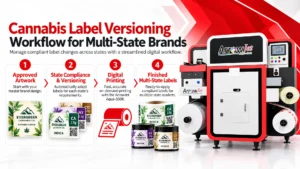
Cannabis Label Versioning Workflow for Multi-State Brands
Table of Contents Cannabis Label Versioning Workflow for Multi-State Brands A cannabis label versioning workflow produces state-specific labels from one master template by moving state-variable
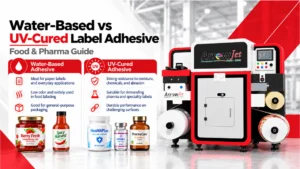
Water-Based vs UV-Cured Label Adhesive: Food & Pharma Guide
Table of Contents Water-Based vs UV-Cured Label Adhesive: Food & Pharma Guide Water-based adhesives suit dry, ambient containers; UV-cured hot melts suit cold, wet, curved
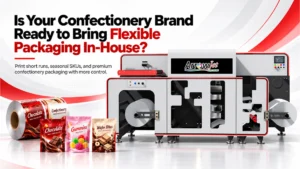
Is Your Confectionery Brand Ready to Bring Flexible Packaging In-House?
Table of Contents Is Your Confectionery Brand Ready to Bring Flexible Packaging In-House? In-house flexible packaging pays off for confectionery brands with many SKUs, short
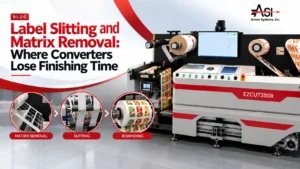
Label Slitting and Matrix Removal: Where Converters Lose Finishing Time
Table of Contents Label Slitting and Matrix Removal: Where Converters Lose Finishing Time Label slitting and matrix removal, plus rewinding, cost converters more finishing time
Limited Edition Spirits Label Printing: 4 Holiday Delay Fixes
Table of Contents Limited Edition Spirits Label Printing: 4 Holiday Delay Fixes Limited edition spirits label printing runs late because of the calendar, not the
Section 179 Label Printer Timing: Install Before December 31
Table of Contents Section 179 Label Printer Timing: Install Before December 31 A section 179 label printer purchase counts for 2026 only if the press