Layered pressure-sensitive label construction showing facestock adhesive and liner

Table of Contents

Pressure-Sensitive Adhesive Manufacturing and Coating Methods

Pressure-sensitive adhesive labels are everywhere: on packaging, tapes, product labels, price labels, and many everyday materials. Their usefulness comes from a simple but powerful property. A pressure-sensitive adhesive stays tacky and can bond to a surface when pressure is applied, without the drying step required by many liquid adhesives.

What Is a Pressure-Sensitive Adhesive?

A pressure-sensitive adhesive, often shortened to PSA, combines stickiness with enough elasticity to remain useful across different surfaces and applications. The right adhesive depends on the surface, the environment, the facestock, and the performance expected from the final label.

Because labels are used on so many products and in so many conditions, PSA manufacturing includes a wide range of materials and coating methods.

The Basic Construction of a Pressure-Sensitive Label

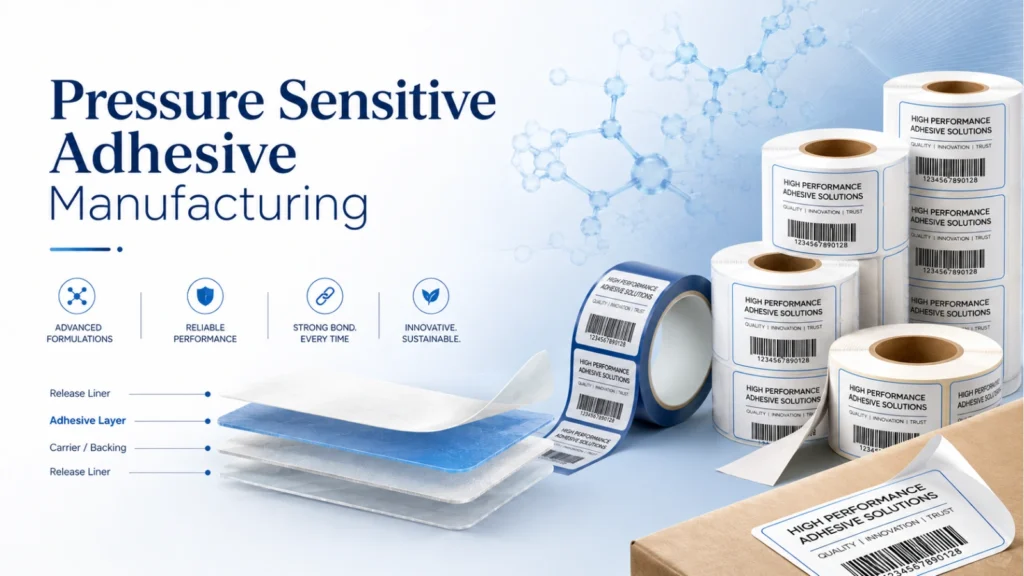
A pressure-sensitive label is often described as a layered construction. The main layers are:

  • Facestock: the visible surface of the label, which may be paper, film, foil, fabric, or another material.
  • Adhesive: the bonding layer selected for the intended surface and use case.
  • Liner: the backing material, usually paper or film, removed before the label is applied.
  • Primer, when used: a treatment layer that can support added adhesive performance.

Direct Coating vs. Transfer Coating

Two broad coating approaches are direct coating and transfer coating. In direct coating, adhesive is applied directly to the facestock. In transfer coating, adhesive is applied to the liner and then transferred to the facestock during lamination.

The best method depends on the adhesive, the materials being coated, the required coat weight, and the needs of the finished label.

Pre-Metered Coating Methods

Pre-metered methods measure the coating before it reaches the substrate. Common examples include gravure roll coating, reverse roll coating, slot die coating, extrusion slot die coating, and curtain coating.

Gravure coating can produce smooth coatings and accurate coat weights. Reverse roll coating uses counter-rotating rolls to meter and apply adhesive. Slot die coating uses pressure through a narrow opening to create uniform coatings. Extrusion slot die coating feeds material from an extruder and is widely used for scalable coating needs. Curtain coating forms a falling sheet of liquid that lands on the substrate and can be useful for certain surfaces.

Post-Metered Coating Methods

Post-metered methods control coating thickness after application. Knife over roll coating spreads adhesive with a metering blade and is useful when more coating is needed on uneven surfaces. Mayer rod, or wire-wound rod coating, is commonly associated with lower-viscosity applications and can be used with many coating and substrate combinations.

Why Coating Method Matters

The coating method affects uniformity, thickness, appearance, cost, and suitability for the intended use. Selecting a method is not only a manufacturing decision. It shapes the way the final label performs on the product.

Connect coating choices to converting performance

Coat-weight uniformity, liner release, facestock stability, and adhesive anchorage can affect printing, die-cutting, matrix removal, dispensing, and final application. A construction that bonds well may still create converting trouble if adhesive ooze, curl, or release force is poorly matched to the process. Converters should ask suppliers for current technical data and test the full construction on the intended press and finisher.

Specify the real application conditions

Document the container material, surface energy, shape, cleanliness, application temperature, service temperature, moisture, chemicals, expected life, and removability. Match those conditions to facestock, adhesive, liner, and print chemistry. Pressure-sensitive does not mean universal: an adhesive that works on smooth glass may behave differently on textured plastic, a tight radius, or a cold, wet surface.

Validate material before a production release

Print and finish a representative roll, then apply labels using the real process. Check feed, print adhesion, die-cut depth, matrix stripping, dispensing, initial tack, dwell, edge lift, and removal behavior. Use supplier guidance for conditioning and test duration. Keep approved material identifiers and settings with the job record so a later substitution does not occur without review.

Document acceptance criteria before production

Turn broad expectations into checks an operator can repeat. An approval record should identify the artwork version, dimensions, approved material, print settings, color reference, required readable text, barcode or code grade where applicable, finishing path, roll direction, core and roll limits, and the defects that require a stop or hold. Include representative photos or retained samples when visual judgment matters. Assign who may approve a first article and who may authorize a material, file, or process substitution.

Then test the job at the points where risk enters: file intake, first print, after a roll change, after finishing, and after realistic application or handling. Sample across the web and over the run rather than checking one convenient label. Record failures and corrective actions in the job history. This discipline helps teams distinguish a design problem from a media, printer, finishing, or application problem and prevents an unreviewed change from becoming the new standard.

Practical review checklist

Review areaQuestions to document
ApplicationWhat must the label communicate, survive, and fit?
MaterialsWhich facestock, adhesive, liner, ink or toner, and coating are approved?
ProductionWhat are typical and peak volumes, changeovers, roll formats, and acceptance criteria?
FinishingHow will labels be cut, inspected, stripped, slit, rewound, packed, or applied?
ValidationWho approves samples, records settings, controls changes, and handles failures?

For current planning, review current digital label printer options, label finishing systems, label materials and application support. Verify the exact configuration, material, and application rather than relying on a category name alone.

Frequently Asked Questions

Use actual artwork, label stock, roll dimensions, variable data, and finishing requirements. Evaluate setup, output, waste, maintenance, and application performance.

No. Capacity must be balanced with job mix, media, staffing, finishing, utilities, floor space, and service requirements.

Ink or toner, facestock, coating, adhesive, liner, printer transport, and finishing all interact. Test the complete construction.

Yes. Product configurations and available options can change. Confirm current specifications and suitability in writing for the proposed application.

Contact Arrow when you have representative files, materials, volumes, and workflow goals for an application-specific discussion.

Ready to improve your label or packaging workflow?

Talk with Arrow Systems about your application, materials, production goals, and the equipment options that may fit.