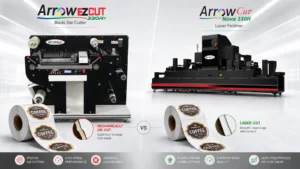
Blade vs. Laser Label Die Cutting: Accuracy, Speed, and Cost per Label
Table of Contents Blade vs. Laser Label Die Cutting: Accuracy, Speed, and Cost per Label Blade die-cutting suits simple shapes and long runs; CO2 laser

UV and aqueous inkjet serve different cosmetic label scenarios — UV for films, foils, and waterproof SKUs; aqueous for paper-forward, clean-beauty, and softer-aesthetic lines.
For beauty brands, the label is the product’s first physical contact with the customer. It must survive humid bathrooms, oily fingers, serum drips, and weeks of friction inside a handbag — while still reading as premium on shelf. The inkjet technology behind your digital label printers determines whether those demands are met across every SKU you launch.
Label failures follow recognizable patterns when technology is mismatched to end use: scuffed lipstick component labels, faded shampoo bottles, or serum packaging that does not hold its finish. The root cause is almost always the same — defaulting to one press for the whole portfolio without mapping each SKU’s durability profile, substrate, and use environment first.

UV inkjet ink stays liquid until exposed to ultraviolet light. As the printhead deposits ink, UV LED lamps immediately polymerize it into a solid film bonded to the substrate surface. Because the ink does not soak in and does not need to evaporate, it sits cleanly on top of films, foils, and synthetic stocks that water-based inks cannot reliably adhere to. ArrowJet UV label printers use this LED-cure architecture across the full product range.
The cured UV film is hard and abrasion-resistant immediately after printing. For cosmetics, this matters on BOPP for shower products, metallized polyester for prestige skincare, and holographic foil stocks for limited editions — substrates and end-use environments where label integrity directly affects brand perception.
Aqueous inkjet uses water as the primary carrier for pigment or dye. Drying happens through heat and evaporation rather than photopolymerization. The resulting ink film is thinner and softer, absorbing into porous substrates — uncoated papers, kraft, and recycled stocks — in a way UV inks cannot replicate.
Without a topcoat, varnish, or laminate, raw aqueous prints are not suited for humid bathrooms or direct water contact. A protective finishing layer is the standard approach for aqueous labels on bath and body SKUs. Substrate selection also matters — review Arrow’s range of cosmetic label substrates to match facestock to the specific finishing path and end-use environment.
A single portfolio can contain three distinct durability profiles: a glass serum bottle on a vanity, a body wash in a shower, and a powder compact in a purse. Each places different demands on ink film integrity, substrate, and finish. Choosing one technology for the entire portfolio without profiling each SKU’s use environment is where most cosmetic label problems originate.
Factor | UV Inkjet | Aqueous Inkjet |
Ink chemistry | UV-curable monomers and oligomers, pigment-based | Water-based, pigment or dye |
Cure / dry method | Instant UV LED polymerization | Heat-assisted evaporation |
Scratch resistance | High out of press; excellent with overprint varnish | Moderate; typically requires lamination or topcoat |
Chemical / oil resistance | Strong against oils, alcohols, and surfactants | Limited unless protected by finishing |
Substrate range | Films, foils, synthetics, papers, and specialty stocks | Best on coated and uncoated papers; select treated films |
Finish / aesthetic | Sharp graphics; supports high gloss, matte, soft-touch, and embellishment | Softer, more natural look; pairs well with uncoated and recycled stocks |
Regulatory profile (cosmetics) | Standard UV inks acceptable for most secondary packaging; review low-migration options where relevant | Generally lower-migration profile; often preferred where softer ink chemistry is a priority |
Run length economics | Strong across short and mid runs; minimal setup waste | Strong for short and mid runs; consumable cost varies with ink coverage |
Finishing compatibility | Compatible with laminating, die-cutting, foiling, and embellishment | Compatible with the same finishing steps; typically requires a protective topcoat for durable end uses |
Treat this table as a starting filter, not a verdict. Final selection should always be validated on your actual substrates, formulas, and finishing path — not on generic benchmarks.
For serums, treatment oils, and prestige foundations, the goal is a finish that reads as expensive at arm’s length and at fingertip. The ArrowJet UV 330H supports high-gloss cosmetic label finishes, dense blacks, and crisp metallic effects on foil and metallized substrates. Pairing UV print with selective varnish or embellishment produces the tactile contrast — matte body, glossed logo — that defines prestige label production.
Shampoos, conditioners, body washes, and shaving products live in continuous humidity and direct water contact. UV’s hard, sealed ink film on BOPP or PE film substrates is the standard choice for these SKUs. Labels printed with the ArrowJet UV 330H stay legible and on-brand through the full use cycle, rather than peeling at the corners after weeks in a shower environment.
Lipstick bullets, compact cases, dropper bottles, and travel-size kits are handled constantly. UV-cured ink films resist abrasion from fingernails, vanity surfaces, and product-on-product contact in retail trays. Every scuff on a premium item undermines the brand — UV chemistry addresses this at the press, not as a post-processing step.
Beauty packaging design rarely commits to a single stock. The ArrowJet UV 330H handles clear-on-clear film labels for a “no-label look” glass container, holographic foils for limited drops, and textured premium papers for indie luxury — often within the same job. The press also supports rigid media up to 50 mm thickness in flatbed mode, expanding into prototyping and specialty packaging applications. This substrate range is decisive for brands running seasonal launches and influencer collaborations.
The ArrowJet UV 330H supports CMYK + White, CMYK + Varnish, and CMYK + White + Varnish configurations. Opaque white enables printing on clear, metallic, and dark substrates. Clear ink and varnish layers enable spot gloss, tactile textures, and multi-layer effects — the building blocks of premium cosmetic label embellishment without a separate embellishment pass.

For body lotions, bar soaps, candles, and apothecary-style lines printed on uncoated, kraft, or textured papers, the ArrowJet Aqua 330R produces a natural, absorbed-ink aesthetic that UV cannot replicate. The look suits brands positioned around craft, wellness, or minimalism — where the label needs to feel hand-crafted rather than manufactured.
Some brands prefer water-based ink chemistry for products applied near eyes, lips, and sensitive skin — particularly where formulation teams want to minimize ink migration risk on labels in close contact with the primary container. Aqueous chemistry is often the preferred starting point for these discussions. Brands should validate against their own regulatory and toxicology review, including FDA cosmetic labeling expectations, INCI accuracy, and applicable state requirements such as Prop 65.
For clean beauty lines emphasizing post-consumer recycled papers, recyclable mono-material constructions, and minimal coatings, aqueous inkjet aligns more naturally than UV. Water-based ink pairs with uncoated and recycled stocks without the heavier topcoat structure UV often requires, supporting recyclability claims across both the label and packaging system.
For core paper-stock SKUs running predictably — a hero body lotion or a year-round bar soap — aqueous inkjet offers attractive consumable economics at moderate ink coverage. Digital production eliminates the plate costs and minimum order quantities of flexographic printing while keeping per-label costs reasonable for consistent, high-frequency production runs. For a broader look at how digital presses fit into beauty brand workflows, see Arrow’s guide to in-house label production.
Regulatory validation — including FDA cosmetic labeling compliance, INCI ingredient listing, and state-level requirements — is the brand’s responsibility and should be confirmed with qualified regulatory counsel. Arrow Systems sells label printing hardware; Arrow does not provide regulatory or compliance advisory services.
The press is only half the production system. Whether you print UV or aqueous, finishing determines the final label that ships: laminated or not, die-cut to shape, foiled, embellished, slit, and rewound. Arrow’s full range of label finishing systems handles both ink technologies, preventing the press decision from constraining your label design or production workflow.
The EZCut 330R+ is a flatbed and roll-to-roll hybrid blade die cutter with a maximum cutting width of 350 mm, cutting accuracy of ±0.1 mm, and a maximum speed of 150 cuts per minute. It supports self-adhesive, PP synthetic, PET, PVC, aluminum plastic film, and flexible materials — covering the full substrate range printed on either the UV 330H or Aqua 330R. Cold lamination is available inline. Best suited for operations needing the versatility to switch between roll-fed label production and flatbed specialty jobs.
The EZCut 350R is a dedicated roll-to-roll multi-blade cutter with up to 6 cutting heads, a cutting speed of 9 m/min, slitting speed up to 100 m/min, and die cutting precision of ±0.1 mm across a maximum label width of 330 mm. Where the 330R+ suits operations that mix roll and flatbed jobs, the 350R is built for higher-throughput consistent label shapes at volume — the right choice for cosmetic operations running core SKUs at scale rather than one-off specialty formats. Inline sheeting and barcode-triggered automatic job changeover support multi-SKU production runs.
The ArrowCut Nova 330R and ArrowCut Nova 250R are laser label finishers that cut without physical dies — enabling custom shapes, perforations, kiss cuts, and etching on both UV and aqueous label rolls. Laser finishing is particularly well-suited for short-run cosmetic jobs with unique label shapes — seasonal launches, limited editions, and influencer collaborations — where the tooling cost of a blade die cannot be amortized across the print run.
When print and finish share job data with minimal manual handoffs, short-run cosmetic label production becomes economically viable at a per-SKU level. Fewer touchpoints between artwork approval and finished roll reduce turnaround time — important when supporting influencer drops, seasonal launches, and ongoing reformulations across dozens of beauty SKUs simultaneously.
List every active and planned SKU. For each one, note the substrate, use environment (vanity, shower, purse, retail tray), and expected handling conditions. Cluster SKUs by durability tier — this mapping reveals whether UV, aqueous, or a dual-press configuration best serves the portfolio.
Translate each SKU cluster into specific requirements: scratch resistance, water and oil exposure level, gloss / matte / soft-touch finish, and any embellishment needs. This is where cosmetic label substrate selection and ink chemistry decisions converge — requirements drive technology, not the reverse.
Include substrate cost, finishing steps, changeover waste, and obsolescence risk on any overprinted inventory in the comparison. Short-run digital printing — UV or aqueous — consistently wins on total cost once revision cycles, SKU proliferation, and lead time are factored in against pre-printed label inventory.
Validate cosmetic label durability before committing the portfolio. Submerge labels in the shower. Expose them to the actual serum formula. Rub them against the compact surface. Decisions made on samples that never contact the actual product or use environment rarely survive real-world deployment. Request label samples from Arrow Systems to pilot on your specific substrates before standardizing.
Properly cured UV inks form a stable, solid film and are widely used across cosmetic secondary packaging. For labels in close or direct contact with sensitive formulations, brands often specify low-migration UV ink systems or aqueous chemistry, and conduct their own regulatory review against FDA cosmetic labeling expectations and applicable state requirements. The right answer depends on your specific product, container type, and regulatory risk posture — validate with your toxicology and regulatory teams rather than relying on a blanket technology claim.
UV inkjet on film substrates typically delivers stronger inherent water and chemical resistance directly off the press, making it the standard choice for shower and bath SKUs. Aqueous inkjet can also produce durable waterproof labels when paired with appropriate lamination or a protective topcoat — but the finishing step is required, not optional. If the portfolio leans heavily toward wet-environment products, UV simplifies the production path. If the SKU mix is split, finishing strategy matters as much as ink chemistry selection.
Often, yes — but the decision depends on substrate range and finish expectations across the portfolio. Brands with diverse line-ups sometimes run a dual configuration: the ArrowJet UV 330H for film, foil, and durability-driven SKUs, and the ArrowJet Aqua 330R for paper-based and softer-aesthetic lines. Arrow’s finishing range — EZCut 330R+, EZCut 350R, ArrowCut Nova 330R, and ArrowCut Nova 250R — keeps the downstream workflow consistent regardless of which press produced the label roll.
Per-label cost varies with ink coverage, substrate, run length, and finishing steps. As a directional pattern, UV inkjet can carry slightly higher ink consumable costs but reduces or eliminates the need for protective laminates on durable film-based applications. Aqueous inkjet can offer lower ink cost on paper stocks but typically adds finishing steps to achieve durability for wet-environment end uses. The most accurate comparison is a total-cost model built on your actual SKU mix, substrate specifications, and run-length projections — not a generic per-label benchmark.
If your beauty brand is evaluating UV versus aqueous inkjet for a specific SKU mix — or exploring a dual-press configuration — Arrow Systems offers a structured assessment for packaging, operations, and procurement leaders.
The assessment reviews your SKU map, durability and finish requirements, substrate strategy, and run-length economics to recommend a press configuration — ArrowJet UV 330H, ArrowJet Aqua 330R, or both — that fits how your brand actually launches and scales products.
Table of Contents Blade vs. Laser Label Die Cutting: Accuracy, Speed, and Cost per Label Blade die-cutting suits simple shapes and long runs; CO2 laser
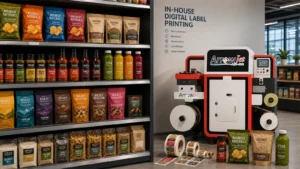
Table of Contents Custom Food Packaging: Key Questions Answered for Food Brands Custom food packaging shapes how shoppers recognize, evaluate, and choose a product —
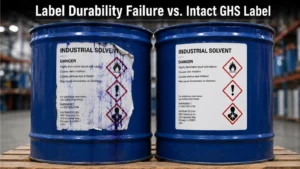
Table of Contents GHS Label Durability Failure: 4 Causes and Practical Fixes GHS label durability failures trace to four causes: aqueous ink chemistry, paper face
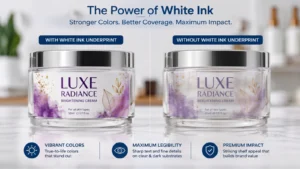
Table of Contents White Ink Clear Label Printing: When You Need It and Why White ink under clear film keeps brand color, mandatory copy, and
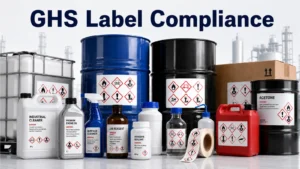
Table of Contents GHS Label Compliance: A Practical Guide for Chemical Label Printing GHS label compliance is a safety-critical requirement for any business that manufactures,
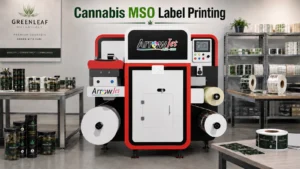
Table of Contents Cannabis MSO Label Printing: In-House or Outsource? Cannabis MSO label printing moves in-house when label versions outgrow converter minimums or batch data