Label Adhesive Types, Properties & Selection Guide
Table of Contents Label Adhesive Types, Properties & Selection Guide The right label adhesive depends on the surface, temperature, shape, and conditions of the application

The right label adhesive depends on the surface, temperature, shape, and conditions of the application — not just the face stock.
Label adhesive failure is frequently misattributed to face stock or print quality — but in most cases, the adhesive was not matched to the application.
A label may need to bond instantly on a high-speed applicator, hold through cold-chain storage, conform to a narrow-radius container, or release cleanly without surface damage. Each requirement points to a different adhesive specification. Selecting the adhesive based on the real-world environment — surface, shape, temperature, and permanence — rather than on face stock alone is the foundation of reliable label performance.
Four properties govern label adhesive performance across most applications.
The adhesive’s immediate holding power at first contact with a surface. A high-tack adhesive grabs instantly — useful for high-speed automated application lines. A low-tack adhesive may require additional dwell time or pressure before it holds, and may allow repositioning before the bond fully sets.
The maximum bond strength the adhesive reaches after fully setting. Ultimate adhesion is influenced by the adhesive’s shear, the roughness of the substrate surface, ambient temperature, and container geometry. On sharply curved surfaces, a stiff label construction can begin to lift before the adhesive reaches its full bond — which is why face stock stiffness and container curvature must be considered together.
The internal cohesive strength of the adhesive layer. High-shear adhesives are firmer and more resistant to splitting under mechanical stress, but may not flow as readily into rough or porous surfaces. Low-shear adhesives are softer, typically delivering higher initial tack, but can be more vulnerable to stress and may creep over time under load.
The adhesive’s ability to maintain its bond outside standard room-temperature conditions. Cold resistance is critical for labels on refrigerated and frozen products, where both the adhesive and the substrate surface may be near or below freezing at the time of application. Heat resistance matters in environments above ambient temperature — including products stored near heat sources, exposed to sunlight, or used in industrial settings.
Most label adhesive decisions fall into four categories, each with distinct tradeoffs.

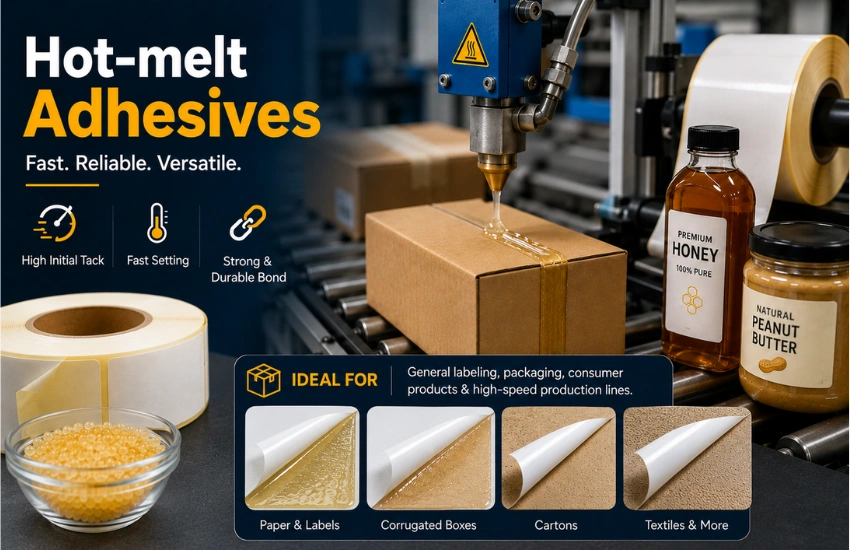
Hot-melt adhesives are typically rubber-based and applied to the label substrate in a molten state, cooling into a bond as the label is dispensed. They are widely used for their high initial tack, water resistance, and cost efficiency relative to other options. Key limitations include lower heat resistance, reduced plasticizer resistance, and susceptibility to bond degradation under extended UV exposure.

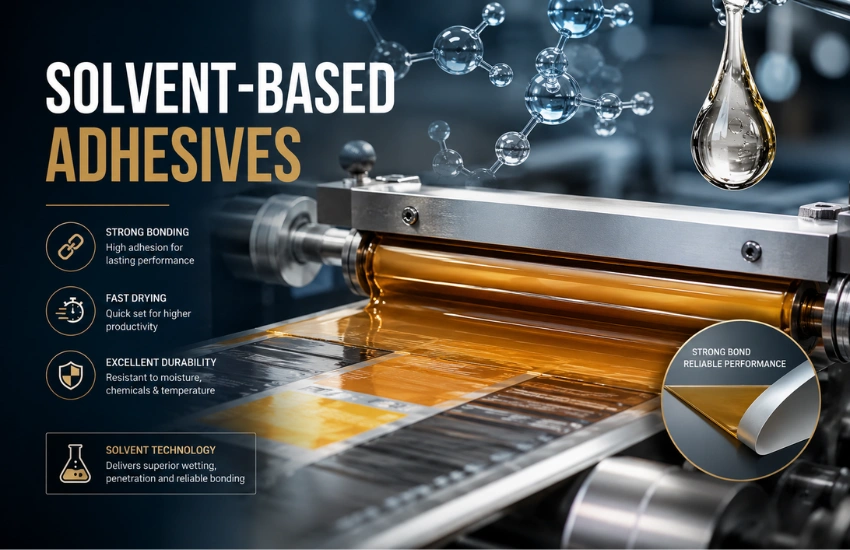
Solvent-based adhesives use rubber or acrylic formulations carried in a liquid solvent medium. They are valued for strong initial tack, effective adhesion on curved, uneven, and rough surfaces, and resistance to water and cold temperatures. Their tradeoffs include higher cost, environmental considerations related to solvent content, and limited plasticizer resistance.

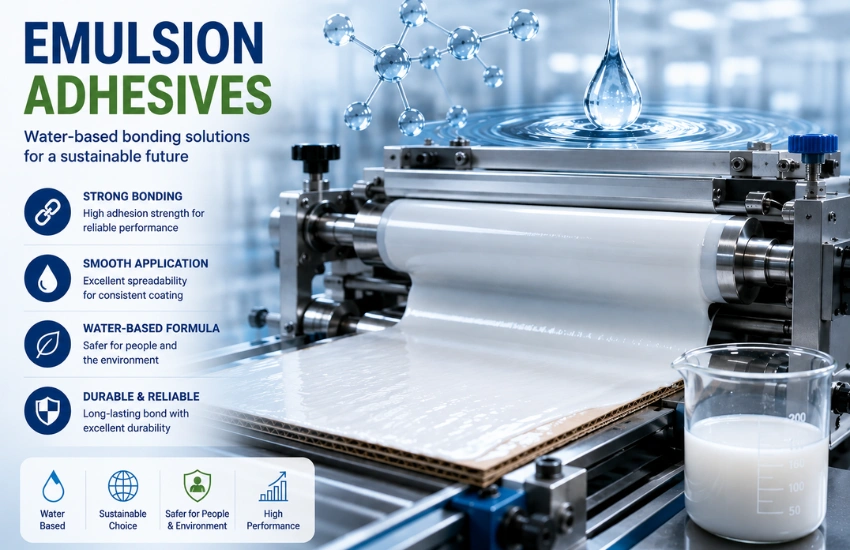
Emulsion adhesives suspend rubber or acrylic polymers in water and are widely used in labeling, packaging, tape, and household adhesive products. They can offer good aging and heat resistance, but typically perform less effectively on non-polar substrates and tend to have lower resistance to cold temperatures and moisture compared with hot-melt and solvent-based formulations.

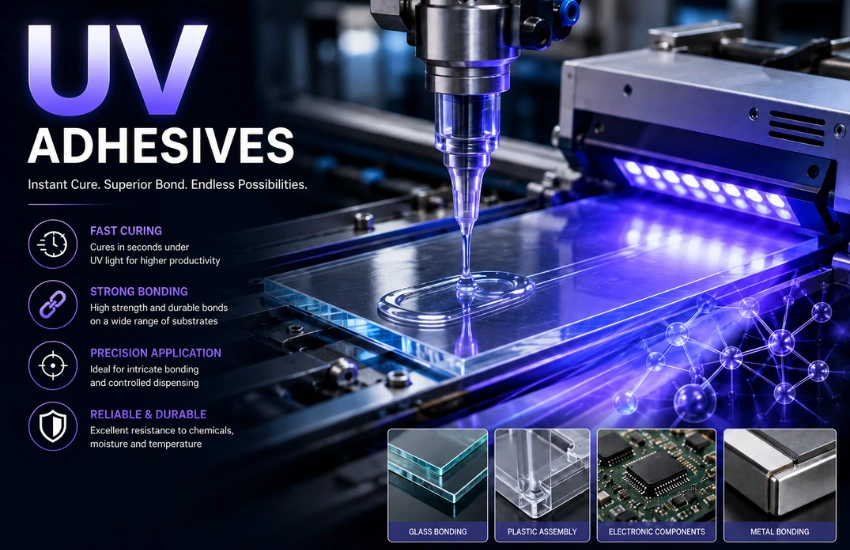
UV adhesives are acrylic-based and cured by exposure to ultraviolet light. The light-curing process can create very strong bonds in a short time window, which is an advantage in certain high-throughput or specialty applications. Tradeoffs include a higher process cost and lower initial tack compared with hot-melt and solvent-based alternatives.
The table below summarizes key performance tradeoffs across the four main label adhesive categories.
Adhesive Type | Initial Tack | Heat Resistance | Cold & Water Resistance | Plasticizer Resistance | Relative Cost | Typical Applications |
Hot-melt (rubber-based) | High | Lower | Good water resistance; moderate cold | Lower | Lower | General labeling, consumer products, high-speed lines |
Solvent-based | High | Moderate | Strong cold and water resistance | Lower | Higher | Curved and rough surfaces, cold-chain products |
Emulsion (rubber or acrylic) | Moderate | Good | Lower water and cold resistance | Moderate | Moderate | Packaging, tapes, general labeling |
UV (acrylic, light-cured) | Lower | Good | Good | Good | Higher process cost | High-strength bonds, specialty labeling |
Start with the actual application conditions — the environment determines the specification, not the other way around.
A complete adhesive selection conversation should address all of the following:
Matching adhesive performance to the complete set of conditions — rather than optimizing for a single factor — produces the most reliable label performance across both production and end use.
When running labels on a digital label press, face stock and adhesive compatibility with the printer’s ink chemistry and media path specifications is an additional selection factor. Arrow’s digital label printers — including the ArrowJet Aqua 330R, ArrowJet Eco 330R, ArrowJet UV 330H, and ArrowJet Hybrid Pro M — are designed to handle a wide range of label stocks. Confirming media compatibility with your specific printer model before finalizing a face stock and adhesive combination is recommended.
Common questions about adhesive properties, application failures, and selection criteria.
Initial tack is the adhesive’s immediate grip the moment a label contacts a surface. Ultimate adhesion is the maximum bond strength reached after the adhesive has fully set — this can take hours depending on the adhesive type, substrate surface, and ambient temperature.
Labels lift on curved surfaces when the face stock is too stiff for the curve radius, when the adhesive has not yet reached full bond strength, or when the label construction cannot conform to the shape. Matching face stock flexibility and adhesive formulation to the container curvature — rather than selecting them independently — reduces lift.
Cold-temperature performance depends on the specific adhesive formulation, not simply the category. Labels intended for refrigerated or frozen products should be specified for low-temperature application, with the minimum application temperature confirmed by the adhesive supplier or label converter.
Hot-melt adhesives are rubber-based, applied in a molten state, and deliver high initial tack and water resistance — but have limited heat and plasticizer resistance. Emulsion adhesives suspend rubber or acrylic polymers in water, offering better aging and heat resistance, but lower cold and moisture resistance and reduced effectiveness on non-polar substrates.
Arrow Systems manufactures digital label printers and finishing equipment. Selecting the right face stock and adhesive combination is a prerequisite for consistent performance on your label press. Contact Arrow Systems to discuss your substrate requirements and how they align with your printer configuration.

Table of Contents Label Adhesive Types, Properties & Selection Guide The right label adhesive depends on the surface, temperature, shape, and conditions of the application

Table of Contents Label Trends: Minimalist Label Design Minimalist label design removes clutter — nude palettes, gradients, transparent labels, and smart-labels let the product speak

Table of Contents Tamper-Evident Label Printing: How to Choose the Right System Match tamper-evident label type — void, breakaway, or destructible — to product risk,

Table of Contents Skincare Label Printing: Materials, Inks & FDA Rules Skincare labels must withstand moisture, oils, friction, and aggressive formulation actives while meeting FDA

Table of Contents Arrow Systems to Participate in R2R USA Conference & Expo 2026 Cleveland, OH — Arrow Systems Inc. will participate in the 2026

Table of Contents Coffee Pouch Printing: Valve Bags and Stand-Up Pouches In-House In-house coffee pouch printing lets specialty roasters produce exact quantities on demand, swap