Pet Food Brand Label Supplier Problems: 5 Signs to Print In-House
Table of Contents Pet Food Brand Label Supplier Problems: 5 Signs to Print In-House Most pet food label supplier problems are a model mismatch: flexo’s

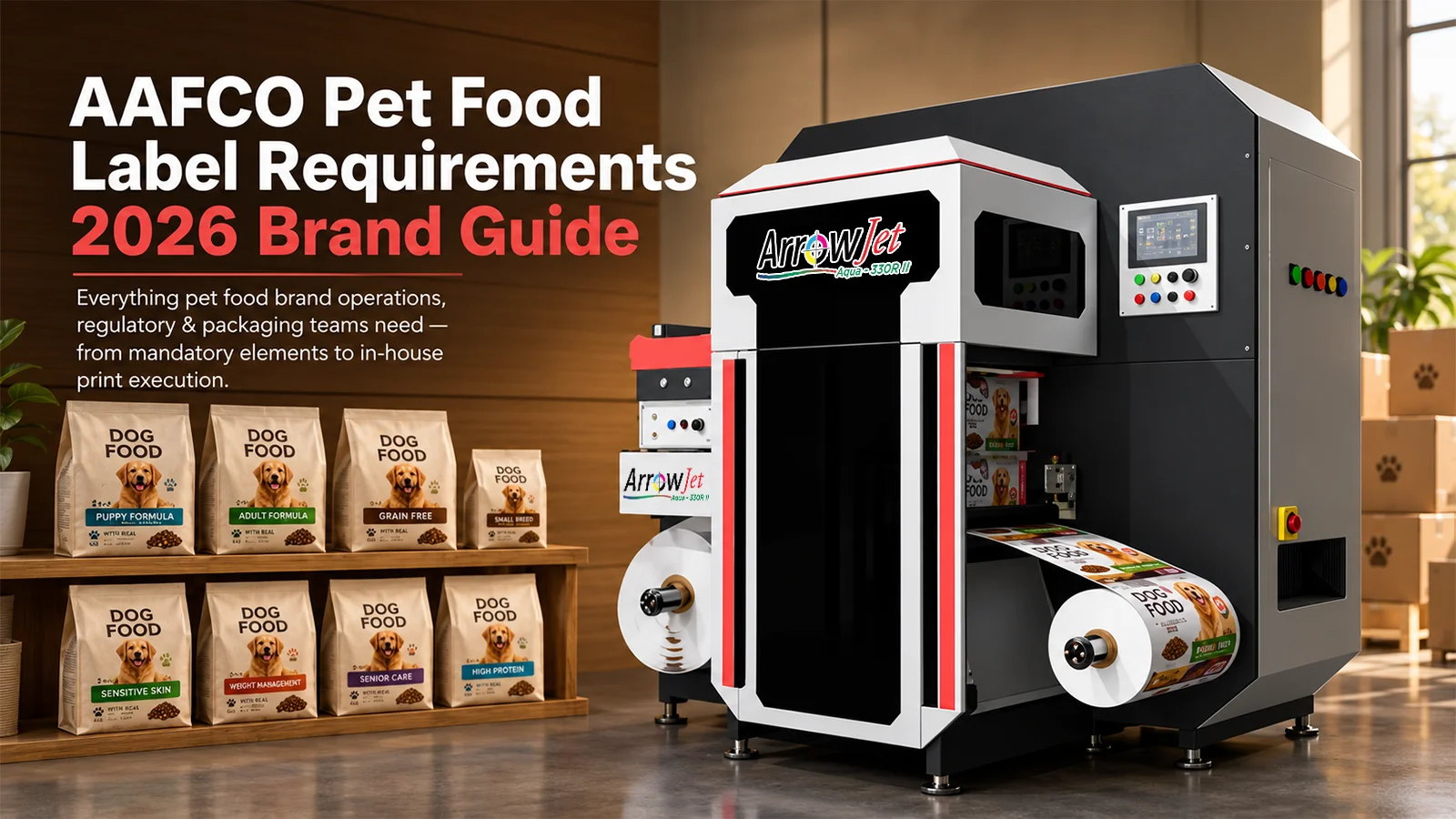
AAFCO pet food label requirements define eight mandatory elements every dog and cat food package must display to pass state registration.
AAFCO is not a regulatory agency — it is a nonprofit that publishes model labeling rules which individual states adopt and enforce through their own feed laws.
The following is a practical reference — not legal advice. Always verify current requirements with each state’s feed control office and the most recent AAFCO Official Publication before finalizing artwork. The Association of American Feed Control Officials (AAFCO) is a nonprofit body of state, federal, and international feed control officials. It publishes model regulations in its annual Official Publication. Individual states then adopt those model regulations — in whole or in part — into their own feed laws, enforced by state feed control officials.AAFCO requires eight elements on every dog or cat food label — missing any one is among the most common reasons state officials reject product registrations.
AAFCO rules specify not just what to print, but which panel each element must appear on — and placement errors are a leading cause of state registration rejections.
| Element | Required Panel | Placement Notes |
|---|---|---|
| Product identity (brand and product name) | Principal Display Panel (PDP) | Most consumer-facing panel at retail |
| Species designation | PDP | Must be legible — not buried in fine print |
| Net quantity statement | PDP, lower third | Required in both U.S. and metric units |
| Identity designators (e.g., “grain-free,” “natural”) | PDP | Where part of the product identity |
| Guaranteed analysis | Information Panel | Must be contiguous with other information panel elements |
| Ingredient statement | Information Panel | Descending order by pre-processing weight |
| Nutritional adequacy statement | Information Panel | Life stage must be explicitly stated |
| Feeding directions | Information Panel | Required for complete and balanced products |
| Calorie statement | Information Panel | kcal ME per kg and per common household measure; set apart from other text |
| Manufacturer or distributor address | Information Panel | Must be sufficient to locate the responsible party |
Common placement errors include printing the net weight on the information panel, burying species designation in fine print, or splitting information panel elements across non-contiguous areas. These errors routinely trigger state registration rejections and can force full artwork redos across every affected SKU.
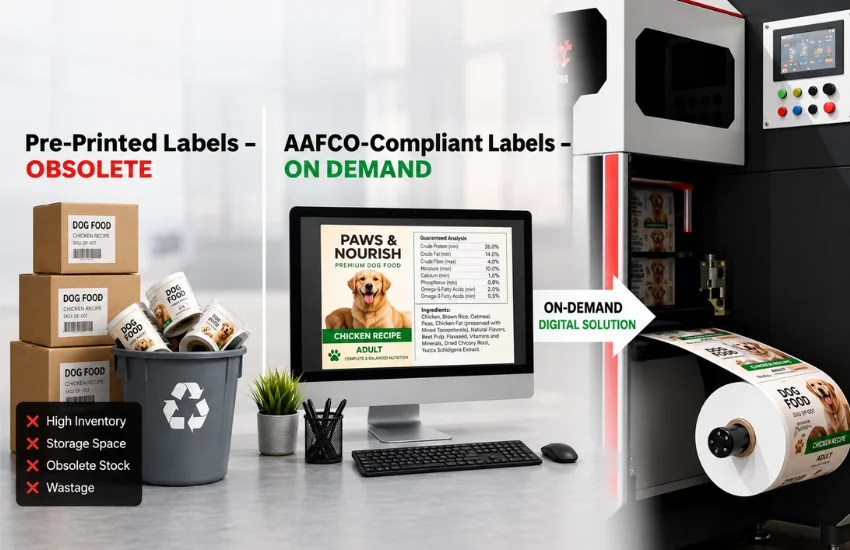
The guaranteed analysis is the most frequently revised element on a pet food label — it must be updated every time a formula changes, making it the primary driver of label obsolescence for brands on pre-printed inventory.
Four values are required at minimum on every label:
Additional guarantees are required whenever a marketing claim is made on the label. Labeling “omega-3 for skin and coat” requires a corresponding guaranteed minimum for that nutrient. The same applies to glucosamine, DHA, taurine (in cat food contexts), and similar functional claims.
Illustrative sample only — not regulatory guidance:
| Nutrient | Guarantee Type | Example Value |
|---|---|---|
| Crude Protein | Minimum | 26.0% |
| Crude Fat | Minimum | 14.0% |
| Crude Fiber | Maximum | 4.5% |
| Moisture | Maximum | 10.0% |
| Omega-3 Fatty Acids* | Minimum (claim-triggered) | 0.30% |
*Not recognized as an essential nutrient by the AAFCO Dog Food Nutrient Profiles. Brands should confirm format, order, and required disclaimers against the current AAFCO Official Publication and each state’s specific feed control requirements.
For any brand with more than a handful of SKUs, pet food label compliance is not a one-time artwork project — it is an ongoing operations problem driven by reformulations, sourcing shifts, and annual AAFCO updates.
Typical change drivers that force label revisions include:
Brands relying on long-run flexographic pre-printed labels absorb the full cost of each change in obsolete inventory. A reformulation that shifts crude protein from 25% to 26% can instantly scrap tens of thousands of pre-printed labels. Teams often report meaningful annual write-offs tied to normal reformulation and regulatory activity — see how brands reduce inventory costs with short-run printing, though actual rates vary by SKU mix and change cadence.
On-demand digital printing changes this economic equation. Paired with disciplined operations automation — version-controlled artwork, approval workflows, and production-triggered label runs — brands can print in quantities matched to current production, not forecasted annual demand.
Bringing label production in-house gives compliance teams direct control over version management, changeover speed, and substrate flexibility across rigid and flexible pet food packaging formats.
Two ArrowJet platforms cover the practical range of pet food packaging:
For brands running freeze-dried, treat, or pouch formats, the ArrowJet Eco 330R is configured for flexible substrates — printing directly to pouch material or specialty label stock. Short-run pouch variants including seasonal flavors, private-label SKUs, and regional test products can be produced without committing to converter minimum order quantities.
In operational terms, in-house digital printing on either platform supports:
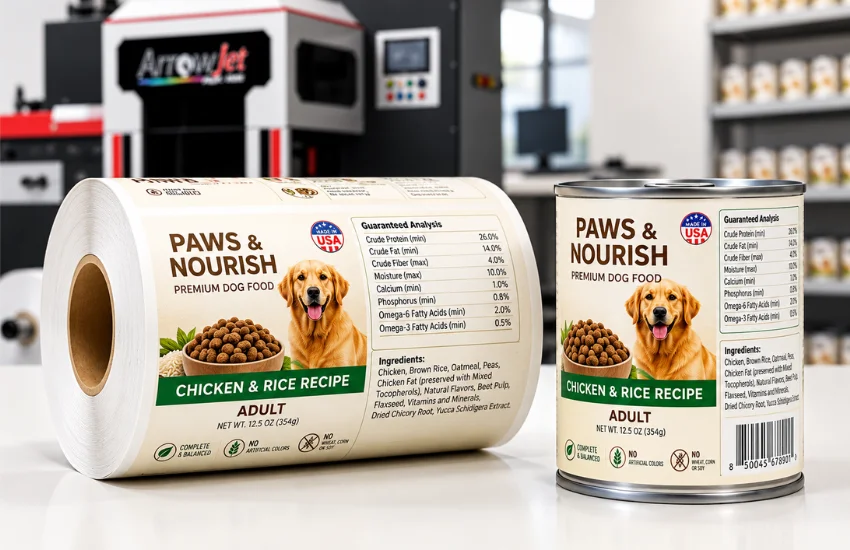
Brands that move label production in-house with a disciplined governance model consistently report four operational improvements across compliance, inventory, and team coordination.
Actual results depend on SKU mix, change cadence, and how consistently version-control and approval workflows are enforced. In-house equipment is a capability. Discipline around AAFCO-compliant label governance is what delivers the outcomes.
Common questions from pet food brand operations, regulatory, and packaging teams on AAFCO compliance, label revision management, and in-house digital printing.
AAFCO publishes an annual Official Publication. Substantive changes — such as updates to nutrient profiles or calorie statement requirements — do not happen every year, but brands should review each edition and monitor state adoption timelines. This unpredictability is one of the strongest operational arguments for on-demand digital label printing rather than bulk pre-printed inventory.
If you’re managing frequent label revisions across multiple SKUs, carrying obsolete pre-printed inventory, or losing weeks to converter lead times every time a formula or AAFCO requirement changes, a structured evaluation can clarify your best path forward.
Arrow Systems offers label printing assessments tailored to your pet food packaging formats — rigid containers, flexible pouches, or both — SKU count, reformulation frequency, and state registration footprint. The assessment evaluates the ArrowJet Aqua 330R and ArrowJet Eco 330R as fit-for-purpose options and maps out how in-house production supports faster compliance response and reduced label obsolescence.
Table of Contents Pet Food Brand Label Supplier Problems: 5 Signs to Print In-House Most pet food label supplier problems are a model mismatch: flexo’s
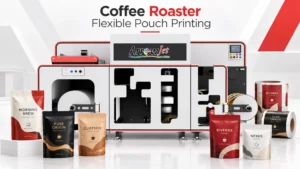
Table of Contents Coffee Roaster Flexible Pouch Printing Workflow: Roll to Bag In-house coffee pouch printing runs five stages — substrate loading, queue setup, the
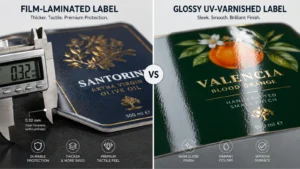
Table of Contents Overlaminate vs. Varnish Labels: How to Choose Protection Film overlaminate protects against immersion, wash-down, and solvents; UV and aqueous varnish suit retail
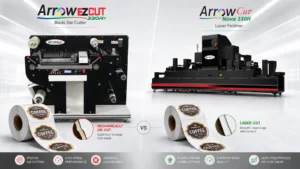
Table of Contents Blade vs. Laser Label Die Cutting: Accuracy, Speed, and Cost per Label Blade die-cutting suits simple shapes and long runs; CO2 laser
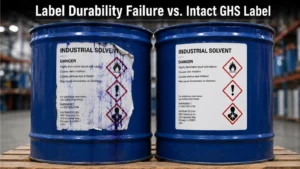
Table of Contents GHS Label Durability Failure: 4 Causes and Practical Fixes GHS label durability failures trace to four causes: aqueous ink chemistry, paper face
Table of Contents White Ink Clear Label Printing: When You Need It and Why White ink under clear film keeps brand color, mandatory copy, and