Vintage Label Design Styles: A Reference Guide for Producers and Brand Owners
Table of Contents Vintage Label Design Styles: A Reference Guide for Producers and Brand Owners Vintage label design draws from a specific visual history. The

Take a walk down any supermarket freezer aisle and you’ll see it: a blizzard of vibrant, glossy pouches competing for your attention. From frozen berries and ready-to-eat meals to meatless burgers and exotic smoothie blends, the frozen food segment is growing rapidly. In fact, the global frozen food Market is projected to reach over $400 billion by 2030. That’s not just growth; it’s an avalanche of opportunity.
While brands are racing to innovate with product offerings, their packaging often lags behind. For many new and emerging food brands, packaging is either too expensive, too generic, or just not robust enough to survive harsh freezer conditions. Worse yet, when it comes to custom printing, many fear the high costs, long lead times, or environmental impact of traditional ink and plate technologies.
So how do you create standout, freezer-safe packaging without breaking the bank or compromising on quality and sustainability?
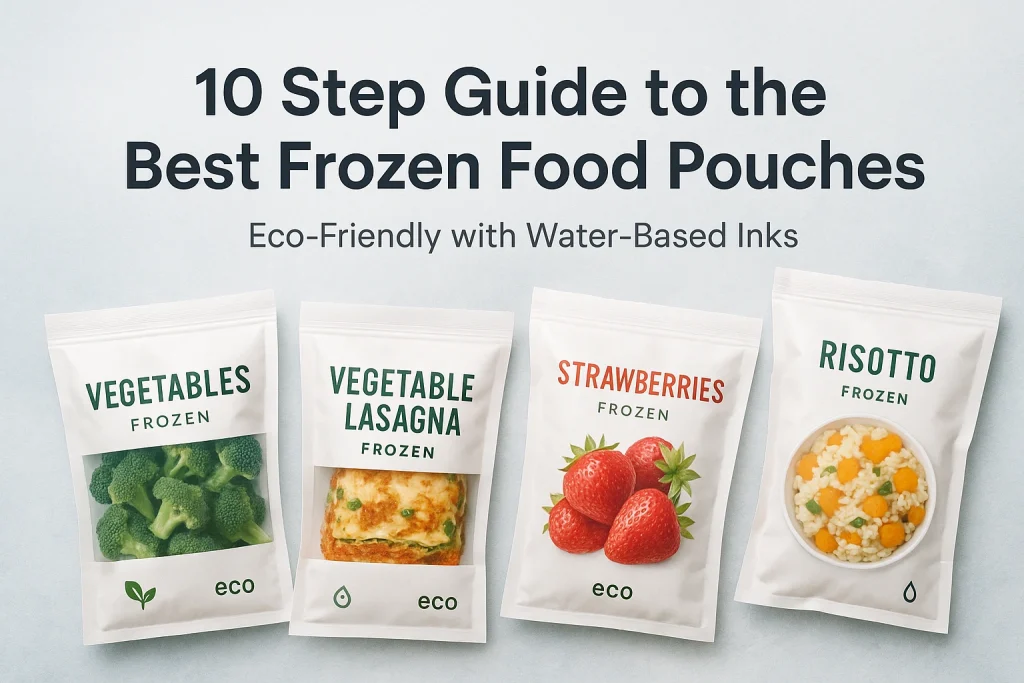
In this guide, we’ll walk you through everything you need to know about custom-printed frozen food pouches—from beginner basics to advanced considerations—with a special focus on digital printing using ArrowJet’s single-pass water-based pigment ink technology. Whether you’re a startup exploring your first frozen product or a seasoned brand looking to scale up sustainably, this blog is for you.
Factor | Requirement |
Moisture Resistance | Requires lamination or top-coating |
Freezer Compatibility | Must test at -18°C or lower |
Ink Adhesion | Substrate must be treated or coated |
Food Safety | Confirm ink system is compliant |
Durability | Test for smudging, abrasion, frost exposure |
Flexible pouches are dominating freezer shelves for a few simple reasons:
Brands like Daily Harvest, Tattooed Chef, and Amy’s Kitchen use high-quality, custom-printed pouches to stand out in a highly competitive market. They’re not just protecting the food—they’re telling a story.
Frozen food packaging has to do more than just look good. It must:
Choosing the wrong materials or printing method can result in cracking, fading, or even food spoilage. That’s why this isn’t just about looking good—it’s about preserving product quality and consumer trust.
Traditionally, printing on flexible packaging required long setup times, high MOQ (minimum order quantities), and expensive printing plates. Digital printing eliminates these bottlenecks by offering:
But here’s where it gets better.
Arrow Systems Inc. has introduced a revolutionary solution with its ArrowJet product line, powered by single-pass water-based pigment ink technology. Here’s why this matters for frozen food packaging:
ArrowJet inks are water-based and meet stringent food-packaging compliance requirements, making them ideal for indirect food contact.
Unlike dye-based or solvent inks, ArrowJet’s pigment inks are naturally resistant to moisture and UV degradation, making them perfect for cold chain environments.
These inks bond well with freezer-grade films and produce vivid, long-lasting prints that won’t smear or fade—even in frosty, wet conditions.
Short-run? No problem. You can print different SKUs, promotional designs, or languages without needing to invest in multiple plates.
Material choice is crucial for print compatibility and freezer performance. Recommended structures include:
ArrowJet printing systems work seamlessly with pre-treated films optimized for ink adhesion and lamination.
Even the best water-based pigment ink needs protection in cold, moist environments. Lamination adds:
Ask your converter about lamination options that are compatible with water-based ink systems.
Big brands are investing in sustainable, small-batch, and direct-to-consumer packaging strategies. Many are turning to digital printing to support:
ArrowJet technology allows you to tap into this trend without massive investment.
Here’s a simple roadmap:
The frozen food industry is only getting colder—but your brand can heat up with the right packaging strategy. Digitally printed, water-based pigment ink pouches are no longer a luxury—they’re a smart, scalable solution that meets modern expectations for quality, sustainability, and speed.
With ArrowJet single-pass water-based pigment ink technology, you get it all: brilliant color, freezer-safe durability, and the flexibility to grow.
Ready to make your mark in the frozen aisle? Reach out to Arrow Systems Inc. and discover how our digital printing solutions can transform your packaging—from concept to cold chain.

Table of Contents Vintage Label Design Styles: A Reference Guide for Producers and Brand Owners Vintage label design draws from a specific visual history. The

Table of Contents Label Adhesive Types, Properties & Selection Guide The right label adhesive depends on the surface, temperature, shape, and conditions of the application

Table of Contents Label Trends: Minimalist Label Design Minimalist label design removes clutter — nude palettes, gradients, transparent labels, and smart-labels let the product speak

Table of Contents Tamper-Evident Label Printing: How to Choose the Right System Match tamper-evident label type — void, breakaway, or destructible — to product risk,

Table of Contents Skincare Label Printing: Materials, Inks & FDA Rules Skincare labels must withstand moisture, oils, friction, and aggressive formulation actives while meeting FDA

Table of Contents Arrow Systems to Participate in R2R USA Conference & Expo 2026 Cleveland, OH — Arrow Systems Inc. will participate in the 2026