
Cost of SKU Proliferation in Sachet Packaging

Table of Contents

The Real Cost of SKU Proliferation in Sachet Packaging: How to Control It (2026)

What Is SKU Proliferation in Sachet Packaging?

SKU proliferation packaging is the rapid expansion of product variations that creates complexity and cost for brands. You started with one product. One SKU. One sachet design. Then customers asked for caffeine-free. Then sugar-free. Then travel-size packs. Then a holiday edition. Then a collaboration with that influencer.

Now you have 47 SKUs. And a sachet printing nightmare.

Every new variation means new printing plates, new inventory, new storage, new complexity. Traditional sachet printing turns SKU proliferation into a profit killer. But it doesn’t have to be this way.

This proven guide explains how multi SKU printing with digital technology eliminates the penalties of SKU management CPG operations face daily.

The Hidden Tax on Every New SKU The Traditional SKU Penalty

With rotogravure or flexographic sachet printing, each SKU carries fixed costs that don’t scale with volume:

Per-SKU Fixed Costs:

  • Gravure cylinders: $5,000-15,000 per design
  • Flexographic plates: $500-2,000 per color per SKU
  • Setup waste: 1,000-5,000 units per production run
  • Artwork prep: $200-500 for plate-ready files

The Math That Kills:

  • 10 SKUs x $8,000 average cylinder cost = $80,000 in setup costs
  • Before you print a single unit
  • Before you know if customers will buy

The Inventory Multiplication Problem

High minimum orders mean every SKU multiplies your inventory burden:

Example: 20 SKUs, 25,000-unit minimum each

  • Total inventory commitment: 500,000 units
  • At $0.50/unit = $250,000 tied up in flexible packaging short runs
  • Storage space: 2,500+ square feet
  • Obsolescence risk: If 5 SKUs fail, $62,500 in waste

This is why big CPG companies are constantly killing SKUs. The carrying costs devour profitability.

The Agility Penalty

When changing a SKU requires new plates:

  • Formula updates: New plates needed
  • Regulatory changes: New plates needed
  • Rebranding: New plates needed for every SKU
  • Seasonal variations: Prohibitively expensive

You’re locked into designs for years because changing them costs too much.

Why Brands Proliferate SKUs Anyway

Market Demand for Variety

Modern consumers expect choice in SKU proliferation packaging:

  • Flavors: Vanilla, chocolate, strawberry, unflavored
  • Sizes: Single-serve, 5-pack, 30-pack, bulk
  • Formulations: Regular, extra strength, caffeine-free, keto-friendly
  • Seasonal: Holiday editions, summer flavors, limited releases

The Long Tail Opportunity

E-commerce enables niche products:

  • Specialized diets (paleo, vegan, allergen-free)
  • Regional preferences
  • B2B customization
  • Personalized nutrition

Each niche is a potential SKU. But traditional sachet printing makes serving them unprofitable.

Competitive Pressure

When competitors launch new variants, you must respond:

  • They add a flavor
  • They partner with an influencer
  • They release a limited edition

Without affordable flexible packaging short runs, you can’t compete.

Sachet Printing: The SKU Proliferation Solution

Zero Fixed Costs Per SKU

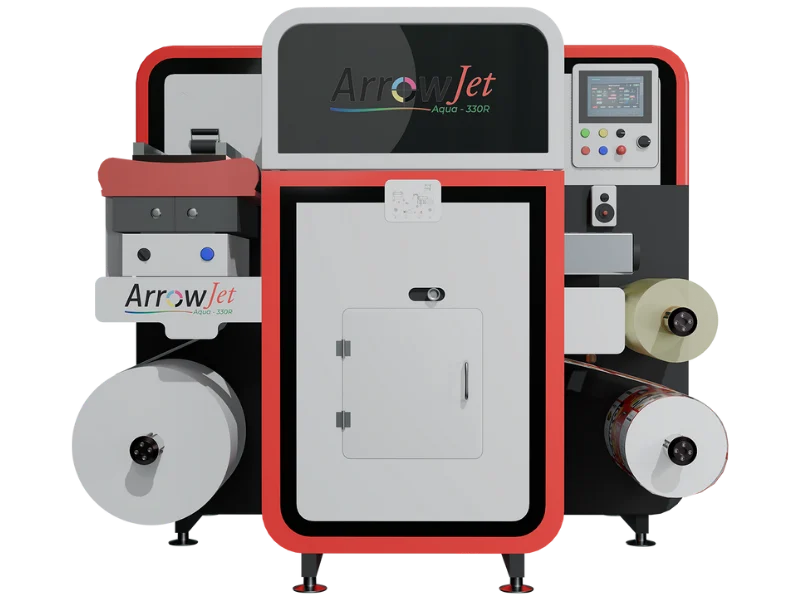
The ArrowJet Aqua 330R Lite uses digital inkjet technology that eliminates per-SKU setup costs for multi SKU printing:

Digital Economics:

  • Plate/cylinder costs: $0
  • Setup waste: Minimal (10-50 units)
  • Artwork changes: Digital file swap
  • Color additions: No additional cost

The New Math:

  • 10 SKUs x $0 setup = $0
  • 50 SKUs x $0 setup = $0
  • Print what you need, when you need it
ArrowJet Aqua 330R Lite

Print-on-Demand Inventory Model

Instead of stocking 25,000 units of each SKU:

  • Print 1,000 units of fast-moving SKUs weekly
  • Print 500 units of medium SKUs monthly
  • Print 100 units of slow SKUs as needed

Result: Same SKU variety, 90% less inventory.

Real-Time SKU Adjustment

When sales data shows:

  • Lemon-lime selling 3x faster → Increase print frequency
  • Tropical blend underperforming → Reduce to quarterly runs
  • Holiday edition sold out → Quick reprint without new plates

You’re optimizing your SKU management CPG mix in real-time, not guessing 6 months ahead.

Case Studies: SKU Proliferation Done Right

Case Study 1: The Electrolyte Brand with 40+ Flavors

Challenge: Sports nutrition company wanted flavor variety as a competitive differentiator but couldn’t afford 40 sets of gravure cylinders.

Traditional Reality:

  • 40 SKUs x $8,000 cylinders = $320,000 setup costs
  • 40 SKUs x 25,000 MOQ = 1,000,000 units minimum
  • Impossible for a startup

Digital Solution:

  • Launched with 40 flavors, 1,000 units each
  • Total startup cost: $20,000-30,000
  • Printed flavors based on weekly sales data
  • Killed 12 underperformers without waste
  • Doubled down on top 8 flavors

Result: 40-SKU portfolio, $0 obsolete inventory, data-driven product mix, acquired by major CPG within 2 years.

Case Study 2: The Tea Company's Seasonal Strategy

Challenge: Artisan tea brand wanted 12 seasonal blends (one per month) but couldn’t store 300,000 sachets (12 x 25,000).

Traditional Reality:

  • Storage costs: $15,000/year
  • Risk of expired product
  • Capital tied up: $150,000+

Digital Solution:

  • Print 5,000 units of current month’s blend
  • Previous month: 2,000 units (clearing remaining)
  • Next month: 1,000 units (building inventory)
  • Just-in-time production for 12 unique SKUs

Result: Zero storage costs for sachets, always-fresh product, authentic seasonal positioning, 35% higher margins.

Case Study 3: The Supplement Brand's B2B Pivot

Challenge: Nutraceutical company discovered B2B opportunity (gyms, hotels, corporate wellness) but each client wanted private label.

Traditional Reality:

  • Each private label client: $8,000-15,000 setup
  • Minimum 25,000 units per client
  • Only viable for massive chains, not mid-size

Digital Solution:

  • Private label minimum: 500 units
  • 50+ private label clients served
  • Each gets unique packaging without plate costs
  • Clients can test with small orders before scaling

Result: B2B revenue grew from 5% to 45% of total sales, 60+ active private label relationships.

The True Economics of SKU Flexibility

Cost Comparison: 20-SKU Portfolio

Cost CategoryTraditional PrintingDigital Sachet Printing
Setup costs$100,000-300,000$0
Initial inventory$250,000$25,000
Storage (annual)$12,000$1,200
Obsolescence (annual)$25,000$2,500
Total Year 1$387,000+$28,700

Assumes 20 SKUs, 25,000-unit traditional MOQ vs. 1,000-unit digital average

The ROI of SKU Agility

Beyond cost savings, flexible packaging short runs enable revenue opportunities:

Faster Time-to-Market:

  • New SKU launch: 2-3 days vs. 4-6 weeks
  • Capture trends before competitors
  • Respond to customer feedback instantly

Higher Hit Rate:

  • Test 10 concepts, scale the 3 winners
  • Kill losers early without waste
  • Improve SKU success rate from 20% to 60%

Premium Pricing:

  • Limited editions create urgency
  • Seasonal SKUs command 15-25% premium
  • Personalization adds 20-30% value

Managing 100+ SKUs: The Digital Playbook

Step 1: Categorize Your SKUs

A. Core SKUs (70% of volume)

  • High-velocity products
  • Print 2,000-5,000 units weekly
  • Stable, predictable demand

B. Seasonal/Promotional (20% of volume)

  • Limited-time offerings
  • Print 500-2,000 units per run
  • Variable timing

C. Long Tail (10% of volume)

  • Niche products
  • Print 100-500 units as needed
  • Infrequent orders

Step 2: Implement Dynamic Scheduling

Weekly Review:

  • Check inventory levels by SKU
  • Analyze sales velocity
  • Adjust print schedule

Monthly Optimization:

  • Review SKU performance
  • Identify candidates for discontinuation
  • Plan new launches

Quarterly Strategy:

  • Assess full portfolio
  • Reallocate capacity to winners
  • Test new concepts

Step 3: Leverage Variable Data

The ArrowJet Aqua 330R Lite can print unique content on every sachet:

Batch/Lot Tracking:

  • Individual codes for traceability
  • QR codes linking to certificates
  • Expiration dates printed on-demand

Personalization:

  • Customer names on B2B orders
  • Different formulas for different segments
  • Regional variations

A/B Testing:

  • Test messaging on 500 units
  • Measure response rates
  • Scale winning messaging

Best Practices for SKU Portfolio Management

1. The 80/20 Rule Applied

80% of sales come from 20% of SKUs. With digital sachet printing:

  • Focus inventory on winners (high-velocity core SKUs)
  • Keep long tail lean (print to order)
  • Test aggressively (low cost of failure)

2. The Rule of Three

Limit active SKUs per “decision point” to 3:

  • 3 flavors (not 15)
  • 3 sizes (not 8)
  • 3 formulations (not 10)

Use multi SKU printing to rotate options seasonally rather than carrying everything.

3. Kill Criteria

Define when to discontinue an SKU:

  • Sales below X units/month for Y months
  • Margin below Z%
  • Inventory turns below W times/year

Digital sachet printing means killing SKUs doesn’t strand $50,000 in obsolete packaging.

4. Version Control

Track SKU versions:

  • Formula V1, V2, V3
  • Packaging Rev A, Rev B
  • Regulatory updates

Digital makes version transitions seamless.

Key Takeaways

  • SKU proliferation packaging doesn’t have to kill profitability
  • Traditional sachet printing adds $5,000-15,000 fixed cost per SKU
  • Digital multi SKU printing eliminates setup costs completely
  • Flexible packaging short runs reduce inventory by 90%
  • Print-on-demand enables real-time SKU management CPG optimization
  • Test 10 concepts, kill 7 losers, scale 3 winners—without waste
  • Seasonal and limited editions become profitable with short runs
  • Private label B2B becomes viable with 500-unit minimums

FAQs

What is SKU proliferation in packaging?

SKU proliferation packaging is the rapid expansion of product variations (flavors, sizes, formulations) that creates operational complexity and cost. In traditional sachet printing, each new SKU requires expensive plates or cylinders, making variety prohibitively expensive for small and mid-sized brands.

How much does each SKU cost with traditional printing?

With traditional sachet printing, each SKU carries $5,000-15,000 in fixed setup costs for gravure cylinders or $500-2,000 per color for flexographic plates. Plus 1,000-5,000 units of setup waste. Digital printing eliminates these costs entirely.

What is the minimum order quantity for digital sachet printing?

Digital sachet printing with systems like the ArrowJet Aqua 330R Lite has no minimum order quantity. Print 100 units or 100,000 units—the setup cost is the same: $0. This enables true flexible packaging short runs.

How do I manage 50+ SKUs without massive inventory?

Categorize SKUs into Core (70% volume, print 2,000-5,000 weekly), Seasonal (20%, print 500-2,000 as needed), and Long Tail (10%, print 100-500 to order). This SKU management CPG strategy maintains variety while minimizing inventory.

Can I print different SKUs in the same production run?

Yes. Digital multi SKU printing allows you to print SKU A for 30 minutes, switch files, and print SKU B immediately. No plate changes, no setup time, no waste. Perfect for flexible packaging short runs.

What happens when I need to update a SKU design?

With digital sachet printing, design updates are instant. Upload the new file and the next sachet prints with the updated design. No new plates, no additional cost, no 4-6 week lead time.

Additional Resources for SKU Management

Learn more about SKU proliferation packaging and flexible packaging short runs:

Conclusion

SKU proliferation packaging doesn’t have to be a cost center. With digital sachet printing, it becomes a competitive weapon:

  • Serve niche markets profitably
  • Test and iterate without massive bets
  • Respond instantly to market changes
  • Personalize at scale for premium pricing

The ArrowJet Aqua 330R Lite transforms SKU flexibility from a luxury only big brands can afford into a tool accessible to businesses of any size. Stop fighting SKU management CPG challenges. Harness them with flexible packaging short runs.


Ready to optimize your SKU portfolio? Contact Arrow Systems for a multi SKU printing assessment and ROI analysis tailored to your product mix.

Questions about flexible packaging? Call us at 1-888-697-2749

Contact With Our Team Now

Memjet Technology Guide

Memjet Technology Guide

Table of Contents Memjet Technology: The Complete Guide to Digital Label Printing Innovation Memjet has become one of the most impactful innovations in modern digital

Read More »