Industrial production example for laser label finishing

Table of Contents

Laser Label Finishing: Workflow and Buyer Guide

Laser finishing uses focused laser energy to cut, mark, engrave, or remove material from a surface. For label and packaging producers, the main appeal is precision and flexibility: digital finishing can support short runs, custom shapes, rapid changeovers, and detailed graphics without relying on a new physical die for every job.

What Laser Finishing Can Do

The earlier guide describes laser finishing as a process that can remove material from a workpiece and create customized finishes, logos, graphics, and text. It also lists common uses such as marking or engraving products, producing precision parts, and precise cutting or welding. In labels and packaging, the most relevant uses are digital die cutting, kiss cutting, scoring, perforating, marking, and prototype development.

Business Benefits

  • Precision: laser systems can create detailed shapes and repeatable cut paths when properly set up.
  • Short-run flexibility: designs can change digitally, which helps with prototypes and small batches.
  • Reduced tooling delays: some jobs can avoid waiting for physical dies.
  • Less waste during iteration: teams can test and adjust cut files before scaling.
  • More product variety: converters can offer custom shapes, promotional labels, and versioned packaging.

Where It Fits in a Label Workflow

Laser finishing usually comes after printing and before final rewind, inspection, or packing. The printed roll or sheet is aligned to a digital cut file, then finished to the required shape. Registration, web control, material compatibility, smoke/extraction management, and operator setup all matter for final quality.

Material and Safety Considerations

Not every material is appropriate for laser finishing. Some films, adhesives, liners, coatings, or laminates may react poorly to heat or produce unacceptable edges. Before purchasing or quoting a laser-finished job, test the exact material stack and confirm safe operation with equipment and material suppliers.

Choosing a Laser Finishing Partner or System

The earlier guide recommends considering equipment quality, reputation, service offering, samples, references, and price. For in-house decisions, also compare service support, software workflow, operator training, material testing, throughput needs, and how the system integrates with existing printing and converting equipment.

Operational Questions Before Adding Laser Finishing

Before adding laser finishing, define the job mix. A shop producing frequent custom shapes, prototypes, and short runs may value digital flexibility more than a shop running the same few shapes every day. Compare changeover time, expected throughput, operator skill, material testing needs, and service support.

Ask suppliers for samples using your actual materials and artwork. Inspect edge quality, registration, heat effects, liner behavior, odor, and downstream application performance. Laser finishing can be powerful, but it needs the right material stack and process controls to produce repeatable commercial work.

Build a Written Application Specification

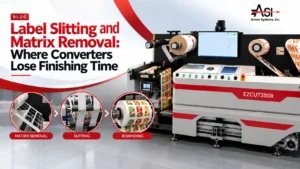
Treat laser label finishing as a production decision, not a feature checklist. Document the product, artwork, run mix, finished format, operating environment, and acceptance criteria. Map every handoff from approved file and material through printing, finishing, inspection, packing, and use. Assign an owner to each handoff and record approved materials, settings, and file versions. This prevents an attractive sample from being mistaken for a repeatable process.

State what the output must survive and how success will be measured. Avoid broad claims such as “durable,” “food safe,” “eco-friendly,” or “cost-effective” without defining the exact construction, test method, comparison, intended use, and jurisdiction. If the job is regulated or safety-sensitive, obtain current documentation for the complete construction and qualified advice for the intended market.

Run a Controlled Production Trial

Use real artwork, production materials, and the intended finishing steps. Include difficult jobs and boundary conditions, then evaluate edge quality, liner damage, residue, extraction, registration, matrix stripping, and roll tension. Run enough material to observe startup, steady production, changeover, inspection, and downstream handling. Keep retained samples, measurements, settings, material lot numbers, and dated photographs so a later run can be compared with the approved result.

Approve the finished output only after it has been converted, applied, and conditioned for the expected environment. A fresh press sample cannot by itself prove adhesion, package integrity, scan performance, shelf life, or sustained throughput. Define who can approve a deviation and when a material, ink, coating, software, or equipment change triggers a new trial.

Compare the Complete Operating Workflow

Compare good finished output rather than headline speed. Record setup, spoilage, cleaning, consumables, operator time, maintenance, utilities, software, storage, finishing, inspection, and rework. Confirm training, service response, spare-parts access, and change-control procedures. The best fit is the workflow the team can run safely and consistently with qualified supplies, not the option that wins one specification.

Decision areaEvidence to collectApproval question
ApplicationReal product, artwork, materials, and exposureDoes finished output work in use?
ProductionSetup, good output, waste, and operator stepsCan the team repeat the result?
SupportQualified supplies, training, maintenance, and serviceCan the workflow be sustained?

Connect Equipment, Materials, and Finishing

Review the proposed process across Arrow’s label finishing systems and digital label printers. Request tests that combine the intended artwork, substrate, production settings, inspection method, and final converting steps.

Frequently Asked Questions

It is digital cutting, marking, engraving, scoring, or perforating using a laser instead of a conventional physical tool.

It can replace dies for some short-run or custom work, but conventional die cutting may still fit longer or repeat jobs.

No. Material compatibility must be tested for cut quality, safety, odor, edge condition, and adhesive performance.

Digital cut files can change quickly, which reduces tooling delays for prototypes, custom shapes, and versioned jobs.

Test real artwork and materials through printing, finishing, application, conditioning, handling, and inspection under the intended production settings.

Ready to improve your label or packaging workflow?

Talk with Arrow Systems about your application, materials, production goals, and the equipment options that may fit.