Table of Contents

Eliminating Wasted Inventory: The Ultimate Guide to On-Demand Box Printing (2026)

On-Demand Box Printing

What Is On-Demand Box Printing?

On-demand case printing (also called direct-to-package printing) is the proven process of applying graphics, text, and branding directly onto corrugated cases using digital inkjet technology—without plates, without setup time, and without minimum order quantities. This revolutionary approach helps businesses eliminate box inventory completely.

Unlike pre-printed boxes ordered in bulk from converters, on-demand corrugated printing happens at the point of packaging or fulfillment. You maintain a stock of unprinted, generic boxes and transform them into branded, SKU-specific packaging moments before they’re needed.

Key technologies that enable you to reduce packaging SKU count:

Both approaches eliminate box inventory and remove the traditional printing bottleneck that forces companies to over-order and over-store.

The Hidden Cost of Box Inventory

Walk into any warehouse storing corrugated packaging, and you’ll find a problem most operations have accepted as inevitable: walls of boxes. Skids upon skids of pre-printed cases, each representing frozen capital, occupied square footage, and continuous operational headaches.

The traditional packaging workflow demands forecasting. You estimate Q3 sales, order 10,000 printed boxes for a reasonable per-unit cost, and hope your predictions hold. They rarely do. Product launches flop. Seasonal demand shifts. Packaging designs become outdated. Suddenly, that $0.42 per box negotiated rate becomes much higher when you’re writing off 3,000 obsolete units.

The best solution? Just-in-time packaging printing lets you print exactly what you need, exactly when you need it. On-demand case printing isn’t science fiction—it’s the new standard for operations that refuse to let packaging dictate their inventory strategy.

Benefits of Just-in-Time Box Printing

Eliminate Obsolescence Risk

Traditional pre-printed packaging carries a 15-20% annual write-off rate. When you eliminate box inventory through on-demand printing, you reduce this waste to 0%. This proven approach saves mid-sized operations $10,000-$15,000 annually. No more MOQs and wasted space storing pre-printed boxes!

Free Up Warehouse Space

Pre-printed box inventory consumes valuable warehouse real estate. By switching to on-demand box printing, you reclaim square footage for revenue-generating activities rather than storage. No more storage shelves packed with unused boxes to be thrown out after 2 years!

Respond to Market Changes Instantly

Product designs change. Regulations update. Seasonal promotions launch. With just-in-time packaging printing, you implement changes same-day instead of waiting 2-4 weeks for new print runs. This allows for seasonal packaging and special offers to be easily offered to customers!

Reduce Total Cost of Ownership

While per-unit costs may appear higher for small runs, the total cost of on-demand case printing is lower when you factor in:

  • Zero setup fees ($800-$2,500 saved per run)
  • No obsolescence write-offs
  • Eliminated storage costs ($0.08-0.15/unit/year)
  • Reduced rush order premiums

UV vs. Water-Based Technology Comparison

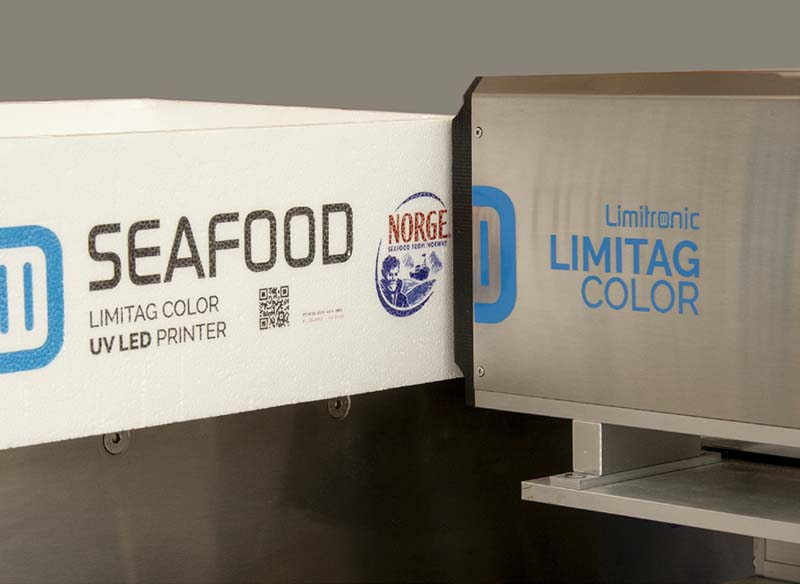
Limitronic V7 (UV-Based)

The Limitronic V7 uses UV-curable inks that cure instantly under LED lamps. This creates a hardened, durable print surface that’s resistant to scratching, water, and UV exposure. Limitronic technology can be used both offline and inline on packaging lines.

Best for:

  • Outdoor or extended storage applications
  • High-risk handling environments (agriculture, industrial)
  • Quick turnaround without drying time
  • Bold graphics requiring high opacity white ink

Sustainability note: Modern UV inks have significantly lower VOCs than traditional solvent-based alternatives, though water-based systems retain the environmental edge for food-contact applications.

Limitronic Color V7

Arrow OverJet Pro (Water-Based)

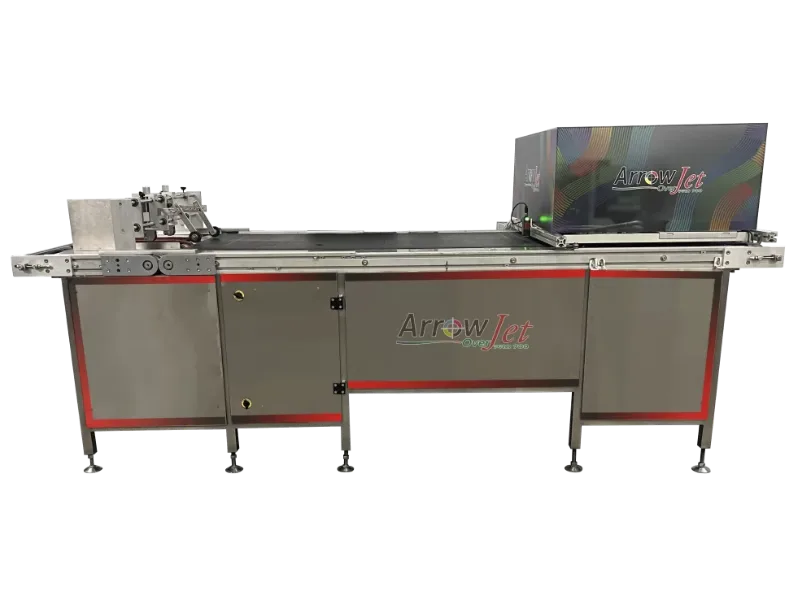
The Arrow OverJet Pro uses water-based pigment inks specially formulated for corrugated adhesion. These inks penetrate the board slightly, creating excellent durability while maintaining a smaller environmental footprint.

Best for:

  • Food and beverage packaging (FDA-compliant formulations available)
  • Premium consumer goods where “green” messaging matters
  • Operations prioritizing VOC reduction
  • Direct food-contact secondary packaging

The choice between UV and water-based often comes down to end-use requirements rather than print quality—both systems deliver photorealistic, full-color graphics.

ArrowJet OverJet Pro 700

ROI Analysis: Traditional vs. On-Demand

Let’s talk numbers. A mid-sized operation running 50 SKUs might maintain $40,000-$80,000 in pre-printed packaging inventory at any given time. That’s capital that could fund equipment, marketing, or growth initiatives.

Cost Comparison Table

Cost FactorPre-Printed BulkOn-Demand Digital
Per-unit cost (100 units)$2.80 (rush)$0.85
Per-unit cost (10,000 units)$0.42$0.85
Setup cost$800-$2,500$0
Obsolescence risk15-20% annual write-off0%
Storage cost$0.08-0.15/unit/year$0
Lead time2-4 weeksSame day

The math shifts dramatically when you factor in obsolescence. A company writing off 18% of their $60,000 annual packaging spend loses $10,800 yearly to outdated inventory. On-demand case printing eliminates that waste entirely.

5 Steps to Eliminate Box Inventory

Step 1: Audit Your Current Inventory

Calculate your total packaging inventory value, square footage usage, and write-off rates. Identify which SKUs have the highest obsolescence risk (seasonal, promotional, experimental products).

Step 2: Identify Quick Wins

Start with SKUs that:

  • Have frequent design changes
  • Represent <500 units per run
  • Are seasonal or promotional
  • Have versioning requirements (regional, language, etc.)

Step 3: Select Your Technology Path

Choose UV if you need outdoor durability and immediate handling. Choose water-based if you need food contact compliance and sustainability positioning.

Step 4: Design for Digital

Update your design files for on-demand corrugated printing:

  • Verify color profiles (RGB to CMYK conversion)
  • Test barcode scannability at target resolution
  • Design for variable data if versioning is needed

Step 5: Phase Your Rollout

Start with 10-20% of your SKUs to validate workflows, train operators, and refine processes. Expand as confidence and efficiency improve.

Real-World Applications

Seasonal Packaging Without the Risk

A craft beverage company normally orders 15,000 holiday-themed boxes in October. Last year, demand exceeded projections and they sold out by December 10th—turning away sales. This year, they’re using just-in-time packaging printing: 200 boxes today, 300 tomorrow, adjusting to actual demand. No surplus. No shortage. No risk.

Regional Variants from Generic Stock

A national electronics retailer maintains one generic box SKU, printing region-specific messaging and compliance labeling at 12 distribution centers. They reduced packaging SKU count by 47 separate box SKUs and eliminated the inventory headaches that came with them.

Promotional Testing at Scale

A CPG brand wanted to test three different package designs for a new product launch. Instead of committing $15,000 to 5,000 boxes of each variant (with two-thirds destined for the dumpster), they used on-demand case printing for 200 of each, ran them to market, and let data drive the final design decision.

Sustainability Advantages

Beyond inventory efficiency, on-demand corrugated printing carries significant sustainability benefits:

  • Reduced waste: Print what you need, eliminate box inventory obsolescence
  • Lower transportation: Print at point of use, not at a converter’s facility
  • Right-sized packaging: Freedom to optimize box sizes without minimum order constraints
  • Water-based options: Arrow OverJet Pro formulations contribute to reduced VOC emissions

For companies with ESG commitments or sustainability-focused customers, just-in-time packaging printing is a tangible operational improvement that supports broader environmental goals.

Implementation Guide

Throughput Requirements: Digital throughput (50-200 feet/minute depending on resolution) suits most fulfillment operations but requires evaluation against peak demand periods.

Operator Training: Modern systems are designed for operator-friendly workflows, but expect a 2-4 week learning curve for file preparation, color management, and maintenance procedures.

Integration: Most on-demand case printing systems integrate with existing conveyor lines, WMS systems, and ERP platforms. Evaluate your current infrastructure for compatibility.

Key Takeaways

  • Eliminate box inventory to free up $40,000-$80,000 in frozen capital
  • Just-in-time packaging printing reduces obsolescence waste from 15-20% to 0%
  • On-demand corrugated printing enables same-day turnaround vs. 2-4 week lead times
  • Choose UV systems for durability, water-based for sustainability
  • Start with quick-win SKUs: seasonal, promotional, or low-volume products
  • Reduce packaging SKU count by using generic stock with variable printing
  • Calculate total cost of ownership—not just per-unit price
  • Plan for 2-4 week operator training during implementation

FAQs

What is on-demand case printing?

On-demand case printing is the process of printing graphics and branding directly onto corrugated boxes using digital inkjet technology. Unlike traditional printing that requires plates and setup, on-demand systems print instantly from digital files, allowing you to eliminate box inventory and print exactly what you need, when you need it.

How much can I save by eliminating box inventory?

Most mid-sized operations save $10,000-$15,000 annually by switching to just-in-time packaging printing. Savings come from eliminated obsolescence (15-20% of inventory value), reduced storage costs ($0.08-0.15/unit/year), and zero setup fees ($800-$2,500 per traditional run).

What is the difference between UV and water-based on-demand printing?

UV-based printing (like the Limitronic V7) uses inks that cure instantly under LED lamps. It’s best for outdoor durability and immediate handling. Water-based printing (like the Arrow OverJet Pro) uses FDA-compliant pigment inks ideal for food packaging and sustainability-focused operations.

Can on-demand printing handle high volumes?

Yes. Modern on-demand corrugated printing systems handle 50-200 feet per minute, depending on resolution. This throughput suits most fulfillment operations. For extremely high volumes, a hybrid approach using on-demand for variable/short-run SKUs and traditional for stable high-volume SKUs often works best.

How do I transition from traditional to on-demand printing?

Follow the 5-step process: (1) Audit current inventory and write-offs, (2) Identify quick-win SKUs, (3) Select UV or water-based technology, (4) Design files for digital output, (5) Phase rollout starting with 10-20% of SKUs. Most operations complete full transition within 3-6 months.

Is on-demand printing more expensive per box?

Per-unit costs for on-demand case printing are higher for large runs ($0.85 vs. $0.42 for 10,000 units) but total cost of ownership is lower. When you eliminate setup fees, obsolescence, and storage costs, on-demand typically saves 20-40% annually for operations with diverse SKU mixes.

Additional Resources for On-Demand Packaging

Learn more about just-in-time packaging printing and on-demand corrugated printing:

Conclusion

The days of warehouses full of pre-printed boxes are ending. On-demand case printing—whether via UV systems like the Limitronic V7 or water-based solutions like the Arrow OverJet Pro—gives operations the flexibility they’ve always needed and the inventory efficiency they’ve always wanted.

When you eliminate box inventory, you free up capital, reclaim warehouse space, reduce waste, and gain the agility to respond to market changes instantly. The question isn’t whether on-demand corrugated printing makes sense for your operation. It’s how quickly you can capture the competitive advantages currently locked in box inventory.


Ready to calculate your inventory savings? Contact Arrow Systems for a facility assessment and ROI analysis tailored to your SKU mix and volume profile. Discover how to reduce packaging SKU count and transform your packaging operation.

Questions about just-in-time packaging? Call us at 1-888-697-2749

Contact With Our Team Now


  •