Brewery Labeling: How Craft Breweries Print Labels In-House to Cut Costs

Brewery Labeling

Table of Contents

Brewery Labeling: How Craft Breweries Print Labels In-House to Cut Costs

In-house brewery labeling lets craft operations print exact run quantities on demand — eliminating MOQs, setup fees, and converter lead times that slow seasonal releases.

In-house digital label printing pays off for craft breweries when SKU count is high, run sizes are short-to-mid, and revision frequency is elevated — conditions that make outside converter MOQs and setup fees expensive. The ArrowJet Aqua 330R is the standard starting point for craft-scale label production; the ArrowJet Aqua 330R Hybrid Pro M addresses higher-throughput needs as volume grows. Arrow’s label finishing systems — including the EZCut 330R+, EZCut 350R, ArrowCut Nova 250R, and ArrowCut Nova 330R — complete the in-house workflow so finished, applicator-ready rolls never require an outside vendor. Where a converter’s long-run per-unit economics still win: high-volume, stable core brands with infrequent design changes.

Key Takeaways

  • In-house printing wins on mix and change — not on single high-volume core brands with stable designs and infrequent revisions.
  • Compare total cost: per-label price, setup and plate fees per revision, MOQ waste, freight, inventory carrying cost, and turnaround risk — not just the converter’s headline quote.
  • Seasonal and limited-edition labels are where on-demand digital printing delivers the clearest, most immediate value — short runs without minimums, and turnaround controlled by your own schedule.
  • The ArrowJet Aqua 330R is the standard platform for craft brewery label printing at short-to-mid run volumes; the ArrowJet Aqua 330R Hybrid Pro M addresses higher-throughput label volume as operations grow into regional distribution.
  • Bringing finishing in-house — through Arrow’s EZCut blade die cutters and ArrowCut Nova laser finishers — completes the in-house case by removing the last external dependency from printed roll to finished, applicator-ready label.
  • Substrate, ink, and laminate selection must be validated against your actual cold-storage and condensation conditions before committing to a production setup.

Why More Craft Breweries Are Printing Labels In-House

The converter model was built for long, stable runs of a single design — a poor fit for how most craft breweries actually operate, with high SKU counts, rotating seasonals, and frequent design revisions.

Digital label presses removed the plates and long setups that made short runs uneconomical. That shift is what makes in-house, on-demand brewery label production realistic at craft scale: you print what a run needs, when the run is scheduled, without committing to quantities an outside converter requires. A digital brewery label printer purpose-built for short-to-mid runs changes the economics of the entire labeling decision.

The minimum order quantity problem

Traditional converters often require minimums of several thousand labels per SKU. When a recipe changes, a logo updates, or ABV language adjusts, labels already ordered can become scrap immediately. Many breweries carry shelves of obsolete labels they paid for but will never apply — a direct cost that rarely appears in the converter’s per-label quote.

SKU proliferation and short release cycles

Between core brands, rotating seasonals, collaborations, and one-off small-batch releases, a growing brewery can manage dozens of active designs simultaneously. Each carries its own setup costs and minimums when produced externally, multiplying both spend and version-control risk across the portfolio. A digital label press configured for brewery production handles that full range within a single platform, without per-design tooling charges.

Turnaround dependence on the converter queue

When labels come from an outside converter, the release calendar is partly controlled by their production queue. A delayed proof or a busy window can push a time-sensitive seasonal past its ideal launch date — a cost that never appears as a line item but is paid in lost sales and missed windows.

The shift to on-demand digital printing

On-demand digital label printers eliminate the plates and setup time that historically made short runs uneconomical. The result is a production model that scales down to the exact run quantity a batch requires, without the fixed-cost structure of conventional offset or flexographic printing. For an overview of how digital printing for beverage labels works across formats and substrates, Arrow Systems has additional reference material on the topic.

Real Cost Comparison: In-House vs. Outside Converter

The honest comparison is total cost — not just the per-label quote — because outside printing often shows a low headline price that excludes the real cost drivers for high-mix brewery operations.

The cost drivers to compare when evaluating contract label printing against in-house production:

Per-label price at your actual run sizes

Converter pricing tiers favor high-volume runs. A brewery running 2,000 to 4,000 labels per SKU rarely qualifies for the best-price tier — so the comparison should use the price point that reflects actual run sizes, not the lowest-volume quote on the rate card.

Plate, die, and setup fees per design revision

Conventional printing charges setup costs each time a design changes. For a brewery revising seasonal artwork, updating ABV language, or refreshing a core brand, these fees recur across every revision cycle. Digital printing has no plates — a revision is a file change with no incremental setup cost.

Minimum order quantities and obsolescence cost

Labels ordered to meet a converter’s beer label MOQ that become obsolete after a branding or formula change represent sunk cost. The per-label price of obsolete inventory is effectively infinite — it was paid but will never be used.

Freight and inventory carrying cost

Every reorder from a converter adds freight. Warehousing many rolls of SKU-specific labels adds space, handling, and tracking cost. In-house production on demand eliminates both: labels are produced when needed, not warehoused in anticipation of future orders.

Factor

Outside Converter

In-House Digital

Minimum order quantity

Often several thousand labels per SKU

Print the exact run quantity needed

Setup / plate fees per revision

Charged per design change

None — revision is a file change

Turnaround

Vendor queue plus freight

On your own production schedule

Obsolescence risk

High on recipe or branding change

Low — produce only what is needed

Freight per reorder

Yes, on every order

Eliminated for in-house runs

Best fit

High-volume, stable core brands with rare design changes

High-mix, change-heavy, seasonal production lines

Where outside printing still makes sense. If a brewery produces very high volumes of a small number of stable, rarely-changed designs, a converter’s per-unit economics on long runs can be difficult to beat. In-house printing excels on variety, revision speed, and turnaround control — not on a single million-unit core brand that changes once every two years.

On payback. Payback periods vary with volume, SKU mix, and how much external waste a brewery was absorbing. Treat any payback estimate as a starting hypothesis to validate against your actual numbers — not a guarantee. The breakeven generally favors in-house printing as SKU count rises, revision frequency increases, and average run size falls.

Seasonal and Limited-Edition Labels: Where In-House Wins

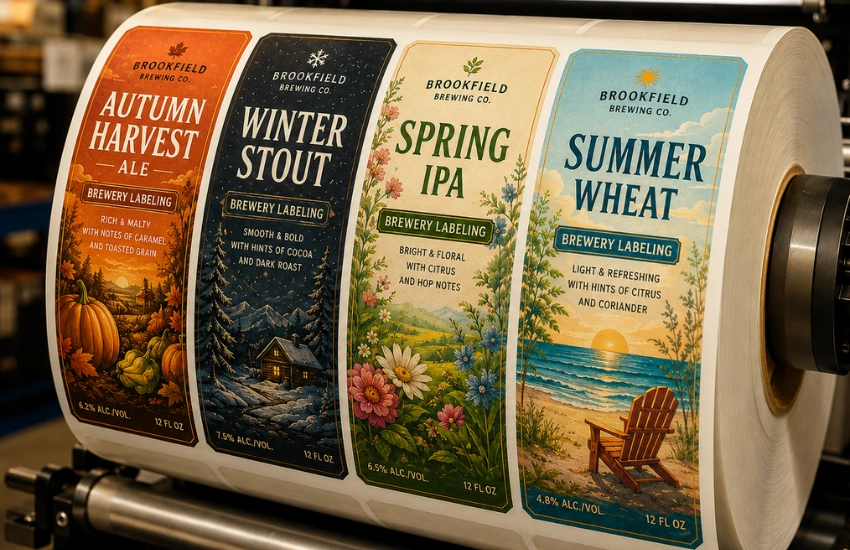
Seasonal beer label printing and limited-edition runs are where in-house brewery labeling delivers the clearest, most defensible value — even before the full cost comparison is settled.

Brewery Labeling

Short runs without minimums

A 24-case pilot release does not need 5,000 labels. In-house printing produces on-demand beer labels in the exact quantity a small batch requires, eliminating the choice between overordering and skipping the release. For taproom exclusives and collaboration beers, that distinction can determine whether a limited release happens at all.

Faster proofing and artwork iteration

When the press is in the building, a design change is a file revision — not a new purchase order. That shortens the loop between approving artwork and producing finished rolls. A late label change that would cost weeks and fees with a converter becomes a same-day correction in an in-house workflow.

Variable data and one-off runs

Digital workflows make it straightforward to swap text, ABV, lot information, or artwork between runs within the same job. That is particularly useful for collaborations, taproom exclusives, and rotating seasonal beer labels where each SKU needs distinct copy but shares a base design structure.

Speed to market on seasonal windows

Seasonal release windows are unforgiving. Bringing label turnaround from weeks of vendor lead time to in-house, on-demand production can be the difference between launching a seasonal on schedule and watching the window close. That timing advantage compounds across every release in a year.

The ArrowJet Aqua 330R for Craft-Scale Brewery Label Printing

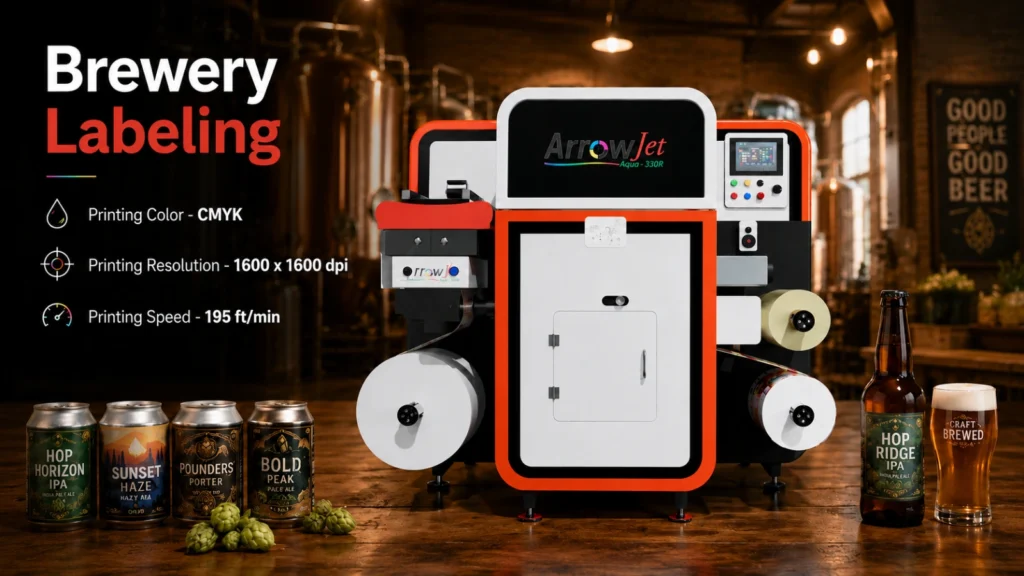
The ArrowJet Aqua 330R is designed for the reality of high-mix, short-to-mid-run production — matching how craft breweries actually batch and release beer rather than how long-run, single-design converters operate.

On-demand short and mid runs

The ArrowJet Aqua 330R prints to exact run quantities with no plates, no long setups, and no minimums. As a beer label printing machine designed for high-mix operations, it matches the reality of craft brewery production — where a core brand, a seasonal release, and a collaboration might all run in the same week at very different quantities, and where over-ordering to meet a converter’s MOQ creates predictable waste.

Multi-SKU flexibility without setup penalties

Moving between core brands, seasonal labels, and limited releases is a job changeover — not a new plate order. The ArrowJet Aqua 330R handles the full mix of a busy craft brewery’s SKU calendar without the per-design setup costs that make high-mix production expensive on conventional print equipment.

Water-based inkjet output for beverage label applications

The ArrowJet Aqua 330R uses water-based pigment inks suited to beverage label applications when paired with appropriate substrates and lamination. For beer labels specifically, substrate and finish selection matter: pressure-sensitive films and papers behave differently in cold storage, condensation environments, and ice baths. The right combination of substrate, ink, and protective laminate is part of getting durable, shelf-ready labels — and should be validated for your specific packaging formats before committing to a production setup. For broader context on managing in-house label production as a workflow, Arrow Systems maintains a dedicated resource on the topic.

Can, bottle, crowler, and variety-pack formats

The press handles the full range of formats a craft brewery applies labels to — standard can wraps, bottle labels, crowler labels, and variety-pack components. Can label printing in-house gives production teams control over run timing and quantities without depending on a converter’s schedule. Because there are no dies to order per shape, switching between label dimensions requires only a file change and a substrate changeover, not an additional tooling cost per format.

The ArrowJet Aqua 330R Hybrid Pro M for Higher-Throughput Label Volume

As a brewery grows into regional distribution and label volume increases, the ArrowJet Aqua 330R Hybrid Pro M provides higher throughput and inline finishing options while retaining the on-demand flexibility that justified going in-house.

Higher print speeds for growing label volume

The ArrowJet Aqua 330R Hybrid Pro M runs at speeds up to 195 ft/min — delivering meaningfully higher throughput than entry configurations when core brand volume grows to the point where production scheduling is the constraint. Higher throughput lowers per-label cost on consistent, high-frequency core brand runs while the press retains the same digital, no-plate flexibility for seasonal and short-run SKUs.

Inline priming, varnishing, and NIR drying options

The Hybrid Pro M supports inline primer and varnish stations with an integrated NIR dryer module — enabling coating steps to happen in the same pass as printing rather than as a separate offline operation. For breweries producing labels that require a protective topcoat for cold-storage or condensation durability, inline coating can improve throughput and reduce handling between press and finishing.

Broad substrate support for full brewery portfolio

The Hybrid Pro M supports coated paper, PP, PET, PVC, BOPP, Mylar, Tyvek, and other materials — covering the substrate range a brewery’s full portfolio may require across can labels, bottle labels, and specialty packaging formats. The 12.75-inch (324 mm) maximum print width accommodates standard label sizes across the brewery packaging formats.

Retains short-run flexibility at higher volume

The goal in scaling is not to trade flexibility for throughput. The Hybrid Pro M retains the digital, no-plate production model that makes in-house printing economical for high-mix operations — so seasonal releases, collaboration labels, and small-batch taproom SKUs remain cost-effective to produce on the same press that handles core brand volume at higher speeds.

Arrow Label Finishers: Completing the In-House Workflow

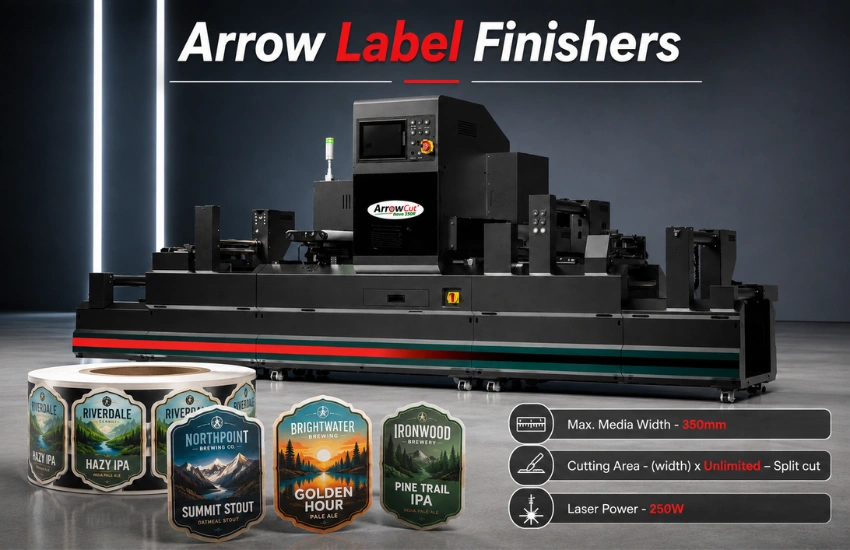
Printing is half the workflow — finishing turns printed rolls into production-ready labels. Arrow’s blade die cutters and laser finishers handle die-cutting, lamination, slitting, and rewinding so the in-house workflow is complete without returning to an outside vendor.

Brewery Labeling

Why finishing belongs in the in-house conversation

A brewery that prints in-house but sends rolls to an outside finisher for die-cutting, lamination, and slitting inherits much of the lead time and minimum-order structure it was trying to escape. Bringing finishing in-house is what completes the cost and turnaround case — and what produces finished rolls in the orientation, shape, and core size the labeling applicator requires, without external dependency at the final step.

Arrow EZCut 330R+ — flatbed and roll-to-roll blade die cutting

The Arrow EZCut 330R+ is a flatbed and roll-to-roll hybrid blade die cutter with a maximum cutting width of 350 mm, cutting accuracy of ±0.1 mm, and a maximum speed of 150 cuts per minute. It supports self-adhesive, PP synthetic, PET, PVC, aluminum plastic film, and flexible materials — covering the substrate range printed on the ArrowJet Aqua 330R and Hybrid Pro M. Cold lamination is available inline. Best suited for operations that need to switch between roll-fed label production and flatbed specialty jobs in the same workflow.

Arrow EZCut 350R — higher-throughput multi-blade roll-to-roll cutting

The Arrow EZCut 350R is a dedicated roll-to-roll multi-blade cutter with up to 6 cutting heads, a cutting speed of 9 m/min, slitting speed up to 100 m/min, and die-cutting precision of ±0.1 mm across a maximum label width of 330 mm. Where the EZCut 330R+ suits mixed roll-and-flatbed operations, the 350R is built for higher-throughput consistent label shapes at volume — the right choice for breweries running core SKUs at scale rather than one-off specialty formats. Inline sheeting and barcode-triggered automatic job changeover support multi-SKU production runs.

ArrowCut Nova 330R — CO₂ laser finishing for custom shapes

The ArrowCut Nova 330R is a laser label finisher with a 150W CO₂ laser that cuts without physical dies — enabling custom shapes, perforations, kiss cuts, and etching at up to 10,000 labels per hour across a 13.7-inch web. Laser finishing is particularly well-suited for short-run brewery labels with unique shapes — seasonal crowler wraps, collaboration formats, and variety-pack components — where the tooling cost of a blade die cannot be amortized across a short print run.

ArrowCut Nova 250R — compact laser finisher for shorter webs

The ArrowCut Nova 250R offers the same die-free laser cutting capability in a more compact footprint, with a 125W CO₂ laser supporting kiss cuts, full cuts, perforations, and etching. It suits craft-scale operations that need laser finishing flexibility without the throughput requirements of the 330R model — a natural complement to the ArrowJet Aqua 330R in a smaller in-house production line.

Slitting and rewinding for applicator-ready rolls

Finished rolls must be delivered in the orientation and core size the labeling applicator requires. Arrow’s finishing systems handle slitting and rewinding as part of the same in-house workflow — producing rolls that go directly from the finisher to the labeling line without an additional conversion step or outside vendor touchpoint.

Frequently Asked Questions — In-House Brewery Label Printing

Common questions from craft brewery operations, production, and packaging decision-makers evaluating in-house digital label printing against outside converters.

There is no single volume threshold — the decision is driven as much by SKU mix as by total output. A brewery with high volume on a few stable, rarely-changed designs may do well with a converter. A brewery with many active SKUs, frequent revisions, and regular seasonal releases often reaches favorable economics at more modest total volumes, because in-house printing eliminates per-design setup fees and MOQ-driven overordering. The more the operation looks high-mix and change-heavy, the sooner in-house tends to pay off.

They can, but durability depends on the full system of substrate, ink, and finishing — not the printer alone. Beverage applications typically call for film substrates (BOPP or PE) and a protective laminate to handle moisture, ice baths, and cooler environments. The right combination should be specified for your specific cans, bottles, and crowlers and validated under your actual handling conditions before committing to a production setup. Arrow Systems offers the ability to try free label samples — a useful first step before specifying a full substrate and finishing configuration for your packaging line.
Effectively, yes. Digital on-demand printing has no plates or long setups to amortize, so you can print the quantity a run requires — whether that is 200 labels for a taproom exclusive or several thousand for a core brand. That removes MOQ-driven overordering and the obsolete label inventory it creates after a recipe, branding, or ABV language change.

The biggest gain is removing the external converter queue. Instead of waiting on lead time plus shipping for each reorder or revision, labels are produced on your own schedule — often within the same production window. Many breweries report compressing turnaround from weeks to days for short runs. Actual timing depends on your workflow, artwork readiness, and finishing setup.

TTB (Alcohol and Tobacco Tax and Trade Bureau) requires approved COLA (Certificate of Label Approval) for most beers sold in interstate commerce. Label content — including ABV, net contents, government warning statement, and producer name and address — must match the approved COLA exactly. In-house printing makes it faster to correct a label when TTB approval requires a text change, since there are no converter setup fees or MOQs on a revision. TTB label compliance is the brewery’s responsibility; Arrow Systems sells label printing hardware and does not provide regulatory advisory services. Consult your TTB-registered importer/brewer record or legal counsel for compliance specifics.

Get a Brewery Labeling Assessment from Arrow Systems

Whether in-house brewery labeling is right for your operation depends on the specifics: SKU mix, run sizes, revision frequency, packaging formats across cans, bottles, and crowlers, and how much external MOQs and lead times are currently costing you. The honest answer for some breweries is to keep long, stable runs with a converter while bringing seasonals, limited releases, and high-mix work in-house.

Arrow Systems can help map that picture before you invest. A structured assessment reviews your actual production volumes, SKU diversity, TTB labeling requirements, and turnaround pressures — then identifies whether a configuration built around the ArrowJet Aqua 330R, ArrowJet Aqua 330R Hybrid Pro M, or Arrow finishing systems fits your operation, or whether you are better served as you are.

Leave a Comment

Your email address will not be published. Required fields are marked *