FDA Supplement Label Requirements: 2026 Compliance Checklist
Table of Contents FDA Supplement Label Requirements: 2026 Compliance Checklist Every dietary supplement sold in the U.S. must satisfy nine mandatory elements under 21 CFR
Automated label compliance for food production is the practice of embedding rules-based regulatory checks — allergen cross-referencing, Nutrition Facts panel generation, regulatory text validation, and version control — directly into the label creation and approval workflow, so that errors are caught before a label reaches the press rather than after it reaches a consumer.
It is the operational difference between a compliance system and a compliance hope. For food producers managing 20 or more active SKUs with allergen complexity or multi-retailer requirements, automation is how label accuracy scales without proportionally scaling headcount.

FDA label compliance is not an administrative nicety for food producers — it is the control point that separates a regulatory clean audit from a Class I recall. Undeclared allergens, incorrectly formatted Nutrition Facts panels, missing weight statements, and outdated regulatory text all create liability exposure capable of shutting down a product line and damaging retailer relationships for years.
The stakes are documented. According to FDA annual recall data, undeclared allergens consistently rank among the leading causes of Class I food recalls — events defined by the FDA as those where there is a reasonable probability of serious adverse health consequences. Operations running 50 or more active SKUs with purely manual review processes experience label error rates two to three times higher than those using automated validation.
Most food producers already know the rules. The gap is not knowledge — it is enforcement. When compliance depends on manual artwork reviews, emailed approvals, and label files distributed across vendor portals and shared drives, mistakes accumulate as SKU complexity grows.
Food labeling automation closes that gap by embedding regulatory checks directly into the label creation and approval workflow — so that errors are caught before a label reaches the press, not after it reaches a consumer.
Manual label compliance fails at scale because human review processes scale linearly with SKU count while error probability scales exponentially — and the regulatory consequences of a single missed allergen declaration are severe.
The core problem is not inattention. The problem is that manual processes scale linearly with SKU count, while error probability scales exponentially.
Food labeling automation replaces manual transcription, version management, and propagation steps with rules-based systems that check compliance automatically before artwork reaches prepress — without removing human judgement from final approval.
Database-driven panel generation ensures every SKU meets fda nutrition label requirements under 21 CFR Part 101.9 — correct rounding, updated Daily Values, and accurate serving size declarations — without manual re-entry. Automated systems generate panels directly from a validated ingredient and formula database. When a formula changes, the panel updates automatically. The transcription risk that produces the majority of FDA nutrition facts requirements warning letters is eliminated at source.
Automated rule engines cross-reference your ingredient database against current fda allergen labeling requirements under FALCPA and the FASTER Act — covering all nine mandated allergens including sesame — flagging any label missing a required declaration before artwork approval. For shared-line operations, the system enforces “may contain” statements based on live production scheduling data rather than manual checklists.
When a regulatory requirement changes, automated systems identify every affected SKU and flag those labels for update — converting a months-long manual audit into a same-day triage. This is the documented, systematic response that FDA inspectors look for as evidence of a functioning preventive control programme under the Food Safety Modernization Act (FSMA).
Automated prepress workflows enforce version control: locked compliance zones on artwork files, mandatory sign-off gates, and full audit trails showing who approved which label version and when. This layer prevents an outdated file from reaching the press during a retailer rebrand, formula reformulation, or regulatory update cycle.
When producing for multiple retailers or shipping to markets with different labeling rules, automation generates and tracks each label variant from a single validated source. One dataset drives every customer-specific version — preventing the silent file divergence that manual per-account management produces over time.
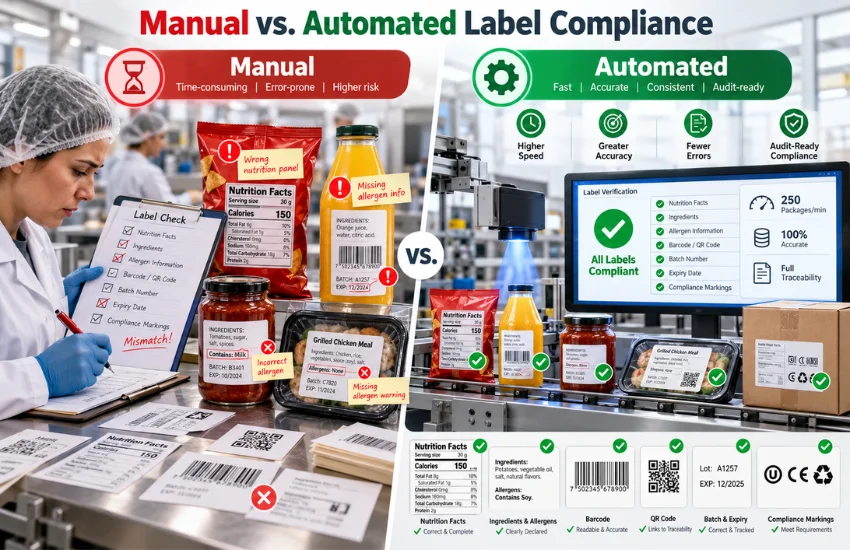
The operational difference between manual and automated FDA label compliance is not just speed — it is the systematic elimination of the error categories that produce FDA warning letters and Class I recall events.
Capability | Manual compliance | Automated compliance |
Allergen cross-referencing across SKUs | Manual checklist — error rate increases with SKU count | Automated database cross-reference — flags missing declarations before artwork release |
Nutrition Facts panel generation | Hand-typed per SKU — transcription errors at formula change | Database-generated — correct rounding, DV, serving size, no re-entry |
Regulatory change propagation | Batch correction projects — slow, incomplete, no audit trail | Same-day SKU flagging — full audit trail of what was updated and when |
Label variant management (multi-retailer) | Separate files per customer — diverge silently over time | Single source of truth — all variants generated from validated dataset |
Audit trail for FDA inspection | Email threads, folder structures — difficult to reconstruct | System-generated approval log — who approved what content and when |
Scale with growing SKU catalog | Headcount scales linearly with SKU count | Process scales without proportional headcount increase |
Compliance automation and digital label printing each address different parts of the label accuracy problem. The combination delivers the strongest risk reduction: fewer errors entering the system, and faster recovery when changes are needed.
CAPABILITY | AUTOMATION ALONE | DIGITAL PRINTING ALONE | BOTH TOGETHER |
Catch compliance errors before press | ✓ | ✗ | ✓ |
Reduce reprint lead time after correction | ✗ | ✓ | ✓ |
Eliminate obsolete label inventory | ✗ | Partially | ✓ |
Propagate regulatory changes across catalog | ✓ | ✗ | ✓ |
Short-run variant production | ✗ | ✓ | ✓ |
Audit-ready version history | ✓ | ✗ | ✓ |
Digital printing alone reduces overrun inventory but does not prevent printing compliance-deficient files. Without automated validation upstream, a technically current label can still carry incorrect allergen declarations or outdated Daily Values.
When compliance-validated label files connect directly to a food production label printing workflow — as Arrow Systems ArrowJet platform is built to support — the result is a closed loop from ingredient database to press, with no manual re-entry points where transcription errors can enter.

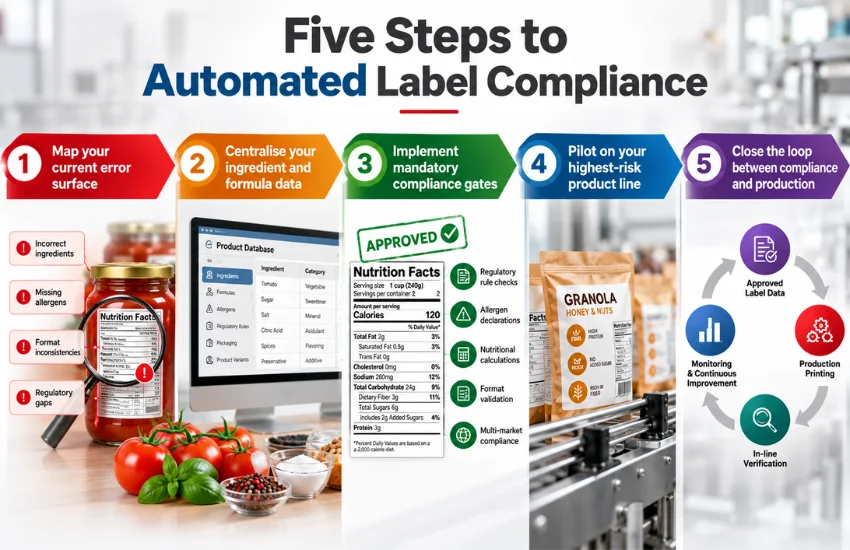
Implementing automated food label compliance follows five sequential steps: auditing current error exposure, centralising ingredient data, installing compliance gates, piloting on the highest-risk product line, and connecting validated files directly to the print workflow.
Audit the past 12 months: how many label corrections were needed, what triggered them, and what each correction cost in time, reprint expense, and production delay. This audit establishes a pre-automation baseline and typically reveals near-miss events that teams had treated as one-off problems rather than systematic risk signals.
Automated compliance requires a single, validated source of truth for ingredients, formulas, allergen classifications, and nutritional values. If this data lives in spreadsheets, vendor COAs, and email threads, consolidation comes first — no automation layer performs reliably on fragmented inputs.
Before any label file goes to press, automated checks should confirm that allergen declarations match current ingredient records, FDA nutrition facts requirements panels are database-generated, required regulatory text is version-correct, and artwork matches the latest approved content. Gates run in seconds and produce the audit trail that supports both internal QA and FDA inspection readiness.
Select the line with the most SKUs, the most frequent formula changes, or the most complex allergen profile. Run the automated workflow for 8 to 12 weeks alongside your existing process, comparing error catch rate, revision speed, and label accuracy against the Step 1 baseline.
Arrow Systems’ ArrowJet digital label printers are purpose-built for the short-run, version-controlled workflow that compliance automation demands — supporting rapid reprints after corrections without minimum run commitments or plate costs.
Connect validated label files to your print workflow — digital, conventional, or hybrid. The goal is a fully closed loop: database-generated compliance content flows directly to production without manual re-entry at any stage. Arrow Systems can advise on integration pathways for your existing ERP and label management setup.
Automated label compliance means embedding rules-based checks — allergen cross-referencing, Nutrition Facts panel generation, regulatory text validation, and version control — directly into the label creation workflow so that errors are caught before printing, not after distribution. For a food producer, it means your FALCPA allergen declarations, 21 CFR Nutrition Facts requirements, and retailer-specific label variants are all validated against a live ingredient database before any artwork file goes to press. The result is a repeatable, auditable process that scales with SKU count without requiring proportionally more headcount. When a formula changes, the panel updates automatically. When a new allergen is added to the FASTER Act list, every affected SKU is flagged the same day — not weeks later during a manual review cycle.
No — automation handles the systematic, data-driven checks where human review is most error-prone, not the expert judgement your quality team provides. Cross-referencing ingredient lists against allergen databases, confirming rounding rules on Nutrition Facts panels, and verifying regulatory text version accuracy are all mechanical tasks well-suited to automation. Your quality team shifts from manual transcription verification to exception review and final approval — a higher-value role that applies their regulatory expertise where it matters.
No. Any food operation running 20 or more active SKUs with allergen complexity, formula variability, or multi-retailer version requirements benefits. A 30-SKU co-packer managing three retailer versions per product faces exactly the label complexity that manual systems handle worst. The infrastructure investment is proportional to scale — a validated ingredient database and automated compliance gates do not require enterprise-level IT to implement.
FSMA — the Food Safety Modernization Act — focuses on preventive controls, but accurate labeling, particularly allergen declarations, is a core compliance requirement that sits alongside FSMA preventive control obligations. According to FDA annual recall data, undeclared allergens rank among the leading causes of Class I food recalls. Automated compliance creates the documented, systematic controls that FDA inspectors look for as evidence of a functioning preventive control programme. Critically, FSMA labeling requirements for label accuracy extend directly to allergen declarations — a gap in your label approval workflow is a gap in your preventive control record.
Yes. Automated compliance is a workflow layer, not a print technology requirement. It integrates with digital, flexo, or hybrid production setups. Where it creates the most operational value in combination with print technology is in short-run environments — when a correction or new variant is needed, a compliant file can go to press the same day rather than waiting on a minimum run or plate remake.
Teams typically see measurable error reduction within one quarter of pilot deployment, with the largest gains in allergen declaration accuracy and Nutrition Facts panel correctness. The error surface audit from Step 1 provides a pre-pilot baseline — most operations are surprised by how many near-miss events their current process contains when label correction events are tracked and categorised rather than resolved and forgotten.
US food labels must declare nine major food allergens: milk, eggs, fish, shellfish, tree nuts, peanuts, wheat, soybeans, and sesame. The first eight were mandated by FALCPA (the Food Allergen Labeling and Consumer Protection Act of 2004). Sesame was added as the ninth mandatory allergen under the FASTER Act, effective January 1, 2023. Each allergen must be declared in plain language — either in the ingredient list or in a separate “Contains” statement. Cross-contact allergens from shared production lines may require additional “may contain” disclosures.
FDA food labeling violations can result in warning letters, mandatory product recalls, import alerts, injunctions, and in serious cases, criminal prosecution. Undeclared allergens typically trigger a Class I recall — reserved for situations with a reasonable probability of serious adverse health consequences or death. Class I recalls require public notification and removal of all affected product from commerce. Beyond regulatory action, a labeling recall creates direct costs from product retrieval, destruction, and production downtime, plus reputational damage with retailers and consumers.
A food label is FDA compliant when it accurately declares all required allergens, contains a correctly formatted Nutrition Facts panel meeting 21 CFR Part 101.9 specifications, carries all mandatory regulatory text, and reflects the current formulation of the product. The challenge is not knowing the rules — it is verifying that every label in a multi-SKU catalog meets them simultaneously. Automated compliance systems verify these conditions programmatically before each print run, creating a documented audit trail. Manual review processes can verify compliance at a point in time, but cannot systematically prevent drift as formulas change, regulatory requirements update, and retailer versions multiply.
If your food operation is managing growing SKU complexity, allergen risk, and regulatory pressure with manual processes, Arrow Systems can help you design an automated fda label compliance workflow that catches errors before they reach the press.
What you get in a no-cost compliance workflow review:
Delivered as a written report within 5 business days. No commitment required.

Table of Contents FDA Supplement Label Requirements: 2026 Compliance Checklist Every dietary supplement sold in the U.S. must satisfy nine mandatory elements under 21 CFR

Table of Contents Chocolate Packaging Printer: How Digital Printing Enables Short Runs and Custom SKUs Digital chocolate packaging printing removes flexo minimums — enabling 50–500

Table of Contents Pet Food Packaging Printer: Why In-House Digital Wins In-house digital printing gives pet food operations direct control over flexible pouches, flat-bottom bags,

Table of Contents Supplement Label Printing: FDA Rules, Materials & In-House Options Supplement labels must satisfy eight FDA-mandated elements, use substrates matched to package format,

Table of Contents Arrow Systems Inc. to Showcase ArrowJet Eco 330R at Warsaw Pack 2026 Global Packaging Industry Meets Innovation: ArrowJet’s Eco 330R Takes Centre

Table of Contents Batch Coding Best Practices for Craft Breweries A practical guide to batch traceability, label quality, and food manufacturing traceability compliance — from