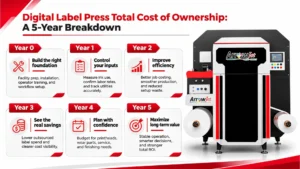
Digital Label Press Total Cost of Ownership: A 5-Year Breakdown
Table of Contents Digital Label Press Total Cost of Ownership: A 5-Year Breakdown Digital label press total cost of ownership is the five-year cost to
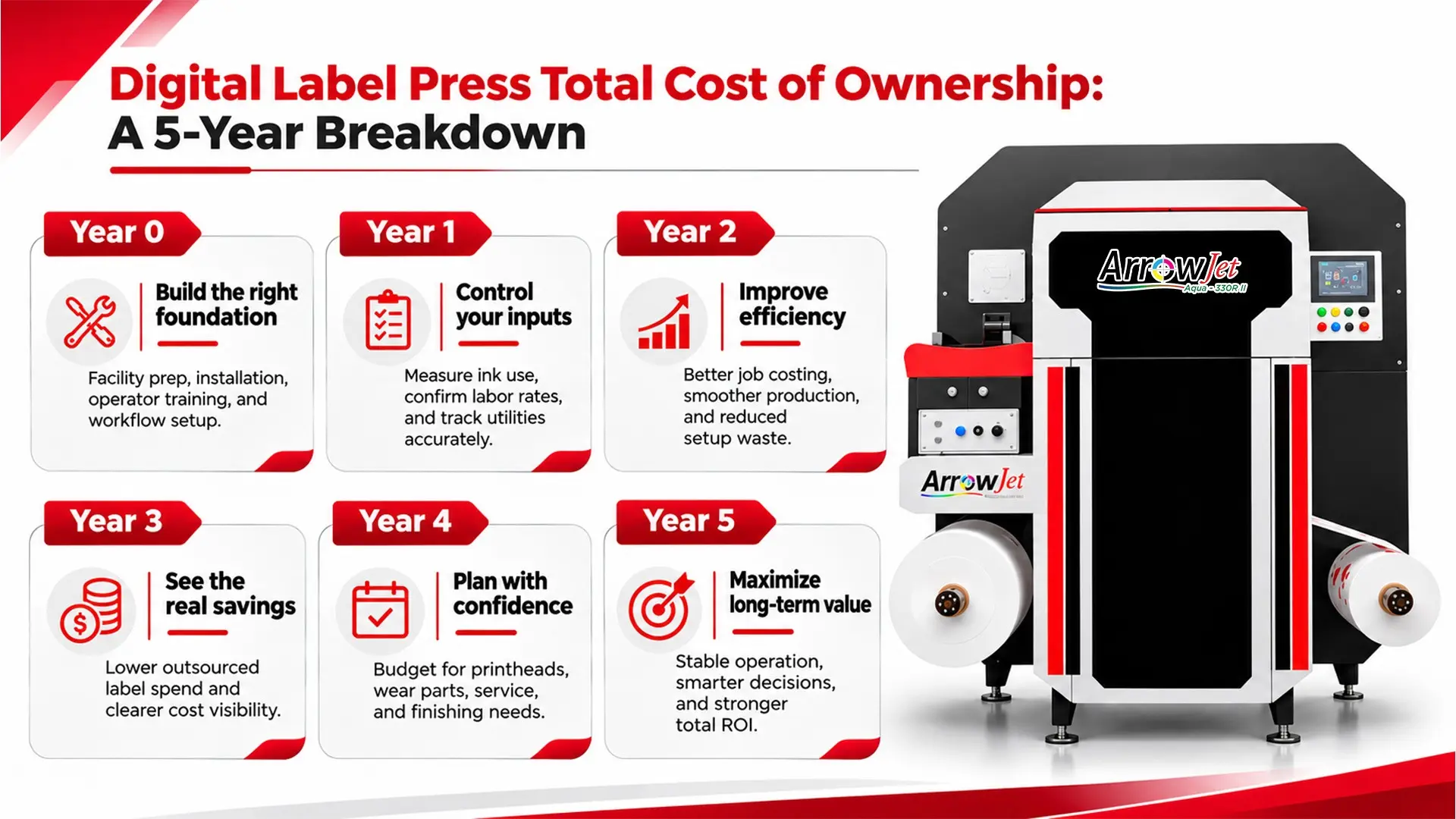
Digital label press total cost of ownership is the five-year cost to buy and run a press, and recurring costs often outweigh the purchase price.
Capital is paid once, but ink, printheads, service, and labor accrue for 60 months, so operating cost usually decides five-year TCO.
Most press quotes lead with two numbers: the purchase price and a per-milliliter ink cost. Neither number tells you what the press will cost to run. A lower-priced press with costlier consumables or higher service exposure can end up more expensive by Year 3. Treat the press as an operating system whose inputs shift with your job mix, facility, and staffing.
Facility preparation
Electrical work, dedicated circuits, flooring, and ventilation needed before the press can be installed at the planned location.
Installation and commissioning
Setup, calibration, and acceptance testing of the press and any finishing equipment by the vendor or a technician.
Operator training
Training sessions plus the hours staff spend away from their regular work while they learn the press, RIP, and maintenance routines.
Ramp-up waste
Substrate and ink consumed while color profiles, die lines, and workflows are dialed in during the first weeks of production.
Downtime risk
The scheduling cost when labels are not ready for a filling or packing run, including overtime and emergency outsourced labels.
This label press operating cost breakdown separates one-time Year 0 costs from costs that recur in every year of the model.
Cost category | Timing | Main cost driver |
Capital and installation | Mostly Year 0; financing recurs | Press and finishing price, financing terms, facility prep |
Ink | Recurring | Label volume, measured ink coverage, container size |
Printheads and wear parts | Recurring reserve | Duty cycle, idle purging, maintenance discipline |
Utilities | Year 0 upgrades plus recurring energy | Power phase, compressed air, temperature and humidity control |
Finishing consumables | Recurring | Number of label shapes, laminated footage, blade and laser upkeep |
Service and support | Recurring | Contract tier, response time, cost of an outage |
Labor and training | Year 0 training plus recurring hours | Press hours, prepress, changeovers, finishing, QC |
Ink cost per label equals cost per ml times ml per label at measured coverage; bulk ink lowers unit price but adds inventory risk.
Factor | Ink cartridges | Bulk ink containers |
Unit cost | Often a higher cost per milliliter | Typically a lower cost per milliliter |
Handling | Simple to swap and easy to track | Fewer replenishment events, larger containers to manage |
Waste risk | Partially used cartridges can be discarded or expire on the shelf | Aged ink can expire if volume is too low to use it in time |
Cash and storage | Smaller purchases and less shelf space | More cash tied up in inventory and disciplined shelf-life and storage control |
To compare bulk ink system cost fairly, factor in replenishment frequency, operator handling time, and any ink lost to expiration. Unit price alone does not show those costs.
Ink cost per label = ink cost per ml × ml consumed per label at your actual coverage
Illustrative only, using hypothetical inputs: if ink costs $X per liter, the per-ml cost is X ÷ 1,000. If a 3 × 4 in. label uses Y ml at your measured coverage, ink cost per label is (X ÷ 1,000) × Y. Multiply that figure by annual volume for each SKU group.
Many cost per label inkjet quotes are based on light coverage, closer to sparse text on a white label than to real production artwork. A full-color beverage or cosmetics label with flood backgrounds can consume far more ink than a text-heavy GHS chemical label or a nutraceutical supplement panel. Ask each vendor to test-print your own representative artwork and report the measured ink consumption per label.
Printhead and wear-part spend depends on duty cycle, idle purging, maintenance, and ink compatibility, so budget it as an annual reserve.
Printhead replacement cost is often the largest unplanned expense in inkjet running costs. Four factors drive how long a printhead lasts.
Duty cycle
Hours of printing per shift and per week. Expected head life should be quoted at your duty cycle, not a generic one.
Idle time and purging
Presses that sit idle may need more frequent purges, which consume ink and stress the nozzles.
Maintenance discipline
Consistent cleaning and capping routines extend head life; skipped routines shorten it.
Ink compatibility
Running only inks approved for the printheads protects the nozzles and any warranty coverage.
Wear items such as wipers, caps, filters, and rollers need their own budget line. Build an annual replacement reserve for printheads and wear parts, based on vendor guidance and your expected duty cycle.
Power phase, compressed air, and temperature and humidity control are facility costs to confirm before you sign the purchase order.
Single-phase vs. three-phase power
The single phase vs three phase power cost question is mostly about facility prep. If a press requires three-phase power and the planned location does not have it, upgrade costs can include new service, panels, and wiring runs. Have a licensed electrician or your facilities team confirm the requirements and quote the work, so the 3 phase vs single phase cost difference enters the Year 0 column as a real number.
Compressed air
If the press or its finishing equipment needs shop air, budget for the compressor, filtration and dryers, maintenance, electricity, floor space, and noise mitigation. Shared plant air may also need verification for capacity and air quality.
Temperature and humidity control
Ink behavior, drying, and substrate stability can shift with temperature and humidity. A press placed in an unconditioned warehouse corner may need an enclosure or HVAC work. Confirm the operating range with your vendor and compare it with your facility data.
Finishing consumables cost scales with job mix: die count, blade wear, laminated footage, and laser upkeep each need their own line.
Dies
Flexible dies usually cost less per shape than rotary dies but wear faster. High-SKU food or private-label programs with many label shapes can drive die spend quickly, so standardizing shapes keeps this line down.
Slitter blades
Replace slitter blades on a schedule tied to footage run and substrate abrasiveness.
Lamination
Chemical, cold-chain, and bath-product labels often need lamination for durability. Illustrative only: model lamination as $[film cost per linear foot] × [annual linear feet of laminated jobs].
Laser finishing
Laser finishers remove the need for dies but carry upkeep costs for optics cleaning, filtration, fume extraction, and filter replacement.
When you price finishing equipment alongside the press, compare die-based and die-free options from the range of label finishing systems against your actual number of label shapes and laminated jobs.
A service contract prices risk transfer, so compare its coverage and response time against what a multi-day outage would cost you.
Contract tiers
What each tier covers: parts, labor, and whether printheads are included.
Preventive maintenance visits
How many scheduled visits per year are included, and what each visit covers.
Remote diagnostic support
Whether remote support is available and during which hours.
Guaranteed on-site response time
The committed time for a technician to arrive after a service call is logged.
Travel charges
What non-contract service calls cost in travel and labor.
Then price the downtime itself. Estimate what a multi-day outage would cost in delayed shipments, overtime, or emergency outsourced labels. That figure tells you how much uptime protection is worth buying and helps you weigh label press maintenance cost against contract coverage.
In-house labor covers prepress, changeovers, finishing, and QC as well as press time, offset by hours spent managing outsourced labels.
Operator hours
Press time per shift, set by label volume and press speed.
Prepress and artwork handling
File preparation, proofing, and version control for every SKU and artwork revision.
Changeovers
Setup time between jobs. A high-SKU, short-run food program can spend more time on setup than on printing.
Finishing, rewinding, and QC inspection
Die cutting, slitting, rewinding to applicator specifications, and inspecting finished rolls.
Cross-training
Training backup operators so the press keeps running during vacations and turnover.
Then offset the hours you already spend managing outsourced labels: issuing purchase orders, chasing proofs, receiving and counting inventory, and writing off obsolete rolls. Labor cost for in-house labels is only half of the comparison. For the operational side of bringing printing in-house, see Arrow’s guide to in-house label production.
Model every cost category from Year 0 to Year 5, record the source of each figure, and run low and high cases on sensitive rows.
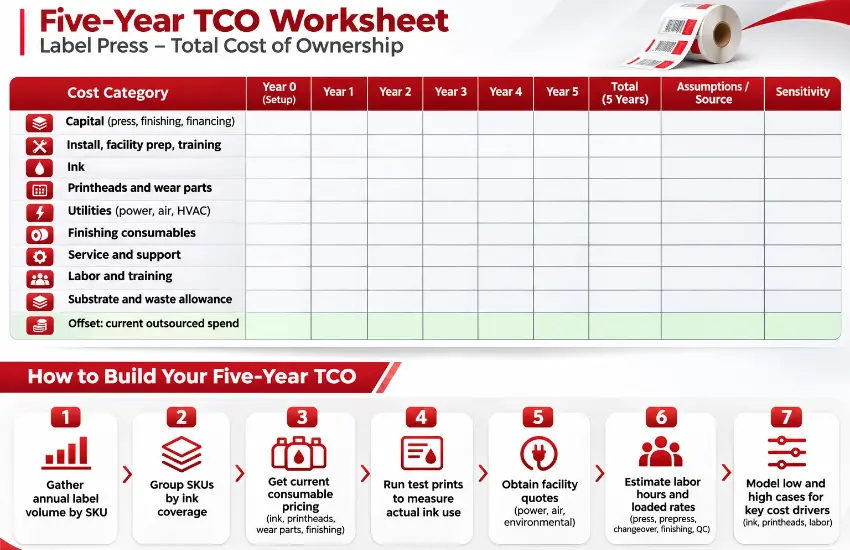
Use this five-year label press TCO worksheet template. Replace each bracketed placeholder with a sourced figure.
Cost Category | Year 0 | Year 1 | Year 2 | Year 3 | Year 4 | Year 5 | Total | Assumptions / Source | Sensitivity |
Capital (press, finishing, financing) | [$] | [$] | [$] | [$] | [$] | [$] | [$] | [Quote #, terms] | [H/M/L] |
Install, facility prep, training | [$] | — | — | — | — | — | [$] | [Electrician quote] | [H/M/L] |
Ink | [$] | [$] | [$] | [$] | [$] | [$] | [$] | [Measured ml/label] | [H/M/L] |
Printheads and wear parts | — | [$] | [$] | [$] | [$] | [$] | [$] | [Vendor guidance] | [H/M/L] |
Utilities (power, air, HVAC) | [$] | [$] | [$] | [$] | [$] | [$] | [$] | [Facility data] | [H/M/L] |
Finishing consumables | [$] | [$] | [$] | [$] | [$] | [$] | [$] | [Job mix] | [H/M/L] |
Service and support | — | [$] | [$] | [$] | [$] | [$] | [$] | [Contract tier] | [H/M/L] |
Labor and training | [$] | [$] | [$] | [$] | [$] | [$] | [$] | [Hours × loaded rate] | [H/M/L] |
Substrate and waste allowance | [$] | [$] | [$] | [$] | [$] | [$] | [$] | [Waste %] | [H/M/L] |
Offset: current outsourced spend | — | [($)] | [($)] | [($)] | [($)] | [($)] | [($)] | [12-month AP data] | [H/M/L] |
Step 1: Pull 12 months of label volume by SKU
Include label size and substrate for each SKU so ink, substrate, and finishing lines can be calculated per label.
Step 2: Segment SKUs into high-, medium-, and low-coverage groups
Coverage drives ink consumption, so each group gets its own ink cost per label rather than one portfolio average.
Step 3: Request consumable price sheets
Ask each vendor for current pricing on ink by container size, printheads, wear parts, and finishing supplies.
Step 4: Run test prints of representative artwork
Measure actual ink consumption per label for each coverage group instead of relying on light-coverage vendor estimates.
Step 5: Get facility quotes for power, air, and environmental control
Have an electrician and your facilities team quote any upgrades the press and finishing equipment require.
Step 6: Estimate labor hours per task and apply fully loaded rates
Cover press time, prepress, changeovers, finishing, and QC, then subtract the hours now spent managing outsourced labels.
Step 7: Flag high-sensitivity rows and model low and high cases
Ink, printheads, and labor usually move the total most, so run each flagged row at a low and a high estimate before deciding.
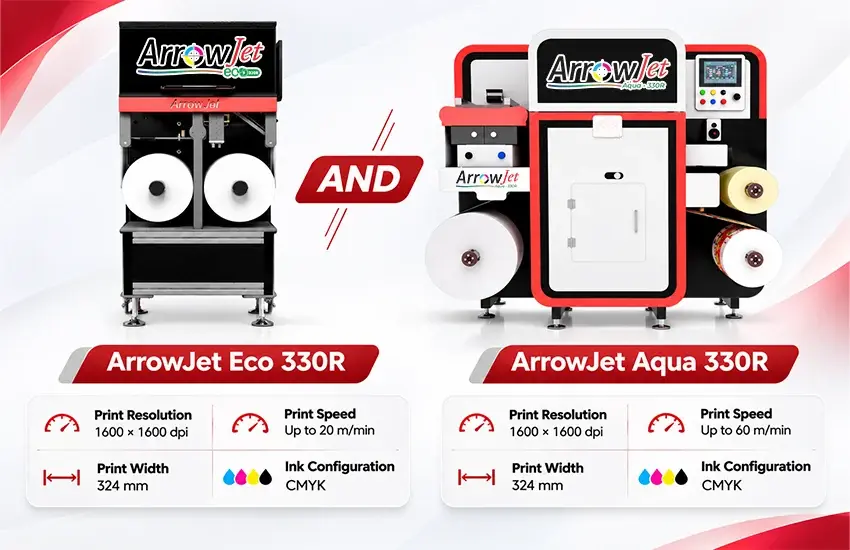
The Eco 330R removes three-phase and compressor lines; the Aqua 330R adds a 2L or 10L ink tank choice and keeps power and air lines.
The ArrowJet Eco 330R and ArrowJet Aqua 330R are digital label printers from Arrow Systems. Both run on the Memjet DuraFlex print engine. This section shows what to model for each press, not which press to choose.
TCO input | ArrowJet Eco 330R | ArrowJet Aqua 330R | Worksheet row affected |
Power requirement | Single-phase 230V | Three-phase 220V / 400V | Install, facility prep; Utilities |
Compressed air | No air compressor required | 6-bar air source required | Utilities; Capital |
Ink supply | CMYK water-based pigment ink | 2L or 10L CMYK tank options | Ink; Labor and handling |
Drying | IR dryer optional | NIR drying option for higher speeds | Utilities; Capital |
Print speed | Up to 20 m/min (about 66 ft/min) | 90, 150, or 195 ft/min | Labor and training |
Max print width | 324 mm | 324 mm | Ink; Substrate and waste |
Install and facility prep
The ArrowJet Eco 330R runs on single-phase 230V power. Remove three-phase upgrade lines if single-phase service is available at the planned location, and have an electrician confirm circuit requirements.
Utilities
The Eco 330R does not require an air compressor. Remove compressor capex, air-treatment equipment, compressor energy, and air-system maintenance from the press line, but keep any air needs from separate finishing equipment.
Labor
Model press hours at a print speed of up to 20 m/min across a 324 mm print width when estimating operator time per job.
Ink
The ArrowJet Aqua 330R offers 2L or 10L CMYK ink tank options. Model the per-ml cost for each container size separately, using current pricing.
Labor and handling
The 10L tank means fewer replenishment events, which may reduce operator handling time. Weigh that against storage space, ink shelf life, and inventory carrying cost.
Utilities
The Aqua 330R runs on three-phase 220V / 400V power and needs a 6-bar compressed air supply. Keep the power-upgrade and compressed-air lines unless the planned location already provides both.
Environmental control
The Aqua 330R operating range is 68–86°F (20–30°C) at 30–50% relative humidity. Budget for HVAC or humidity control if the planned location falls outside that range.
To complete the model, ask Arrow Systems for current consumable pricing, service options, and printhead coverage for the press you are evaluating.
Common questions from operations, packaging, and finance teams building a five-year TCO model for an in-house digital label press.
Multiply ink cost per milliliter by the milliliters each label consumes at its actual coverage. Then add per-label shares of substrate, finishing consumables, printhead reserve, labor, and service. Calculate high-coverage and low-coverage SKU groups separately rather than using one average. Measured consumption from test prints of your own artwork is the most reliable input, because light-coverage vendor estimates can understate ink use on full-color designs.
Not always. Bulk containers often lower the unit cost per milliliter, but the savings depend on using the ink before it expires, and low-volume operations may discard aged ink. Bulk also raises upfront inventory cost and storage needs. Model annual ink consumption, container size, shelf life, and replenishment labor together. Bulk tends to make the most sense when volume is steady and storage conditions are controlled.
Yes, unless your warranty or service contract explicitly covers printheads. Head life depends on duty cycle, idle purging, maintenance discipline, and ink compatibility, so ask each vendor for expectations at your production profile. Build an annual replacement reserve into the worksheet rather than treating a head failure as a surprise. Also confirm whether head replacement requires a technician visit, which adds travel and downtime costs.
Compare the five-year in-house total against your full outsourced cost, not just invoice totals. Outsourced cost includes label purchases, freight, minimum-order overruns, obsolete inventory write-offs, rush fees, and internal hours spent on purchase orders, proofing, and receiving. In-house economics often improve with high SKU counts, frequent artwork changes, and short runs. The result depends heavily on your volume, ink coverage, and staffing model.
Before you finalize the model: measure ink at your coverage by SKU group, carry a printhead and wear-part reserve, confirm power, shop air, and environmental requirements, price downtime explicitly, and offset against your full outsourced spend.
Send Arrow Systems your annual label volume, typical label sizes, a few representative artwork files, your finishing needs, and facility details such as available power and shop air. Arrow will help you populate the model with current ArrowJet Eco 330R and ArrowJet Aqua 330R consumable, service, and utility inputs, including an ink-consumption test on your own artwork, so your business case starts from measured data.
Table of Contents Digital Label Press Total Cost of Ownership: A 5-Year Breakdown Digital label press total cost of ownership is the five-year cost to
Table of Contents Cannabis Label Smudging: Why Pre-Roll and Vape Labels Fail Cannabis label smudging on pre-roll tubes and vape carts has four causes: unprotected
Table of Contents Label Converter Finishing Capacity: Adding Blade and Laser Lines Label converter finishing capacity falls short from volume, job mix, or both. Diagnose
Table of Contents Confectionery Packaging Capacity Planning: Use Q4 Data for ROI Confectionery packaging capacity planning works best on cost data logged during Q4 peak,
Table of Contents Gold Foil Labels Digital Printing: Foil Effects Without Stamping Digital presses create gold foil label effects by printing on pre-metallized PET film
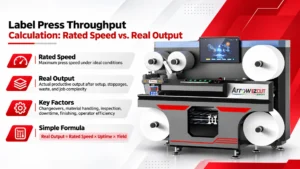
Table of Contents Label Press Throughput Calculation: Rated Speed vs. Real Output A label press throughput calculation turns rated speed into realistic labels per shift,