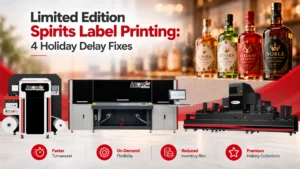
Limited Edition Spirits Label Printing: 4 Holiday Delay Fixes
Table of Contents Limited Edition Spirits Label Printing: 4 Holiday Delay Fixes Limited edition spirits label printing runs late because of the calendar, not the
Limited edition spirits label printing runs late because of the calendar, not the press: four sequential waits push labels past the bottling slot.
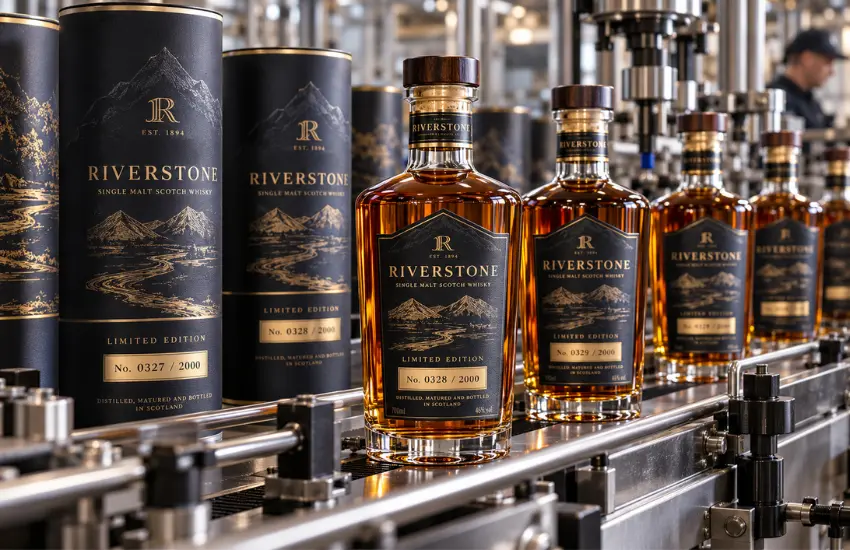
Holiday spirits releases run against fixed bottling, retail, and gift-packaging dates, and labels are usually the last variable item on that path.
This guide is for distillery and winery packaging, operations, and compliance leads planning a Q4 release. Holiday releases run against three dates the packaging team does not control.
Bottling or co-packer slot
Bottling and co-packer slots are booked months ahead and often have little room to move once confirmed.
Distributor and retailer holiday sets
Distributor and retailer holiday sets close on schedule, whether or not the seasonal SKU has arrived.
Gift-box and gift-tube deliveries
Gift boxes and gift tubes must match the final label dimensions and placement, so every label change has to be checked against secondary packaging.
Glass, closures, and liquid are committed early, while artwork is often the final creative decision. Gift season bottle labeling adds coordination with secondary packaging, which raises the stakes on every late label change.
Limited release bottle labels are especially exposed. Quantities are small, finishes are premium, creative approval comes late, and bottle shapes and neck labels are often unique to the release. Conventional converter workflows handle that combination more slowly than almost any other job type.
In an illustrative scenario, a craft distillery plans about 3,000 numbered cask-strength bottles. Artwork is final in late August, the mobile bottler is booked for mid-October, and gift tubes are on order. Six weeks later, everything is ready except the labels.
Four sequential waits push limited-edition labels past the bottling slot, and each one has its own timeline position and its own fix.
Wait | Typical symptom | Timeline position | Fix this season |
Outsourced proof loops | Approval drags on and the run date keeps moving | Directly after artwork release | One approver, one checklist, COLA questions settled before round one |
Minimum order quantity commitments | Ordering far more labels than bottles | At the very front of the schedule | Order to bottle count plus a defined overage |
Premium finishing queues | Printed labels waiting for embellishment | Between print and cut | Lock the embellishment spec before proofing |
Cutting dies ordered after artwork locks | Approved art waiting on die lead time | After approval, right before cutting | Fix dieline geometry early or remove the die |
Physical proof rounds add transit and review time, so a few days per round can grow into weeks before production can start.
Proofing delay symptom
Approval drags on. Each proof round brings a new comment, and the run date keeps moving.
Proofing delay root cause
Color and finish can only be judged on real stock. A PDF will not show how a deep burgundy prints on embossed or textured estate paper, or how ink sits on clear or metallic film. Proofs therefore ship physically, and a label proof approval delay of a few
days per round can grow into weeks across three rounds.
Proofing timeline position
Proofing sits directly after artwork release, before anything else can start. Every day lost in proofing pushes back every downstream step.
Proofing fix this season
TTB allowable revisions
TTB lists the changes permitted on an approved label without a new COLA on pages 3 and 4 of TTB Form 5100.31. According to TTB’s allowable revisions guidance, examples include changing label shape, background color, or font colors and adding a vintage date. Check the current form or ask your compliance advisor before late edits, so COLA timing does not surprise you in round three.
Plate-based minimum order quantities force overbuying on small releases and pull the artwork lock earlier than marketing needs.
MOQ symptom
The team orders far more labels than it has bottles, and the converter wants final art before the team is ready.
MOQ root cause
Plate-based converter workflows are built around minimum order quantities (MOQs). A release of a few hundred or a few thousand bottles often falls below those minimums, which forces overbuying. Securing a production slot also forces an early artwork lock.
MOQ timeline position
MOQ scheduling sits at the very front of the calendar. It pulls the art lock earlier and shrinks marketing’s creative window, and late changes still happen anyway.
MOQ fix this season
For short run spirits labels, the goal is to print what the release needs, not what a press minimum dictates.
White underprint, spot varnish, and foil-look accents can each add a pass or a handoff, and every finishing station has its own queue.
Premium finishing symptom
The labels are printed but sit waiting for embellishment.
Premium finishing root cause
Gift-season buyers expect strong shelf presence, which often means foil-look accents, white underprint on clear or metallic stock, and spot varnish. Each effect can require an extra pass or a handoff to another station. Premium spirits label finishing is where converter schedules quietly stretch.
Premium finishing timeline position
Embellishment sits between print and cut, often behind other customers’ jobs.
Premium finishing fix this season
Custom steel dies for shaped fronts and neck labels carry their own lead time, which often starts only after artwork is approved.
Cutting die symptom
Artwork is approved, and then the converter reports that the cutting die has its own lead time.
Cutting die root cause
Unique bottle shapes, shaped fronts, neck labels, closure strips, and numbered collector labels often need custom steel dies. Many teams do not order the die until artwork is locked, so die lead time runs after approval instead of alongside it.
Cutting die timeline position
Die lead time sits after approval and right before cutting, adding a separate wait to the critical path.
Cutting die fix this season
Plan backward from the bottling date; the in-house path wins because steps run in parallel, not because each step is dramatically faster.
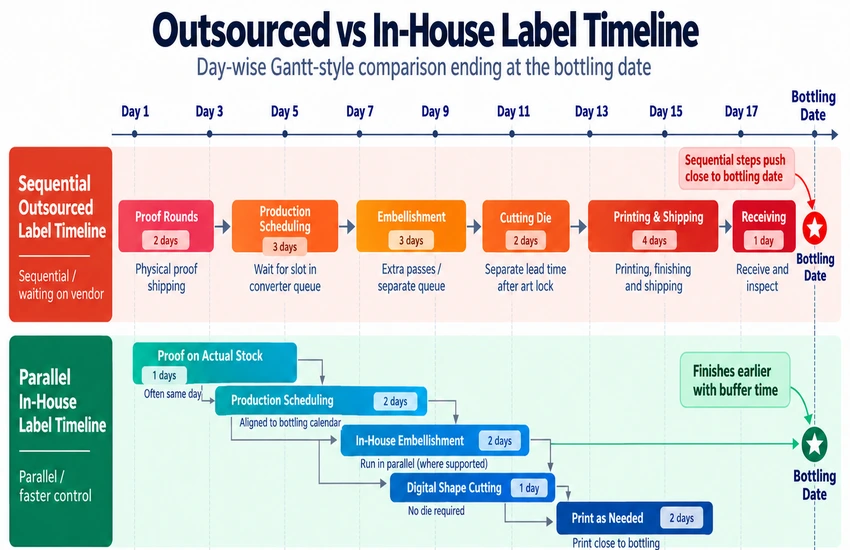
All durations below are illustrative ranges that vary by converter, substrate, and complexity. Use them to map your own calendar, not as benchmarks.
Step | Outsourced sequential path (illustrative) | In-house parallel path (illustrative) |
Proof rounds | Several business days each when proofs ship physically | Often hours to a day, printed on actual stock |
Production scheduling | Waits for a slot in the converter’s queue | Scheduled against your bottling calendar |
Embellishment | Extra passes, possibly in a separate queue | Handled in-house where equipment supports it |
Cutting die | Separate lead time after art lock | No die; shape cut from a digital file |
Overage and reprints | Re-enter the converter queue | Printed as needed close to bottling |
The in-house path does not win because each step is dramatically faster. It wins because the steps stop waiting on each other.
Bringing proofing, printing, and finishing in-house schedules label output against your bottling calendar instead of a converter’s queue.
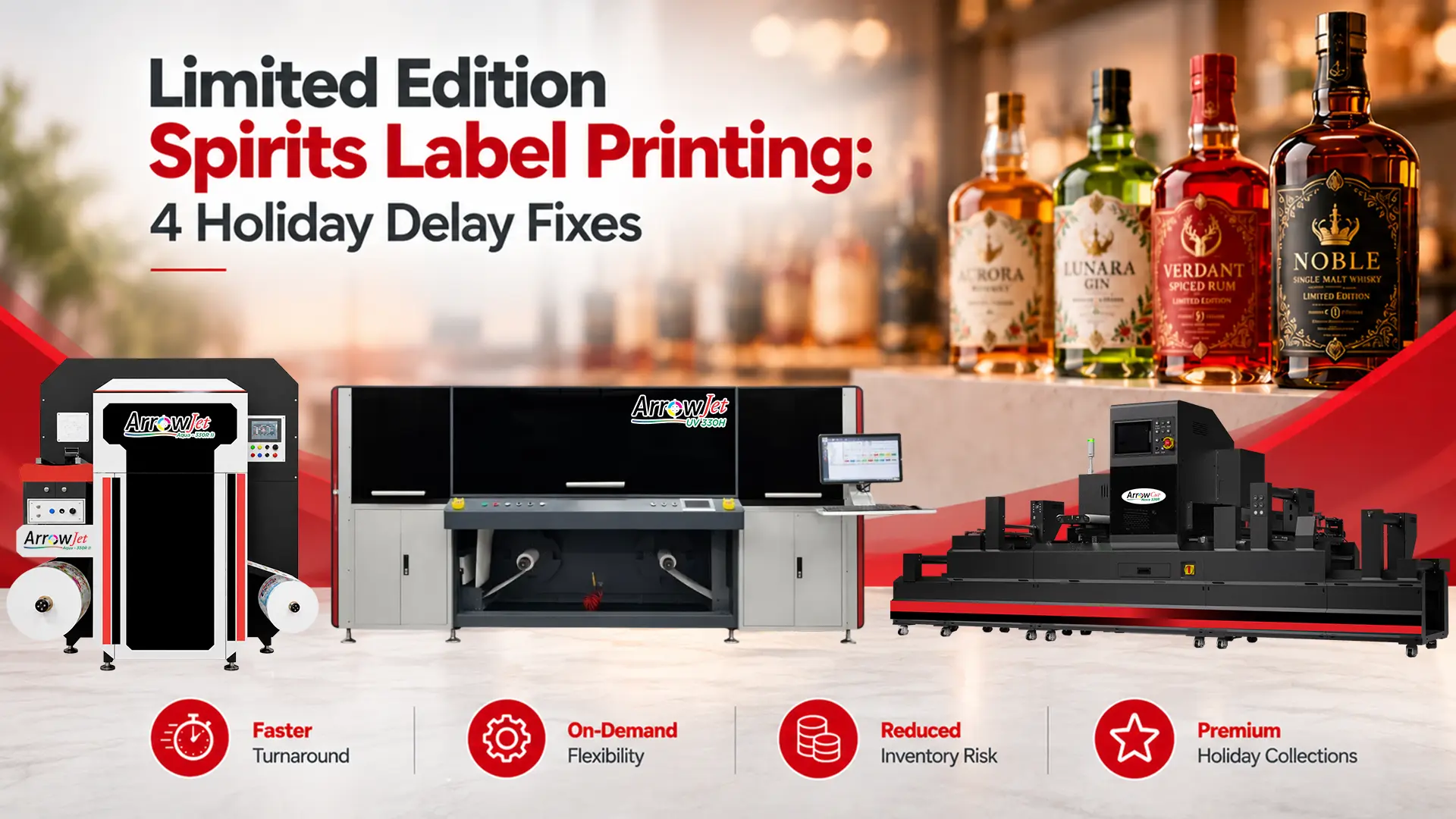
For small, high-value seasonal SKUs, moving proofing, printing, and finishing in-house changes who owns the calendar. Arrow Systems manufactures digital label printers and label finishing equipment for in-house production, and teams planning seasonal spirits label production often evaluate three machines for this workflow.
ArrowJet Aqua 330R II overview
The ArrowJet Aqua 330R II is a roll-to-roll digital label printer built on the Memjet DuraCore engine, with adphos aNIR near-infrared drying. It prints at 90, 150, or 220 ft/min across a 12.69-inch (322 mm) print width.
Seasonal spirits label use
In-house wine label printing
The ArrowJet Aqua 330R II also supports in-house wine label printing for back labels and small-batch releases.
ArrowJet UV 330H overview
The ArrowJet UV 330H is a hybrid UV label press that combines roll-to-roll and flatbed printing in one system. It supports CMYK + White, CMYK + Varnish, and CMYK + White + Varnish configurations at a print width of up to 330 mm, and its hybrid design supports short runs, prototypes, and sampling.
White ink and varnish effects
Opaque white enables printing on clear, metallic, and dark substrates, while clear ink and varnish add spot gloss, texture, and tactile finishes. Explore the wider range of ArrowJet UV label printers for white ink and varnish work.
Foil-look accent
A foil-look accent can be built as a metallic effect, such as white ink and varnish on a metallic substrate. A foil-look accent is not true hot-foil stamping, so judge the result on your own stock before committing a design.
ArrowCut Nova 330R overview
The ArrowCut Nova 330R is a roll-to-roll laser label finisher with a 150-watt CO2 galvo laser and a 13.7-inch web width. It laminates, die-cuts, removes the matrix, and slits inline, at up to 10,000 labels per hour.
Die-free cutting for seasonal shapes
The ArrowCut Nova 330R cuts custom shapes from a digital file without a steel die, with full cut, kiss cut, and perforation functions. Neck labels, shaped fronts, and one-off bottle formats can change late without adding die lead time. See Arrow’s full range of label finishers for other finishing options.
Before peak season: test substrates, adhesives, and ice-bucket performance on your actual bottles.
Confirm label application on your bottling line or with your co-packer. Validating early means Q4 is about execution, not experimentation.
TTB COLA requirements and label compliance are the producer’s responsibility and should be confirmed with TTB or a qualified compliance advisor. Arrow Systems sells label printing and finishing hardware; Arrow does not provide regulatory or compliance advisory services.
Common questions from distillery and winery packaging, operations, and compliance teams planning limited-edition holiday label production.
Plan backward from your bottling or co-packer date, not forward from artwork approval. Allow time for proof rounds, finishing, cutting, and shipping to the bottling site, then add a buffer for one unplanned revision. Holiday wine label lead time and spirits label lead time vary widely by converter, substrate, and complexity, so confirm each step with your suppliers before marketing commits to a creative schedule.
Sometimes. TTB publishes a list of allowable revisions on pages 3 and 4 of TTB Form 5100.31, and examples on that list include changing label shape, background color, or font colors and adding a vintage date. Changes outside that list may need a new or revised COLA. Check the current form or ask your compliance advisor before late artwork edits, ideally before the first proof round rather than after approval.
They can come close, but they are not identical. Digital approaches use metallic effects, such as white ink and varnish on a metallic substrate, plus spot varnish for texture contrast. True hot-foil stamping and embossing are different processes. The honest test is to print your own artwork on your actual stock and judge it on the bottle under retail lighting.
Want to check fit and timing before the next Q4 window? Arrow Systems offers two ways to evaluate in-house label equipment for seasonal releases.
Request sample prints of your own seasonal artwork on your preferred wine paper or metallic stock, including white ink and varnish effects and a die-free cut of your bottle shape.
Book a short-run label workflow consultation to see how the ArrowJet Aqua 330R II, ArrowJet UV 330H, and ArrowCut Nova 330R could bring proofing, printing, and finishing in-house.
Table of Contents Limited Edition Spirits Label Printing: 4 Holiday Delay Fixes Limited edition spirits label printing runs late because of the calendar, not the
Table of Contents Section 179 Label Printer Timing: Install Before December 31 A section 179 label printer purchase counts for 2026 only if the press
Table of Contents Beer Label Curling in Cold Storage: Diagnose the Mismatch Beer label curling in cold storage signals a facestock, adhesive, or application mismatch
Table of Contents Paper vs. Film Labels: A Substrate Buyer’s Guide Paper wins on cost and aesthetics in dry, indoor conditions; film wins wherever moisture,
Table of Contents In-House Label Printing vs. Print on Demand: Cost by Volume In-house label printing vs. print on demand comes down to a cost-per-label
Table of Contents Pharmaceutical Label Version Control Workflow for FDA Changes A GMP label version control workflow moves an approved revision to the line: change