Beer Label Curling in Cold Storage: Diagnose the Mismatch
Table of Contents Beer Label Curling in Cold Storage: Diagnose the Mismatch Beer label curling in cold storage signals a facestock, adhesive, or application mismatch

Beer label curling in cold storage signals a facestock, adhesive, or application mismatch — rarely just one bad label roll.
Paper facestock shrinks as cold, dry air pulls out moisture while the adhesive layer holds still, and container curvature adds mechanical load.
Facestocks move dimensionally; adhesive layers do not. Uncoated and coated paper facestocks absorb and release moisture with the surrounding air. Move a labeled bottle from a humid packaging room into a dry cooler, and the paper gives up moisture and shrinks slightly. The adhesive film underneath does not shrink with it, so tension builds and concentrates where resistance is lowest — edges and corners.
Adhesives get stiff before they get weak. Pressure-sensitive adhesives depend on flow to wet out a surface. As temperature drops toward the adhesive’s minimum application temperature and lower service limit, tack and flow fall off. A cold-temperature pressure-sensitive adhesive is formulated to keep flowing in that range. A general-purpose permanent may simply lose the ability to relax the shrink tension the facestock is creating.
Container geometry adds mechanical load. Small-diameter bottles, high-crown cans, and shoulder placements force a flat label onto a curve. That spring-back concentrates stress at the corners. It is why curl and flagging often show up on 12 oz bottles first while the same material holds on a straight-wall can.
Left undiagnosed, a cold storage label failure keeps repeating every time the SKU reaches the cooler, because the underlying variable never gets isolated. The three patterns below point to three different suspects.
Failure Mode | Where It Starts | Peel Test Result | Likely Cause |
Curl | Symmetrical across leading and trailing edges, or all four corners | Adhesive stays on the container | Facestock dimensional movement |
Edge lift / peel | Starts at one edge only | Adhesive comes away with the facestock | Incomplete wet-out, or an adhesive used outside its service or application window |
Flagging | Label ends stand off a curved surface without fully separating | Label does not fully separate | Container diameter, web tension, or application pressure and dwell |
Run this seven-step sequence on real failed units before changing any material — it separates substrate, adhesive, and process causes.
Step 1: Pull 10 to 20 failed units
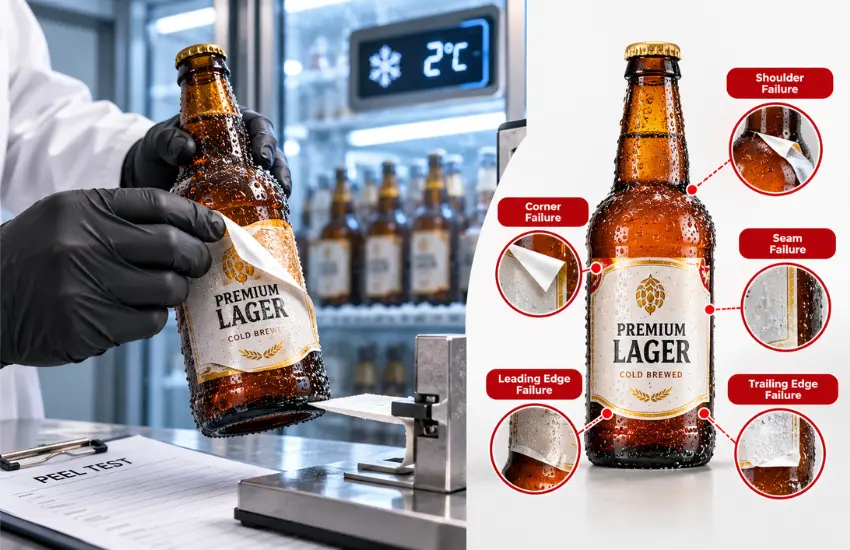
Record where the failure starts on each one — corner, leading edge, trailing edge, seam, or shoulder — and photograph it.
Step 2: Run the peel test
Lift a failed label and note where the adhesive stayed. Adhesive on the glass or aluminum indicates facestock-driven curl. Adhesive on the label back indicates low-temperature adhesion failure or poor wet-out.
Step 3: Compare cooler and ambient units from the same run
If the ambient units are clean and the cooler units are not, the trigger is temperature or humidity change, not the labeler.
Step 4: Compare formats
Check bottle against can, and across diameters and label sizes. Failures that track one container geometry are mechanical, not chemical.
Step 5: Segment by SKU, run, roll, and shift
A single roll or single shift failing points to a material lot or operator setup, not the specification.
Step 6: Read the spec sheet
Confirm facestock type, adhesive class, minimum application temperature, service-temperature range, caliper, and liner. If the sheet says only “paper, permanent,” you do not yet have a specification.
Step 7: Log the environment
Capture packaging room temperature and relative humidity, container surface temperature at the labeler, and elapsed time from labeling to entering the cooler.
Log steps 6 and 7 on every run. Without that record, the next failure turns into another guessing exercise.
A correctly specified label substrate can still fail in the cooler if it was applied to the wrong container surface or humidity condition.
Wet or cold glass and aluminum
Containers coming off a rinser, filler, or pasteurizer often carry a film of water or condensation. That boundary layer keeps the adhesive from contacting the container, so you get a partial bond that looks fine and releases later. Cold containers also chill the adhesive on contact, cutting flow at the exact moment wet-out has to happen.
High-humidity packaging rooms
Summer packaging days can drive paper facestocks to a high moisture content before the pallet ever reaches the cooler. The larger the humidity delta between application and storage, the more shrink tension you build. Conditioning rolls in the room where they will run helps, but it does not erase the delta.
Pressure and dwell
Under-set nip pressure, worn brushes, or short roller contact leaves air pockets and low-contact areas. Verify pressure and dwell at changeover, not just label placement.
Time to chill
Many pressure-sensitive adhesives keep building bond strength for hours at ambient temperature. Moving pallets into a cold room soon after labeling can lock in a partial bond. Where the schedule allows, holding labeled product at ambient before chilling is one of the cheapest controls available.
Label facestock choice removes or adds the dimensional-movement driver; adhesive class decides whether the bond can relax cold-induced tension.
Uncoated and felt or textured papers
Strongest craft aesthetic. Highest moisture absorption and dimensional movement. Most prone to curl and edge damage through condensation cycles.
Coated papers
Better surface durability than uncoated. Still moisture-permeable through edges and back. Often improved by a laminate or varnish.
BOPP label film, PP, and PE films
Dimensionally stable and moisture resistant, which removes the primary curl driver. Clear and white film look different from paper and may require design changes.
Pressure sensitive label adhesive is the trade term; a search for cold weather adhesive or pressure sensitive adhesive label is usually describing the same problem. The classes below are grouped by function, not brand.
General-purpose permanent
Adequate for ambient dry-shelf SKUs.
Cold-temperature or low application temperature
A cold temperature adhesive, the class built for low temperature applications, is formulated to wet out on chilled containers and hold through refrigeration.
Wet-strength or ice-bucket oriented
Intended for immersion and repeated condensation cycles.
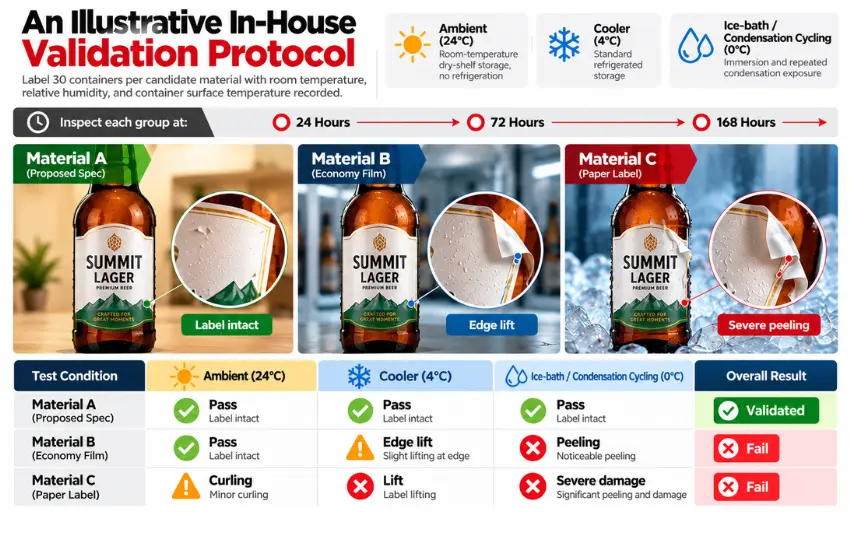
Offered as an example rather than a published standard: label 30 containers per candidate material with room temperature, relative humidity, and container surface temperature recorded.
Validation Group | Conditions Tested |
Ambient | Room-temperature dry-shelf storage, no refrigeration |
Cooler | Standard refrigerated storage |
Ice-bath / condensation cycling | Immersion and repeated condensation exposure |
Inspect each group at 24, 72, and 168 hours, and mark curl or lift by location on a simple diagram. The material that holds across all three groups becomes your validated spec for that SKU family.
Short qualification runs on real substrates make cold-chain material testing economical, tying each validated stock to its SKU through production.
The hard part of a cold-chain material change is qualification economics. Traditional pre-printed buys make it expensive to test paper against film against a topcoated stock, so breweries keep running whatever is already on the shelf. The ArrowJet Aqua 330R, a water-based inkjet label press from Arrow Systems, changes that math in a few practical ways.
The equipment behind your digital label printers determines whether a validated material spec actually holds once a run leaves the qualification stage and reaches production volume.
Short qualification runs across candidate substrates
In-house beer label printing across several candidate substrates, using your own artwork, means you evaluate real labels in your cooler instead of blank swatches.
SKU-to-material discipline
Seasonal and limited-release runs stay on the validated stock rather than a leftover roll from an unrelated job.
Traceability through operations automation
Variable data and batch linkage tie substrate, adhesive spec, material lot, and shift to each run, so a future failure narrows to a lot instead of a season.
Built for food and beverage label production
The Aqua 330R is Nestlé Guidance Compliant and runs Food & Beverage, Cosmetics, Pharmaceutical, Nutraceutical/Supplement, and Flexible Packaging applications, so a beer-label qualification run sits on a platform already established in food-contact packaging.
Speed and format range from qualification to production
Three speed tiers (90, 150, and 195 ft/min) and a maximum media width of 380mm cover most beverage label formats, so the same press that prints a short qualification run can also run the validated SKU at production volume once the material spec is confirmed.
Substrate and adhesive suitability still has to be confirmed in your own cold-chain conditions. Printing capability shortens the loop; it does not replace the test.
Common questions from brewery packaging, production, and quality teams diagnosing label curl and adhesion failures in cold storage.
The cooler changes two things at once. Cold air is typically drier, so a paper facestock releases moisture and shrinks slightly while the adhesive layer stays put, creating edge tension. At the same time, the temperature drop reduces adhesive tack and flow, so the bond can no longer relax that tension. Ambient units never see either stress, which makes side-by-side ambient and cooler samples from the same run the single most useful comparison available to you.
Start with the peel test and the segmentation check. If adhesive stays on the glass and curl is symmetrical, you are looking at facestock movement, which is a material specification issue. If adhesive comes away with the label and lift starts at one edge, suspect wet or chilled container surfaces, low nip pressure, or short dwell. Then check whether failures cluster by roll, shift, or container diameter. Material problems appear across the run; process problems usually track one setup, operator, or format.
Film facestocks remove the biggest curl driver, because BOPP, PP, and PE barely move with humidity. That is a real advantage in coolers and ice baths. But film alone does not fix an adhesive applied to wet glass, insufficient application pressure, or immediate chilling after labeling, and it changes the tactile and visual character many craft brands are built on. Teams often get further by matching a cold-temperature adhesive and the right topcoat to the look they want, then validating that combination in their own conditions.
Bring the evidence: failed units, current label spec sheets, packaging-room temperature and humidity logs, and the list of affected SKUs. That is enough to run a structured cold-chain label review with Arrow Systems and trace a beer label curling cold storage failure to substrate, adhesive, or application environment.
The review defines a material specification you can test, and shows how short qualification runs on your own artwork can validate a substrate before you commit a SKU to it.

Table of Contents Beer Label Curling in Cold Storage: Diagnose the Mismatch Beer label curling in cold storage signals a facestock, adhesive, or application mismatch

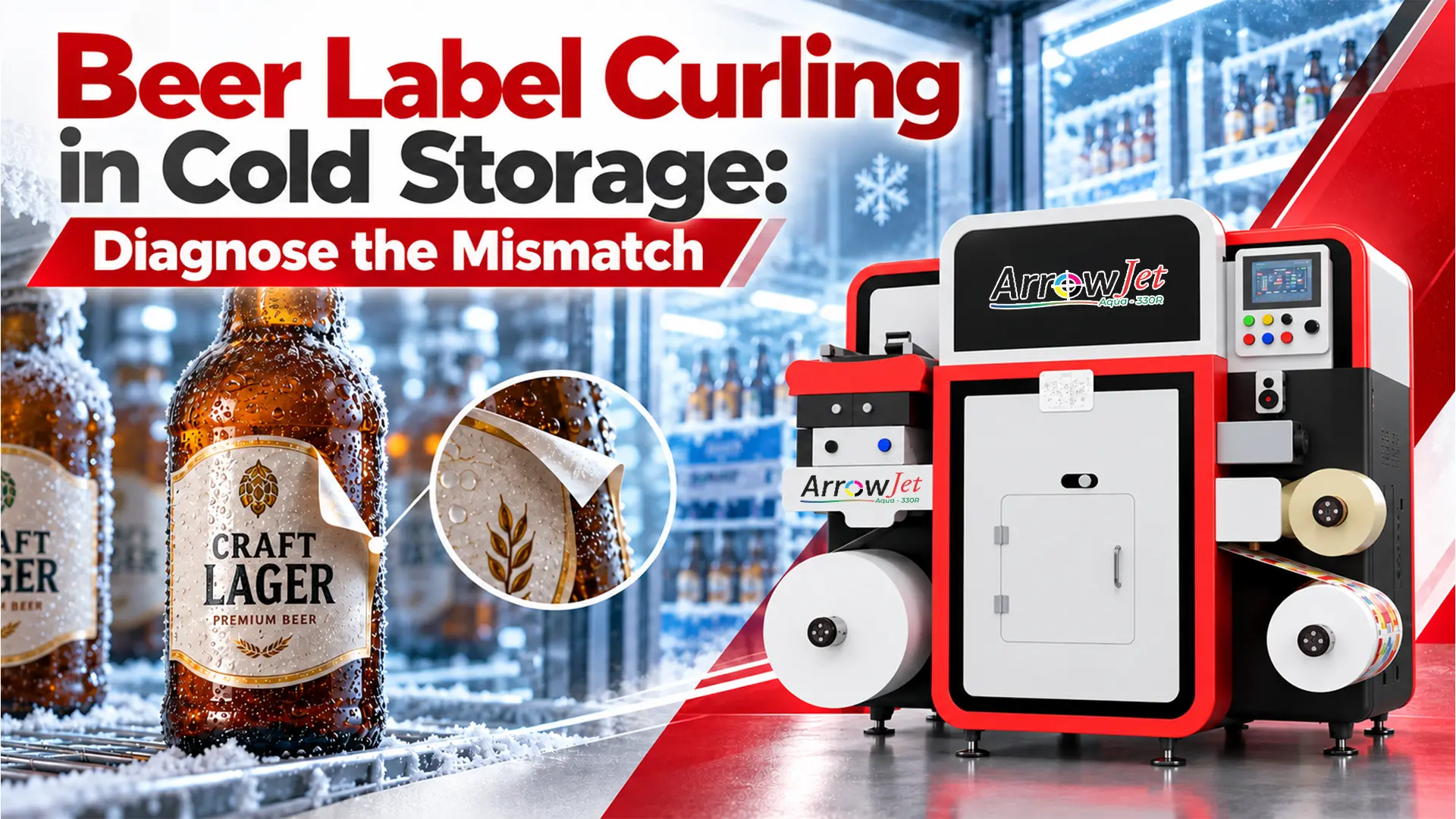
Table of Contents Paper vs. Film Labels: A Substrate Buyer’s Guide Paper wins on cost and aesthetics in dry, indoor conditions; film wins wherever moisture,
Table of Contents In-House Label Printing vs. Print on Demand: Cost by Volume In-house label printing vs. print on demand comes down to a cost-per-label
Table of Contents Pharmaceutical Label Version Control Workflow for FDA Changes A GMP label version control workflow moves an approved revision to the line: change
Table of Contents Mylar vs BOPP Flexible Packaging: Substrate Selection Guide PET (Mylar) leads on oxygen and aroma barrier and heat tolerance; BOPP leads on

Table of Contents When to Add a Second Label Printer: Capacity Decision Guide Three measurable signals decide it — sustained utilization above your scheduling ceiling,