Paper vs. Film Labels: A Substrate Buyer’s Guide
Table of Contents Paper vs. Film Labels: A Substrate Buyer’s Guide Paper wins on cost and aesthetics in dry, indoor conditions; film wins wherever moisture,
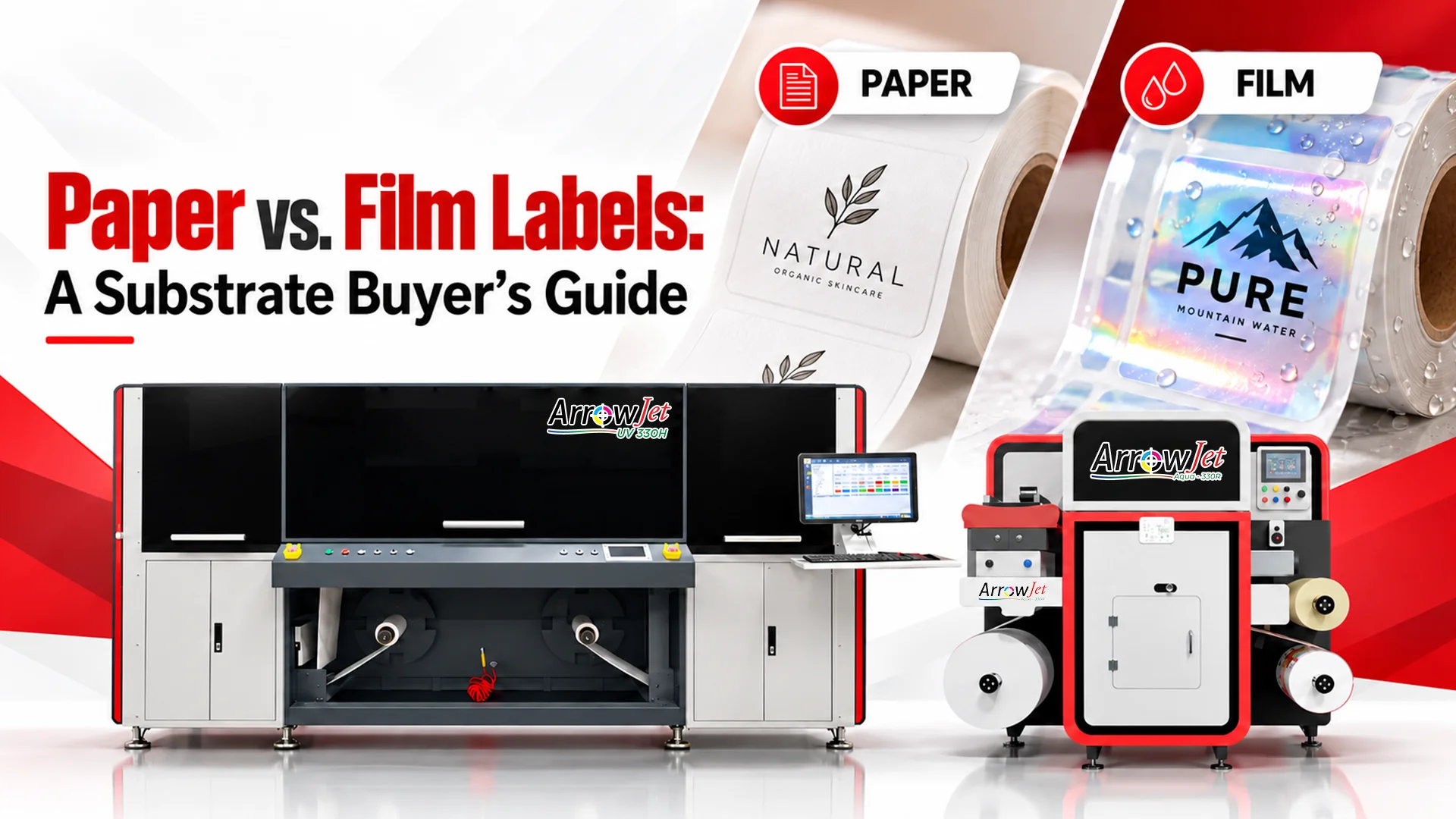
Paper wins on cost and aesthetics in dry, indoor conditions; film wins wherever moisture, cold, chemicals, abrasion, or sunlight appear.
Paper is not a compromise material — in dry, indoor, short-service-life conditions, it is the correct engineering answer.
This guide is for operations, engineering, QA, and packaging teams who own label specs and get the call when labels come off in the field. Most substrate decisions get made twice: once on price, then again after a label peels in a freezer case, smears after a caustic wash-down, or scuffs unreadable in transit.
Lowest cost per label
Paper facestocks are typically the least expensive pressure sensitive label stock, and the cost gap widens on large-format case and carton labels.
Printability and aesthetics
Uncoated, matte, and textured papers deliver the natural, non-plastic look many food, beverage, and specialty brands want. Ink sits well and dries fast.
Recyclability and repulpable options
Paper facestocks and repulpable case-label constructions can simplify corrugated recycling streams, producing more sustainable pressure sensitive labels than a laminated film construction. Verify claims with your material supplier and your own waste program.
Conformability on rough surfaces
On fibrous or uneven substrates such as corrugated, paper often lays down better than a stiffer film.
Best-fit conditions: dry ambient warehousing, short shelf-life or fast-turn SKUs, corrugated shipping cases, dry-goods cartons, hardware and dry-fill packaging, and pharmacy or dispensing labels that live indoors for a defined period.
Paper failures start in wet conditions — the mechanism determines whether the fix is a facestock, adhesive, or topcoat change.
Fiber saturation
Paper is a fiber matrix. Absorbed water swells fibers, destroys tensile strength, and produces wrinkling, tearing, and delamination. It shows up first on cold storage labels used on iced protein cases and condensation-heavy cooler storage.
Edge lift and adhesive stiffening
Below freezing, many general-purpose adhesives lose tack as they stiffen. Paper’s own dimensional movement adds stress at the perimeter — the result is classic cold storage failure: corners curling off a frozen case within days.
Condensation cycling
Product moving freezer to dock to cooler to truck sees repeated wet and dry cycles. Each cycle drives moisture under the edges and weakens the bond further.
Ink smear and barcode dropout
After a wash-down cycle, ice slurry, or hose contact, unprotected paper can bleed or abrade. A dropped barcode or lot code stalls scanning at receiving and creates traceability gaps that require manual resolution.
Solvent and cleaner attack
Caustic CIP chemistry on dairy and beverage lines, plus solvents and lubricants on chemical pails, drums, and totes, will soften paper and lift adhesive well before they affect a film.
Abrasion loss
Hand-handled totes, returnable containers, automotive parts bins, and pallet-to-pallet transit rub print off paper quickly.
UV exposure
Paper labels on equipment, drums, or inventory in yard or outdoor storage fade and embrittle in sunlight. A film facestock with UV-stabilized ink and a protective topcoat produces UV resistant labels that hold their color and bond for years in the same yard or outdoor storage.
The downstream cost is where the savings disappear: relabeling labor, held shipments, rejected loads, and repeat scanning problems that nobody traces back to the substrate spec.
Film substrates replace the fiber matrix with a continuous polymer film — there is nothing to saturate, which explains most of the durability gap.
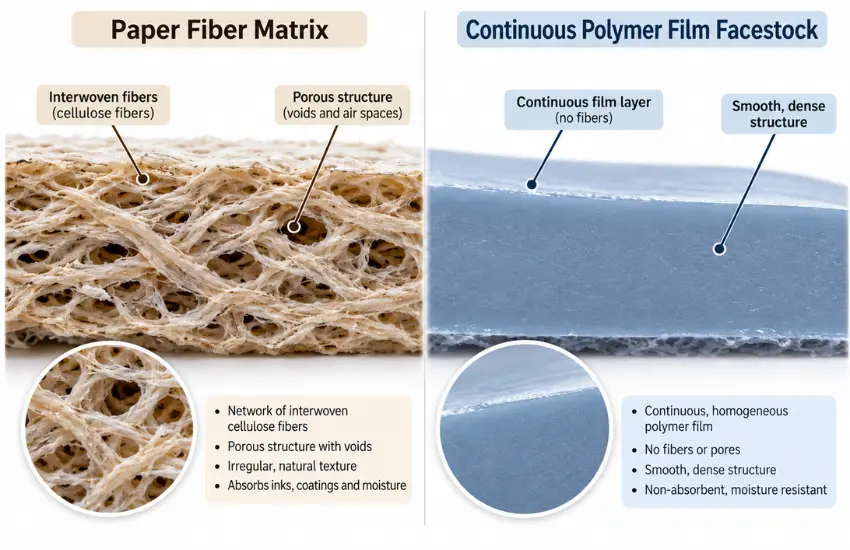
The decision to move to film usually comes down to moisture, chemical exposure, abrasion, or a service life measured in years rather than weeks.
BOPP (biaxially oriented polypropylene)
The workhorse film. A BOPP label is available in white, clear for a no-label look, or metallized, commonly in the 2 to 3 mil range of BOPP label material — confirm against your supplier’s data sheet. It offers strong moisture resistance, good clarity, moderate chemical resistance, and a cost position modestly above paper. Common uses: bottles, jars, tubs, cold-chain packaging, and household or personal care containers.
PET (polyester)
The step up. A PET label, often sold simply as a polyester label, handles higher temperatures, resists solvents and abrasion better than BOPP, and holds dimensional stability under stress, often at a thinner caliper for comparable stiffness. Used for chemical drum and tote identification, rating and asset plates, tamper-evident constructions, and parts that see heat or aggressive cleaners.
PP and PE (polypropylene and polyethylene)
Softer and more conformable films. A PP label — often specified as polypropylene label material — is the right choice for squeezable bottles, irregular geometry, and containers that flex in use, where a stiffer PET label would tunnel or pop off.
Substrate | Moisture | Temperature Tolerance | Chemical Resistance | Abrasion | Relative Cost | Typical Use |
Paper | Poor | Narrow | Poor | Low | Lowest | Dry cases, cartons, short service life |
BOPP (white, clear, metallized) | Very good | Broad, including freezer with the right adhesive | Moderate | Good | Moderate | Bottles, tubs, cold chain, retail |
PET / polyester | Very good | Broadest, including elevated heat | Good to excellent | Excellent | Highest | Drums, totes, rating plates, parts |
PP / PE | Very good | Broad | Moderate | Good | Moderate | Squeeze bottles, conformable containers |
Ratings are general and directional. Validate every row against supplier data for your specific construction.
Adhesive class matters as much as facestock
Waterproof labels still fail if you pair a premium facestock with a general-purpose adhesive. Match the label adhesive to the job: permanent all-temp or freezer-grade for direct-to-frozen application, wash-off for returnable glass, high-tack for low-surface-energy plastics such as HDPE and PP pails.
Topcoats and finishing as durability multipliers
Receptive topcoats make non-porous films printable with the right ink chemistry, and laminates or UV varnishes add chemical, scuff, and light protection on both paper and film constructions. Arrow’s label finishing systems apply cold lamination and protective topcoats inline, regardless of which substrate or press produced the roll.
A repeatable substrate selection workflow beats SKU-by-SKU guessing: profile the environment, match materials, then test before buying.
Step 1: Profile the full journey environment
Temperature range and rate of change, moisture and condensation exposure, chemical and cleaner contact, handling and abrasion frequency, expected service life, and outdoor exposure.
Step 2: Identify the application surface
Corrugated, HDPE pail, coated glass, stainless steel, powder-coated metal, or flexible film. Texture and surface energy drive adhesive choice.
Step 3: Define the readability requirement
Human-readable only, scanned 1D barcode, or 2D code, plus how long it must stay scannable and at which points in the journey.
Step 4: Match facestock, adhesive, and topcoat as one system
Change one element and re-check the others — a substrate upgrade with the wrong adhesive still fails.
Step 5: Run a pre-qualification test
Freeze and thaw cycling, water immersion plus rub, cleaner or solvent wipe, hand-scuff or taber-style abrasion, and scanner verification after each step. Test on the actual container, at the actual application temperature.
Step 6: Document and lock the spec
Record facestock, adhesive, topcoat, and print profile, then enforce it in your label management workflow so a paper stock cannot quietly substitute for an approved film.
Choose paper if
The label lives indoors in dry ambient conditions, service life is short, the surface is corrugated or fibrous, cost per label dominates, and there is no wash-down, freezer, chemical, or outdoor exposure.
Choose film if
The product enters a freezer or cooler, sees condensation cycling, gets washed down or wiped with cleaners, contacts solvents or oils, is handled frequently or returned, stores outdoors, or must scan reliably for months to years.
On cost framing: film runs meaningfully more per label than paper, and the premium varies with size, construction, and volume. Weigh that premium against relabeling labor, a held or rejected shipment, and the administrative cost of closing a traceability gap. In practice, avoiding a single rejected load can offset a substantial share of a substrate upgrade on the affected SKU.
Paper and film behave differently at the printhead, not just in the field — porous paper absorbs ink, while non-porous film cannot.
Porous paper ink absorption
Paper absorbs aqueous ink and dries largely by penetration into the fiber matrix, which is part of why an aqueous pigment press is a natural fit for paper-forward label runs.
Non-porous film ink requirements
Films cannot absorb anything, so they need a receptive topcoat, a compatible ink chemistry, or both, plus more dwell time or pinning and curing energy to set the image. UV-curable ink systems polymerize on contact instead of soaking in, which is why a hybrid UV press is built to run film, foil, and synthetic stocks directly.
Operational effects to plan for:
Color profiles differ by substrate
Expect separate ICC profiles and ink laydown limits for paper, white BOPP, and clear film.
Dry time and blocking risk
Under-dried film can block on the rewind, so slower speeds or added drying capacity may be required.
Static and tension
Films build static and respond differently to web tension than paper, so handling and rewind settings usually need adjustment.
Inline finishing
Lamination adhesion, die-cut depth, and matrix removal all change with facestock stiffness and liner choice.
On-demand digital label printing lets you run the correct substrate per SKU in the quantity you need, instead of buying long conventional runs of one compromise material — connecting production schedule data, artwork version control, and approved substrate specs so the right material and the current revision run together.
Mixed paper and film portfolios need a press built for variable data, short runs, and inline finishing across substrate types.
ArrowJet Aqua 330R for paper-forward and Nestlé-guidance-compliant portfolios
The ArrowJet Aqua 330R is a Memjet DuraFlex®-powered aqueous pigment press running at 90/150/195 ft/min across a max media width of 380mm on three-phase 220V/400V power. It is Nestlé Guidance Compliant across food and beverage, cosmetics, pharmaceutical, nutraceutical/supplement, and flexible packaging verticals — the portfolio breadth a mixed paper-and-treated-film label program needs from a single press.
ArrowJet UV 330H for film, foil, and durability-driven SKUs
The ArrowJet UV 330H is a true hybrid UV label press combining roll-to-roll and flatbed printing in one platform, with CMYK plus White and Varnish ink configurations. Because UV ink cures on contact instead of soaking in, the UV 330H handles films, foils, and specialty stocks that need built-in scratch and chemical resistance without an added topcoat step.
When matching any system to your substrate portfolio, confirm ink and topcoat compatibility across your material list, drying capacity at your target speeds, web handling for both paper and film, changeover behavior between substrates, and how substrate and version data flow in from your production planning tools.
Specify by environment and service life first, then price the substrate — and lock the approved spec into your label workflow.
Common questions from operations, engineering, QA, and packaging teams choosing between paper and film label substrates.
Not automatically. Film removes the fiber-saturation problem, but cold-chain performance depends heavily on the adhesive and the application conditions. A film facestock with a general-purpose adhesive can still edge-lift on a frozen surface. Pair a film facestock with an all-temp or freezer-grade adhesive, and confirm the application temperature, because labels applied to already-frozen packaging behave differently than labels applied warm and then frozen. Freeze and thaw cycling on your actual container is the reliable way to know.
Sometimes, with qualification. Refrigerated conditions are less severe than frozen, but condensation is often worse because product cycles between cooler and ambient. A coated or laminated paper with a suitable adhesive may hold on a dry, stable surface with a short service life. Paper tends to struggle where product is iced, hosed, or repeatedly cycled. If a barcode has to scan at multiple downstream points, film is the lower-risk choice.
Look at where the failure occurred. Wrinkling, tearing, softening, ink smear, fading, or scuffed print point to the facestock or topcoat. Clean lift at the edges, sliding, tunneling, or the label coming off intact with residue behind it points to the adhesive or the surface prep. Also check whether the label is still readable, because a label that stayed bonded but became unscannable is a print protection issue, not a bond issue.
Film generally costs more per label than paper, with polyester typically the highest and BOPP closer to the middle. The premium varies with size, construction, and volume, so treat any published multiple as illustrative rather than a rule. The more useful comparison is total labeling cost: material plus relabeling labor, held or rejected shipments, and complaint handling. Many teams use film only on the SKUs and environments that need it and keep paper where conditions are genuinely benign.
Bring us your hardest label environment — freezer-to-dock cold chain, caustic wash-down, solvent-exposed drums, or high-contact parts handling. Arrow Systems offers a structured, no-obligation assessment for operations, engineering, and packaging teams evaluating paper and film substrates.
The assessment reviews your environment profile, a paper and film adhesive shortlist, and a pre-qualification test plan you can run in your own conditions — plus which press configuration, from the ArrowJet Aqua 330R to the ArrowJet UV 330H, fits how your portfolio actually runs.
Table of Contents Paper vs. Film Labels: A Substrate Buyer’s Guide Paper wins on cost and aesthetics in dry, indoor conditions; film wins wherever moisture,
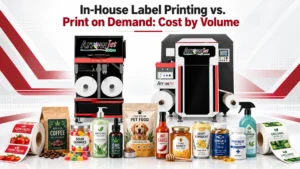
Table of Contents In-House Label Printing vs. Print on Demand: Cost by Volume In-house label printing vs. print on demand comes down to a cost-per-label
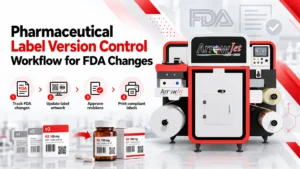
Table of Contents Pharmaceutical Label Version Control Workflow for FDA Changes A GMP label version control workflow moves an approved revision to the line: change
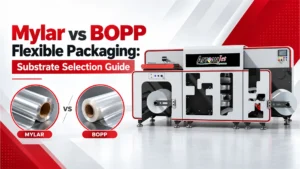
Table of Contents Mylar vs BOPP Flexible Packaging: Substrate Selection Guide PET (Mylar) leads on oxygen and aroma barrier and heat tolerance; BOPP leads on
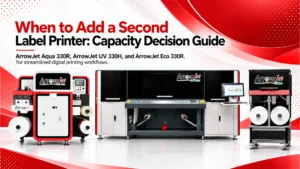
Table of Contents When to Add a Second Label Printer: Capacity Decision Guide Three measurable signals decide it — sustained utilization above your scheduling ceiling,
Table of Contents Diagnosing Supplement Label Peeling HDPE Bottle Failures HDPE label peeling traces to low surface energy, an adhesive mismatch, or moisture exposure —