Aqueous vs. UV Inkjet Pharmaceutical Labels: What GMP Requires
Table of Contents Aqueous vs. UV Inkjet Pharmaceutical Labels: What GMP Requires No FDA regulation names a compliant ink chemistry — GMP governs label accuracy,
No FDA regulation names a compliant ink chemistry — GMP governs label accuracy, control, and change management, not the ink itself.
Choosing between aqueous vs uv inkjet pharmaceutical labels comes down to migration exposure, lifecycle conditions, substrate, and code legibility for your specific application.
The choice rarely belongs to print operations alone — packaging engineering, quality, serialization, and operations each own a piece of the decision.
Packaging engineering owns substrate and container compatibility. Quality owns migration risk assessment, qualification protocols, and change control. Serialization leads own code readability and verification pass rates, while operations owns throughput, changeover time, and uptime. Disagreement between these groups is normal — quality generally wants the lowest-risk chemistry, and operations generally wants the most durable and fastest one.
Serialization label printing adds a layer of legibility requirements on top of standard GMP obligations — GS1 barcode grade and 2D code contrast have to survive the full distribution and shelf-life cycle, not just look correct at time zero.
The four variables that usually settle the choice
Contact and migration exposure (how close printed ink gets to the drug product, and through what pathway), lifecycle conditions (cold-chain condensation, isopropyl alcohol wipe-down, autoclave adjacency, distribution abrasion, and multi-year shelf life), substrate (coated paper, uncoated paper, BOPP, PET, PE films, and synthetics), and legibility over time (GS1 barcode grade, 2D serialization code contrast, small-point regulatory text, and Braille interaction on cartons).
A label on a shipping carton, or a folding carton for a blister wallet, sits at a meaningful distance from the dosage form — barrier layers often intervene, and migration discussion there focuses mainly on set-off and odor. A pressure-sensitive label applied directly to an HDPE bottle, an LDPE dropper, a thin-wall vial, or a permeable film is a different exposure class. Realistic transfer mechanisms include permeation through thin or permeable container walls, penetration through facestock and adhesive layers, and set-off before application. Most quality teams treat primary container labeling as the conservative case and specify accordingly.
Aqueous ink uses water as its carrier and dries by evaporation; UV-cured ink polymerizes instantly under UV or LED energy, and each mechanism drives a different compliance argument.
Why aqueous is often easier to defend near a primary container
Water-based ink sets generally contain no photoinitiators and no reactive monomers, which removes an entire category of low-molecular-weight species from the migration conversation. Odor concerns are typically lower as well. For teams seeking a low migration ink pharmaceutical starting point, aqueous chemistry is usually the more defensible default. Best-fit applications include pressure-sensitive labels on primary containers where migration sensitivity is high, permeable or thin-wall containers and droppers, high-mix short-run work such as clinical trial labels and multi-language artwork, and coated paper or inkjet-receptive facestocks.
Real limitations to plan for
Aqueous inks commonly require coated, topcoated, or inkjet-receptive stock — non-porous films and synthetics may print poorly without a receptive coating. Drying takes energy and time, which affects press configuration and can constrain throughput relative to instant-cure systems. Uncoated aqueous prints are typically less resistant to rub and alcohol wipe than cured systems; lamination or varnish frequently closes that gap, but the finishing layer then becomes part of the qualified configuration.
What to verify before committing
Adhesion on your exact facestock, rub resistance after drying, IPA wipe performance, humidity and condensation exposure, and code grade at time zero and after accelerated aging.
Why cure completeness — not ink chemistry alone — carries the argument
UV inkjet cures by polymerization under UV or UV LED energy rather than by evaporation, producing a generally tough film. Photoinitiator and monomer migration concerns arise primarily when ink is under-cured, when film thickness exceeds the cure window, or when lamp output has drifted. Fully cured low-migration systems are widely used, including in food-contact-adjacent applications. Ink chemistry alone does not carry the argument for UV — the documented cure condition does.
Where UV-cured inkjet tends to win
Film and synthetic substrates — BOPP, PET, PE — with broad substrate latitude and no topcoat requirement in many cases; cold-chain labels exposed to condensation and freeze/thaw handling; surfaces subject to IPA wipe-down or cleanroom disinfectant contact; abrasion during distribution and over-labeling; and instant cure that supports productive inline finishing.
Controls that matter
Specify a low-migration ink set wherever a meaningful migration pathway exists and obtain the supplier’s declaration of the basis for that claim. Define and monitor the cure window — lamp or LED output, speed range, and ink laydown limits. Treat lamp and LED maintenance and output verification as documented, change-controlled parameters. Evaluate set-off risk in the finished roll or stack, not only on a single printed sample.
21 CFR Parts 210 and 211 address labeling in operational terms — accuracy, legibility, material control, and change control — with no category of “FDA-approved ink.”
Pharmaceutical label GMP requirements are procedural, not chemical — 21 CFR label compliance is demonstrated through documented evidence and change control, not through a specific ink formulation.
21 CFR Part 11 addresses electronic records and electronic signatures where a digital workflow creates or maintains GMP records — relevant to digital label press workflows storing artwork versions, print logs, and inspection results electronically. What suppliers can legitimately provide instead of an ink approval: statements that raw materials comply with applicable food-contact or packaging-ink frameworks, low-migration declarations with a stated basis, cure or dry condition specifications, substrate and coating compatibility data, and safety data sheets.
GMP obligation | How aqueous typically satisfies it | How UV-cured typically satisfies it | Evidence to collect |
Accurate, legible labeling | High resolution on receptive stock; strong small-text rendering | High resolution across films and synthetics | Print samples with code grading; small-point text inspection |
Legibility maintained through expiry | Often requires varnish or laminate for abrasion and moisture | Cured film generally resists abrasion, moisture, and solvents | Aged samples with barcode and 2D grade at intervals |
Material suitability for the packaging system | No photoinitiators; generally lower migration concern profile | Low-migration ink set plus verified cure window | Ink composition compliance statements; migration risk assessment |
Written procedures and controlled process parameters | Dry temperature, speed, and substrate profile locked | Cure energy, speed, and laydown limits locked | Approved print profiles; parameter change records |
Documentation and change control | Print profile and finishing spec versioned | Same, plus lamp and LED output monitoring records | Change-control records tied to each configuration |
Electronic records integrity (Part 11 scope) | Applies to workflow, not chemistry | Applies to workflow, not chemistry | Audit trails, user access controls, version history |
A borrowed food-industry benchmark, not an FDA requirement
The Nestlé guidance on packaging inks is a food-industry supplier document that works largely through exclusion and restriction, identifying ink raw materials that suppliers should not use — or should use conditionally — in packaging inks for food applications. Pharma buyers borrow it because pharma has no equivalent consolidated ink list; asking a supplier about alignment gives a quality team a recognizable, testable question instead of an open-ended one. Global suppliers commonly reference other frameworks alongside it, including EU GMP expectations for packaging materials, positive-list style national ordinances, and printing ink association guidance on low-migration formulation. Alignment with a food-industry ink guidance is a useful procurement specification, not an FDA requirement, and it confers no regulatory approval. The ArrowJet Aqua 330R is Nestlé Guidance Compliant, which is the kind of documented, testable specification quality teams can point to in a supplier review.
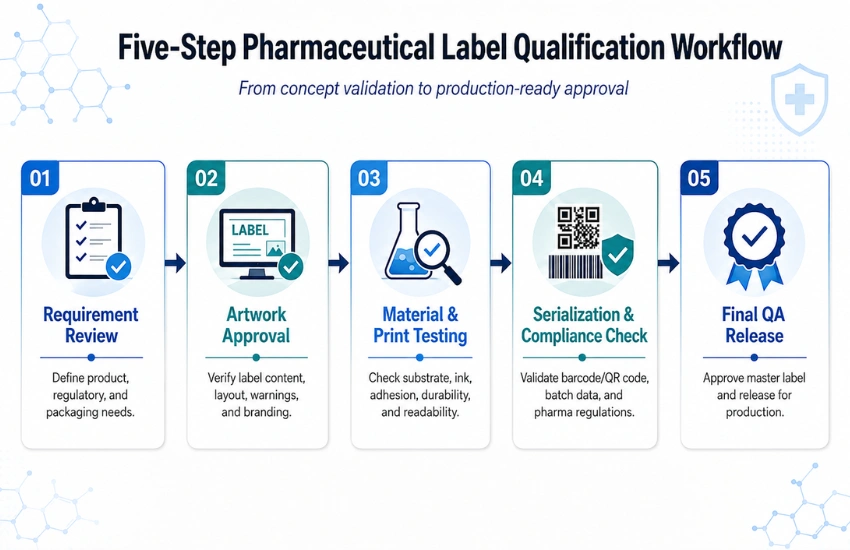
Classify the application, define testable acceptance criteria, request supplier documentation, trial the full configuration, then lock it under change control.
Qualification protects the configuration; automation protects execution. Practical integration points include artwork and version release triggered from ERP or MES so only approved revisions reach the press, and on-demand print quantities that reduce obsolete pre-printed label inventory across high-mix and clinical SKUs. Inline vision verification with 2D code grading rejects marginal codes before aggregation, while automatic logging ties every printed label version to an approved artwork revision and batch record.
Cost justification should be built from your own records, not from generic figures. Pull the labeling deviations you have actually investigated, add the rework and line downtime attached to each, and compare that total against the incremental cost of rigorous qualification plus inline verification.
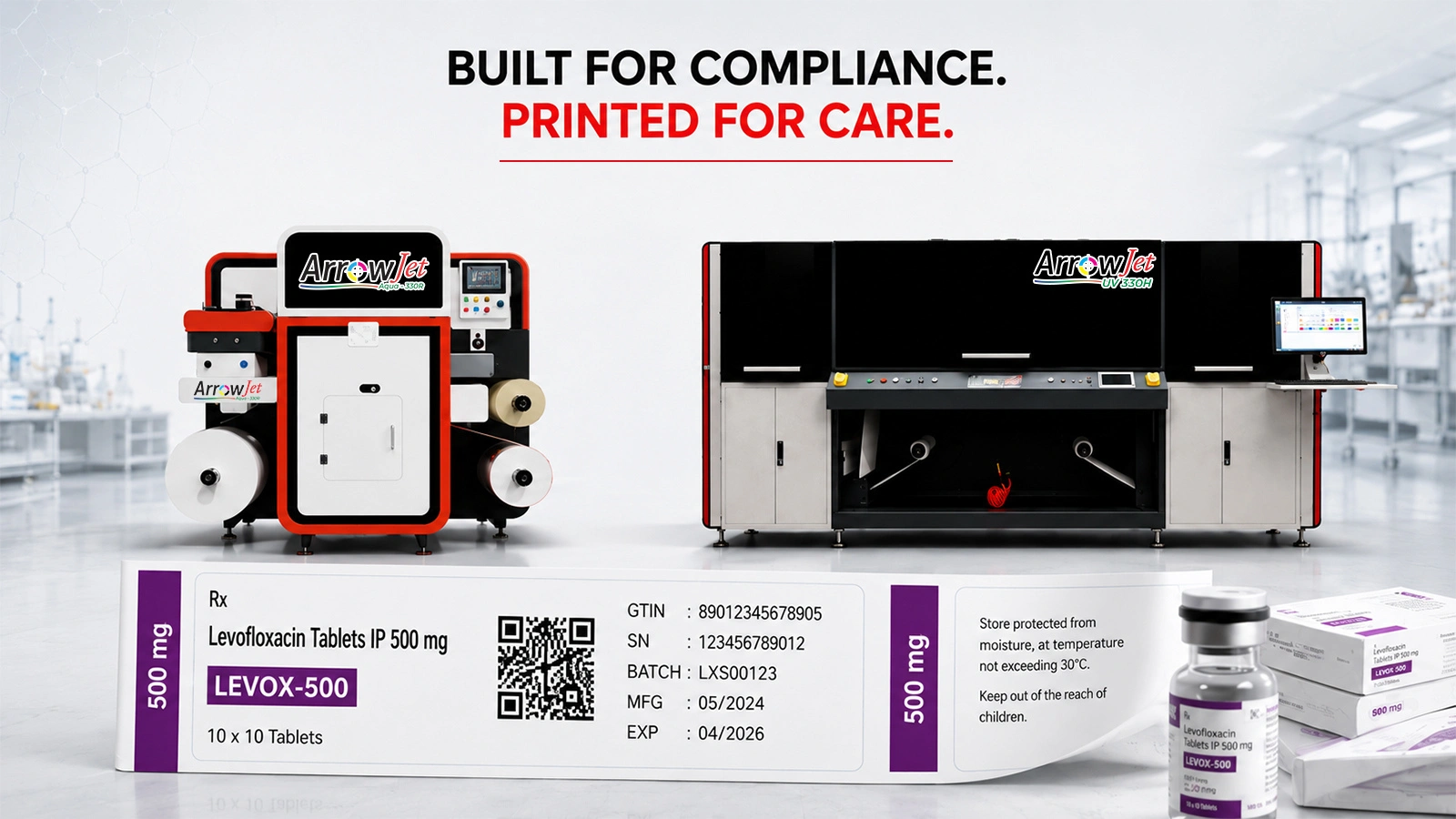
The ArrowJet Aqua 330R is a high-speed, water-based pigment inkjet press built for the migration-sensitive, high-mix side of pharmaceutical labeling.
Migration-sensitive, primary-container-adjacent labeling
The ArrowJet Aqua 330R’s water-based pigment ink set contains no photoinitiators or reactive monomers, which is the composition profile that makes aqueous the easier chemistry to defend for pressure-sensitive labels on primary containers, thin-wall vials, and permeable packaging where migration sensitivity is high.
High-mix, short-run and clinical trial work
Digital, single-pass production suits high-mix, short-run work such as clinical trial labels, multi-language artwork, and low-volume SKUs — the run profile common across pharmaceutical secondary and primary labeling where flexographic plate costs and minimum order quantities are a poor fit.
Nestlé Guidance Compliant ink specification
The ArrowJet Aqua 330R is Nestlé Guidance Compliant, giving quality teams a documented, testable procurement specification to reference during ink and press qualification — a useful data point in a migration risk assessment, though not a substitute for the team’s own regulatory review.
Industries served
Beyond pharmaceutical applications, the ArrowJet Aqua 330R is used across cosmetic, food and beverage, nutraceutical and supplement, and flexible packaging label production — relevant context for pharma converters who also run adjacent regulated categories on the same press.
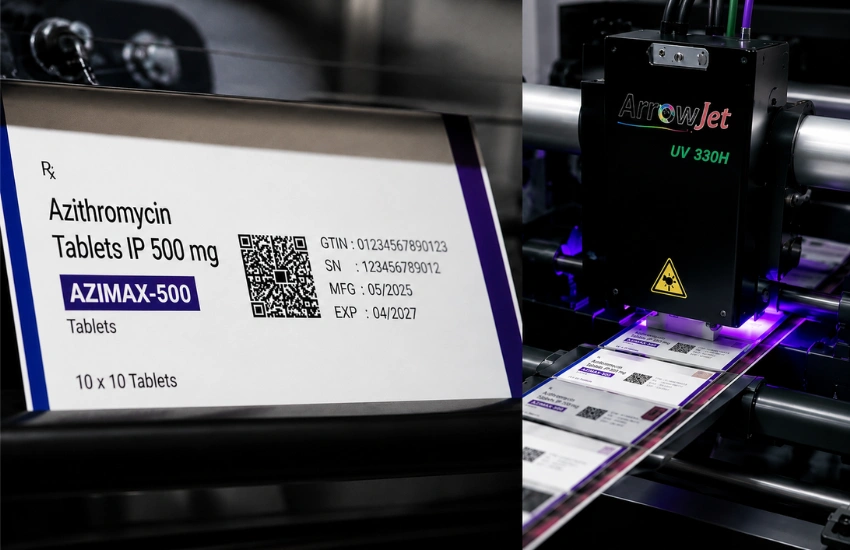
The ArrowJet UV 330H is a true hybrid UV label press combining roll-to-roll and flatbed printing — built for durability-driven pharmaceutical applications on films and synthetics.
Cold-chain, IPA wipe-down, and distribution durability
UV-cured ink forms a hard, sealed film that resists abrasion, moisture, and solvent contact — the profile pharmaceutical secondary packaging needs for cold-chain labels exposed to condensation and freeze/thaw handling, surfaces subject to IPA wipe-down or cleanroom disinfectant contact, and abrasion during distribution and over-labeling. For cold chain label printing specifically, code grade after condensation and freeze/thaw cycling is the test that matters most.
Substrate range for films and synthetics
The ArrowJet UV 330H handles BOPP, PET, and PE film and synthetic substrates with broad latitude and no topcoat requirement in many cases — substrate flexibility that matters when a single pharma portfolio spans coated paper folding cartons and film-based shipper labels.
Ink configuration options
The press supports CMYK + White, CMYK + Varnish, and CMYK + White + Varnish configurations. Opaque white enables printing on clear, metallic, and dark substrates, while clear ink and varnish support spot gloss and tactile finishes — relevant where secondary packaging also carries brand and tamper-evidence requirements alongside regulatory text.
Roll-to-roll and flatbed in one platform
A true hybrid design switches between roll media and flatbed printing on one press, supporting rigid media up to 50 mm thickness in flatbed mode alongside standard roll-fed label production — useful for packaging engineering teams prototyping cartons or rigid inserts alongside standard label runs without a second machine.
Migration sensitivity, substrate, durability demand, and SKU mix are the four factors that separate an Aqua 330R application from a UV 330H application.
Decision factor | Leans toward ArrowJet Aqua 330R (aqueous) | Leans toward ArrowJet UV 330H (UV-cured) |
Migration sensitivity | Higher — label near primary container, thin-wall or permeable packaging | Lower — folding cartons, shippers, secondary packaging |
Substrate range | Coated papers and inkjet-receptive facestocks | Films and synthetics including PET, BOPP, PE, and mixed substrates |
Durability demand | Moderate; lamination or varnish available for added resistance | High — IPA wipe-down, cold-chain condensation, distribution abrasion |
SKU mix and run length | High-mix short runs, clinical labels, multi-language artwork | High-mix and longer runs where instant cure supports inline finishing |
Finishing dependency | Varnish or laminate often part of the qualified spec | Cured film often adequate without an added protective layer |
Key control parameter | Dry conditions and substrate receptivity | Cure window, lamp and LED output monitoring, low-migration ink selection |
Treat this table as a starting filter, not a verdict. Specifications, ink availability, and qualification evidence should be confirmed for your specific application.
Many pharma portfolios are not one application. A common outcome is a hybrid strategy: aqueous for pressure-sensitive labels on primary containers and migration-sensitive SKUs, UV-cured for durable outer packaging, cold-chain labels, film-based labels, and anything routinely wiped with alcohol. Running both chemistries means maintaining two qualified configurations — accept that cost deliberately rather than forcing one chemistry onto an application it does not fit. Sound GMP label printing strategy treats this as a portfolio decision, not a single press purchase.
Which chemistry can hold code grade through our full shelf life on our facestock?
Grade actual codes at time zero and after accelerated aging on the production substrate — not a generic benchmark.
What cure or dry verification method becomes a documented in-process parameter?
Lamp or LED output and dry temperature and speed both need a defined, monitored acceptance window.
Which finishing layer is required, and does it change our migration assessment?
Varnish, laminate, or topcoat becomes part of the qualified configuration the moment it’s added.
What documentation will the ink supplier provide, and in what form?
Composition statements, low-migration declarations, and cure or dry specifications should be reviewed as documents — not accepted verbally.
GMP conformance — including 21 CFR Parts 210/211, migration risk assessment, and Part 11 electronic records scope — is the manufacturer’s responsibility and should be confirmed with qualified quality and regulatory teams. Arrow Systems sells label printing hardware; Arrow does not provide regulatory or compliance advisory services.
Common questions from packaging engineers, quality and validation leads, and serialization owners evaluating ink chemistry for pharmaceutical label production.
No FDA regulation specifically mandates low-migration ink for pharmaceutical labels. CGMP expectations in 21 CFR Parts 210 and 211 address label accuracy, legibility, control, reconciliation, and documented procedures rather than ink formulation. Many quality teams still require low-migration ink sets as an internal specification when a label is applied to or near a primary container, because the packaging system as a whole must be suitable for its intended use. The practical requirement is a documented risk assessment supported by supplier composition statements and your own test data.
It can be, and it is used that way, but the burden of evidence is higher. The relevant concerns are photoinitiator and monomer migration when ink is under-cured, plus set-off in wound rolls before application. Teams using UV-cured inkjet here typically specify a low-migration ink set, define and monitor a validated cure window with lamp or LED output verification, evaluate set-off on finished rolls, and document a migration risk assessment for the specific container and product. Aqueous is often the lower-effort path when migration sensitivity is high.
Both can hold acceptable code grade, and the real difference is what protects the code. Cured UV films generally resist abrasion, moisture, and solvent contact well, which helps 2D serialization codes survive distribution handling and cold-chain condensation. Aqueous prints on receptive stock can achieve excellent initial contrast and edge quality, and typically benefit from varnish or lamination where handling is aggressive. The reliable answer comes from grading your actual codes at time zero and after accelerated aging on your production substrate and finishing configuration.
Request ink composition compliance statements referencing applicable packaging-ink frameworks, low-migration declarations with the stated basis for the claim, safety data sheets, cure or drying condition specifications with tolerances, and substrate, ink, coating, and adhesive compatibility data. For the press, request print profile documentation, inline inspection and code-grading capability details, parameter access controls, and audit-trail and electronic-record functionality relevant to Part 11 scope. Ask what the supplier can support versus what your team must generate, since no supplier can provide regulatory approval of an ink.
Pick one real pharmaceutical application and qualify it instead of debating chemistry in the abstract. Bring the container and substrate, lifecycle conditions such as cold chain and IPA wipe-down, target shelf life, serialization and code-grade requirements, and your SKU mix and run lengths.
Arrow Systems can support your qualification protocol with a documented application-fit comparison of the ArrowJet Aqua 330R (aqueous) and ArrowJet UV 330H (UV-cured), including supplier documentation and change-control artifacts worth requesting before purchase.

Table of Contents Aqueous vs. UV Inkjet Pharmaceutical Labels: What GMP Requires No FDA regulation names a compliant ink chemistry — GMP governs label accuracy,

Table of Contents Color Sticker Printer for Business: 4 Reasons to Print In-House Businesses invest in a color label printer to reduce dependence on outside

Table of Contents Digital Label Printer for a Small Brand: The Real Break-Even Math Break-even for an in-house digital label press is driven by SKU

Table of Contents Color Label Printer Benefits: A Practical Guide for Businesses A color label printer gives businesses on-demand control over label production — from

Table of Contents Cosmetic Label Adhesion Problem: Bubbling and Lifting on Glass Cosmetic label bubbling and label lifting on glass trace to four variables: surface

Table of Contents Label Adhesive Types: Permanent, Removable, and Freezer-Grade Label adhesives fall into three working classes — permanent, removable, and freezer-grade — matched to