Pet Food Brand Label Supplier Problems: 5 Signs to Print In-House
Table of Contents Pet Food Brand Label Supplier Problems: 5 Signs to Print In-House Most pet food label supplier problems are a model mismatch: flexo’s
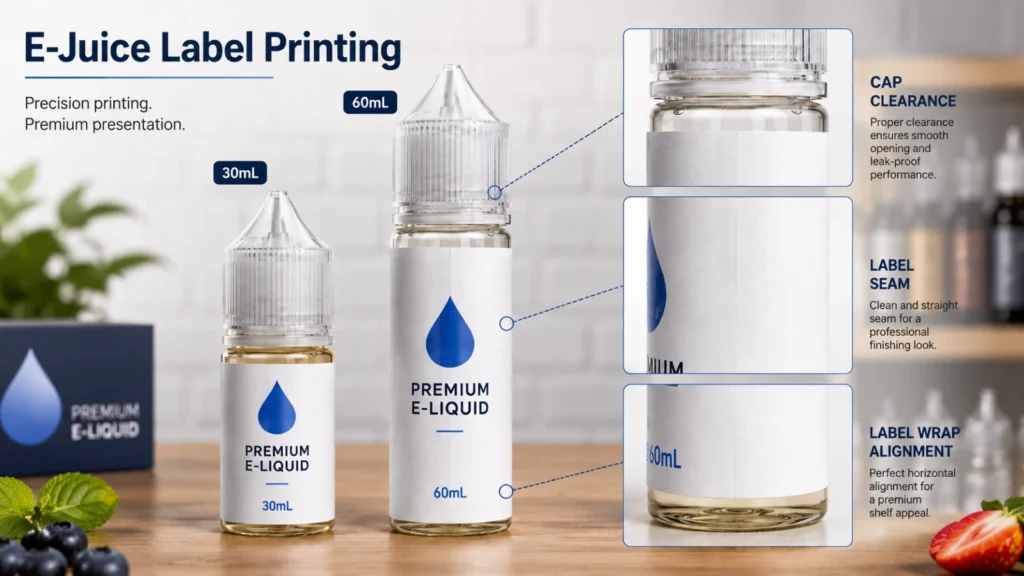
E-juice labels must fit small bottles precisely, survive moisture and handling, carry FDA-required nicotine warnings, and stay consistent across every flavor SKU in a product line.
Important — Regulatory Notice
Vaping and nicotine-related products are subject to federal, state, and local regulations that change frequently. This article is general packaging guidance only. Confirm all current requirements — including FDA nicotine-warning rules, state age-verification laws, and local labeling restrictions — with qualified legal and regulatory counsel before printing or selling any product.
A label that fits on paper may still fail in practice. Round bottles, tapered necks, and varying cap clearance zones all affect how a label applies and sits on the container. Different bottle sizes — 10 mL, 30 mL, 60 mL, and 120 mL formats are all common in the e-juice market — each require their own confirmed label dimensions.
Before committing any label to a production run, create a physical proof on the actual container. Check the following:
The label should cover the intended area without leaving a visible gap at the back-seam or wrapping more than a few millimetres past the overlap target.
On cylindrical bottles, the label seam should fall at a consistent location — usually the back. An under- or over-cut label creates a step or double-layer at the seam that degrades shelf appearance.
The top edge of the label must not interfere with cap seating or tamper-evident bands. Verify clearance on a filled and sealed bottle, not just an empty container.
Required warning statements must remain legible at normal shelf-viewing distance after the label is applied and the bottle is positioned in its retail or display environment.
Paper labels are poorly suited to e-juice bottles. When a paper label absorbs moisture or oil, the substrate degrades, print adhesion weakens, and required safety text may become illegible — which creates both a brand impression problem and a potential compliance issue.
Substrate | Key Properties | Typical Use on E-Juice |
BOPP (Biaxially Oriented Polypropylene) | Moisture-resistant, flexible, good conformability on round bottles | Standard opaque or white label stock for most formats |
PET (Polyester) Film | Higher dimensional stability, oil-resistant, good ink adhesion | Premium and high-durability applications; clear label stock |
Clear BOPP / No-Look Labels | Transparent — lets bottle colour show through | Brands that want an “on-bottle” printed appearance |
When labels are printed using UV-cured inkjet technology, the ink is polymerised at the point of printing, producing an ink layer that bonds directly to the film substrate and resists smearing, moisture ingress, and surface abrasion without requiring a separate lamination step.
A clear varnish layer — applied inline during printing — adds a physical barrier over the ink surface. It also enables premium visual effects such as spot gloss, matte contrasts, and tactile textures that contribute to shelf differentiation.
A thermal or pressure-sensitive film laminate applied after printing provides the highest level of surface protection for labels in demanding storage or handling environments. Lamination is typically added as a post-press operation by a finishing system.
Regulatory Caution
The following summarises requirements as understood from FDA guidance. Rules can change, and state and local regulations may impose additional requirements. Do not treat this summary as legal advice or a compliance checklist. Verify current requirements with qualified legal and regulatory professionals before printing any product label.
FDA’s authority over electronic nicotine delivery systems (ENDS) — including e-cigarettes and e-liquid products — expanded significantly in 2016 through the deeming rule. Key labelling-related requirements that have applied since that period include:
Labels must include a warning that the product contains nicotine, an addictive chemical. The required warning statement text is specified in the regulations and is not a brand’s choice to rephrase.
The warning must appear in a conspicuous location and be printed at no smaller than 12-point font. Text that blends into the background, is obscured by the cap, or is positioned at the bottom of the label in small print does not satisfy the requirement.
The warning must occupy at least 30% of one of the principal display panels. For a small 10 mL or 30 mL bottle, this is a significant portion of the available label real estate — design around this requirement from the start, not as an afterthought.
Regulations prohibit selling these products to persons under 21, restrict vending machine sales, and ban the distribution of free samples. These rules affect packaging and point-of-sale material in addition to the product label itself.
Regulations governing these products have continued to evolve after 2016. Always review the current FDA rule text, any relevant Enforcement Guidance documents, and applicable state and local ordinances before committing label artwork to production.
When each SKU in a product line uses a different layout, type treatment, or placement for required information, customers struggle to compare variants and regulatory warnings may be inconsistently applied. A structured label system solves both problems.
Label Element | Consistent Across Line | Changes Per Variant |
Brand name / logo placement | ✓ Fixed position and size | |
Nicotine-warning block | ✓ Fixed position; same font, same size | |
Regulatory text (ingredients, batch, etc.) | ✓ Fixed zone, consistent type size | |
Flavour name / descriptor | ✓ Changes per SKU | |
Nicotine strength indicator | ✓ Changes per strength variant | |
Background colour / accent colour | ✓ Changes per flavour family | |
Bottle-size format label dimensions | ✓ Changes per bottle size |
Digital printing supports this architecture directly: because no printing plates are involved, the label file for each variant is simply a different digital file using the same template. Switching between a mango flavour at 3 mg/mL and a menthol at 6 mg/mL requires no physical setup change on the press — only a file change.
E-juice brands face a particular challenge that makes in-house label printing operationally attractive: their SKU counts are high, regulatory warning requirements can change, and new flavour introductions are frequent. A conventional converter relationship — with plate fees, MOQs, and 2–4 week lead times — adds cost and delay at every change point.
Digital inkjet label presses address this by treating each label file as a print-ready digital asset. The correct quantity for a given production run prints without overproduction, and an updated label file (reflecting a nicotine-warning revision, a formula change, or a new flavour) goes to print as soon as the artwork is approved.
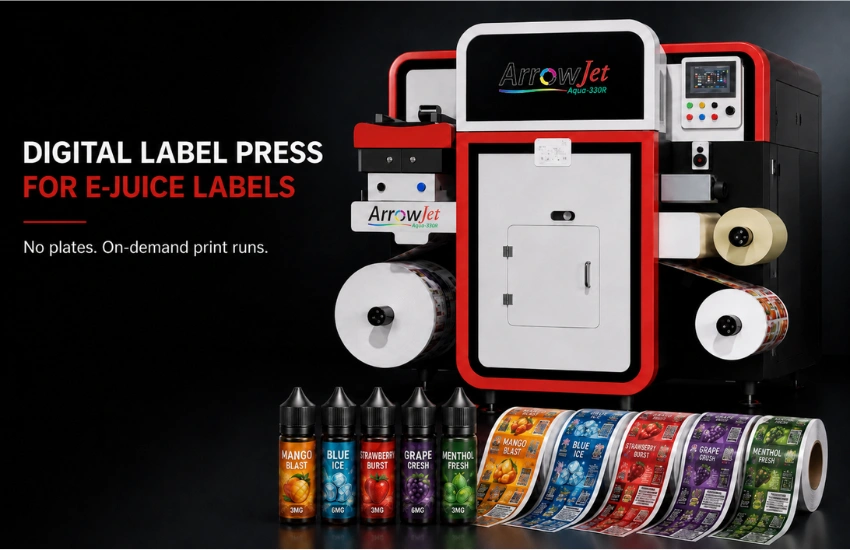
The ArrowJet Aqua 330R is a roll-to-roll water-based pigment inkjet label press using Memjet’s DuraFlex technology. It prints at resolutions up to 1600×1600 dpi on BOPP, PET, PP, and coated paper substrates — the most common label stocks for e-juice bottles.
For e-juice brands, the key operational advantage is on-demand production: each flavour and strength variant is a separate digital file. The press switches between them without plate changes, making short-to-medium runs per SKU economically practical. Water-based pigment inks provide colour-accurate output without solvents, simplifying workplace compliance.
The ArrowJet UV 330H is a true hybrid UV label press that combines roll-to-roll and flatbed printing in a single platform. For e-juice label production, its key differentiator is UV-cured ink — the cured ink layer is moisture- and scratch-resistant directly off the press, which is well-suited to labels that will encounter liquid, oils, and frequent handling.
The UV 330H also supports opaque white ink — essential for printing visible, high-contrast labels on clear or translucent e-juice bottles where the background is not white. CMYK + White + Varnish (WV) configurations allow spot-gloss and matte contrast finishes that reinforce premium brand positioning on shelf.
Both the Aqua 330R and UV 330H are plateless digital systems. Label files for each flavour, strength, and bottle size are stored digitally and printed on demand. There are no plate fees, no plate storage requirements, and no plate lead times when artwork changes.
Digital inkjet label presses are not constrained by minimum order quantities. A brand can print exactly the labels needed for a production batch — 200 labels for a new flavour trial, or 5,000 for a core product restock — without overproduction or obsolete inventory exposure.
When a regulatory requirement changes or a formula is updated, the revised label file can go to production the same day the artwork is approved. The same change at an outside converter requires new plates and a multi-week lead time.
If you’re evaluating in-house digital label printing for your e-juice brand, Arrow Systems can produce a sample label run on your artwork using the ArrowJet press configuration that matches your substrate and volume requirements.
E-juice bottles are small, so even minor sizing errors cause labels to wrinkle, overlap at seams, or obscure required warning text. A physical proof on the actual container before a production run is the only reliable check — digital mockups do not capture how a label conforms to a specific bottle shape and finish.
BOPP (biaxially oriented polypropylene) and PET (polyester) films are the most common choices because they resist moisture and oils. A UV-cured ink layer or protective varnish adds further scratch resistance for bottles handled frequently during vaping sessions or stored in pockets and bags.
FDA regulations require that nicotine addiction warnings appear on the principal display panel, be conspicuous and legible at no smaller than 12-point font, and cover at least 30% of the panel area. Rules have evolved since FDA expanded authority over these products in 2016, and state regulations may add further requirements — always verify current requirements with qualified legal counsel before printing.
Digital inkjet label presses require no printing plates, so artwork for each flavour, nicotine strength, or bottle size is stored as a digital file and printed on demand. Switching between variants takes seconds with no plate changeover cost or minimum order quantity per SKU — which is a significant operational advantage for brands managing 10, 20, or more active variants.
The ArrowJet Aqua 330R is a roll-to-roll water-based pigment label press suited for high-speed e-juice label production across BOPP and PET substrates. For brands requiring UV-cured labels with opaque white ink on clear bottles, or spot varnish finishes for premium positioning, the ArrowJet UV 330H adds those capabilities as a hybrid UV press.
No. This article is a general planning overview only. FDA regulations, state laws, and local ordinances governing vaping and nicotine products change frequently. Confirm all current requirements with qualified legal and regulatory counsel before printing or selling any product.
Table of Contents Pet Food Brand Label Supplier Problems: 5 Signs to Print In-House Most pet food label supplier problems are a model mismatch: flexo’s
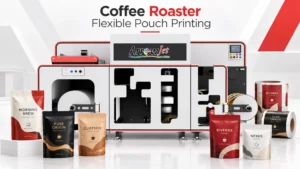
Table of Contents Coffee Roaster Flexible Pouch Printing Workflow: Roll to Bag In-house coffee pouch printing runs five stages — substrate loading, queue setup, the
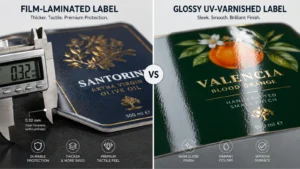
Table of Contents Overlaminate vs. Varnish Labels: How to Choose Protection Film overlaminate protects against immersion, wash-down, and solvents; UV and aqueous varnish suit retail
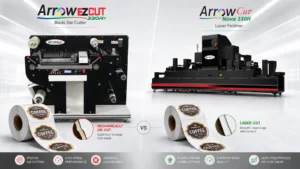
Table of Contents Blade vs. Laser Label Die Cutting: Accuracy, Speed, and Cost per Label Blade die-cutting suits simple shapes and long runs; CO2 laser
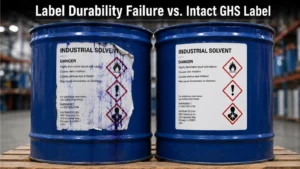
Table of Contents GHS Label Durability Failure: 4 Causes and Practical Fixes GHS label durability failures trace to four causes: aqueous ink chemistry, paper face
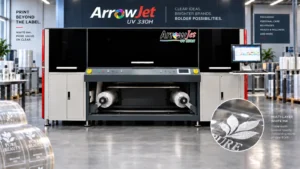
Table of Contents White Ink Clear Label Printing: When You Need It and Why White ink under clear film keeps brand color, mandatory copy, and