Blade vs. Laser Label Die Cutting: Accuracy, Speed, and Cost per Label
Table of Contents Blade vs. Laser Label Die Cutting: Accuracy, Speed, and Cost per Label Blade die-cutting suits simple shapes and long runs; CO2 laser

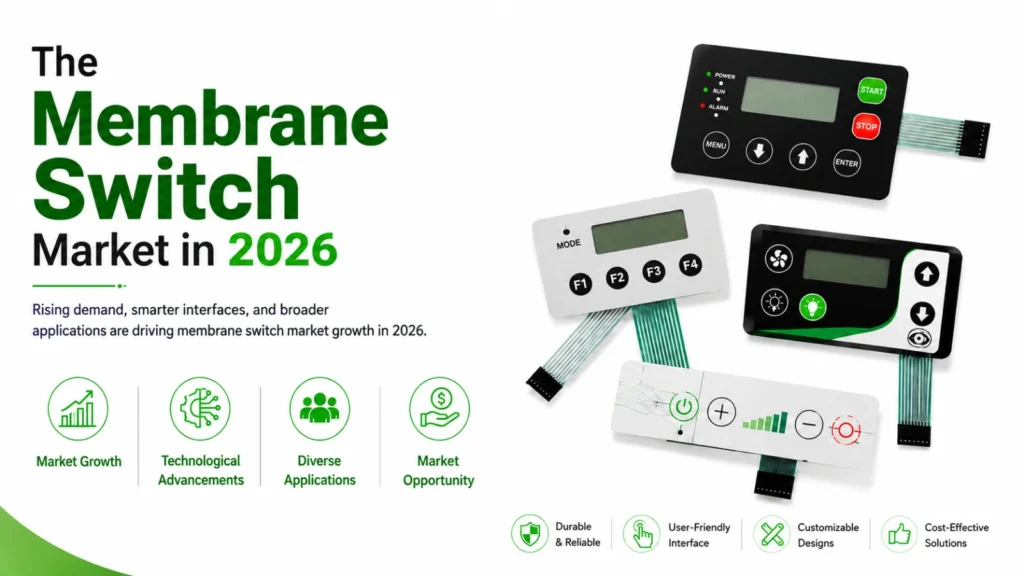
The global membrane switch market reaches USD 9.42 billion in 2026, growing at 8.4% CAGR — driven by medical, industrial, and electronics demand that is reshaping production requirements for overlay and interface manufacturers.
The membrane switch market is valued at USD 9.42 billion in 2026, on track to reach USD 13 billion by 2030 — representing consistent above-market growth at 8.4% CAGR across a broad cross-section of industries.
Membrane switches are thin, sealed, flexible user-interface components used to register input in everything from industrial control panels and medical diagnostic devices to household appliances and automotive dashboards. Their combination of compactness, cost efficiency, environmental sealing, and customizable graphics makes them a durable, practical choice across a wide range of end-use environments where conventional mechanical keyboards and touchscreens are impractical or over-specified.
The figures below summarize the verified market trajectory. All figures are sourced from Research and Markets and The Business Research Company and should be read as directional industry estimates rather than precise actuals.
USD 8.69B (2025) → USD 9.42B (2026) → USD 13B (2030)
Global membrane switch market, 8.4% CAGR. Source: Research and Markets; The Business Research Company.
|
Year / Metric |
Value |
Context |
|
Market size 2025 |
USD 8.69 billion |
Baseline reference year. Source: The Business Research Company. |
|
Market size 2026 |
USD 9.42 billion |
Current year estimate — the headline figure for planning and production purposes. Source: Research and Markets. |
|
Market forecast 2030 |
USD 13 billion |
Five-year trajectory. Use for long-range capacity and investment planning context only. Source: Research and Markets. |
|
Overall CAGR |
8.4% |
Compound annual growth rate through 2030. Consistently above broader industrial manufacturing averages. Source: Research and Markets. |
|
PCB sub-segment CAGR |
~9% (2026–2033) |
The PCB-integrated membrane switch segment is growing faster than the overall market, driven by demand for more complex, multi-layer interface designs in medical and industrial applications. |
An 8.4% CAGR is meaningful in the context of mature manufacturing categories. It reflects not just modest growth across existing applications, but an active expansion into new sectors and product formats where membrane switches are displacing heavier, more expensive, or more mechanically complex alternatives. For manufacturers operating in this space, that pace of growth implies a sustained increase in production orders, design iterations, and durability requirements over the next several years.
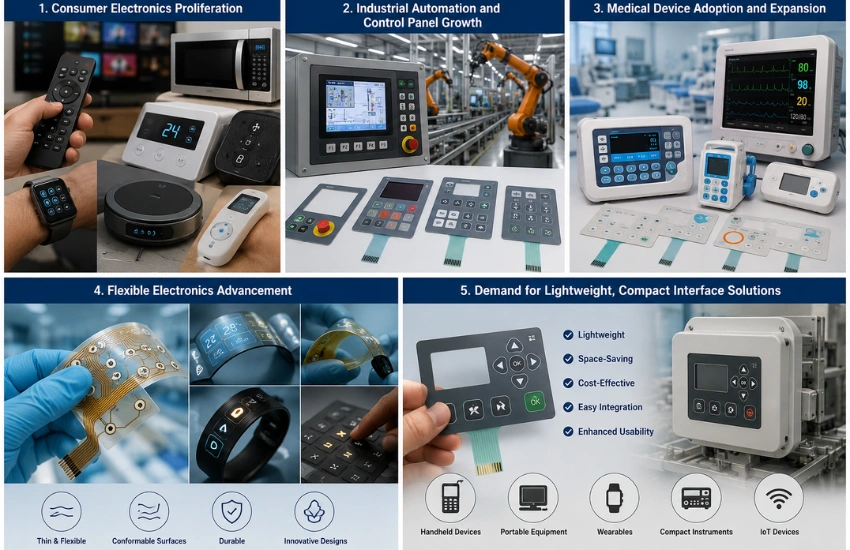
Five macro forces are driving membrane switch demand — each creating distinct production pressure around volume, customization, durability, and speed-to-market for manufacturers in the space.
Asia-Pacific is the largest membrane switch market by volume; North America is the fastest-growing region, driven by reshoring, electronics tariffs, and domestic manufacturing investment.
Region | Market Position | Key Growth Factors |
Asia-Pacific | Largest regional market by volume | Established electronics manufacturing base; high production volumes in consumer electronics and industrial equipment; concentration of component and finished goods supply chains in China, Japan, South Korea, and Southeast Asia. |
North America | Fastest-growing region in forecast period | Manufacturing reshoring driven by supply chain risk management and electronics tariff policy; expansion of domestic medical device production; industrial automation investment; government incentives for domestic electronics and defense manufacturing. |
Europe | Established, stable market | Strong industrial and automotive manufacturing base; high specification standards in medical and safety-critical applications; steady demand from German, Italian, and Scandinavian industrial equipment sectors. |
North America’s position as the fastest-growing region is directly relevant for US-based manufacturers evaluating in-house membrane switch printing capability. The structural shift toward domestic production — driven by supply chain localization, electronics tariff exposure, and reshoring incentives — is increasing demand for production equipment that enables manufacturers to bring overlay and interface graphics production in-house rather than depending on offshore supply chains. This trend affects not just finished switch manufacturers but also OEM equipment producers who specify membrane interface graphics as part of their finished product.
Membrane switches are deployed across nine confirmed application categories — spanning medical, industrial, automotive, consumer electronics, and aviation — each with distinct durability, substrate, and print quality requirements.
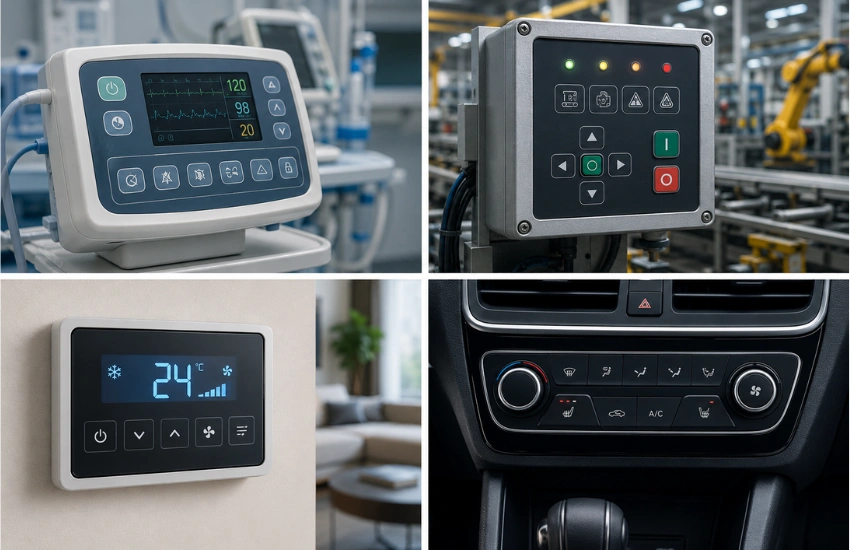
Market growth is translating into higher production volumes, more complex graphic requirements, and tighter durability standards — creating new demands on printing systems for polycarbonate and polyester overlay films.
The membrane switch market’s 8.4% annual growth rate is not simply an increase in unit demand — it also reflects a qualitative shift in what buyers expect from the interfaces they specify. Across medical, industrial, and automotive applications, three production pressures are converging simultaneously:
Four factors will shape the membrane switch market’s competitive dynamics in 2026 — each with direct implications for manufacturers evaluating their production capabilities and equipment investment decisions.
Common questions from manufacturers, converters, and OEM buyers researching membrane switch market size, growth trends, regional dynamics, and application demand in 2026.
Five macro forces are driving demand: continued consumer electronics proliferation, expansion of industrial automation and control panel installations, medical device adoption and volume growth, advances in flexible electronics enabling new interface designs, and demand for lightweight and compact interfaces across manufacturing and consumer product sectors. Each force creates distinct production pressure around customization volume, durability specification, print quality, and production speed.
The global membrane switch market is growing at a compound annual growth rate (CAGR) of 8.4% through 2030, based on Research and Markets data. The PCB membrane switch sub-segment is growing at approximately 9% CAGR between 2026 and 2033, driven by demand for more complex multi-layer interface designs in industrial and medical applications. Both rates are above typical industrial manufacturing growth averages, reflecting active market expansion rather than organic replacement demand.
The ArrowJet MTS-48 is a UV LED industrial flatbed printer engineered specifically for membrane switch production, control panel overlays, nameplates, and instrument panels. It prints on polycarbonate, polyester, PET, and Tedlar® film with Arrow’s proprietary PolyFlex PC UV LED inkset — formulated for second-surface precision, actuation durability, and GE Lexan® and Valox® PTX compliance.
Print speeds up to 580 ft²/hr (6-head configuration). Maximum printing area 2,500 × 1,300 mm. Up to 1,200 dpi resolution with 3–6 Ricoh Gen6 printheads. Verified durability: up to 3 years lightfastness and up to 1,500 hours weathering resistance.
See ArrowJet MTS-48 Specifications and Request a Sample →
Table of Contents Blade vs. Laser Label Die Cutting: Accuracy, Speed, and Cost per Label Blade die-cutting suits simple shapes and long runs; CO2 laser
Table of Contents Custom Food Packaging: Key Questions Answered for Food Brands Custom food packaging shapes how shoppers recognize, evaluate, and choose a product —

Table of Contents GHS Label Durability Failure: 4 Causes and Practical Fixes GHS label durability failures trace to four causes: aqueous ink chemistry, paper face

Table of Contents White Ink Clear Label Printing: When You Need It and Why White ink under clear film keeps brand color, mandatory copy, and

Table of Contents GHS Label Compliance: A Practical Guide for Chemical Label Printing GHS label compliance is a safety-critical requirement for any business that manufactures,
Table of Contents Cannabis MSO Label Printing: In-House or Outsource? Cannabis MSO label printing moves in-house when label versions outgrow converter minimums or batch data