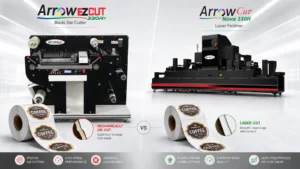
Blade vs. Laser Label Die Cutting: Accuracy, Speed, and Cost per Label
Table of Contents Blade vs. Laser Label Die Cutting: Accuracy, Speed, and Cost per Label Blade die-cutting suits simple shapes and long runs; CO2 laser
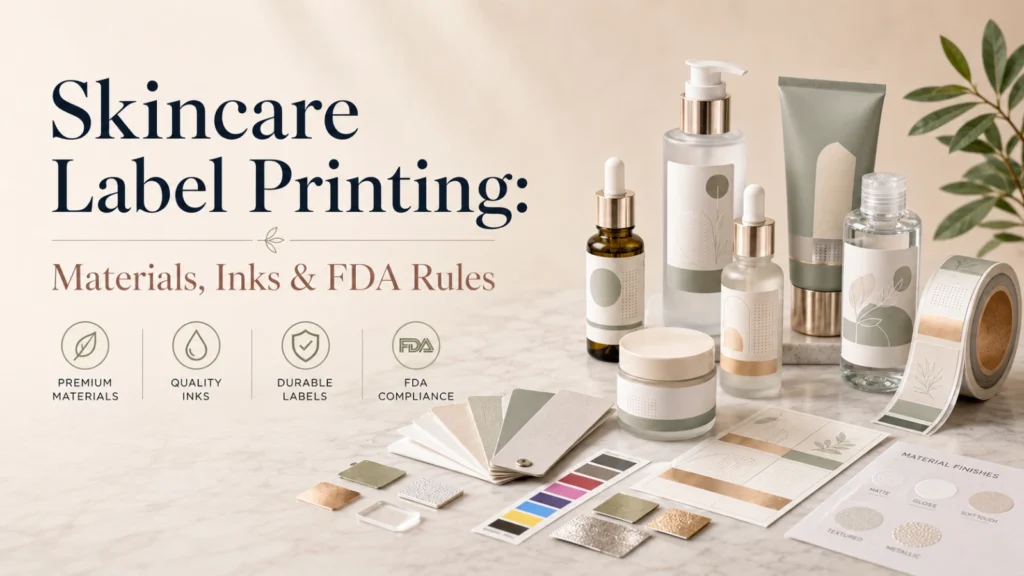
Skincare labels must withstand moisture, oils, friction, and aggressive formulation actives while meeting FDA cosmetic labeling requirements.
Skincare labels face unique stressors — moisture, chemical contact, friction, and premium finish expectations — that food and industrial labels rarely encounter together.
A label that looks beautiful on day one but curls at the edges by day thirty is a failure. Selection has to start with the realistic operating environment of the SKU, not the design comp, while meeting FDA cosmetic labeling requirements.
Persistent moisture and humidity
Bathrooms, showers, and refrigerated storage for actives create continuous exposure to water vapor and condensation that can weaken adhesives and attack paper substrates.
Direct contact with oils, alcohols, and sunscreen actives
Formulation ingredients like avobenzone, octocrylene, zinc oxide, glycols, and carrier oils can attack inks, topcoats, and adhesives over time, causing discoloration, smearing, or label failure.
Repeated friction from handling and dispensers
Travel bags, airless pumps, tube crimps, and daily handling create mechanical stress that can scratch inks, lift edges, or delaminate improperly finished labels.
Wide substrate range with varying surface energy
Skincare packaging spans flint glass, amber glass, PET, HDPE, PP, aluminum, and laminate tubes — each requiring different adhesive and surface preparation strategies for reliable adhesion.
Premium aesthetic expectations
Brand identity often demands matte films, soft-touch finishes, foils, metallic effects, and tight registration — features that add complexity to substrate selection, ink compatibility, and finishing workflows.
BOPP film with permanent adhesive is the standard for cleansers, lotions, and hair care; polyester (PET) is recommended for serums, sunscreens, and products with aggressive ingredient profiles when paired with digital label printers.
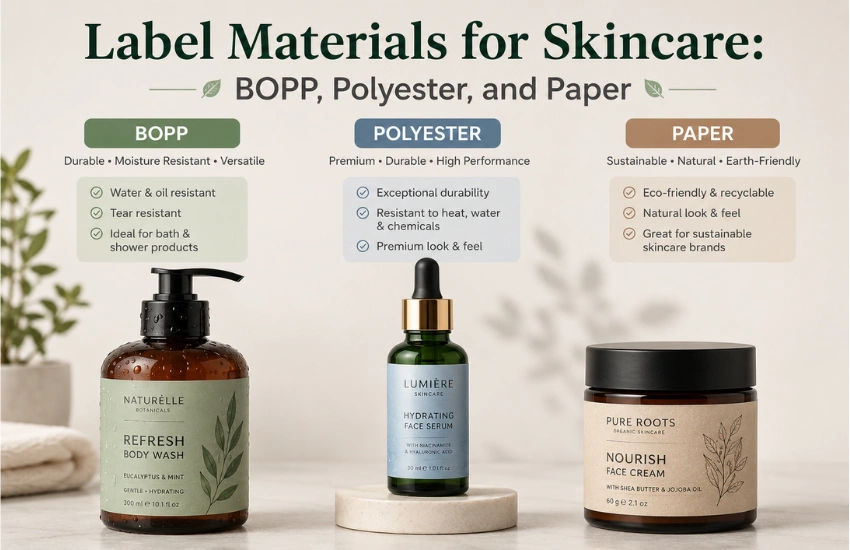
Three primary facestock materials cover most cosmetic packaging applications, each with different performance characteristics across moisture exposure, chemical contact, and temperature variation. Modern color label printer technology delivers excellent results on all three substrate types.
Biaxially Oriented Polypropylene — BOPP
Excellent moisture and humidity resistance with good conformability for curved bottle surfaces. Available in white, clear, and metallic finishes. The most widely used substrate for cleansers, toners, body lotions, hair care, and mass-market skincare that may encounter shower splash and counter spills but is not subjected to aggressive solvents or extreme abrasion. Cost-effective relative to polyester.
Polyester — PET
Superior stiffness, dimensional stability, and resistance to heat, chemicals, and tearing compared to BOPP. Appropriate for products containing high-percentage acids, retinoids in alcohol carriers, essential-oil-rich formulations, and other aggressive actives. Withstands autoclaving, heat-tunnel processing, and sterilization methods. Holds tight registration through extended storage and supply chains. Supports foil and metallized constructions for premium brand identity. Higher cost per square inch than BOPP, justified when durability requirements are demanding.
Paper (laminated or uncoated)
Reinforces natural, apothecary, or sustainability-forward brand positioning. Best suited for bar soaps, outer cartons and secondary packaging, and dry-shelf products like powders or balms in tins. Poor choice for direct contact with wet environments unless protected with robust laminate — edges remain a vulnerability even when laminated.
Substrate | Best Fit | Moisture Resistance | Chemical Resistance | Relative Cost |
BOPP / PP | Cleansers, lotions, hair care, mass skincare | Strong | Moderate | Lower |
Polyester (PET) | Serums, sunscreens, professional and prestige | Strong | Strong | Higher |
Paper (laminated or uncoated) | Bar soap, cartons, dry-shelf SKUs | Weak without laminate | Weak | Lower |
Adhesive selection must match both the package substrate material and the environmental conditions the label will encounter from filling through consumer use. Proper selection of label materials with appropriate finishing is critical.
Glass containers
High surface energy accepts most permanent acrylic adhesives well, but cold-fill processes and condensation can challenge initial tack before full cure. Always verify adhesion after fill, cap, and representative aging period.
PET and HDPE bottles
Surface treatment varies by supplier and production method. Corona-treated surfaces accept adhesives more reliably than untreated bottles. Verify treatment levels before qualifying adhesives.
PP and LDPE tubes
Low surface energy requires specialized LSE (low surface energy) adhesives to achieve reliable bond strength. Standard adhesives formulated for glass or treated PET will fail on untreated polypropylene tubes.
Airless pumps and metallized components
Some assemblies carry silicone mold-release residues or other contaminants that interfere with bond formation. Always run adhesion testing on actual production components after fill and assembly.
Testing note: A BOPP label with permanent adhesive that performs well on a treated PET bottle may fail entirely on an untreated PP tube. Always pull samples of the actual production container and test adhesion after fill, cap, and a representative aging period.
Aqueous pigment inkjet delivers excellent print quality on topcoated substrates with low VOC profile; UV-curable inks provide native moisture, oil, and abrasion resistance without additional finishing. For waterproof skincare labels, UV label printers are often the more forgiving choice.
Aqueous pigment inkjet uses water as the carrier and pigment as the colorant. For most everyday skincare SKUs, it delivers excellent print quality on coated films and papers with a favorable profile for brands sensitive to VOCs and migration concerns.
Excellent print quality on coated substrates
Produces sharp text, smooth gradients, and wide color gamut on topcoated BOPP, PET, and paper — critical for reproducing premium brand visuals and small-type INCI declarations.
Low VOC profile
Water-based ink systems avoid volatile organic compounds found in solvent inks, supporting cleaner production environments and addressing brand concerns about migration on secondary packaging applications.
Strong color accuracy and skin-tone rendering
Pigment-based aqueous inkjet excels at reproducing accurate skin tones, subtle color shifts, and brand-critical Pantone matches — important for prestige and color-cosmetics packaging.
Topcoating or lamination required for full durability
Aqueous pigment generally requires a topcoat or laminate for full water and chemical resistance on plastic films. Treat it as a high-quality print layer that finishing protects.
UV-curable inks polymerize instantly under UV light, forming a tough, cross-linked film directly on the substrate. For waterproof skincare labels, sunscreen, body oil, and travel-format SKUs, UV inkjet is often the more forgiving choice.
Strong scratch and abrasion resistance
UV inks cure to a hard, polymerized surface that resists scratching and scuffing without additional lamination, reducing finishing costs and simplifying production workflows.
Better resistance to oils, alcohols, and sunscreen actives
The cross-linked polymer structure of cured UV ink resists attack from formulation ingredients like carrier oils, alcohol-based toners, and chemical sunscreen actives that can soften or smear lesser inks.
Direct printing on untopcoated films
UV inkjet adheres reliably to untopcoated BOPP and PET films, expanding substrate options and eliminating the need for pre-topcoated materials in many applications.
Formulation testing note: A print system that handles a water-based cleanser perfectly may fail when exposed to a retinol serum in an alcohol carrier. Always test the specific ink-substrate-finish combination against the actual product formulation before qualifying a label material specification.
Lamination and varnish options protect printed labels from moisture, oils, and abrasion — gloss for maximum protection, matte for tactile differentiation, soft-touch for prestige positioning.
Gloss laminate
Provides maximum protection, premium clarity, and strong chemical resistance. Gloss laminate is the standard for high-end serums, sunscreens, and products with aggressive formulations.
Matte laminate
Delivers a softer, more tactile aesthetic with a similar protection profile to gloss. Matte finishes reduce glare and fingerprint visibility on high-touch products.
Soft-touch laminate
Offers tactile differentiation for prestige brands with a velvety surface feel. Verify scratch behavior and fingerprint resistance, as some soft-touch films are more susceptible to scuffing than gloss or matte.
Spot UV and selective coating
Combines matte base layers with high-gloss spot UV accents for logo lockups, brand marks, or key product claims, adding visual depth while maintaining overall durability.
Compliance note: FDA cosmetic labeling regulations require ingredient declarations to be legible to the average consumer under ordinary purchase conditions. A soft-touch black label with dark gray INCI text may look premium in controlled lighting but fail the legibility test on a retail shelf.
Cosmetic labels require identity statements, net contents, business information, and INCI ingredient declarations — sunscreens are regulated as OTC drugs with Drug Facts panels and specific warning language. Similar to pharmaceutical labeling, sunscreen requirements are stringent.
Legal disclaimer: The following is a practical orientation — not legal advice. FDA cosmetic labeling rules continue to evolve, and the Modernization of Cosmetics Regulation Act (MoCRA) has introduced additional considerations. Verify current requirements directly with FDA guidance and qualified regulatory counsel before finalizing label content.
In general, cosmetic labels in the U.S. are expected to include the following elements:
Identity statement
A clear statement of what the product is — for example, “Face Serum,” “Body Lotion,” or “Cleansing Gel” — typically appearing on the principal display panel.
Net quantity of contents
The amount of product in the container, expressed in both U.S. customary units (fluid ounces, ounces) and metric units (milliliters, grams), displayed prominently on the principal display panel.
Name and place of business
The name and address of the manufacturer, packer, or distributor responsible for the product, usually appearing on the information panel or back label.
Ingredient declaration
A list of ingredients in descending order of predominance, typically using INCI nomenclature, located on an information panel where consumers can read it before purchase.
Warnings and directions where applicable
Any required caution statements, usage instructions, or warnings specific to the formulation or product category — for example, sunscreen application instructions or warnings for products containing certain preservatives.
Note for operations teams: Every regulatory requirement — identity statement, ingredient declaration, allergen callout, net contents — is a potential revision trigger. Formula changes, supplier switches, FDA guidance updates, and MoCRA compliance deadlines all require updated labels. When labels are pre-printed in bulk, each revision creates obsolete inventory that must be quarantined or destroyed.
The ArrowJet Aqua 330R uses water-based pigment inkjet for wide color gamut, smooth skin tones, and clean small text on BOPP, PET, and paper substrates — paired with topcoating or lamination for bathroom-shelf durability.
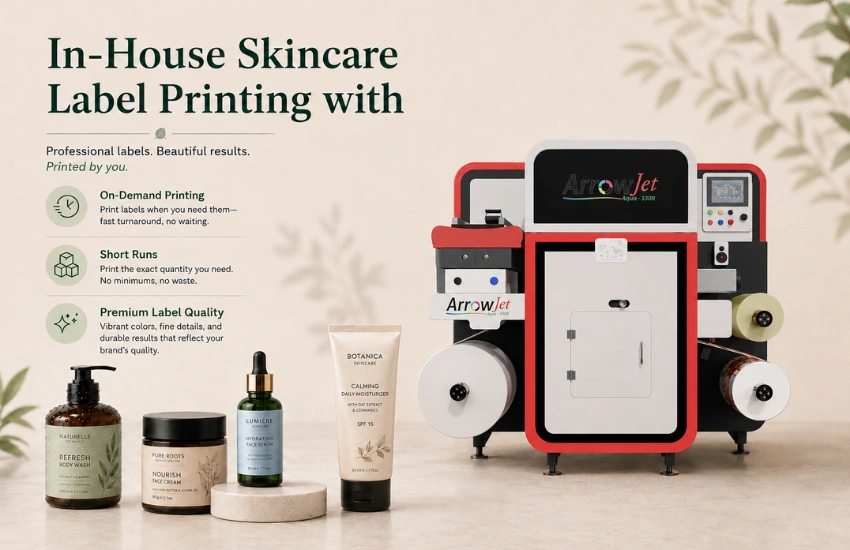
Print quality skincare brands expect
Aqueous pigment delivers wide gamut, smooth skin tones, clean small text for INCI declarations, and accurate Pantone matching on the BOPP, PP, PET, and paper substrates that dominate the cosmetic category.
Print only what the next production run needs
On-demand printing eliminates obsolete inventory when a formula, claim, or regulatory requirement changes.
For skincare operations evaluating in-house label production, the ArrowJet Aqua 330R is a strong fit for most cosmetic SKUs.
The ArrowJet UV 330H uses UV-curable inks for native moisture, oil, and abrasion resistance — ideal for sunscreens, body oils, travel sets, and spa lines.
UV-curable inks polymerize on the substrate, producing a durable print layer with strong native resistance to moisture, oils, alcohols, and abrasion. For SKUs where the label has to survive aggressive chemistries or rough handling, UV simplifies the finishing stack and reduces failure modes.
Chemical sunscreen actives like avobenzone and octocrylene can attack lesser ink systems. UV inks resist these formulations without delamination or color shift.
Products with high oil content create constant transfer to the label surface. UV inks maintain adhesion and print integrity under continuous oil exposure.
Travel-size formats face friction inside bags, kits, and toiletry pouches. UV inks resist scratching and scuffing without additional lamination.
Products subject to repeated handling, cleaning, and professional use benefit from UV ink durability, maintaining brand presentation through extended shelf life and heavy use.
Many operations run both technologies — aqueous for the core skincare portfolio, UV for the most demanding SKUs — and route jobs accordingly.
Decision Factor | ArrowJet Aqua 330R | ArrowJet UV 330H |
Ink chemistry | Aqueous pigment | UV-curable |
Best-fit SKUs | Cleansers, lotions, hair care, prestige skincare | Sunscreens, oils, travel sets, spa lines |
Native chemical and abrasion resistance | Moderate; depends on finishing | Strong out of the gate |
Substrate flexibility | Topcoated BOPP, PP, PET, paper | Wider range, including untopcoated films |
Typical finishing requirement | Topcoat or laminate for full durability | Often reduced finishing stack |
Polyester (PET) film generally offers the highest durability for skincare, with strong resistance to moisture, heat, chemicals, and tearing. BOPP is a strong, more cost-effective option for the majority of SKUs. Final selection should account for the actual formulation, container, and expected handling environment.
Modern aqueous pigment inkjet produces high-quality, color-accurate labels suitable for most skincare SKUs when paired with appropriate topcoated substrates and finishing such as laminate or varnish. For SKUs with aggressive actives or heavy abrasion exposure, UV-curable inks typically provide a wider durability margin.
Cosmetic labels are generally expected to include an identity statement, net contents, name and place of business, and an ingredient declaration using INCI names. Sunscreens are regulated as OTC drugs with additional Drug Facts requirements. Requirements continue to evolve, including under MoCRA — verify current guidance with FDA resources and qualified regulatory counsel.
In-house printing tends to make sense when SKU counts are high, revisions are frequent, launch speed is a competitive factor, or external converter MOQs are creating obsolete inventory. The exact breakeven depends on volume, SKU mix, and finishing requirements; model these factors against your specific operation rather than relying on a generic threshold.
If you’re evaluating substrate options, matching ink chemistry to aggressive formulations, or deciding whether in-house digital printing fits your cosmetic operation, a structured assessment can clarify your best path forward.
Arrow Systems offers skincare label assessments tailored to your formulations, FDA compliance workflow, and packaging formats — helping you identify whether the ArrowJet Aqua 330R or ArrowJet UV 330H fits your production goals.
Table of Contents Blade vs. Laser Label Die Cutting: Accuracy, Speed, and Cost per Label Blade die-cutting suits simple shapes and long runs; CO2 laser
Table of Contents Custom Food Packaging: Key Questions Answered for Food Brands Custom food packaging shapes how shoppers recognize, evaluate, and choose a product —
Table of Contents GHS Label Durability Failure: 4 Causes and Practical Fixes GHS label durability failures trace to four causes: aqueous ink chemistry, paper face
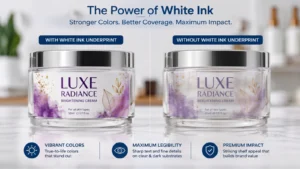
Table of Contents White Ink Clear Label Printing: When You Need It and Why White ink under clear film keeps brand color, mandatory copy, and
Table of Contents GHS Label Compliance: A Practical Guide for Chemical Label Printing GHS label compliance is a safety-critical requirement for any business that manufactures,
Table of Contents Cannabis MSO Label Printing: In-House or Outsource? Cannabis MSO label printing moves in-house when label versions outgrow converter minimums or batch data